
A 1031 exchange is one of the most powerful tools in a real estate investor's toolkit. It essentially allows you to swap one investment property for another of a "like-kind," all while deferring capital gains taxes. But this isn't a free-for-all; the IRS has laid out very specific 1031 exchange real estate rules that govern everything from timelines to property qualifications. Getting these rules right is the difference between a successful, tax-deferred transaction and a costly mistake.
Unlocking a Powerful Wealth-Building Tool

Think of a 1031 exchange as a strategic upgrade for your real estate portfolio. Imagine selling a rental property and having to hand over a hefty chunk of your profit to the IRS. With a 1031, you can instead roll the entire amount from the sale into a new property. This keeps your capital working for you at its full strength, dramatically accelerating your ability to build wealth over time.
This isn't some obscure strategy reserved for the super-rich. It's a mainstream tactic. In fact, a deep dive into commercial property deals revealed that a surprising 10% to 20% of all transactions involved a 1031 exchange, showing just how common it is for savvy investors to use this strategy.
Key Benefits of a 1031 Exchange
When you execute a 1031 exchange correctly, the financial advantages can be massive. By keeping your hard-earned equity intact and reinvesting it, you can:
- Compound Your Returns: With more capital to work with, you can buy a bigger or better property, which can lead to higher returns.
- Diversify Your Portfolio: You could swap one large property for several smaller ones, spreading your risk across different markets or property types.
- Boost Your Cash Flow: Trade a piece of raw land that isn't generating any income for a multi-unit apartment building that does.
- Consolidate Your Holdings: Simplify your life by exchanging several smaller, management-intensive properties for one larger, more efficient asset.
A 1031 exchange is far more than a simple tax loophole. It's a foundational tool for smart portfolio growth, giving investors the flexibility to adapt to changing markets without taking a huge tax hit that would drain their capital.
Before diving in, it’s crucial to understand the intricate rules of the game. Deferring taxes is an incredible benefit, but it demands meticulous planning and strict compliance with IRS guidelines. For a deeper look into the regulations, resources on mastering 1031 real estate exchange rules are invaluable. You can also get a better handle on the taxes you're deferring by reading our guide: https://alliedtax.com/capital-gains-tax-explained-how-to-minimize-your-tax-liability/.
1031 Exchange Key Rules at a Glance
Navigating a 1031 exchange means sticking to a strict set of rules. The table below breaks down the most critical requirements you'll need to follow for a successful, tax-deferred transaction.
| Rule Category | Requirement | Key Takeaway |
|---|---|---|
| Property Qualification | Both properties must be "like-kind" and held for investment or business use. Personal residences do not qualify. | The definition of "like-kind" is broad for real estate, but the use of the property is what matters most. |
| 45-Day Identification Period | You must formally identify potential replacement properties in writing within 45 days of selling your original property. | This deadline is absolute and has no extensions. Meticulous planning is essential. |
| 180-Day Exchange Period | You must close on the purchase of the new property within 180 days of the original sale, or by your tax return due date. | This timeline runs concurrently with the 45-day rule. The clock starts the day you sell. |
| Value & Equity | The new property must be of equal or greater value, and you must reinvest all equity from the sale. | Taking cash out ("boot") or acquiring a smaller mortgage can trigger a taxable event. |
| Qualified Intermediary | You cannot have direct control of the funds. A neutral third-party "Qualified Intermediary" must hold the proceeds. | This is non-negotiable. Trying to manage the funds yourself will disqualify the entire exchange. |
Think of these rules as the fundamental building blocks of your exchange. Getting any one of them wrong can jeopardize the entire tax deferral, so it pays to have a firm grasp on them from the very beginning.
The Landmark Case That Shaped Modern Exchanges
To really get a handle on today's 1031 exchange real estate rules, it helps to look at where they came from. The idea of deferring taxes on a property swap isn't new. In fact, it's a long-standing principle in U.S. tax law, designed to keep investment capital flowing. Think about it—without this provision, investors would lose a chunk of their equity to taxes with every single transaction, which would seriously pump the brakes on the real estate market.
The groundwork was laid nearly a century ago. It all started with the Revenue Act of 1918, which first allowed for tax-free exchanges of livestock. A few years later, in 1921, Section 202 of the Revenue Act broadened this concept to include real estate, letting investors swap "like-kind" properties to keep the economy moving. You can dig deeper into this legislative history and its impact to see how these early laws shaped modern investing.
For decades, these exchanges were simple but incredibly rigid. The common understanding was that the swap had to happen simultaneously. You and the other party had to be at the same table, at the same time, signing over the deeds. As you can imagine, this was a logistical nightmare and made finding the perfect deal almost impossible.
The Starker Decision: A Game Changer
Everything changed with a single court case: Starker v. United States. Back in 1967, a timberland owner named T.J. Starker sold a large parcel of land to Crown Zellerbach Corporation. But instead of taking cash, he struck a deal where the corporation would buy and hand over suitable replacement properties to him over the next five years.
The IRS, naturally, took issue with this. They argued that because the exchange wasn't simultaneous, it shouldn't qualify for tax deferral. The Starker family disagreed and took them to court. In a pivotal 1979 decision, the Ninth Circuit Court of Appeals sided with the Starkers, and in doing so, officially gave birth to the delayed exchange.
This landmark ruling was the catalyst for the modern 1031 exchange process. It acknowledged the practical reality that finding and closing on a replacement property takes time, forever changing how investors could structure their deals.
From Courtroom to Codebook
The Starker case opened up a whole new world of possibilities, but it also created what many in Washington D.C. saw as a loophole. So, Congress stepped in to formally define and regulate the delayed exchange process to prevent it from being misused. This is how we got the specific rules and strict timelines that are central to any exchange today.
This legislative response gave us two critical pillars of the modern 1031 exchange:
- Strict Timelines: The 45-day identification period and the 180-day closing window were created to put a reasonable time limit on completing the deal.
- The Qualified Intermediary (QI): The role of the QI became mandatory to solve the "constructive receipt" problem. This ensures the seller can't touch or control the cash from their sale, which would trigger a taxable event.
When you understand this backstory, you see the rules aren't just arbitrary red tape. They are the direct result of a legal battle that won investors more flexibility, followed by a smart legislative effort to create a structured and fair system for everyone. The Starker decision is the reason you can take your time finding a replacement property, and the regulations that followed are why the process demands such careful planning and execution.
Meeting the Critical 1031 Exchange Timelines
When it comes to a 1031 exchange, the clock is your biggest adversary. The entire process hinges on two deadlines that are as strict as they are unforgiving. They kick in the very moment the sale of your old property closes, and missing either one—even by a day—can unravel the whole exchange and land you with a hefty tax bill on your capital gains.
Think of it as a countdown that starts the second you hand over the keys. There are no extensions, no pauses, and no do-overs. Getting these dates right is fundamental to the 1031 exchange real estate rules.
The 45-Day Identification Period
First up is the 45-Day Identification Period. From the day your original property sale is finalized, you have precisely 45 calendar days to officially pinpoint potential replacement properties. This isn't just about window shopping; you have to put it in writing.
This written declaration needs to be specific, listing the exact properties you're considering. You have to sign this document and get it to your Qualified Intermediary (QI) before the clock strikes midnight on day 45. And yes, weekends and holidays count, so you have to be on top of your calendar.
For most investors, this 45-day sprint is the most stressful part of the entire exchange. It forces you to have your investment strategy locked down and be ready to move fast.
The pressure of the 45-day rule can't be overstated. It essentially requires you to do most of your homework and due diligence before your sale even closes, so you can hit the ground running with a list of viable options.
This visual guide breaks down the key milestones in the 1031 exchange process.
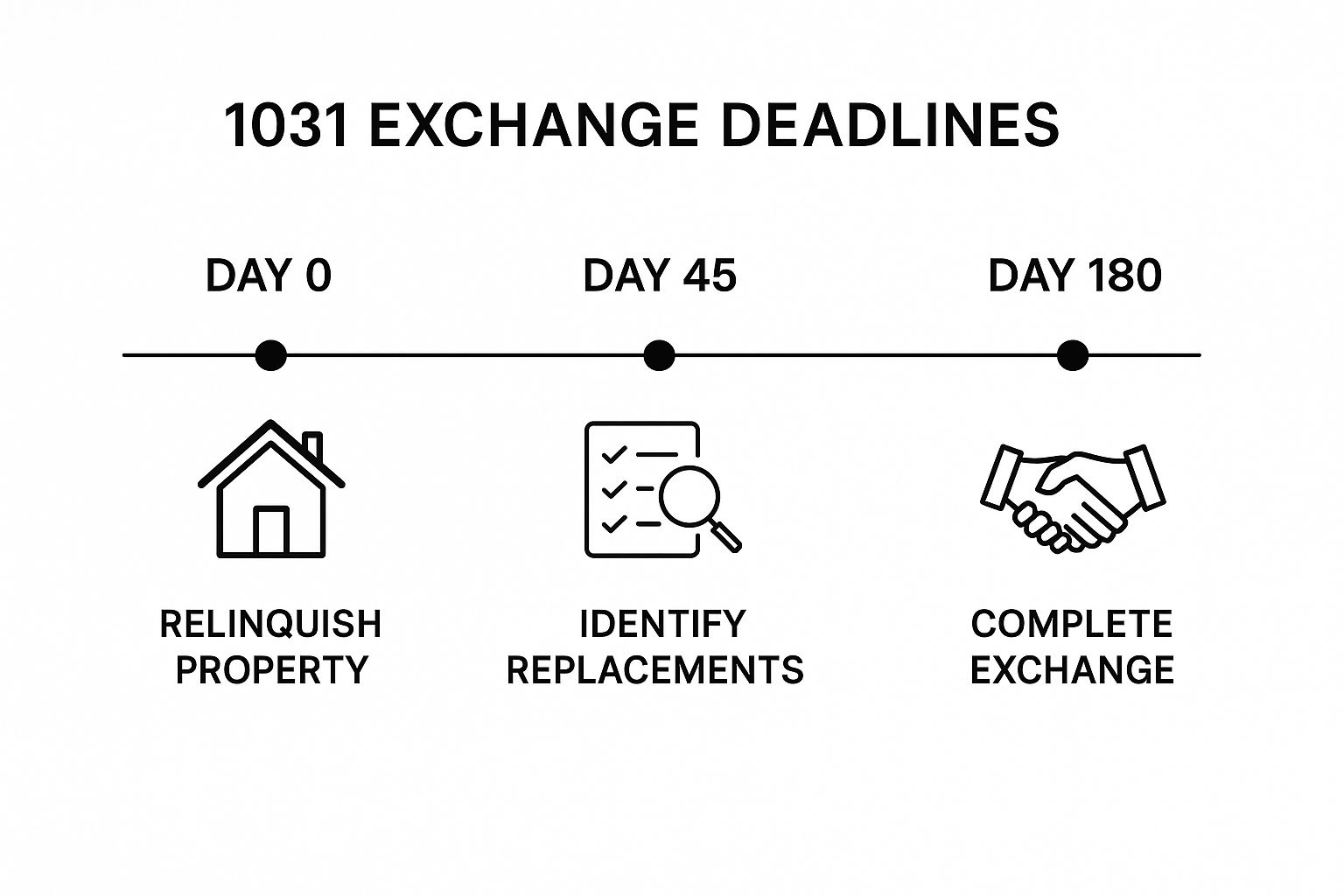
As you can see, both timelines start from the same point—the sale of your property—but they require you to manage both immediate decisions and longer-term closing goals simultaneously.
The 180-Day Exchange Period
The second deadline is the 180-Day Exchange Period. You have to actually buy and close on one or more of your identified properties within 180 calendar days from the sale of your original property. Here’s a common trap: many people think the 180 days start after the 45 days are up.
That’s not how it works. The two timelines run at the same time.
Your 45-day identification window is really just the first 45 days of your total 180-day exchange period. After day 45, your list of potential properties is locked in. From that point on, your only job is to close the deal on a property from that list.
To see how this works in practice, let's walk through a simple timeline.
Example 1031 Exchange Timeline
| Event | Date | Day Count | Action Required |
|---|---|---|---|
| Relinquished Property Closes | March 1 | Day 0 | The clock starts ticking for both deadlines. |
| Identification Deadline | April 15 | Day 45 | Last day to submit your signed, written list of potential replacement properties to your QI. |
| Exchange Deadline | August 28 | Day 180 | Last day to close on the purchase of a replacement property from your identified list. |
This timeline shows that you don’t have 45 days plus 180 days; you have a total of 180 days, with a critical milestone at the 45-day mark.
This structure demands that you get ahead of the game. Waiting until day 44 to start looking for properties is a recipe for disaster. The most successful investors I've worked with often have their replacement properties scouted—and sometimes even unofficially lined up—before their original property is even under contract.
Navigating the Deadlines Successfully
Staying on track comes down to solid preparation and a great team. A frequent mistake is simply getting the start date wrong. Remember, the clock starts on the day the sale is officially closed and the deed is recorded, not the day you sign the contract.
Here are a few tips to manage the timelines like a pro:
- Start Your Search Early: Begin looking for replacement properties long before you sell. Have a shortlist ready to go.
- Build Your A-Team: You need a real estate agent who understands 1031s, a reliable lender, and a reputable Qualified Intermediary. Their expertise is your best defense against costly errors.
- Have Backup Plans: The rules allow you to identify more than one property. It's smart to list backups in case your top choice falls through during negotiations or inspections.
By treating these deadlines with the respect they demand and planning your moves carefully, you can navigate the countdown without the stress, secure your tax deferral, and make a great move for your portfolio.
Identifying Replacement Properties the Right Way

Getting through the 45-day identification period isn't just about finding a great investment—it's about meticulously following a very specific set of IRS rules. Think of your identification list not as a casual wishlist, but as a formal, legally binding declaration. A misstep here can unravel your entire tax-deferral strategy.
The good news is that the IRS gives you three distinct ways to identify your replacement properties. You only need to meet the criteria for one of them. Which one you choose really boils down to your investment goals and how wide of a net you need to cast.
The Three-Property Rule
This is the go-to for most investors, and for good reason. It’s simple, direct, and incredibly straightforward.
With this rule, you can pinpoint up to three potential replacement properties, and their total market value doesn't matter. From that list, you can end up buying one, two, or all three to finalize your exchange.
- Best for: Investors who have already done their homework and have their sights set on a handful of top-tier properties.
- Example: You sell your old property for $500,000. You can identify a condo for $600,000, a duplex for $750,000, and a commercial building for $1.2 million. The combined value is way over your exchange amount, but under the Three-Property Rule, that’s perfectly fine.
The simplicity here is its biggest advantage, making it a solid, reliable choice for the vast majority of 1031 exchanges.
The 200% Rule
What if your strategy is to trade one large property for several smaller ones? The Three-Property Rule can feel a bit tight. That's where the 200% Rule comes in, offering much-needed flexibility.
This rule lets you identify more than three properties, but it comes with one major string attached: the combined fair market value of all properties on your list can't be more than 200% of the value of the property you sold.
The 200% Rule is the diversification play. It lets you build a deeper bench of potential properties, giving you backups if your first-choice deals don't pan out.
Let's say you sell a property for $1 million. The 200% Rule means you could identify five different properties, as long as their total value is $2 million or less. This gives you a much better chance of landing the right assets.
- Best for: Investors looking to spread their capital across several smaller properties or those who simply want more backup options in a competitive market.
- Example: You sell a building for $700,000. You could identify four potential properties valued at $400,000, $350,000, $300,000, and $250,000. Their total value is $1.3 million, which is well under the $1.4 million (200%) ceiling.
This rule is a fantastic tool, but it does require you to keep a running tally to make sure you stay within the limit.
The 95% Rule
The 95% Rule is the least common of the bunch and is typically reserved for very large, complex, or institutional-grade exchanges. It’s powerful but carries significant risk.
This rule lets you identify an unlimited number of properties with no cap on their total value. The catch? It’s a big one. You must actually acquire at least 95% of the total value of all the properties you identified.
This is a high-stakes gamble. If just one small deal on your list falls through, it could easily push you below the 95% threshold and torpedo the entire exchange.
- Best for: Highly structured transactions, like acquiring a pre-negotiated portfolio of properties where there's near-certainty that every deal will close.
- Example: You identify ten properties with a combined value of $10 million. To make the 95% Rule work, you must close on at least $9.5 million worth of those properties. If you only manage to close on $9 million worth, the exchange fails.
For the everyday investor, the risk is usually just too high. It’s a specialized tool for very specific situations.
Formal Identification Requirements
No matter which rule you follow, the identification process itself is strict. You have to submit a signed, written document to your Qualified Intermediary (QI) before midnight on the 45th day.
This document must be crystal clear, describing each property with either its street address or a formal legal description. As you’re identifying properties and arranging financing, it's a good time to understand how mortgage rates affect your buying power. To further sharpen your financial strategy, check out our guide on tax deductions for real estate investors (https://alliedtax.com/tax-deductions-for-real-estate-investors/).
Getting a Grip on Like-Kind and Qualified Use
To really understand how a 1031 exchange works, you need to get familiar with two core concepts: the "like-kind" rule and the "qualified use" rule. Think of them as the twin pillars holding up the entire structure. They’re what determine if your deal gets the green light for tax deferral, so getting them right is non-negotiable.
Let's break down what they actually mean in practice.
What Does "Like-Kind" Actually Mean?
The term "like-kind" is one of the most misunderstood parts of the 1031 process. A lot of investors hear it and immediately think they have to trade an apartment building for another apartment building or a duplex for a duplex.
Thankfully, the IRS is way more flexible than that. For real estate, "like-kind" has less to do with the property's quality or what it looks like and more to do with its fundamental nature. As long as you're swapping one piece of real estate for another within the United States, you're generally in the clear.
This flexibility is what makes the 1031 exchange such a powerful tool. It allows you to pivot your investment strategy without triggering a massive tax bill. You could trade a high-maintenance rental property for a hands-off commercial building or swap a piece of raw land for an income-producing storefront.
Here are a few examples of perfectly valid like-kind exchanges:
- A single-family rental house for a vacant lot.
- An office building for a multi-unit apartment complex.
- A retail storefront for an industrial warehouse.
- A working farm for a small strip mall.
The key is that you are exchanging real property for other real property. You couldn't, for instance, exchange your rental house for shares in a Real Estate Investment Trust (REIT). Even though it's real estate-related, a REIT is a security, not a direct property interest, so it doesn't qualify.
The All-Important "Qualified Use" Rule
While the like-kind rule gives you a lot of wiggle room, the "qualified use" rule is where you need to be much more careful. This is where investors often get into trouble.
The rule is simple on its face: both the property you're selling and the property you're buying must be held for productive use in a trade or business, or for investment.
The key word here is intent. Your primary reason for holding both properties has to be for business or investment purposes. You can't use a 1031 exchange to defer taxes on a personal asset.
The qualified use requirement is the bright line that separates a legitimate, tax-deferred exchange from an attempt to sidestep taxes on a personal home or a quick flip. The IRS is very clear on this: personal use is out.
This means certain properties are automatically disqualified from a 1031 exchange, including:
- Your primary residence.
- A vacation home or second home that's mostly for personal use.
- Property bought with the clear intention of immediately reselling it (a "flip").
- A parcel of land you're developing to sell off as individual lots.
The popularity of these exchanges is staggering. Between 2008 and 2017 alone, investors successfully completed over 500,000 of them. You can learn more about the prevalence of 1031 exchanges on 1031specialists.com.
How Long Is Long Enough? The Holding Period Question
This brings up one of the most frequently asked questions: how long do I have to hold the property to prove it’s for investment?
The IRS has never actually put a specific timeframe in the rulebook, which leaves it in a bit of a gray area. However, the common wisdom and guidance from most tax pros is to aim for a holding period of at least 24 months.
Holding a property through two full tax cycles creates a strong argument that your intent was for long-term investment. If you sell in less than a year, you’re waving a big red flag for an audit. The IRS could easily argue that you were just trying to flip the property for a quick profit, which would blow up your 1031 exchange.
The goal is to properly defer your capital gains taxes and avoid other tax headaches like rental property depreciation recapture, which can be a nasty surprise if you’re not prepared for it.
Common Questions About 1031 Exchange Rules

Once you get a handle on the basics of a 1031 exchange, the real-world questions start popping up. It's one thing to know the timelines and property rules, but it's another to navigate the "what if" scenarios that can make or break a deal. These are the details that often trip up even seasoned investors.
Let's dive into the most common sticking points I see in my practice. We'll move past the textbook definitions and get into the practical answers you need.
What Is Boot and How Do I Avoid It?
You’ll hear the term "boot" a lot in 1031 circles. It sounds more complicated than it is. In short, boot is anything you receive in the exchange that isn't "like-kind" property. This could be cash you pull out at closing, getting a smaller mortgage on the new property, or even other assets thrown into the deal.
Getting boot doesn't automatically kill your exchange, but it does trigger a tax bill. The boot portion is considered a taxable gain. For example, if you pocket $20,000 in cash from the sale, you'll owe capital gains tax on that $20,000.
The goal for a completely tax-deferred exchange is zero boot. To hit that target, you just need to follow two golden rules:
- Trade Up or Equal: Your new property must be worth the same as, or more than, the one you sold.
- Reinvest All Equity: Every dollar of cash from the sale must go into the purchase of the new property.
One of the sneakiest forms of boot is "mortgage boot," or debt relief. If the loan on your new property is smaller than the loan you paid off on the old one, that difference is taxable—unless you offset it by adding an equivalent amount of your own cash to the deal.
Can I Do a 1031 Exchange With a Partner?
Absolutely, but it adds a few extra hoops to jump through. When a property is owned by a partnership or LLC, the most important concept to remember is what we call the "same taxpayer rule." This means the exact same entity that sells the old property must be the one that buys the new one.
So, if "Main Street Partners, LLC" is the seller, then "Main Street Partners, LLC" must be the buyer. An individual partner can't just take their cut of the proceeds and roll it into their own personal 1031 exchange.
Partnership exchanges demand careful planning, especially when some partners want to cash out and others want to exchange. The deal has to be structured to maintain the continuity of the legal entity to keep the IRS happy.
What if one partner wants out? There are advanced strategies, like a "drop and swap," that can make this work. But be warned: these are complex maneuvers that require guidance from tax and legal professionals who live and breathe this stuff. Trying it on your own is a recipe for disaster.
What Happens if I Can’t Find a Property in 45 Days?
The 45-day identification period is written in stone. The IRS is notoriously strict about this deadline—there are no extensions. It doesn't matter if it's a tough market, your top-choice deal fell apart, or you had a personal emergency. If you haven't identified your replacement properties in writing by midnight on day 45, the exchange fails.
When that happens, your Qualified Intermediary (QI) has to return your funds, and the sale of your original property becomes a fully taxable event. This is precisely why preparation is everything. The smartest investors start shopping for their next property long before their current one is even under contract.
Your best defense is to use the identification rules to your advantage. The Three-Property Rule, for instance, lets you formally identify up to three potential properties. This gives you crucial backup options in case your Plan A doesn't pan out.
Can I Use 1031 Exchange Funds for Renovations?
This is a great question, especially for value-add investors. Many people want to buy a fixer-upper and use the tax-deferred funds for the renovation. The good news is you can, but it has to be done through a special structure called a Build-to-Suit or Improvement Exchange.
In a standard exchange, your funds are off-limits for improvements once you take title. With a Build-to-Suit Exchange, the process is different. Your QI holds the exchange funds in an account and pays contractors directly for improvements before the property is officially deeded to you.
This structure allows the value of the renovations to be rolled into the final purchase price of your replacement property. It’s a powerful way to meet the "trade up in value" requirement while creating equity. Just know that it’s more complex and requires a QI who has specific experience with these types of transactions. It needs to be set up perfectly from day one.
Navigating the nuances of a 1031 exchange, from managing boot to structuring complex partnership deals, is not something you should do alone. At Allied Tax Advisors, we specialize in helping real estate investors like you implement tax strategies that protect your capital and fuel your growth. Let our team of experienced professionals bring the clarity you need for a seamless and successful exchange.
Discover how we can help you optimize your real estate investments at https://alliedtax.com.