
Let's clear up one of the most common points of confusion for freelancers and small business owners: the whole "1099 vs. LLC" debate. The truth is, it’s not a choice between one or the other. A 1099 is simply a tax form, while an LLC is a legal business structure.
You can absolutely be an independent contractor who gets 1099 forms and runs your business as an LLC. The real decision isn't about choosing between these two terms. It's about deciding if you should operate as a sole proprietor (the default for independent contractors) or if it's time to formalize your business by creating an LLC.
Understanding the Core Concepts of 1099 and LLC

When you're just starting out, these terms can feel like a foreign language. But breaking them down is simple. One defines how you're paid and taxed, and the other defines your business's legal standing.
A 1099 contractor is the IRS's term for a self-employed person. It’s not a business you have to register; it's just the default status. If a client pays you more than $600 in a year for your services, they are required to send both you and the IRS a Form 1099-NEC. This is the simplest way to get started—no paperwork, no fees, just you and your work.
A Limited Liability Company (LLC), on the other hand, is a formal business structure you create by registering with your state. Setting up an LLC makes your business a distinct legal entity, separate from you personally. That separation is its most powerful feature.
Key Foundational Differences
The most critical difference comes down to liability. As a 1099 contractor operating by default as a sole proprietor, there is no legal distinction between you and your business. If your business gets sued or racks up debt, your personal assets—your car, your savings, even your home—could be on the line.
An LLC changes that entirely. It builds a legal wall between your business and personal finances. This "corporate veil" means that if the business faces a lawsuit or debt, your personal assets are generally protected.
The biggest mental shift is realizing this isn't an "either/or" choice. The real question is whether you should operate as a sole proprietor (the default 1099 status) or form an LLC for enhanced protection and flexibility.
Taxation is another area where they diverge. A sole proprietor pays self-employment taxes on all their net business income. An LLC, however, opens the door to more advanced tax strategies. You can learn more about how to structure your business finances after you understand the tax classification for an LLC.
This table offers a quick snapshot of the fundamental differences.
Core Differences Between 1099 Contractor and LLC
This table provides a concise, at-a-glance comparison of the most critical distinctions between operating as a 1099 contractor and forming an LLC.
| Feature | 1099 Independent Contractor (Sole Proprietor) | Limited Liability Company (LLC) |
|---|---|---|
| Primary Identity | Tax classification for a self-employed person | Formal legal business structure registered with the state |
| Liability | Unlimited personal liability; personal assets are at risk | Limited personal liability; personal assets are protected |
| Setup Process | No formal setup required; it's the default status | Requires filing formation documents with the state and paying a fee |
| Legal Status | You and the business are legally the same entity | The business is a separate legal entity from its owner(s) |
Ultimately, an LLC offers a level of professionalism and protection that a sole proprietorship simply can't match, though it does come with more administrative work.
How Each Structure Protects Your Personal Assets

When you're weighing whether to stick with a 1099 setup or form an LLC, this is arguably the most important conversation to have. It's about protecting what's yours—your home, your car, your personal savings—from anything that could go wrong in your business. This isn't just a box to check on a form; it’s the legal firewall between your professional life and your personal one.
As a 1099 independent contractor, you're usually operating as a sole proprietor by default. In the eyes of the law, there is no legal separation between you and the business. They are one and the same. If a client sues you or your business racks up debt it can't pay, your personal assets are completely on the line.
The Exposure of a 1099 Contractor
Let's make this real. Imagine you're a freelance graphic designer working as a 1099 contractor. You create a logo for a client who later gets sued for trademark infringement because of it. The client, in turn, sues you for the damages.
Here’s what that means for you:
- Unlimited Personal Liability: The lawsuit isn’t just against "your business"—it's against you, personally.
- Personal Assets at Risk: If a judgment is made against you, your personal savings, your car, and even your house could be fair game to settle the debt.
- Business Debts are Personal Debts: That business loan you took out? It's your personal responsibility. There's no distinction if the business can't pay it back.
This direct pipeline from your work to your personal finances is the biggest risk of staying a default 1099 contractor.
The Liability Shield of an LLC
Now, let's run that scenario back. This time, you're the same graphic designer, but you've set up a single-member LLC. An LLC (Limited Liability Company) creates a legal barrier often called a "corporate veil." This is what separates you, the individual, from the business entity. Your LLC can now own property, take on debt, and sign contracts on its own behalf.
If that same lawsuit happens:
- Liability is Contained: The legal action is aimed at the LLC's assets, like the funds in your business bank account.
- Personal Assets are Shielded: In most cases, your personal property—your home, your family’s savings—is untouchable.
The entire point of an LLC is to draw a line in the sand. It contains business risks so that a professional mistake doesn't turn into a personal financial catastrophe.
But that protection isn't bulletproof. You have to maintain that legal separation, or a court could decide to ignore it. This is a concept known as piercing the corporate veil, and it happens when owners don't treat the business as a truly separate entity.
Keeping Your LLC’s Shield Intact
To make sure your LLC's protection holds up, you must act like your business is separate from you. If you don't, you're giving a court a reason to treat your assets as the business's assets.
Here are the non-negotiables:
- Separate Bank Accounts: This is rule number one. All business income goes into a dedicated business account, and all business expenses are paid from it. Never commingle funds.
- Avoid Personal Guarantees: Try not to sign personal guarantees for business loans or credit cards. Doing so essentially waives your LLC's liability protection for that specific debt.
- Proper Record-Keeping: Keep clean books for the LLC that are totally separate from your personal finances. This proves it's a legitimate, distinct entity.
At the end of the day, while being a 1099 contractor is simple, it leaves you vulnerable. In the 1099 vs LLC debate, the LLC offers a crucial layer of security, creating a clear and defensible line between what your business owes and what you own.
How Taxes and Potential Savings Stack Up

While liability protection is a huge reason people choose to form an LLC, let's be honest—it’s the money that often makes the decision. The way you structure your business can directly impact your tax bill, potentially saving you thousands of dollars every year. The entire conversation starts with one critical number: 15.3%.
If you're a 1099 independent contractor, you're essentially a sole proprietor. That means every single dollar of your net profit gets hit with the 15.3% self-employment tax. This covers both your Social Security and Medicare contributions. Unlike a W-2 employee who splits this cost with their employer, you’re on the hook for the whole thing. And remember, that’s on top of your regular income taxes. It adds up fast.
This is exactly where forming an LLC can be a powerful financial move. A standard single-member LLC is taxed just like a sole proprietorship by default, but it gives you the option to choose a different tax status. The most popular choice by far is the S Corporation.
The Game-Changing S Corp Election
Filing to have your LLC taxed as an S Corp completely changes how your income is handled. It lets you divide your earnings into two distinct buckets: a reasonable salary and owner distributions.
- Reasonable Salary: You have to pay yourself a fair market wage for the actual work you do. This salary is subject to the usual payroll taxes, just like any other employee.
- Owner Distributions: Here’s the magic. Any profit left over after paying your salary can be taken as a distribution. These distributions are not subject to that 15.3% self-employment tax.
This is the core strategy. You limit the hit from self-employment taxes to just your salary, which can dramatically lower your overall tax burden.
Choosing the S Corp election is a strategic pivot for profitable freelancers and consultants. It allows you to pay yourself a fair wage while taking the rest of the profits home without the heavy self-employment tax on every dollar earned.
A Real-World Tax Comparison
Let’s make this concrete. Imagine two freelance consultants who each netted $84,000 last year.
Scenario 1: The 1099 Contractor
As a sole proprietor, this contractor has to pay self-employment tax on their entire net income. In 2024, that 15.3% tax is applied to 92.35% of the income. For an $84,000 profit, that comes out to roughly $11,864 in self-employment taxes alone, before even touching federal or state income tax. That’s a significant chunk of change.
Scenario 2: The LLC Owner (with S Corp Election)
This consultant formed an LLC and elected S Corp taxation. They determined a reasonable salary for their work is $50,000 a year. The remaining $34,000 can be taken as a distribution.
- Taxes on Salary: The $50,000 salary is subject to the 15.3% payroll tax, which amounts to $7,650.
- Taxes on Distributions: The $34,000 is completely exempt from self-employment tax.
Just by setting up this structure, the LLC owner’s self-employment tax bill is $7,650. When you compare that to the 1099 contractor’s $11,864, the LLC owner just saved $4,214 for the year. That kind of savings easily justifies the cost and effort of maintaining an LLC. Exploring all the tax advantages of an LLC can reveal even more ways to keep your hard-earned money.
What About Business Deductions?
It’s important to remember that both 1099 contractors and LLC owners can write off all their ordinary and necessary business expenses. This includes things like:
- Home office costs
- Software subscriptions
- Business-related travel and mileage
- Professional development courses
The real difference here isn't what you can deduct, but how you do it. An LLC creates a formal, separate legal entity for your business finances. This not only makes your deductions look more legitimate in the eyes of the IRS but also encourages better, cleaner bookkeeping from the start.
Evaluating Startup Costs and Ongoing Administration
Beyond the big-picture items like liability and taxes, the practical reality of choosing between being a 1099 contractor and forming an LLC often boils down to two things: money and time. The upfront investment and the long-term administrative grind are worlds apart, and your choice needs to fit where your business is today—and where you plan to take it.
For a 1099 independent contractor, the beauty is in its simplicity. Frankly, there are no real startup costs. You can land a client and start working that same day without filing any special paperwork or paying state fees. Your main administrative job is just to track your income and expenses for tax time, which is just good business hygiene anyway.
Breaking Down LLC Formation Costs
Forming an LLC, on the other hand, means you’ll be opening your wallet from day one. These costs aren't going to break the bank for most people, but they are a very real part of the calculation.
- State Filing Fees: This is what you pay your state to officially create the LLC. It's a one-time fee that can be anywhere from $50 to $500, depending on where you live.
- Registered Agent Fees: Every LLC needs a registered agent—a designated point of contact for official legal and state mail. You can technically name yourself, but many founders hire a professional service for privacy and to make sure nothing gets missed. Expect that to run between $100 and $300 a year.
- Operating Agreement: While not every state requires single-member LLCs to have one, a formal operating agreement is one of the smartest things you can do. Getting a lawyer to help you draft a solid one will add to your initial costs.
Think of these expenses as an investment. You're paying for the legal separation and professional credibility that an LLC brings to the table.
Deciding to form an LLC isn't just about paying a setup fee; it's a commitment to a higher standard of business formality. That discipline is exactly what keeps your liability shield intact down the road.
The Long-Term Administrative Commitment
The real difference in effort and expense shows up long after you're up and running. This ongoing compliance is where the two paths truly split.
A 1099 contractor has almost no formal upkeep. As long as you're making quarterly estimated tax payments and keeping good records, you’re golden. There are no state reports to file or annual fees to pay just to keep your sole proprietorship status. It’s a lean model designed for getting things done without the red tape.
An LLC, however, demands consistent attention to stay in "good standing" with the state. This means you'll be responsible for:
- Annual Reports: Most states make LLCs file a report each year (or every other year) to keep their business info current. This usually comes with a fee, from pocket change to a few hundred dollars.
- Franchise Taxes: Some states hit you with a franchise tax or an annual LLC tax. It’s basically a fee you pay for the privilege of doing business there, even if you don't make a profit.
- Dedicated Bookkeeping: To keep your personal and business finances separate (which is the whole point of the liability shield), you absolutely must have clean, dedicated books. Getting a handle on basic accounting for small business is a non-negotiable skill for any LLC owner.
Sure, these tasks require more work. But they also create a formal structure that reinforces your legal protection and sets your business up to scale in a way that just being a 1099 contractor never could.
When to Operate as a 1099 vs When to Form an LLC
Figuring out whether to stick with being a 1099 contractor or to form an LLC isn't about finding one right answer. It’s about being honest about where your business is today and where you want it to go. The decision really boils down to your income, your industry's risk level, and your long-term vision.
What works for a side hustle won't work for a growing enterprise. The key is to match your business structure to your current stage of growth.
The Ideal Scenario for a 1099 Contractor
For most people just starting out, operating as a 1099 independent contractor is the default—and for good reason. It's simple, costs nothing to get started, and lets you focus on the work itself. Think of it as the path of least resistance.
You should probably stick with the 1099 setup if you are:
- Just starting out or side-hustling: If your business is brand new or just a part-time gig, the paperwork and cost of an LLC are an unnecessary headache.
- Working in a low-risk industry: Are you a freelance writer or a graphic designer working with small clients? The chances of getting sued for massive damages are pretty low, so personal liability isn't a pressing concern.
- Testing a business idea: A 1099 structure is perfect for dipping your toes in the water. You can see if your concept has legs without sinking time and money into a formal legal entity.
If you're still in the early phases of starting a new business, the 1099 route offers a direct path to start earning income without getting bogged down in legal formalities.
Key Triggers for Forming an LLC
As your business grows up, you'll hit certain milestones that scream, "It's time for an LLC!" The personal asset protection and potential tax advantages become too valuable to ignore once real money and real risk are on the table.
This decision tree gives you a great visual for when to make the leap, based on how steady your income is and the level of risk you face.
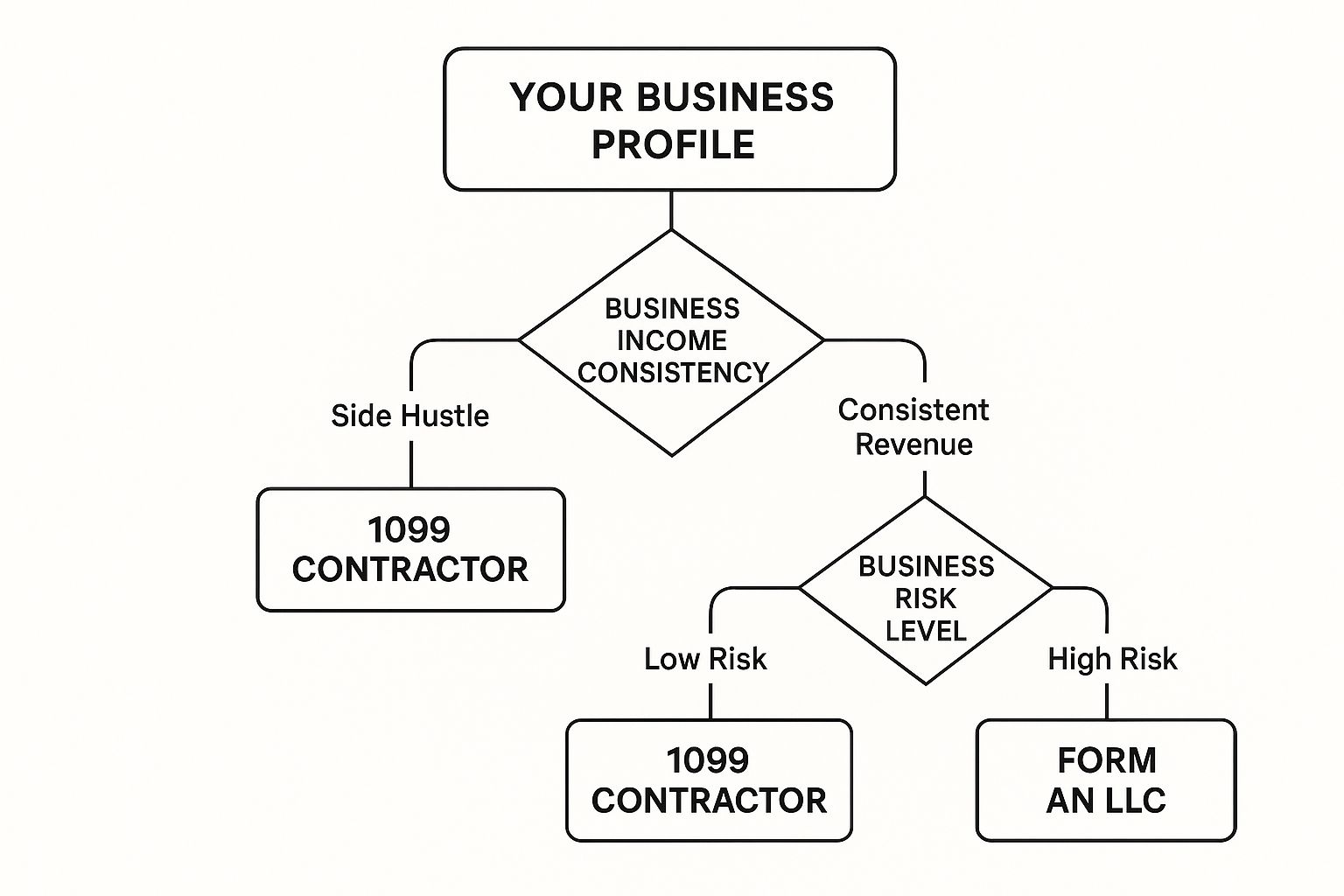
As the infographic shows, once your revenue stream is consistent, the decision really hinges on how risky your line of work is.
Look for one or more of these signs that it’s time to upgrade to an LLC:
-
Your income becomes significant and consistent: There's no single magic number, but a common rule of thumb is to seriously consider an LLC once your net income crosses the $40,000-$60,000 threshold. At that point, the tax savings you could get from an S Corp election will likely more than cover the setup and maintenance costs.
-
You operate in a high-risk field: If a mistake in your work could lead to a lawsuit—think construction, high-stakes financial consulting, or handling sensitive client data—an LLC is essential. It builds a legal wall between your business debts and your personal assets, like your house and savings.
-
You plan to hire employees or contractors: The moment you bring other people onto your team, your liability exposure skyrockets. An LLC creates a formal business entity to employ them, which helps shield you personally from any potential disputes or workplace issues.
Forming an LLC is a strategic move that signals your business is evolving from a freelance gig into a serious, scalable enterprise. It’s an investment in liability protection, tax efficiency, and professional credibility.
In the end, it all comes down to foresight. The 1099 structure is a fantastic launchpad for testing your ideas and getting off the ground. But once your business has momentum, with real revenue and real risks, the LLC becomes a critical tool for building something that lasts.
Answering Your Key Questions About 1099 vs. LLC
Even after breaking down the core differences, you probably still have a few specific questions. Let's tackle some of the most common ones that come up when you're on the fence between being a 1099 contractor and forming an LLC.
Can I Be a 1099 Contractor and Have an LLC?
Yes, and this is probably the biggest source of confusion for new business owners. The key is to stop thinking of them as competing options.
Think of it like this: your LLC is the formal business structure—the legal "box" that holds your company. The "1099" is simply the name of the tax form a client sends to report what they paid your business. So, when you have a single-member LLC, clients pay your LLC, and at the end of the year, they'll issue a 1099-NEC to your LLC. The LLC structure is what's working in the background to separate your personal assets from your business liabilities.
Is There an Income Level Where Forming an LLC Makes Sense?
There's no hard-and-fast rule from the IRS, but a good rule of thumb many accountants use is to start seriously thinking about an LLC once your net self-employment income is consistently hitting the $40,000 to $60,000 range.
Why that number? It's the point where the potential tax savings you could get from an S-Corp election start to really outweigh the annual fees for maintaining the LLC. As your income grows beyond that, the case for forming an LLC and getting strategic with your taxes becomes much, much stronger.
The decision to form an LLC is less about hitting a magic income number one time and more about recognizing a consistent pattern of profitability. When your side hustle has officially grown into a stable business, it's time to protect it with the right legal structure.
Does an LLC Make Me Look More Professional?
It absolutely does. For a lot of clients, especially larger companies with formal procurement processes, working with a registered business like an LLC signals a higher level of credibility and permanence.
It shows you're a serious business owner, not just someone freelancing on the side. This professional polish can give you a real edge when you're bidding for bigger projects, trying to build lasting client relationships, or just separating yourself from the crowd. An invoice with an LLC name on it simply carries more weight.
How Do I Pay Myself From My LLC?
How you get paid from your LLC comes down to how it's taxed. For a solo owner, there are two main ways this works:
-
Default Taxation (Treated as a Sole Proprietorship): You pay yourself with an "owner's draw." It's as simple as it sounds—you just transfer money from your business bank account to your personal one. There's no payroll and no tax withholding on the transfer itself.
-
S-Corp Taxation: This route is a bit more formal. You have to pay yourself a "reasonable salary" for the work you do, which means running actual payroll and withholding taxes. After your salary is paid, you can take the remaining profits out as distributions (draws), which have the major benefit of not being subject to self-employment tax.
Figuring out the right business structure and tax strategy can feel overwhelming. The team at Allied Tax Advisors offers expert guidance to help you make the best choice for your financial future. Learn more about our business filing and advisory services.