
You close the month, review your profit and loss, and something looks off. Your team finished the work. The client approved it. But the invoice won't go out until next month, so revenue is missing from the current period.
That gap is where many small businesses lose visibility. If you only record income when you send the invoice or collect cash, your monthly results can swing for reasons that have nothing to do with actual performance. An accrued revenue journal entry fixes that timing problem and gives you a cleaner month-end close.
Table of Contents
- What Is Accrued Revenue and Why Does It Matter
- How to Record an Accrued Revenue Journal Entry
- Real-World Examples Across Different Businesses
- The Reversing Entry Process Explained
- Bookkeeping Best Practices and A Month-End Checklist
- Frequently Asked Questions About Accrued Revenue
What Is Accrued Revenue and Why Does It Matter
You close the books on the last day of the month. A project is substantially complete, your team has done the work, and the client will be billed next week. If that revenue stays out of the month-end close, the financial statements miss part of what the business earned.
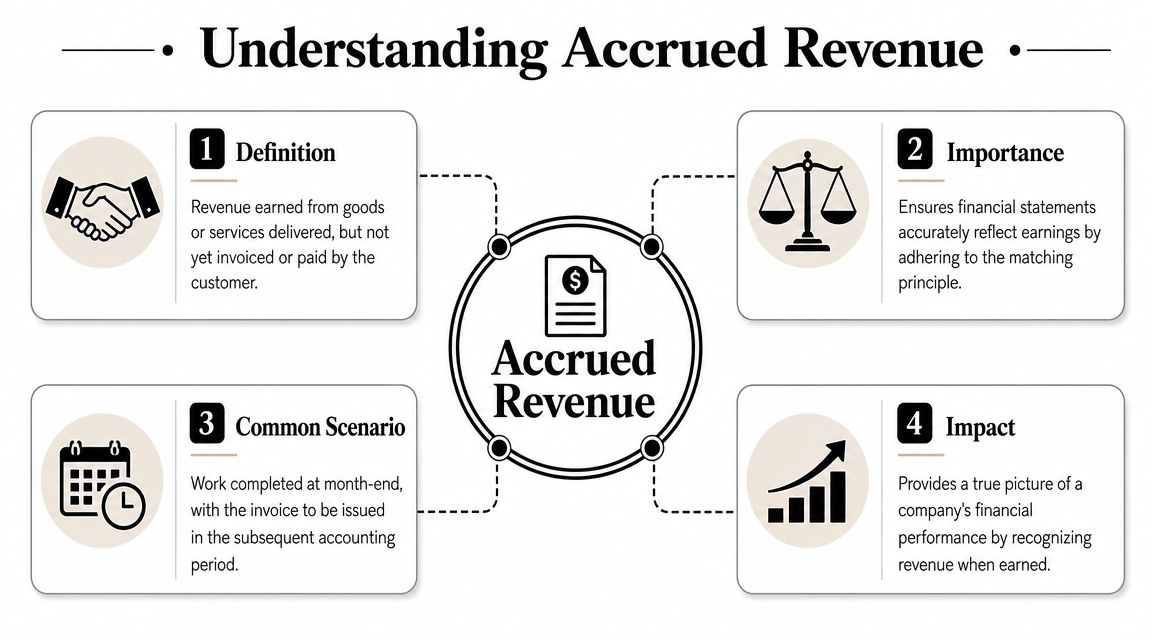
Accrued revenue is income earned before the invoice is issued or cash is collected. Under accrual accounting, revenue is recognized when the work is performed or the earning event occurs, not when the payment hits the bank account.
The month-end problem it solves
This shows up in real businesses all the time. A consultant finishes a phase of work on March 31 but sends the invoice on April 3. A landlord earns rent under the lease terms before the billing run goes out. A software company has usage charges for the last week of the month that will not be invoiced until the next cycle.
Without an accrual, March revenue is understated and April revenue is overstated. That distorts gross margin, owner distributions, bonus calculations, and lender reporting. I see this most often in companies that have good operations but a loose close process. The work gets done. The billing lags. The books end up telling the wrong story.
A simple rule helps. If the company has earned the revenue and can support the amount with records, it usually belongs in the current period even if the invoice has not been sent yet.
Why owners should care beyond compliance
Accrued revenue improves decision-making, not just GAAP compliance. If monthly reporting swings because billing dates drive revenue recognition, owners can misread trends and react to timing noise instead of actual performance. For a clearer sense of operating performance, this primer on how accrual accounting reveals true profitability is a useful companion to month-end revenue questions.
It also helps to step back and confirm whether your books should be maintained on a cash or accrual basis for management purposes. This guide to the difference between cash basis and accrual basis lays out the owner-level trade-offs clearly.
A few business types run into accrued revenue regularly:
- Consulting and agencies: Time is worked this month, but scope review or invoice approval happens next month.
- SaaS and usage-based billing: Revenue is earned during the service period before final metered charges are calculated.
- Construction and project-based firms: Work may be earned based on milestones or percentage complete before formal billing.
- Professional practices: Legal, accounting, design, and advisory firms often finish month-end work before invoices go out.
Software matters here too. In QuickBooks or IRIS, the hard part usually is not posting the journal. It is having support behind the number so the accrual can be reversed cleanly and matched to the eventual invoice. Owners who treat accrued revenue as a documented month-end estimate, rather than a guess, get cleaner financials and fewer cleanup entries later.
Book it accurately, and the income statement reflects what was earned in the period. The balance sheet also shows the amount customers owe for value already delivered.
How to Record an Accrued Revenue Journal Entry
Month-end often exposes the same problem. The work is done, the client has received value, but the invoice will not go out until next month. If you leave that revenue out of the close, the month's financials understate what the business earned.

The basic journal entry
At period-end, record the revenue that has been earned but not yet billed by debiting Accrued Revenue and crediting Revenue. Ramp's guide to the accrued revenue journal entry walks through several timing examples and notes that the entry creates an asset without affecting cash at the time you book it.
| Account | Debit | Credit |
|---|---|---|
| Accrued Revenue | Earned amount | |
| Revenue | Earned amount |
That entry puts the income in the right period and creates a receivable-type asset for the amount you expect to bill.
A practical example you can follow
Assume a marketing agency finishes a retainer month on June 30, but the final usage adjustment is calculated and invoiced on July 3. If the contract and service logs support $6,200 earned through June 30, book the accrual at June month-end.
The entry would look like this:
| Account | Debit | Credit |
|---|---|---|
| Accrued Revenue | $6,200 | |
| Revenue | $6,200 |
In practice, I tell owners to work through four steps:
- Confirm the earning event happened by the cutoff date. That could be completed service hours, a contract milestone, delivered units, or usage records.
- Measure the amount from support, not from memory. Use the signed agreement, approved timesheets, project tracker, or billing report.
- Post the journal to the correct revenue account so the P&L stays meaningful by service line.
- Save support with the entry so the bookkeeper can reverse it cleanly and match it to the invoice later.
That last step matters more than many teams expect. A correct journal with weak support often creates more cleanup work than a delayed entry.
How this works in QuickBooks and IRIS
The accounting is simple. The software setup is where errors creep in.
In QuickBooks, book the accrual through a journal entry dated the last day of the month. Use a clear memo that ties to the customer, contract, and service period. I also recommend adding the reversal date to the memo if your process uses manual reversals, because that reduces duplicate revenue when the invoice posts next month.
In IRIS, the same principle applies. Use a dedicated accrued revenue account, attach backup if the system allows it, and keep a month-end schedule outside the ledger that lists each accrual, why it was booked, and when it should reverse. The schedule is what keeps the close controlled, especially if more than one person touches billing.
Owners who want tighter close procedures can strengthen the process with a short set of bookkeeping basics for small business. Good accounting entries depend on good bookkeeping discipline.
Where this lands on your financial statements
The impact shows up right away in two places:
- Income statement: revenue increases in the period the work was earned.
- Balance sheet: accrued revenue increases as a current asset until billing or collection clears it.
The cash flow statement does not change at initial recognition because no cash moved.
Finance teams handling specialized payroll and journal workflows can find useful context in these PEO accounting insights for finance leaders when standardizing entries across multiple systems.
Real-World Examples Across Different Businesses
Many explanations stop after the textbook debit and credit. That's where business owners get stuck. The true challenge is handling situations where billing, delivery, and approval don't line up neatly.

Tipalti points out that many guides don't show how to handle unusual billing such as milestone-based projects or long-term service contracts, and that the core issue is the workflow across close, invoice timing, and reversal timing in its discussion of accrued revenue workflows. That's exactly where practice differs from theory.
Consulting and professional services
A consulting firm may deliver advisory work throughout the month, then send invoices after internal review. If the work is completed by month-end, the firm often needs an accrued revenue journal entry even though no invoice exists yet.
The support usually comes from time records, signed deliverables, or a contract milestone. What works well is using a consistent cutoff rule. For example, only accrue work that has been completed and is billable under the agreement. What doesn't work is accruing “expected” revenue based on optimism.
A clean consulting close often includes:
- Approved workpapers: Hours or milestones should be reviewed before posting.
- Named revenue accounts: Use the correct income account, not a generic catch-all.
- Client-level support: Each accrual should tie back to a specific customer matter.
Rental income earned before billing or collection
Rental situations can create confusion because owners tend to think in terms of deposits and collections. But if rent has been earned under the lease and billing or collection trails the earned period, the same timing issue can arise.
The hard part is separating earned rent from advance payments, credits, or disputed charges. If the tenant owes for a completed rental period, that points toward earned revenue. If the tenant paid before the period was earned, that points the other direction and belongs in deferred revenue, not accrued revenue.
For landlords tightening up rent operations, this resource on how to manage rent payments efficiently is useful from an operations standpoint because cleaner billing and collection processes reduce the number of messy month-end adjustments.
A reliable accrual starts with a reliable lease file. If the lease terms, billing dates, and concessions aren't organized, the journal entry becomes a guess.
Milestone and long-term contract work
Construction-style and implementation work is where owners most often need judgment. The issue isn't whether accrued revenue exists. The issue is how much has been earned at close.
In milestone-based contracts, vendors commonly calculate the amount using contract value multiplied by completion percentage or milestone delivery, then post the accrual at month-end or project-end close. That approach is described qualitatively across major guidance, and it's usually the right starting point if your contract is written around measurable deliverables.
What works:
| Situation | Better approach |
|---|---|
| Clearly defined milestone completed | Accrue the amount tied to that milestone |
| Partial completion with documented progress | Use a supportable completion measure |
| Mixed contract with setup plus recurring service | Separate the earned portion from future service periods |
What doesn't work is posting a broad estimate with no contract support, then hoping the invoice will sort it out later. That's how reversals get missed and balances linger in accrued revenue for months.
The Reversing Entry Process Explained
Recording the accrual is only half the job. The second half is clearing it properly when billing catches up.

Finlens describes the standard workflow as a three-stage close-and-reclass process: (1) record an adjusting entry at period-end, (2) reverse the accrual when the invoice is issued, and (3) record the normal accounts-receivable invoice, warning that skipping the reversal can overstate revenue and receivables in its guide to accrued revenue processing.
Why the reversal matters
Without the reversal, the invoice can create a second revenue hit. That's the classic double-counting problem. I see this most often when businesses post the month-end accrual manually, then let software post the customer invoice automatically in the next period without clearing the earlier entry.
The result is avoidable but damaging. Revenue is overstated, receivables are messy, and the reconciliation takes longer than it should.
The best reversing entry is the one scheduled when the original accrual is posted. If you wait and rely on memory, you'll eventually miss one.
The three-part workflow in practice
A clean process usually follows this sequence:
- At month-end: Record the accrued revenue journal entry for the earned but unbilled amount.
- When billing occurs: Reverse or reclass the accrual so it doesn't remain on the books.
- Post the invoice normally: Let accounts receivable reflect the billed balance and follow your standard collection process.
Discipline matters more than complexity. Small businesses don't usually struggle because the entry is hard. They struggle because timing varies by customer, and someone has to own the follow-through.
A good month-end file should show the original support, the reversal date, and the invoice reference once billing is complete. If any one of those pieces is missing, the account tends to drift.
Bookkeeping Best Practices and A Month-End Checklist
The most reliable accrued revenue process is boring in the best way. Same review date, same support standard, same reversal routine, every month.
QuickBooks and IRIS workflow tips
In QuickBooks, most businesses handle accrued revenue through a journal entry at close. The practical issue isn't finding the journal screen. It's setting up the chart of accounts and naming conventions clearly enough that your bookkeeper can tell the difference between unbilled earned revenue, billed receivables, and deferred revenue.
A few habits help:
- Use a distinct accrued revenue account: Don't bury it in miscellaneous current assets if you review it often.
- Attach support to the entry: If your version of QuickBooks allows document attachments or memo detail, use it.
- Set a reversal reminder: If automatic reversals aren't part of your workflow, maintain a closing log outside the general ledger.
For businesses using IRIS for payroll and broader accounting support, the same principle applies. Payroll data may drive project costing or service period cutoffs, but payroll timing doesn't determine revenue timing. Keep those workflows coordinated, not blended.
If you want a broader close framework to pair with these entries, this monthly bookkeeping checklist is a practical reference.
Month-end accrued revenue checklist
| Step | Action | Verification |
|---|---|---|
| 1 | Identify work completed before period-end but not yet billed | Contract, milestone report, time log, or lease support is on file |
| 2 | Calculate the amount earned | Amount ties to the agreement and internal support |
| 3 | Record the journal entry | Debit is in accrued revenue and credit is in the correct revenue account |
| 4 | Review financial statement impact | Balance sheet shows a current asset and revenue appears in the proper period |
| 5 | Schedule the reversal | Reversal date is noted for the billing period |
| 6 | Match later invoice to the accrual | Invoice clears or reclasses the accrued balance without duplicating revenue |
| 7 | Reconcile open accrued revenue items | Old balances are investigated and resolved |
A final practice point matters here. Keep accrued revenue small, specific, and well-supported. If the account becomes a dumping ground for “things we'll figure out later,” your close stops being reliable.
Frequently Asked Questions About Accrued Revenue
Is accrued revenue the same as accounts receivable
No. Both are assets, but they represent different points in the revenue cycle. Accrued revenue is revenue you have earned before sending the invoice. Accounts receivable is an amount you have already billed and are waiting to collect.
That difference matters during close. If your staff posted the customer invoice, the balance usually belongs in receivables, not accrued revenue. In practice, I tell clients to ask a simple question: Has billing gone out yet? If yes, use accounts receivable. If no, and the revenue is earned, accrued revenue is usually the cleaner choice.
How is accrued revenue different from deferred revenue
They are opposites in timing. Accrued revenue records income after you earn it but before billing or collection. Deferred revenue records cash received before you earn it, so it stays on the balance sheet as a liability until you deliver the product, complete the service period, or hit the contract milestone.
This mix-up shows up often in businesses with retainers, annual contracts, deposits, or milestone billing. The fastest test is this one: Have you already done the work or delivered the goods? If yes, you are closer to accrued revenue. If no, and cash came in first, you are dealing with deferred revenue.
What if the final invoice differs from the accrual
This happens. Reverse or clear the accrual, post the actual invoice, and record the difference in the correct revenue account based on what changed.
A small variance may come from final hours, usage data, shipping adjustments, or a contract true-up. A larger variance usually points to a weak estimate at month-end. If that pattern keeps showing up, review the support behind the accrual, including time reports, milestone approvals, usage logs, or delivery records. In QuickBooks, that often means tracing the journal entry back to the customer job or class detail so the cleanup does not sit in a generic revenue line. In IRIS, the same principle applies. Keep the accrual support tied to the underlying job or reporting period so the later invoice clears cleanly.
Should I use accrued revenue or accounts receivable in the first entry
Use the account setup that matches your billing process and software, then apply it the same way every month. If the customer has not been billed, many businesses book the first entry to an accrued revenue or unbilled receivable account. Once the invoice is issued, they move that amount into accounts receivable.
Consistency matters more than the label by itself. Your team needs to separate unbilled earned revenue from billed receivables, reverse entries on time, and avoid recording revenue twice.
If your books need tighter month-end procedures, clearer revenue recognition, or help cleaning up old accruals, Allied Tax Advisors can help you build a process that fits the way your business bills, closes, and reports.