
Hands down, the single biggest reason to form a corporation is the legal separation it creates between the business and you, the owner. Think of it as a financial shield. This structure protects your personal assets—your home, your savings, your car—from any business debts or lawsuits. That's a level of protection a sole proprietor simply doesn't have.
Why Forming a Corporation Unlocks Business Potential

Picking a business structure is a lot like choosing the right tool for a job. A sole proprietorship can feel like a simple, one-person ride—perfect for getting started on a smooth, local path. But if you're planning to build something bigger, something that can go the distance and navigate some serious bumps in the road, you'll need a more powerful engine. That's a corporation. It’s engineered for growth, resilience, and a long-term journey.
Setting up a corporation is so much more than paperwork. It's a strategic move that fundamentally shifts how your business runs, grows, and protects everyone involved. At the heart of it all is the legal process of Company incorporation, the formal step that breathes life into your business as its own entity, completely separate from its founders.
The Foundational Pillars of a Corporation
This separation is where the real magic happens. It builds a protective wall between what the business owes and what you own personally, giving you the peace of mind to take the smart, calculated risks needed to grow. This formal structure also sends a powerful signal of stability and professionalism, which can make all the difference when trying to land larger clients or build trust with suppliers.
When you incorporate, three main benefits immediately jump out:
- Limited Liability Protection: This is the big one. It's the core advantage ensuring that if the business faces debt or a lawsuit, your personal assets are kept safe and sound.
- Access to Capital: Corporations have a straightforward way to raise money by selling stock. This opens the door to a wide range of investors, from friends and family to serious venture capitalists.
- Perpetual Existence: A corporation isn't tied to its owners' lifespans. It can exist indefinitely, even if the founders step away. This is absolutely critical for any kind of long-term vision or legacy planning.
A corporation is an artificial being, invisible, intangible, and existing only in contemplation of law. As a separate legal entity, it can own property, enter contracts, and sue or be sued, all on its own behalf.
Setting the Stage for Scalability
Beyond these core strengths, the corporate structure is practically built for scaling up. Ownership can be transferred easily by selling shares, which makes planning for a future sale or passing the business down a much cleaner process. It also gives you the ability to offer stock options—a fantastic tool for attracting and keeping top talent who want a real piece of the company's success.
By putting this framework in place, you’re not just operating a business; you’re building a valuable asset. You're creating something durable that can outlive its founders, pivot with the market, and attract the resources needed for major growth. For any entrepreneur with big, long-term ambitions, this makes it the clear choice.
Building Your Financial Fortress with Limited Liability

When entrepreneurs are weighing their options for a business structure, there's one benefit that always comes to the top of the list for corporations: limited liability. Frankly, this is the single most powerful reason to incorporate. It’s a legal and financial shield that draws a clean, sharp line between your personal life and your business.
Think about it this way. As a sole proprietor, you are the business. If the business gets hit with a massive lawsuit or racks up debt it can't pay, you go down with it. Your personal assets—your house, your car, your savings—are all on the line.
A corporation changes the game completely by building a separate, watertight vessel for your business. You're no longer the ship itself; you're the captain. If the business fails, the ship might sink, but you can get off safely.
In the eyes of the law, the corporation becomes its own "person." It can sign contracts, take on debt, and even get sued all on its own. This means if things go south, creditors and lawsuits can generally only go after the assets owned by the corporation, not the personal assets of the shareholders.
Understanding the Corporate Shield
This protective barrier is what gives founders the confidence to take the calculated risks necessary to grow. Without it, the fear of losing everything you own would paralyze innovation and hold back expansion. It makes entrepreneurship a far more secure and manageable endeavor.
Here’s how this protection actually works in the real world:
- Business Debts: Let's say your corporation takes out a loan to buy equipment and can't repay it. The bank's claim is against the corporation’s assets (like its bank accounts and that new equipment), not your personal checking account.
- Lawsuits: If a customer slips and falls on your business property, the lawsuit is aimed at the corporation, not you personally. Your home and savings are kept out of the crosshairs.
- Contractual Disputes: If your business can't fulfill a major contract with a supplier, any financial penalties are the corporation's problem to solve, not yours.
This liability shield doesn't just protect you; it's also a massive draw for investors. People are much more willing to put their money into a business when they know their personal financial risk is capped at whatever they invested. This legal bedrock is what has enabled equity markets to grow to such a massive scale. By early 2025, the U.S. stock market alone had over $45 trillion in equity market capitalization, a number made possible because limited liability allows companies to raise money from millions of individual shareholders.
The core principle is simple: as a shareholder, the most you can lose is what you've put in. This turns a potentially catastrophic personal risk into a defined, manageable business risk.
Maintaining Your Liability Protection
Now, while this corporate shield is incredibly strong, it isn't indestructible. To keep this crucial protection intact, you have to respect the legal separation between you and your company. You can't treat the corporation's bank account like your personal piggy bank.
Here are the key practices for keeping that shield in place:
- Avoid Commingling Funds: Keep corporate money and personal money completely separate. That means separate bank accounts, separate credit cards, and separate financial records. No exceptions.
- Adequate Capitalization: Make sure the corporation has enough cash to operate as a legitimate business. Deliberately underfunding a company can look like you're trying to dodge your responsibilities.
- Observe Corporate Formalities: This is the boring but essential stuff. Hold regular board and shareholder meetings, take detailed minutes, and follow the rules laid out in your corporate bylaws.
If you start blurring these lines, a court could decide to ignore the corporate structure entirely in a process known as piercing the corporate veil. By treating your corporation like the distinct legal entity it is, you solidify that financial fortress and gain the peace of mind you need to focus on building something that lasts.
Bringing in the Big Bucks: How Corporations Raise Capital
Every business with big dreams eventually hits a point where it needs fuel for the fire. For most small ventures, that fuel comes from personal savings or a bank loan. But corporations have access to a much more powerful and scalable engine for raising money, and it completely changes the game.
The idea is both simple and brilliant. Instead of one person trying to fund everything themselves, a corporation can slice its ownership into thousands, or even millions, of little pieces called shares of stock. It then sells these shares to all sorts of people, from your neighbor down the street to massive investment firms.
Why Serious Investors Prefer Corporations
This setup is exactly what professional investors—think angel investors and venture capitalists (VCs)—are looking for. These are people who invest in high-growth businesses for a living, but they won't just hand over a check without a solid, predictable structure in place. A corporation gives them precisely that.
The formal rules, clear ownership stakes, and professional documentation give them confidence that their investment is in good hands. They’re not just giving cash to a founder; they're buying a concrete piece of a legally distinct entity that has its own rights and responsibilities.
For an investor, buying stock in a corporation is far less risky than funding a sole proprietorship. The limited liability protection extends to them, their ownership is clearly defined, and the shares can be sold later, providing a clear path to realizing a return on their investment.
This formal framework makes it infinitely easier to hammer out investment terms, set up a board of directors, and map out an "exit strategy"—all non-negotiable items for professional money. Trying to secure that kind of funding without a corporate structure is a non-starter.
The Power of Selling Shares
The ability to issue stock opens up a whole playbook for raising capital, with different plays for every stage of a company's growth.
- Getting Off the Ground: In the beginning, founders can sell shares to friends, family, or early-stage angel investors to get the cash needed to build the first product and open the doors.
- Pouring on the Gas: Once the business model is proven, it can go after bigger checks from VC firms in exchange for a slice of the company. These "funding rounds" (you'll hear them called Series A, B, C, etc.) can inject millions of dollars to fund aggressive expansion and marketing.
- Going Big League: For the most successful companies, the final step is an Initial Public Offering (IPO). This is where the corporation sells its shares to the general public on a stock exchange like the NASDAQ or NYSE, raising incredible sums of money and providing a big payday for early investors and employees.
This is the exact path that small startups have followed to become the giants we know today. The ability to raise capital is what allows companies to gather the massive resources needed to scale operations and dominate markets. Just look at the numbers: by 2025, the world's largest corporations reached mind-boggling valuations, with NVIDIA at roughly $4.16 trillion and Microsoft at $3.76 trillion. That kind of capital, built share by share, is what lets them fund world-changing R&D and out-muscle the competition. You can dive deeper into these figures with this market analysis of the largest companies by market cap.
Easy In, Easy Out: Liquidity and Transferability
Another huge plus is the liquidity of corporate ownership. Trying to sell your piece of a partnership or an LLC can be a messy, drawn-out affair that often needs the blessing of the other owners. Selling shares in a corporation? It's usually a much cleaner transaction.
This ease of transfer is a massive advantage. It means investors have a clear path to cashing out by selling their shares to someone else. It also makes it far simpler for founders to plan for retirement, create a succession plan, or sell the company outright. On top of that, it enables things like employee stock option plans (ESOPs), which are fantastic tools for attracting top-tier talent by giving them a real stake in the company’s success. This smooth transfer of ownership is a key reason the corporate structure is so dynamic and well-suited for long-term growth.
Understanding Corporate Taxes and Strategic Planning
Let's talk taxes. The first thing most people hear about corporate taxes is the dreaded phrase "double taxation." It sounds ominous, but the idea is actually pretty simple. A standard C Corporation pays taxes on its profits. Then, when it pays out those profits to shareholders as dividends, the shareholders have to pay personal income tax on that same money.
Yes, it's a two-tiered system. But focusing only on that is like judging a powerful truck by its gas mileage alone, without ever looking at its towing capacity or off-road capabilities. The full picture of corporate taxation includes some incredibly valuable strategic advantages and powerful deductions that can make it the right choice.
The Power of Business Deductions
One of the biggest upsides to the corporate structure is the sheer breadth of expenses you can deduct before your taxable profit is even calculated. This goes way beyond the basics like rent and office supplies. It covers crucial investments in your team that can dramatically lower your company's tax burden.
For instance, a corporation can fully deduct the cost of employee salaries and wages. But the real magic happens with employee benefits, which creates a fantastic win-win for everyone.
- Health and Life Insurance: A corporation can generally deduct 100% of the premiums it pays for employee health, dental, and life insurance plans.
- Retirement Plans: Any contributions the company makes to employee retirement plans, like a 401(k), are fully deductible.
- Training and Development: Investing in your team's skills is an investment in your company's future—and it’s also a deductible business expense. Studies have shown that a well-trained team can lead to a 21% increase in profitability.
These deductions do more than just save you money on taxes; they help you attract and keep the kind of talent that will drive your business forward.
The infographic below shows just how many doors the corporate structure opens when it comes to funding your growth—a major reason many founders embrace this model.
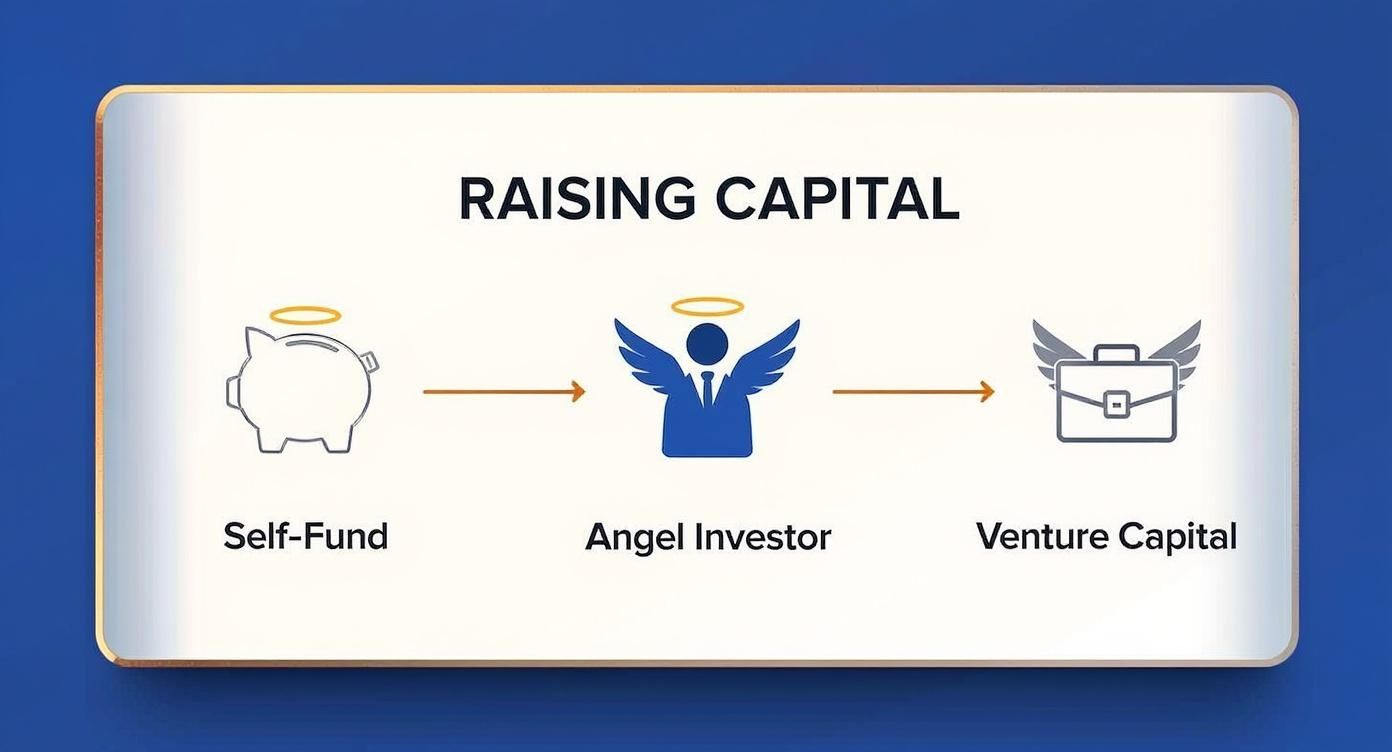
As you can see, this structure is built for raising capital in ways that just aren't available to simpler entities.
Comparing Business Structures at a Glance
Choosing a business structure can feel overwhelming, with each option having its own set of rules for liability, taxes, and ownership. To make it easier, we've broken down the key differences in a simple table. This will help you see, at a glance, how a C Corporation or S Corporation stacks up against an LLC or a sole proprietorship.
| Feature | Sole Proprietorship | LLC | C Corporation | S Corporation |
|---|---|---|---|---|
| Liability | Unlimited personal liability | Limited liability ("corporate veil") | Limited liability ("corporate veil") | Limited liability ("corporate veil") |
| Taxation | Pass-through (personal tax return) | Pass-through (by default) or corporate | Double taxation (corporate and shareholder level) | Pass-through (shareholder level only) |
| Ownership | One individual | One or more members | Unlimited shareholders | Up to 100 U.S. shareholders |
| Raising Capital | Difficult (personal loans, savings) | Moderately difficult (member contributions) | Easiest (can issue stock to investors) | Can issue stock, but with restrictions |
| Continuity | Ends with the owner | Can continue after owner leaves | Perpetual existence | Perpetual existence |
This table provides a high-level overview, but the best choice always depends on your specific goals for growth, liability protection, and tax efficiency.
The S Corp Election: A Smart Alternative
What if you could have the solid liability protection of a corporation without the double taxation? That's exactly where the S Corporation election comes in. It’s a powerful tax strategy that lets you have the best of both worlds.
By filing a simple form with the IRS, an eligible corporation can choose to be taxed as a "pass-through" entity. This means the company's profits and losses flow directly to the shareholders' personal tax returns. The business itself pays zero federal income tax.
An S Corp election gives you the strong legal shield of a corporation combined with the tax-friendly structure of a partnership.
This approach is incredibly popular with small business owners who want the credibility and legal separation of a corporation but prefer to avoid the corporate tax layer. It solves the double taxation problem completely, as all income is taxed just once at the individual level.
Making this move does require filing the right paperwork on time. To get the full details on the requirements, check out our guide on what is Form 2553, the document that unlocks S Corp status. Getting your tax structure right from the beginning is one of the most important decisions you'll make, setting a solid foundation for everything that comes next.
Enhancing Credibility and Ensuring Perpetual Existence

While the financial perks of forming a corporation are often the main draw, some of the most powerful benefits are about perception and permanence. When you incorporate, you’re not just changing your tax status; you’re enhancing your company's credibility and giving it a life of its own, completely separate from you. These are the qualities that lay the groundwork for a lasting, respected enterprise.
It’s amazing what adding "Inc." or "Corp." after your business name can do. It sends an immediate, powerful signal to customers, potential partners, and investors. That simple suffix communicates seriousness, stability, and a commitment to doing things by the book. This perceived professionalism can be a huge leg up, helping you stand out from less formally structured competitors.
Building a Reputation of Stability
In business, how you’re perceived can become your reality. An incorporated business is almost always seen as more reliable and less of a flight risk. This boost in credibility can swing open doors that might otherwise stay shut for a sole proprietor or partnership.
Just think about the practical advantages this brings:
- Attracting Larger Clients: It’s common for big companies to have policies requiring their vendors and partners to be incorporated. Your corporate status can be the ticket to landing those larger, more lucrative contracts.
- Securing Financing: When you walk into a bank, a corporation looks more stable. Lenders see a clearer financial picture and a more durable entity, which often makes it easier to get the loans or lines of credit you need to grow.
- Negotiating with Suppliers: Suppliers are often more willing to offer favorable payment terms to a corporation because they see you as a more permanent and dependable customer.
This isn't just about feeling more legitimate—it's a tangible asset that can directly fuel your growth and impact your bottom line. It shows the world you've built your business on a solid, legally recognized foundation.
The Power of Perpetual Existence
Another profound advantage is what’s known as perpetual existence. A sole proprietorship legally dies with its owner. A corporation, on the other hand, is a distinct legal entity that can, in theory, live forever.
Think of a corporation as a ship on a long voyage. The captain and crew may change over the years, but the ship itself continues its journey. The business is the vessel, not just the people steering it at any given moment.
This continuity offers incredible stability and makes long-term planning much simpler. The death, disability, or departure of a founder doesn't automatically trigger the end of the business. Instead, ownership is passed on smoothly through the sale or inheritance of stock, allowing the company to operate without missing a beat.
This structure is absolutely critical if you're building a business you hope will outlast you. It creates a clear path for succession, letting a founder pass the company to family or sell it to new owners. As the business grows and changes, you may need to update its core documents. You can learn more about this by reading up on amending articles of incorporation, a key part of managing a corporation’s journey over the long haul.
Ultimately, this enduring nature makes a corporation a more dependable partner for long-term contracts and a more secure asset for its owners. It transforms your personal hard work into a lasting legacy.
When Does Incorporating Make the Most Sense?
Choosing your business structure is one of the most important decisions you'll make as a founder. While the perks of a corporation are compelling, it's definitely not a one-size-fits-all solution. So, when does it stop being just an option and become the smartest strategic move for your company? It really boils down to your long-term vision.
For many businesses—think a freelance writer or a small local boutique with no plans to franchise—an LLC or a sole proprietorship often works just fine. They're simpler to manage and have fewer regulatory hoops to jump through.
But if your ambitions are bigger, the corporate framework isn't just helpful; it's practically essential.
Scenarios Where a Corporation Is the Clear Winner
If any of the following are on your business roadmap, setting up as a corporation is almost always the right call. The entire structure is built to handle high growth, complex ownership, and serious fundraising, making it the go-to for founders with big plans.
Think about the difference between a new tech startup and a freelance photographer. The photographer’s goal is likely creative control and a steady stream of clients. The startup, on the other hand, is probably aiming for rapid growth and market disruption, which demands a completely different legal and financial toolkit.
Here are the key signs that a corporation is the right fit for you:
- You Plan to Seek Outside Investment: This is the big one. If you intend to raise money from angel investors or venture capitalists (VCs), incorporating is non-negotiable. Investors need the clean, formal structure and clearly defined share ownership that only a corporation can offer.
- You Want to Attract Top Talent with Stock Options: In a competitive market, offering employee stock option plans (ESOPs) can be the deciding factor in landing key hires. Since only corporations can issue stock, this powerful incentive is exclusive to this structure.
- You Envision Selling the Company Someday: A corporation’s ownership is neatly divided into shares of stock. This makes the process of selling the business—or even just a piece of it—far cleaner and more straightforward than trying to sell an LLC or partnership.
- You Anticipate Significant Growth and Scale: The corporate structure is designed for scale. The world's largest companies, like Microsoft and Amazon, operate as corporations because it allows them to manage complex operations across dozens of countries and serve billions of customers. Amazon’s massive scale, for instance, lets it build huge distribution networks that drive down costs and keep prices competitive.
A corporation is the vehicle of choice for any business that sees itself on a national or global stage, needing the fuel of outside investment and the horsepower of a scalable ownership structure.
Making a Confident Decision
Ultimately, the choice to incorporate comes down to your blueprint for the future. If your five-year plan includes pitching to investors, building a large team with equity incentives, or setting the stage for an acquisition, the benefits of a corporation are hard to ignore. It provides the legal and financial architecture needed to build a durable, high-growth enterprise.
Choosing this path aligns your legal foundation with your ambitious goals from day one. To see how a corporation stacks up against other options, explore our detailed breakdown of different business structure types and find the perfect fit for your vision.
Common Questions We Hear About Incorporation
Making the leap to incorporate can feel daunting, and it's natural to have questions. Let's walk through some of the most common ones we get from entrepreneurs, clearing up the key points we've covered.
What’s the Real #1 Benefit of a Corporation?
Hands down, the single biggest reason business owners incorporate is for limited liability protection. Think of it as a legal firewall between your business and your personal life.
This structure means your company is its own "person" in the eyes of the law. If the business takes on debt or, heaven forbid, gets sued, your personal assets—like your house, car, and savings account—are generally off-limits. This separation is what gives entrepreneurs the confidence to take calculated risks and grow.
Beyond that crucial protection, the ability to issue stock makes a corporation the go-to structure for anyone serious about raising capital. Investors understand and prefer it.
When Is It Time to Switch from an LLC to a Corporation?
That's a great question, and the answer almost always comes down to your ambition for the company. The moment your business goals pivot toward high-growth strategies, it's time to have the conversation.
You should seriously consider converting to a corporation if your roadmap includes:
- Raising Venture Capital: VCs and most angel investors simply won't invest in an LLC. They require the C Corporation structure.
- Giving Employees Stock Options: If you want to attract top-tier talent by offering them a piece of the pie (equity), you need to be a corporation.
- Eyeing an IPO: Thinking of taking the company public one day? You absolutely must be a corporation to make that happen.
The bottom line is this: when your focus shifts from just protecting what you have to aggressively funding future growth, a corporation becomes the clear choice.
A simple way to think about it: An LLC is fantastic for protecting personal assets in a straightforward business. A corporation is built to attract outside investment and scale to the moon.
Making this change is a major milestone. It's about aligning your legal foundation with your biggest vision for the company's future.
Here at Allied Tax Advisors, we live and breathe this stuff. We help business owners navigate these pivotal moments every single day. Whether you're weighing your options for a new venture or planning your next big growth phase, our team is here to build the right strategy for your financial goals.
Find out how we can help at https://alliedtax.com.