
Amending your articles of incorporation is how you officially tell the state that something fundamental about your company has changed. This isn't just internal housekeeping; it's a formal legal update to the public document that first established your corporation. You'll need to file an amendment for major shifts like a new company name, an increase in authorized shares, or a change in your core business purpose. It's a critical step to keep your company's legal framework in sync with its real-world evolution.
Why You Might Need to Amend Your Articles
Think of your articles of incorporation as your company’s birth certificate. It’s the foundational document you filed with the state that officially brought your corporation into existence. But businesses don't stand still. They grow, pivot, and evolve—and when they do, that "birth certificate" sometimes needs an update.
Amending your articles is more than just paperwork. It’s about ensuring your legal structure accurately reflects your current operations and future plans. It’s a normal part of the business lifecycle. The business world moves fast, and companies have to adapt. With millions of new businesses forming every year—around 7.69 million globally back in 2016, according to the International Business Registers Report—it's a safe bet that countless more are amending their documents to keep up.
Common Triggers for an Amendment
So, what kind of change is big enough to require a formal amendment? A few common situations almost always trigger the need to file.
A company rebrand is probably the most frequent reason. If you're changing your business name, you absolutely have to file an amendment to make it legally binding. Trying to operate under a new name without updating your articles is a recipe for trouble—it can create major headaches with banks, contracts, and state agencies.
Another huge driver is the need to raise capital. If your company is gearing up to bring in investors, you'll almost certainly need to authorize more shares of stock than you originally listed. This isn't optional; it's a must-do for most funding rounds.
Here's a quick reference table to help you spot when an amendment is necessary.
Common Scenarios Requiring an Amendment
| Business Scenario | Type of Amendment | Why It Matters |
|---|---|---|
| You're rebranding the company. | Change of Corporate Name | Your legal name must match your operating name for contracts, bank accounts, and state compliance. |
| You need to raise capital from investors. | Increase in Authorized Shares | You can't issue shares you haven't legally authorized. This is a prerequisite for most equity financing. |
| Your business model has shifted significantly. | Change of Business Purpose | Aligns your legal purpose with your actual operations, which can be important for liability and contracts. |
| You're moving your main office to a new state. | Domestication/Change of Domicile | This is a complex process often requiring amendments in both the old and new states to legally "move" the corporation. |
| You need to add or remove specific rules for directors. | Altering Corporate Governance Provisions | You might want to add indemnification clauses to protect directors or change voting rights. This must be in the public record. |
At the end of the day, any significant change to the core information in your original articles—name, shares, purpose, agent, or address—likely calls for an amendment.
Other key reasons include:
- Changing Your Registered Agent: While some states have a simpler form for this, others demand a formal amendment to your articles.
- Updating Corporate Governance: You might want to add or remove specific provisions about director liability or shareholder rights to attract investors or new board members.
Don't confuse your articles with your bylaws. It's a common mix-up. Your articles of incorporation are a public document filed with the state. Your bylaws are your internal rulebook for how the company operates. Amending articles is a formal state-level process, whereas changing bylaws is usually just an internal board vote.
Keeping your articles of incorporation up-to-date is just good corporate governance. It prevents legal messes down the road and shows that you're running a tight ship. As you think about your company's structure, understanding the differences between an S Corp vs an LLC for small business can also shine a light on the kind of compliance you'll be dealing with long-term. Ultimately, amending your articles is a proactive move that supports your company's growth and legal health.
The Amendment Process From Resolution to Filing
So, you've decided your articles of incorporation need an update. Changing this foundational document isn't just a matter of filling out a form; it's a formal process that starts with internal approval and ends with the state giving you the green light.
I'll walk you through the entire journey, from getting the board and shareholders to sign off on a resolution all the way to filing the official Certificate of Amendment with the Secretary of State.
Let's start with a high-level look at how this usually plays out.
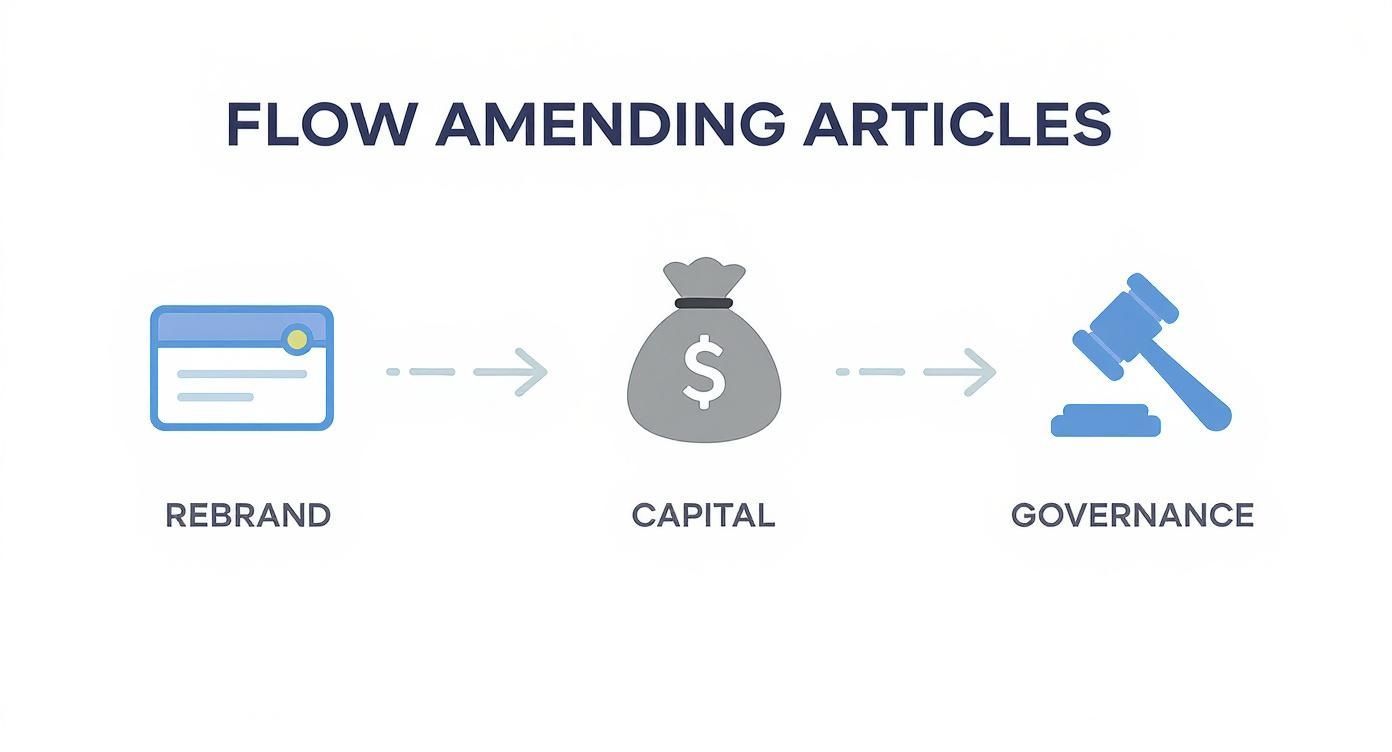
As you can see, whether you're rebranding, changing your capital structure, or tweaking governance, the path involves distinct stages. Getting this right from the beginning saves a lot of headaches later on. Knowing which approvals you need and when is half the battle.
Let's dive into the first crucial step: getting everyone on the same page internally.
Drafting The Formal Resolution
Before you even think about state paperwork, you need a formal resolution. This is the internal document that makes the proposed change official within your company. It’s your way of ensuring every director and shareholder knows exactly what's being changed and why.
This resolution should be detailed. It needs to spell out the rationale for the amendment and quote the exact new language for the articles. A little tip from experience: try to use the same wording your state's form requires. It minimizes confusion and potential rejections down the line.
Typically, the board secretary handles the first draft, often using previous meeting minutes as a template. To make things even clearer, especially if you're increasing shares or changing names, consider adding a simple summary table right in the resolution.
A good resolution should include:
- The full proposed company name and any official abbreviations.
- The exact number of new shares and their par value if you're adjusting capital.
- The revised governance clauses if you're updating your board's structure.
Once the draft is ready, you'll need to schedule a board meeting. Make sure you give proper notice as required by your bylaws—this is often 10 to 20 days out. During the meeting, this isn't a simple majority vote; you'll need a special resolution, which usually requires a two-thirds majority to pass.
A special resolution is a big deal. It legally binds the company to the change and becomes a permanent part of your corporate records via the meeting minutes.
After the vote passes, the resolution is officially adopted and recorded in your corporate minute book. Now, with your internal approvals locked in, you can move on to the state forms.
Filling Out The State Amendment Form
This is where the rubber meets the road. Head over to your Secretary of State's website and find the Certificate of Amendment form. Be careful here—many states have different forms for different entity types, so grab the right one.
When you fill it out, precision is everything.
- Enter your corporate name exactly as it was originally filed. No variations.
- Have your date of incorporation and file number handy.
- Carefully specify the changes, section by section, copying the language directly from your approved resolution.
- Don’t forget to include the date the resolution was passed and get the required signatures.
I can't stress this enough: typos or inaccuracies are the number one reason for rejections and delays. Double-check your corporate number and every spelling against your original articles. Some states also require signatures to be notarized, so confirm that beforehand.
Filing fees and methods vary quite a bit by state. Here’s a quick snapshot:
| State Agency | Submission Method | Typical Fee |
|---|---|---|
| Delaware Secretary of State | Online or mail | $200 |
| California Secretary of State | Mail only | $30 |
| Nevada Secretary of State | Online or mail | $75 |
With the form completed and signed, get your payment ready. If you're in a hurry, most states offer expedited processing for an extra fee. It’s often worth it.
By the way, if your changes also affect your company's tax status, you might need to look into IRS filings. You can learn more about how that works in our guide on Entity Classification Elections.
Avoiding Common Filing Pitfalls
You'd be surprised how many filings get bounced back for simple, avoidable mistakes. A missing corporate seal or an incorrect signature block is a classic. Paying with the wrong format—like a personal check when a cashier's check is required—can also cause an automatic rejection.
Keep an eye out for these other common slip-ups:
- Using outdated information from old stock certificates.
- Entering the wrong state code or mailing address.
- Forgetting to file corresponding amendments for subsidiary entities.
Here’s a pro tip: Once you file, ask for a scanned receipt and an email confirmation. This gives you proof of submission and a reference number.
A quick, polite follow-up call or email to the state office a week or so after filing can sometimes trim weeks off your turnaround time.
Once you receive the approved amendment, you're not quite done. The final step is to place the certified copy in your corporate minute book. This ensures your internal records are perfectly aligned with the public record, preventing any confusion for future audits or legal matters.
Now you can pop the champagne. A quick announcement to your stakeholders is a great way to celebrate the milestone and keep everyone in the loop.
Follow these steps, and you’ll find the process is far less intimidating than it seems. Good luck
Navigating Complex Share Structure Changes
Altering your company’s share structure isn’t a casual update; it’s a major realignment of who owns what and how value flows. Often, this kind of amendment comes up because you’re gearing up for something big—a new financing round, a strategic partnership, or a merger that demands a fresh look at ownership stakes.
Picture your startup securing interest from a venture capital group. They’re impressed by your traction but want a slice of preferred stock that carries extra voting clout and a liquidation cushion. If your articles of incorporation only mention a single class of common shares, you’ll need to file an amendment to introduce that preferred class and avoid deadlocks later.

Every tweak you make ripples through the cap table, recalculates existing equity percentages, and sets the stage for future fundraising. It’s not just forms and fees; it’s the backbone of long-term financial strategy.
Increasing Authorized Shares For Growth
Starting out, you might file for 10,000 authorized shares and never think much of it. Fast forward a year or two, and you’re lining up investors, building an employee stock option pool (ESOP), or launching an incentive plan. Suddenly, 10,000 feels painfully limiting.
Amending your articles to boost that cap—say, to 10,000,000—is the legal green light for issuing new stock. Without that change, you simply can’t grant equity.
Key Takeaway: Think of authorized shares as your total available inventory. The amendment officially increases your inventory, giving you the flexibility to sell or grant stock as your company expands.
Creating New Classes Of Stock
It’s common to have at least two classes of equity when serious investors come knocking. Founders and early employees typically hold Common Stock, which comes with basic voting rights. Institutional backers, on the other hand, look for Preferred Stock that offers perks like:
- Liquidation Preferences: Investors get paid first when the company is sold.
- Anti-Dilution Protections: Guards against losing value if share prices drop in subsequent rounds.
- Enhanced Voting Rights: A stronger voice on key corporate decisions.
Including these new share classes can feel daunting at first. In practice, it means carefully drafting the rights and privileges, circulating a board resolution, and filing the amendment. If you’re weighing tax implications, our detailed guide on how to file as an S corp sheds light on strategic elections.
Reverse Stock Splits And Cap Table Management
Sometimes you need to tighten rather than expand. A Reverse Stock Split—for example, consolidating every ten shares into one—can clean up small, lingering positions on your cap table. This maneuver often precedes a fresh fundraising push or prepares the company for regulatory filing thresholds.
Pulling off these structural changes means locking in board approval, getting shareholder sign-off, and submitting precise language to your state agency. Skipping any step or misunderstanding the ripple effects could leave you with unexpected tax bills or equity disputes down the line.
Understanding State-Specific Filing Rules
Where you incorporated isn't just a detail on a form; it's the legal jurisdiction that dictates the entire rulebook for your company. This is especially true when you need to amend your articles of incorporation. Thinking the process is a one-size-fits-all affair is a common and costly mistake. The truth is, every state has its own unique set of requirements.
We're not talking about minor details here. The differences can be significant, from filing fees and shareholder approval thresholds to the exact wording you need in your board resolution. What sails through in Delaware could get flat-out rejected in California.
Over the years, corporate governance has generally moved toward more flexibility. A great example is the UK's Companies Act 2006, which simplified the amendment process—a principle you can see reflected in various forms across the US. You can get more background on this trend on Wikipedia. But how that flexibility is interpreted and implemented varies wildly from one state to the next.
Key Jurisdictional Differences
Let's look at three popular states for incorporation—Delaware, California, and Nevada—to see just how different the rules can be. Each has tailored its approach to its own legal and business climate.
In Delaware, a simple name change is a pretty straightforward affair with a standard fee. But if you're altering your share structure, you could trigger a complex franchise tax recalculation. California, on the other hand, is known for its tougher corporate regulations and often demands more detailed information on the amendment form, along with specific notice requirements for shareholder meetings.
Then you have Nevada, often seen as a more business-friendly state, which can mean faster processing times and slightly lower fees for certain amendments. These aren't just administrative quirks; they're critical details that directly impact your timeline and budget.
Pro Tip: Never, ever rely on a generic template you found online or a guide for another state. Your first and only source of truth should be the official website of the Secretary of State where your company is incorporated. That's where you'll find the current forms, fee schedules, and filing instructions.
Filing Comparison for Delaware California and Nevada
To put these differences into a clearer perspective, here's a quick comparison of what you can expect in these three popular states. This is a great starting point, but always remember that fees and timelines can change.
| Requirement | Delaware | California | Nevada |
|---|---|---|---|
| Standard Filing Fee | ~$194+ | ~$30 | ~$175 |
| Typical Processing | 2-3 Weeks | 2-4 Weeks | 1-2 Weeks |
| Expedited Service | Yes (extra fee) | Yes (extra fee) | Yes (extra fee) |
| Submission Method | Online or Mail | Primarily Mail | Online or Mail |
Before you even draft the first document, do your homework. Mapping out these key state-specific variables upfront will save you from the massive headaches—and costs—of a rejected filing. Pinpoint the correct form, calculate the exact fee, and confirm the approval process. A little research now will ensure your amendment goes through smoothly.
What to Do After Your Amendment Is Approved

Getting that official, stamped approval from the Secretary of State is a great feeling. It’s tempting to file it away and consider the job done, but don’t close the book just yet. The legal amendment is complete on paper, but now you have to make that change a reality across your entire business.
I’ve seen it happen too many times: a company goes through the whole process only to drop the ball on these final steps. This oversight can quickly snowball into serious compliance issues, frozen bank accounts, or tax filing nightmares that completely defeat the purpose of the amendment in the first place.
A systematic approach is your best friend here.
Update Your Internal Corporate Records
First things first, get your own house in order. Your internal corporate records are the official story of your company, and they need to be kept perfectly in sync with your public filings.
Start with your corporate minute book. This is more than just a binder; it’s a legal requirement. Take the certified copy of the amendment you received from the state and place it right behind your original Articles of Incorporation. This creates a clean, chronological paper trail of your company's legal structure.
With that done, pull out your corporate bylaws. Think about the change you just made. Did you authorize more shares? Change the number of directors? If your amendment affects something governed by the bylaws, you'll need to update them, too. Keeping these documents aligned prevents internal confusion and potential governance disputes down the road.
Notify External Stakeholders and Agencies
Once your internal records are squared away, it’s time to tell everyone else. A simple name change, for example, has a ripple effect that touches nearly every part of your operations. Your bank should be one of your first calls—you need to get your new name on all business accounts, checks, and debit cards to avoid rejected payments.
Here’s a quick checklist of who to contact:
- The IRS: If you've changed your corporate name, you must notify the IRS to update the name associated with your Employer Identification Number (EIN). This is non-negotiable for tax and payroll purposes.
- Your Bank and Lenders: Every financial institution you work with needs a copy of the approved amendment to update your accounts and loan documents.
- State and Local Agencies: Don't forget about state tax permits (like sales tax) and any local business licenses or permits. They all need to reflect your new legal name.
- Vendors and Key Clients: Let your partners know about the change so they can update their systems. The last thing you want is an invoice or contract issued to the wrong legal entity.
The goal is a seamless transition. Forgetting to update your EIN with the IRS after a name change is a classic mistake that can cause them to reject your tax filings, leading to penalties and a bureaucratic headache you definitely don't need.
We see companies use this process for major strategic shifts all the time. For instance, the pharmaceutical giant Shionogi & Co., Ltd. recently amended its articles to adopt a new governance model. This structural change was designed to make its board more efficient and is a perfect example of how amending articles of incorporation is a critical tool for keeping a company modern and competitive. You can read more about how companies adapt their governance framework on the official Shionogi site.
Common Questions About Corporate Amendments
When it comes to changing your articles of incorporation, a lot of specific, practical questions tend to pop up. Getting the right answers is key to avoiding delays or, worse, making a legal mistake. Let's walk through some of the most common things business owners ask when they get to this point.
Articles of Incorporation vs. Bylaws
It's really easy to get these two foundational documents mixed up, but they play completely different parts in your company's life.
Think of your articles of incorporation as your company's birth certificate. It’s the official document you file with the state that brings the corporation into legal existence. It’s public and foundational.
Your bylaws, on the other hand, are the internal operating manual. This document lays out the rules for how your company runs day-to-day—things like board meeting procedures, officer responsibilities, and voting rights. Bylaws aren't filed with the state, and changing them is usually a straightforward internal process handled by the board. Amending the articles is a much more formal, public-facing affair.
How Long Does an Amendment Take?
This really depends on your state's processing times, which can be all over the map. In a lot of places, your change becomes official the moment the Secretary of State's office accepts your paperwork. Some states even give you the option to set a future effective date, which is handy for strategic planning.
Just be aware that standard processing can take anywhere from a few business days to several weeks. If you’re in a hurry, nearly every state offers an expedited service for an extra fee. It’s often worth it if you’re on a tight deadline.
Fixing a Mistake on Your Original Articles
What happens if you notice a typo or a factual error on the articles you first filed? This situation calls for a different tool than a standard amendment.
For correcting an error from your initial filing, you'll typically file what's known as a "Certificate of Correction." An amendment is for making a new change to the company after it's been up and running—like a name change or an update to the share structure. It’s not for fixing clerical mistakes made in the past.
Do I Need a Lawyer to File an Amendment?
This is the big question, and the honest answer is: it depends on what you’re changing.
For a simple administrative update, like changing the address of your registered agent, you can probably manage it on your own without much trouble. But for anything more significant, getting professional advice is a smart move.
You should seriously consider hiring a lawyer when you're:
- Changing your share structure, especially if you're creating new classes of stock.
- Adding complex governance rules or clauses to indemnify your directors.
- Doing anything involving a stock split or a reverse stock split.
An attorney will make sure the wording is perfect, all the procedural boxes are ticked, and that your change doesn't accidentally trigger some nasty legal or tax problem you didn't see coming.
Keeping up with corporate amendments and staying compliant can feel like a full-time job. The experts at Allied Tax Advisors offer comprehensive tax and accounting solutions to guide your business through every stage of its growth. Learn how we can support your business goals.