
When tax season comes knocking, you’re probably on the hunt for every deduction you can find. A common question that pops up is, "Are my car registration fees tax deductible?" The short answer is yes, but it’s a bit more nuanced than a simple yes or no.
For personal vehicles, only a very specific part of that fee can be written off.
Your Quick Guide to Deducting Car Registration Fees
Think of your annual car registration bill as a mixed bag of different charges. Most of what you pay covers flat administrative costs—things like new license plates, smog checks, or basic processing fees. But hidden in that total might be a charge that offers a tax break.
The magic word here is ad valorem. If your state charges an ad valorem tax as part of your registration, you're in luck. This is just a fancy term for a tax based on the value of your vehicle.
The IRS treats this value-based portion as a personal property tax, which means you can deduct it. However, any flat fees that everyone pays, regardless of their car's make or model, are not deductible for personal use. You can find more details on vehicle taxation policies over at worldbank.org.
There's one big catch, though. To claim this deduction, you have to itemize your deductions on Schedule A of your tax return. You can’t take the standard deduction and write off your registration fees.
This is a critical choice. You only benefit from itemizing if your total itemized deductions—including state and local taxes, mortgage interest, and charitable donations—add up to more than the standard deduction for your filing status. For many people, the standard deduction is the simpler and more valuable option. It's really important to understand the difference between the standard deduction vs. itemized deductions before deciding.
Let's break it down into a simple summary.
Car Registration Fee Deductibility at a Glance
This table quickly shows whether you can deduct your car registration fees based on how you use your vehicle and what kind of fee it is.
| Vehicle Use | Type of Fee | Is It Deductible? | Where to Claim |
|---|---|---|---|
| Personal | Value-Based Portion | Yes, if you itemize | Schedule A (Form 1040) |
| Personal | Flat-Rate Portion | No | Not applicable |
| Business | Entire Fee | Yes, as a business expense | Schedule C (Form 1040) |
As you can see, the rules are very different for personal and business use. While personal deductions are limited, the entire fee for a business vehicle is generally considered a standard business expense.
Cracking the Code: The IRS Three-Part Test
So, can you write off your car registration fees? The IRS gives a solid "maybe," and it all comes down to a specific set of rules they've laid out. Think of it as a three-point checklist. If the fee your state charges ticks all three boxes, you can deduct at least a portion of it.
The whole thing hinges on a concept called an ad valorem tax. It sounds complicated, but it just means the tax is based on the value of the item. It’s the same logic behind your home's property tax—a more expensive house means a higher tax bill. For your car, this means the deductible part of your registration fee must be based purely on your vehicle's worth.
This infographic breaks down how to figure out if your fee makes the cut.
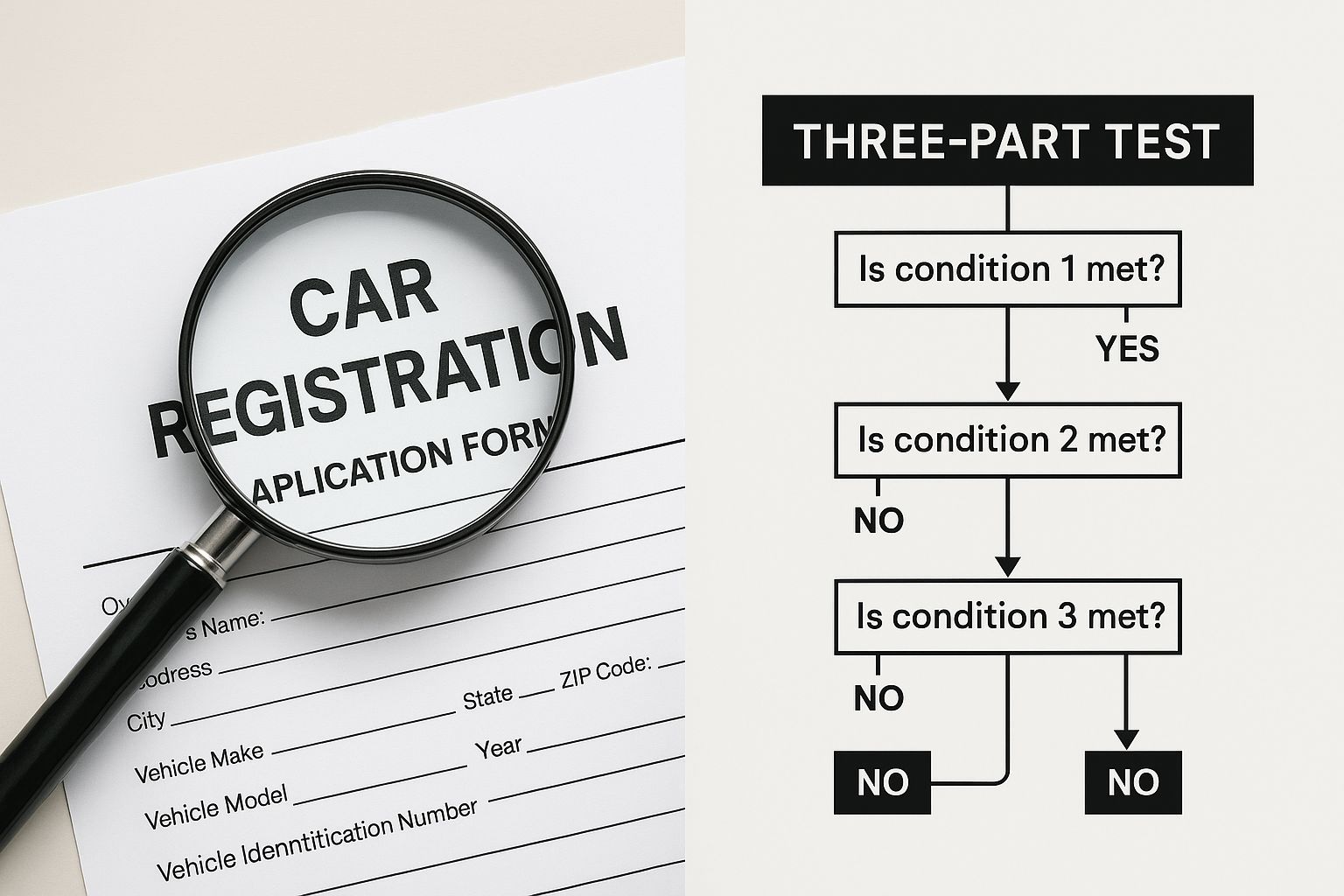
As you can see, understanding this test is the key to unlocking the deductible part of your annual registration bill.
The Three Official Criteria
To count as a personal property tax deduction, your registration fee has to meet all three of the following IRS requirements. It’s a package deal—miss even one, and that portion of the fee isn't deductible.
Here’s the official breakdown:
- It Must Be an Ad Valorem Tax: This is the big one. The charge has to be calculated strictly based on your car’s value. Any part of the fee based on other factors, like your vehicle’s weight, age, or engine size, won't qualify.
- It Must Be Charged Annually: The tax has to be a yearly expense. It doesn't matter if you pay it in installments or all at once; the key is that it's an annual charge.
- It Must Be for Personal Property: The tax must be on personal property, and your car definitely fits that bill. This just separates it from real estate taxes.
The IRS language is precise here. A fee is only deductible if it is "substantially in proportion to the value of the personal property." This is their way of saying that flat fees, regardless of what they're called, never pass the test.
Time to play detective with your registration bill. You need to look for specific line items—things labeled "property tax," "excise tax," or "ad valorem tax." The other charges on there, like for your license plate, title, or emissions test, are not deductible because they're just flat fees for services.
How Your State Determines Your Tax Deduction
Where you live is the single biggest factor in figuring out if you can deduct your car registration fees. There’s no national standard here; it’s a total patchwork of state-level rules, which is honestly where most of the confusion comes from.
Some states spell out the deductible part on your bill, making it easy. Others, however, don't tie their fees to your car's value at all, which means you're out of luck for a personal tax deduction. Nailing down which camp your state falls into is the first step.
Value-Based vs. Flat-Fee States
The heart of the matter is how your state calculates what you owe. The only way you get a deduction is if your state charges what’s called an ad valorem tax—a fancy term for a fee based on your car's value.
States like California, Iowa, and Minnesota do exactly this. Their registration bills include a specific line item, often called a "vehicle license fee" or "registration tax," that goes up or down depending on how much your car is worth. That specific portion is the part you can deduct.
On the flip side, plenty of states couldn't care less about your car's Kelley Blue Book value. Places like Texas, Pennsylvania, and Florida charge fees based on other things, like the vehicle's weight, its age, or just a simple flat rate for everyone. Since these fees have nothing to do with your car’s value, none of the cost is deductible as a personal property tax.
Think of it this way: if the fee would be the same for a $5,000 clunker as it is for a $50,000 luxury SUV, you almost certainly can't deduct it.
To give you a clearer picture of how much this varies, I've put together a quick comparison of a few states. It really drives home why you have to check your own state’s specific rules and can't just rely on what a friend in another state does.
State-by-State Car Registration Fee Examples
This table illustrates how different states calculate registration fees and whether a portion is typically deductible as a personal property tax.
| State | Fee Calculation Method | Potentially Deductible Portion? |
|---|---|---|
| California | Combination of flat fees and a value-based Vehicle License Fee (VLF) | Yes, the VLF portion is based on value. |
| Texas | Primarily based on vehicle weight and county-specific fees | No, fees are not based on the vehicle's value. |
| Minnesota | A registration tax based on the vehicle's base value and age | Yes, the registration tax is value-based. |
| Florida | Based on vehicle weight and type, plus initial registration fees | No, fees are not calculated based on value. |
As you can see, two people could pay $300 to register their cars in different states, but only one might get a tax break from it. It all comes down to the "why" behind the fee.
A Whole New Ballgame: The Rules for Business Vehicles
When your vehicle is essential to your business, the IRS rules for deducting registration fees completely change—and for the better. Forget about that complicated three-part test for personal deductions. For business use, the path to tax savings is much more direct.
If you use a vehicle 100% for business, the entire registration fee is fair game. You can deduct the full amount as an ordinary and necessary business expense. This includes all those flat fees and administrative costs that are off-limits on a personal return. It’s a clean, simple write-off that directly lowers your taxable income.

This is a critical distinction for freelancers, independent contractors, and small business owners everywhere. For a vehicle used exclusively for work, the entire registration bill becomes a valuable business expense, which can make a real difference in your tax liability.
How to Handle Deductions for Mixed-Use Vehicles
But what if your car pulls double duty, serving both business and personal needs? The IRS has a clear method for this. You can deduct the portion of your registration fee that corresponds to its business use. The trick is to keep a detailed, accurate log of your miles.
Let's walk through an example. Say your total registration fee for the year was $400. Your mileage log shows you drove a total of 15,000 miles, with 10,500 of those being for business trips. Your business use percentage is 70% (10,500 business miles / 15,000 total miles).
In this case, you could deduct $280 (which is 70% of your $400 fee) as a business expense. This is the IRS-approved way to fairly account for a vehicle that serves two purposes.
This simple calculation is a huge plus for anyone who spends a good chunk of their workday on the road. For a deeper dive into this topic, take a look at our comprehensive guide on https://alliedtax.com/deducting-vehicle-expenses/.
Of course, taxes are just one piece of the puzzle. When a vehicle is used for work, it's crucial to have the right protection. Understanding the specific commercial vehicle insurance requirements is non-negotiable, as a personal policy often won't cover you for business activities, leaving you exposed to significant risk.
Claiming Your Deduction Step by Step
Alright, so you’ve confirmed that part of your car registration fee is deductible. Now, how do you actually claim it on your tax return? The steps are a bit different depending on whether you’re deducting it as a personal expense or a business expense, but both require a sharp eye for detail.
For a personal vehicle, you can only take this deduction if you itemize. This means you'll pass up the standard deduction in favor of listing out all your individual deductible expenses. You’ll report the ad valorem (value-based) part of your registration fee on Schedule A (Form 1040), right on the line for state and local personal property taxes. It only makes sense to do this if your total itemized deductions add up to more than the standard deduction for your filing status.
Reporting on the Right Tax Forms
If you're using the vehicle for business, things are much more straightforward. You can deduct the cost without having to itemize.
- Sole Proprietors and Freelancers: You'll list the entire registration fee (or the business portion of it) on your Schedule C (Form 1040). It goes under the "Car and Truck Expenses" category.
- Partnerships and Corporations: This deduction gets logged directly on your main business tax return, whether that’s a Form 1120 for C-corps or a Form 1065 for partnerships.
Key Takeaway: No matter which path you take, the absolute most important thing is keeping good records. The IRS wants to see proof, so hang on to your registration statements, payment receipts, and any official paperwork that breaks down what you paid for.
Keeping Impeccable Records
Let’s be clear: without the right paperwork, the IRS can deny your deduction if you ever get audited. The best practice is to keep a dedicated folder—either a physical one or a digital one on your computer—for every vehicle-related expense.
Your registration renewal notice is the star of the show here, as it usually itemizes the different charges. Pair that with proof of payment, like a credit card statement or canceled check, and you're golden. For business owners, this is non-negotiable. Learning how to track business expenses is fundamental to getting every deduction you deserve and staying compliant. Think of your records as your best defense and the secret to a much smoother tax season.
Common Mistakes to Avoid on Your Tax Return
Navigating the rules for car registration fees can be tricky, and it's easy to make a simple mistake that could get your deduction rejected or even trigger an IRS notice. Let's walk through the most common slip-ups so you can file with confidence.
Probably the biggest mistake people make is deducting their entire registration bill. Most states bundle multiple charges into that one fee, but only the portion based on your car's value—the ad valorem tax—is potentially deductible for personal use. Those flat fees for license plates, inspections, or administrative costs don't count.
Another classic error is trying to claim this deduction while also taking the standard deduction. Think of it as an either/or choice. You can only deduct state and local property taxes (which includes the value-based car fee) if you itemize your deductions on Schedule A. You simply can't do both.
Overlooking State-Specific Rules
It’s tempting to think tax rules are one-size-fits-all, but when it comes to vehicle fees, that's a recipe for trouble. What you can deduct depends entirely on your state's laws and how you use your car.
Vehicle registration taxes are all over the map, especially when you look globally. In some parts of Europe, like Denmark, these taxes can climb as high as 150% of the car's value. Businesses might be able to write that off, but personal deductions are often severely limited. You can find more fascinating details on global vehicle tax policies from research on theicct.org.
Crucial Tip: Always check your specific state's rules. Just because your bill calls something a "tax" doesn't mean the IRS agrees. They have their own strict definition for what qualifies as a deductible personal property tax.
Errors with Business and Mixed-Use Vehicles

If you use your car for work, a whole different set of potential mistakes comes into play. The most common one? Botching the calculation for your business-use percentage.
Here are a few pitfalls to sidestep:
- Guessing Your Mileage: An estimate won't cut it in an audit. You need a detailed, regularly updated mileage log to prove your business use.
- Claiming 100% Business Use Incorrectly: Do you ever use the car for a grocery run or a weekend trip? If so, you can't claim it as 100% business. You have to be honest and prorate your expenses.
- Forgetting to Deduct the Fee: On the flip side, some business owners completely forget they can deduct the entire registration fee as a business expense. Don't leave that money on the table
Common Questions on Vehicle Tax Deductions
Let's tackle some of the most common questions that pop up when people think about deducting their car-related expenses.
Can I Deduct the Sales Tax I Paid on a New Car?
Yes, this is often a possibility. The IRS gives you a choice: you can either deduct your state and local income taxes or your state and local sales taxes. You can't do both.
If you opt for the sales tax deduction, you can include the sales tax you paid on a major purchase like a car. This gets added to either the standard sales tax deduction amount for your state or the total you've calculated from all your actual receipts.
What if My Registration Bill Doesn’t Break Down the Fees?
This happens all the time. If your bill is just a single lump sum without any details, the best course of action is to get in touch with your state's DMV.
They should be able to provide an itemized breakdown, which will help you isolate the specific amount that's based on your car's value and therefore deductible.
Keep in mind the SALT cap. The federal deduction for all state and local taxes—often called the SALT deduction—is currently capped at $10,000 per household each year. This single cap includes your property taxes, your state income or sales taxes, and any deductible, value-based portion of your car registration.