
Let's get right to it: are HOA fees tax deductible? For your primary home, the answer is a straightforward no. The IRS views these fees just like any other personal upkeep cost, similar to mowing your lawn or painting your fence—it's part of maintaining your personal space, not a business expense.
But this is where things get interesting. The rules pivot entirely if you start generating income from your property. If you rent it out or use part of it as a dedicated home office, those same HOA fees can flip from being a personal cost to a legitimate business write-off.
Understanding When HOA Fees Are Tax Deductible
The Internal Revenue Service (IRS) draws a firm line in the sand between what it considers a personal expense and a business expense. For the vast majority of homeowners, HOA fees land squarely on the personal side of that line.
Why? Because those payments cover services that directly enhance your day-to-day life. Think community pool maintenance, landscaping for common areas, or security patrols. Since you're the one enjoying these benefits personally, the IRS says you can't deduct the cost.
This distinction affects millions of us. Data from the U.S. Census Bureau's American Community Survey shows that around 21.6 million households pay these fees. For most of them, it's simply a non-deductible cost of homeownership. You can find more details about why the IRS views these as personal expenses, but the core principle is simple: if it's for personal use, it's not a write-off.
The game changes the second that property starts making you money. That's the key that unlocks the exceptions.
Key Scenarios for Deductibility
The tax treatment of your HOA fees all comes down to how you use the property. It's the purpose of the property that transforms the expense from a personal cost into a necessary business one.
Here are the main situations where you can likely deduct your HOA fees:
- You Have a Rental Property: Once you rent out your condo, townhouse, or house, it becomes an income-producing asset—a business. Your HOA fees are now an ordinary and necessary expense for keeping that rental business running.
- You Have a Home Office: If you use a portion of your home exclusively and regularly for your business, you can deduct the percentage of your HOA fees that corresponds to that office space.
This simple flowchart helps visualize the decision-making process.
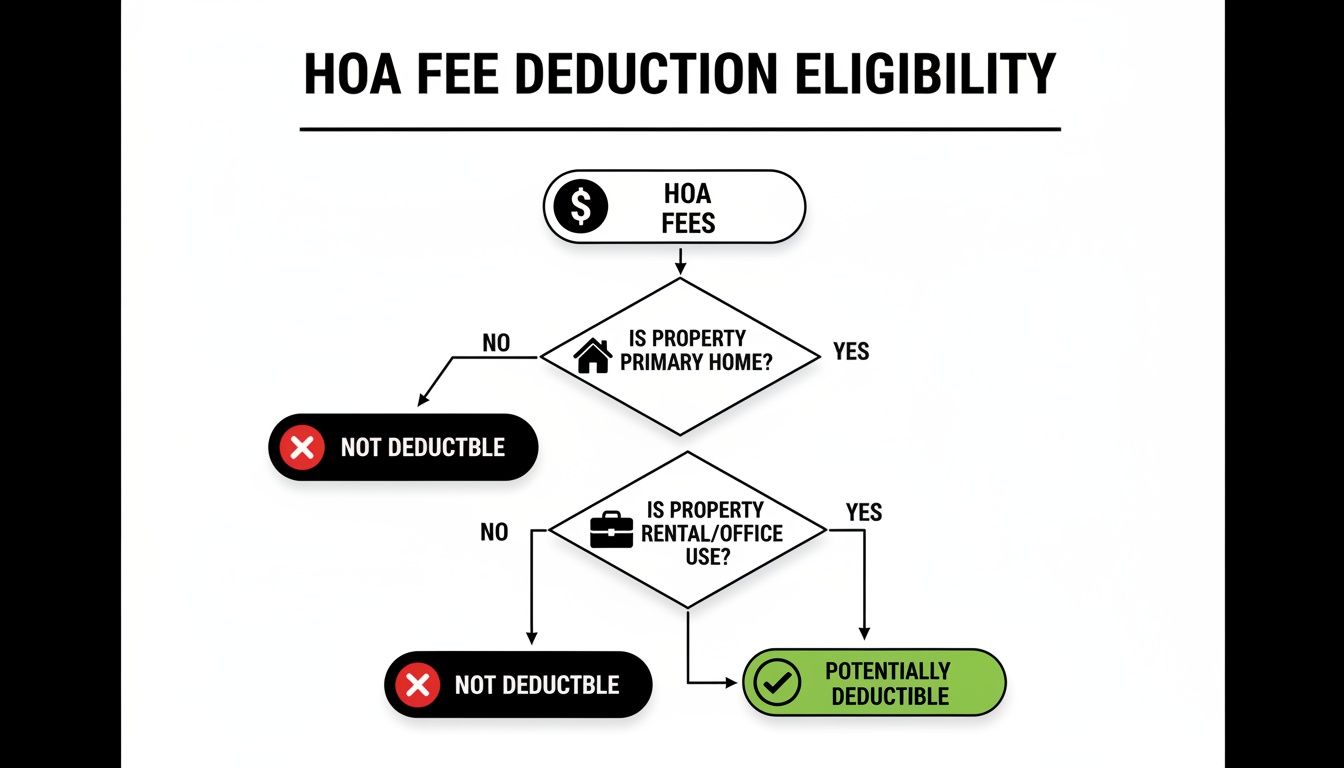
As you can see, the path to a deduction only opens up when business activity enters the picture. Let's dive deeper into these exceptions and break down the IRS rules into clear, actionable steps so you can figure out if your fees qualify.
HOA Fee Deductibility at a Glance
For a quick summary, here’s a table that breaks down when you can and can't deduct those fees.
| Property Type | Can You Deduct HOA Fees? | Key Consideration |
|---|---|---|
| Primary Residence | No | It's a non-deductible personal expense. |
| Rental Property | Yes | The fees are a necessary business expense for your rental activity. |
| Home Office | Partially | You can deduct the percentage of fees that corresponds to your business-use space. |
| Vacation Home | It Depends | If you rent it out, you can deduct fees for the rental period. If it's for personal use, you can't. |
This table provides a high-level overview, but as with all things tax-related, the specifics matter. The next sections will explore the nuances of each of these scenarios.
Why Your Primary Home's HOA Fees Aren't Deductible

It’s one of the most common questions I hear from homeowners: "I pay all this money to my HOA every year. Can I at least get a tax break for it?" It’s a logical question. But when it comes to your primary residence—the home you live in—the IRS has a very clear and firm answer: these fees are not deductible.
The reason for this comes down to how the IRS classifies the expense. In their eyes, the HOA fees for your main home are a personal living expense. That puts them in the exact same category as your electricity bill, your groceries, or the insurance you pay on your house. These are all considered costs of maintaining your personal lifestyle, not costs incurred to make money.
Think of your HOA fee as a bundled payment for shared services that benefit you personally. You can't deduct what you pay a gardener to mow your own lawn, right? For the same reason, you can’t deduct your portion of the HOA fee that pays for landscaping the community’s common areas.
The Personal Benefit Rule Explained
The "personal benefit rule" is the key concept here. If an expense is mainly for your personal comfort, convenience, or enjoyment, you generally can't write it off on your taxes. Your HOA fees are a textbook example.
Let's look at what those fees typically cover and why the IRS views them as a personal benefit:
- Community Maintenance: This covers things like landscaping, snow removal, and general upkeep of shared spaces. These services make your neighborhood a nicer place for you to live.
- Amenities: That fee gives you access to the community pool, clubhouse, or gym. These are direct personal perks that enhance your lifestyle.
- Basic Services: Payments for things like community-wide trash collection, security patrols, or pest control are all services that contribute directly to your personal comfort and safety.
Because you and your family are the ones enjoying these benefits, the IRS says you can't deduct the cost. The money isn't being spent to help you earn a living; it's being spent to help you live.
The IRS's Viewpoint: The IRS asks one fundamental question: "Was this expense necessary to produce taxable income?" When it's your primary home, the answer for HOA fees is a clear "no." The payments are for improving your personal living environment, not a business asset.
Distinguishing Personal Upkeep from Business Expenses
Getting this distinction straight is the key to understanding the whole "are HOA fees tax deductible?" puzzle. While the fees for your primary home are a no-go, the logic flips entirely when a property is used to generate income. The fee itself doesn't change—it still pays for the pool and the landscaping—but the purpose of the property does.
Let’s imagine you own two identical condos side-by-side.
- Condo A (Your Home): You live here. The HOA fee is a personal expense, supporting your lifestyle. It's not deductible.
- Condo B (Rental Property): You rent this one out to a tenant. The HOA fee is now a necessary business expense for maintaining a property that generates rental income. It is deductible.
This comparison makes it crystal clear: the context of how you use the property is everything. The fee is just a fee, but its tax treatment hinges entirely on whether it’s tied to personal living or to an income-producing activity. This rule sets the stage for the powerful exceptions we'll explore next for real estate investors and business owners who work from home.
The Big Exception: Deducting HOA Fees on Your Rental Property
When it comes to your own home, the question "are HOA fees tax deductible?" almost always gets a firm "no." But the moment you rent that property out, the rules of the game change entirely.
For tax purposes, a rental property is a business. This simple shift in status is a game-changer. Suddenly, those monthly HOA fees are no longer a personal expense. They become an ordinary and necessary business expense, just like advertising the unit or hiring a plumber. This is, by far, the most common and powerful way to write off HOA fees.
Every dollar you pay to the HOA for your rental property can be used to lower your taxable rental income, which ultimately means a lower tax bill for you.
How HOA Fees Become a Business Write-Off
Think about it this way: your HOA dues pay for services that keep the property safe, clean, and desirable—all things that are essential for attracting and keeping good tenants. Whether the money goes toward landscaping, pool maintenance, security, or even trash removal, it's all in support of your rental business.
Because of this direct link, the entire amount you pay in HOA fees for a property that is either rented or actively available for rent is 100% deductible.
You’ll claim this deduction on Schedule E (Supplemental Income and Loss), the go-to IRS form for reporting your rental income and expenses. Your HOA fees will sit right alongside other key deductions like mortgage interest, property taxes, insurance, and repairs. If you're looking for a deeper dive into this, our guide on https://alliedtax.com/taxes-on-rental-income/ covers all the bases.
For property owners who manage their finances, understanding solid service charge accounting practices is also a huge help, as it provides a framework for tracking these exact kinds of expenses.
A Landlord's Example in the Real World
Let's see what this looks like with some actual numbers.
Imagine you own a condo that you rent out for the full year.
- Monthly HOA Fee: $300
- Total Annual HOA Fees: $300 x 12 = $3,600
You can deduct the full $3,600 on your Schedule E. If you happen to be in the 22% tax bracket, that single deduction could knock about $792 off your tax bill ($3,600 x 0.22). That’s real money back in your pocket.
What About Partial-Year Rentals?
It's not always a clean, full-year rental. What if you live in the property for a few months and then rent it out? Or maybe it's a vacation home you rent out seasonally.
In these mixed-use scenarios, the IRS requires you to prorate the deduction. You can only deduct the fees for the time the property was officially a rental.
Here’s the simple math:
- Count the Rental Days: Tally up the number of days the property was either rented or listed as available for rent.
- Find the Rental Percentage: Divide your rental days by 365.
- Calculate Your Deduction: Multiply your total annual HOA fees by that percentage.
Let's try an example:
- Total Annual HOA Fees: $3,600
- Rented for: 6 months (about 182 days)
- Rental Percentage: 182 ÷ 365 = 49.8%
- Deductible Amount: $3,600 x 0.498 = $1,792.80
Even in a partial-year situation, you're still able to deduct nearly $1,800—a benefit you’d completely miss out on otherwise.
Keep Your Records Straight (This Is Non-Negotiable)
If you're going to claim these deductions, you have to be ready to back them up. An audit is unlikely, but if it happens, the IRS will want proof.
Key Takeaway: Proof is everything. A line item on your bank statement isn't enough on its own. You need documentation that clearly ties the expense to your rental property for the specific time period you're claiming.
Here’s what your file should contain:
- HOA Statements: Keep every monthly or quarterly statement you receive.
- Proof of Payment: Canceled checks, credit card receipts, or bank statements showing the payment cleared.
- Rental Agreements: Your signed leases are the ultimate proof that the property was operating as a rental.
Deducting HOA Fees for Your Home Office

For the millions of Americans running a business from home, there's another important exception to the rule. If you have a legitimate home office, you can absolutely write off a portion of your HOA fees. This is a game-changer, turning what is normally a non-deductible personal expense into a valuable business deduction.
The secret sauce here is proving to the IRS that part of your home is used exclusively and regularly for business. You don't necessarily need a room with four walls and a door, but the space has to be clearly defined and used only for work. Once you nail down that requirement, you can deduct the percentage of your HOA fees that corresponds to the size of your home office.
This can unlock some serious tax savings, but it means you'll have to do a little math and stick to the IRS guidelines. You have two ways to calculate your deduction.
Calculating Your Home Office Percentage
The entire deduction hinges on a simple ratio: the square footage of your office compared to the total square footage of your home. This percentage is the key that unlocks deductions for your HOA fees and other indirect home costs.
Here’s how to figure it out:
- Measure Your Office: Get the square footage of the space you use only for your business. For a simple rectangular room, just multiply the length by the width.
- Measure Your Home: Find the total square footage of your entire home.
- Do the Math: Divide the office square footage by your home's total square footage.
Let's say you have a 200-square-foot office inside a 2,000-square-foot house. Your business-use percentage is 10% (200 / 2,000). That 10% is the portion of your annual HOA fees you can potentially write off.
Method 1: The Actual Expense Method
This approach requires more attention to detail, but it often leads to a bigger tax deduction. When you use the actual expense method, you take that business-use percentage you just calculated and apply it to all your actual home-related expenses, including your HOA dues.
Let’s stick with our 10% example:
- Annual HOA Fees: $4,000
- Business-Use Percentage: 10%
- Deductible HOA Fee Amount: $4,000 x 0.10 = $400
You’d report this $400 deduction, along with 10% of your utility bills, homeowners insurance, and other indirect costs, on Form 8829, Expenses for Business Use of Your Home. The catch is that this method demands excellent record-keeping throughout the year. For a more detailed breakdown, our guide on the tax implications of working from home dives much deeper into this.
Method 2: The Simplified Option
If the idea of tracking every single bill gives you a headache, the IRS offers a much simpler way out. The simplified option lets you deduct a flat rate for your home office, which is currently $5 per square foot for up to 300 square feet.
This puts a hard cap on your deduction at $1,500 per year (300 sq. ft. x $5).
Here’s the catch: If you take the simplified route, you cannot separately deduct a portion of your HOA fees. The $5-per-square-foot rate is an all-inclusive figure meant to cover all your indirect home expenses—utilities, insurance, repairs, and yes, your HOA dues.
So, you face a trade-off. The simplified method is incredibly easy and requires almost no paperwork. However, you might be leaving money on the table if your actual expenses, including that HOA fee, add up to more than the flat-rate deduction.
Ultimately, your choice depends on your finances and how much time you want to spend on bookkeeping. Just remember, the actual expense method is the only one that lets you directly deduct a portion of your HOA fees for a home office.
Tax Rules for Special Assessments and Capital Improvements

Aside from your regular monthly dues, you might occasionally get hit with a special assessment. This is a one-time charge from the HOA, usually to pay for a large, and often unexpected, expense. The tax rules for these assessments are quite logical, but it all boils down to what the money is being used for.
If the assessment is for basic maintenance or repairs—think fixing a storm-damaged community fence or covering a budget shortfall for this year’s landscaping—it’s treated exactly like your normal HOA fee. That means for your primary residence, it is not deductible. It’s just another personal expense of homeownership.
But the story changes completely when the assessment is for a capital improvement.
Understanding Capital Improvements
So, what exactly is a capital improvement? It's a significant, long-term upgrade that adds value to the community's property, extends its life, or adapts it for a new use. We’re not talking about simple patch-up jobs here; these are major projects that enhance the entire neighborhood.
A few classic examples of capital improvements include:
- Replacing the entire roof on the community clubhouse.
- Repaving all the community roads, not just filling potholes.
- Installing a brand-new, modern security gate system.
- Building a new community playground or swimming pool from scratch.
When you pay a special assessment for a project like this, you don't get to write it off right away. Instead, that payment turns into a powerful, long-term tax benefit that far too many homeowners miss out on.
Adding to Your Property's Cost Basis
The amount you pay for a capital improvement special assessment can be added to your home's cost basis. The easiest way to think about your cost basis is as the total sum you've invested in your property. It starts with what you paid for the house and includes certain other expenses you've incurred along the way.
Key Takeaway: Increasing your cost basis is a long-game tax strategy. You don't get an immediate deduction, but it directly shrinks the taxable profit—what the IRS calls capital gains—you'll owe when you eventually sell your home.
Let's say you bought your home for $400,000. A few years later, you pay a $5,000 special assessment to have all the community roads repaved. Your new adjusted cost basis is now $405,000. That simple accounting tweak could save you a chunk of change on capital gains tax down the line.
For those undertaking major renovations, particularly on older buildings, it’s worth noting that other tax incentives can come into play. For instance, services from Historic Tax Credit Consultants can help property owners navigate very specialized financial strategies.
What About Rental Properties?
Now, if you're a landlord, the rules are a bit different and, frankly, a bit better. When you pay a special assessment for a capital improvement on a rental property, you also add it to the property's basis. But since it's a business asset, you can then start recovering that cost through depreciation.
This means you can deduct a piece of the assessment's cost each year over the useful life of the improvement. Knowing how to calculate depreciation is a fundamental skill for any real estate investor wanting to maximize their annual deductions and boost cash flow. Just be sure to keep meticulous HOA records that clearly separate routine fees from these major capital improvement assessments.
Putting It on Paper: How to Claim HOA Deductions on Your Tax Return
Knowing you can take a deduction is one thing; knowing exactly where to put it on your tax forms is another. Getting this right is crucial for an accurate return and for making sure you get the full tax benefit you’ve earned.
Fortunately, claiming your HOA fee deduction isn't overly complicated. It just needs to land on the correct IRS form. Where you report it depends entirely on why you're claiming it—is it for a rental property you own or for your home office? Let's walk through exactly where these expenses go.
For Rental Properties: Use Schedule E
If you're a landlord, this part is pretty simple. Your rental property is a business, and the HOA fees are just another cost of operating that business. These expenses belong on Schedule E (Supplemental Income and Loss), the go-to form for all things related to rental real estate income and expenses.
You won't find a line item labeled "HOA Fees," but that's no problem. They fit perfectly under the "Other Expenses" category.
Here’s the game plan:
- Tally Up: First, add up all the HOA fees you paid for the rental property over the entire tax year.
- Find the Line: On Schedule E, scan the expenses column until you find the line for "Other."
- Fill It In: In the space provided, just write in "HOA Fees" and enter the total amount.
That's it. This amount will be added to your other deductible costs like mortgage interest and repairs, reducing the taxable income you report from the rental.
For a Home Office: Use Form 8829
Claiming part of your HOA fees for a home office requires a different form: Form 8829 (Expenses for Business Use of Your Home). This is the form you’ll use if you’re calculating your home office deduction using the actual expense method.
Heads Up: This is a big one. You can only deduct a portion of your HOA fees for a home office if you use the actual expense method. If you take the easy route with the simplified deduction ($5 per square foot), you can't also deduct HOA fees. It's one or the other.
On Form 8829, your HOA fees are considered an "Indirect Expense." Think of these as costs that benefit the entire home, not just the office—things like your electricity bill or homeowners insurance. You’ll add your total annual HOA fees into this pool of indirect costs.
The form then does the math for you, applying your business-use percentage (say, 10% if your office takes up 10% of your home's square footage) to calculate the deductible portion. That final number gets carried over to your Schedule C, reducing your business's taxable profit. Just be sure to keep all your HOA statements and home measurement records handy, in case the IRS ever has questions.
A Few Common Questions About HOA Fee Deductions
Let's dive into some of the specific questions that pop up all the time when homeowners and investors try to figure out their HOA fee deductions. Getting the details right can make a real difference, so here are some straightforward answers to common scenarios.
Can I Deduct HOA Fees for a Vacant Rental Property?
Yes, you almost always can. The IRS really only cares about one thing here: is the property genuinely available for rent?
As long as you're actively trying to find a tenant—running ads, listing it with an agent, and keeping it ready for move-in—it's still a business asset. That means all the ordinary and necessary expenses, including your HOA dues, remain fully deductible even during those empty months between tenants.
What if My Property Is Mixed-Use?
This is where things get a little more complicated. If you have a property that pulls double duty, like a vacation condo you rent out for part of the year, you have to do some math. You can only deduct the portion of your HOA fees that directly corresponds to its use as a rental.
For instance, say your annual HOA fees are $4,800. If you rented the property out for three months, or 25% of the year, your deduction would be $1,200 ($4,800 x 0.25). This is why keeping a detailed log of personal vs. rental days is absolutely essential.
The Bottom Line: When it comes to deducting HOA fees, the use of the property is everything. If it's a rental business, the entire fee is a business expense. If it's a mix, you have to split it.
Does It Matter What the HOA Fee Is Used For?
For a rental property, not really. As far as your taxes are concerned, it doesn't matter if the HOA is spending your money on landscaping, pool chemicals, or the security guard at the front gate. It all falls under the umbrella of a deductible operating expense for your rental business.
The one big exception is a special assessment. If the HOA hits you with a one-time charge for a major capital improvement—like replacing the entire community's roofing—that’s different. You can't deduct it immediately. Instead, you add that cost to your property's basis and depreciate it over its useful life.
When Should I Call a Tax Pro?
While this guide should clear up the basics, some situations just scream for professional advice. If you're wrestling with the math for a mixed-use property, dealing with a hefty special assessment, or trying to correctly claim a home office deduction, it's time to bring in an expert.
A good tax professional can provide advice tailored to your specific situation, ensuring you're following IRS rules to the letter and not leaving any money on the table.
Navigating rental property taxes, capital gains, and business deductions can be complex. At Allied Tax Advisors, our team of experts provides clear, personalized guidance to help you make confident financial decisions. Find out how we can simplify your taxes and optimize your returns by visiting us at https://alliedtax.com.