
Yes, you can often deduct what you pay for health insurance, but it's rarely a straightforward affair. For most people with a traditional job, those premiums are already handled with pre-tax dollars right from your paycheck, so you can't deduct them again.
It's a different story, though, if you're self-employed or if you pay for your insurance with after-tax money and find yourself with high medical bills. In those cases, a tax deduction might absolutely be on the table.
Your Guide to Deducting Health Insurance Premiums
Figuring out if you can deduct your health insurance premiums is one of the most common headaches come tax season. The IRS does lay out a few specific ways to lower your tax bill with these costs, but the rules really hinge on your job situation and exactly how you're paying for coverage.
Think of it this way: the government essentially offers two main roads to this deduction. One is a direct, easy-to-navigate highway for the self-employed. The other is a winding country road with a steep toll, designed for those who itemize their deductions.
The Two Primary Paths for Deduction
When it comes to deducting medical premiums, most people will find themselves heading down one of two paths. Each has its own map and rules of the road.
- The Self-Employed Health Insurance Deduction: This is what we call an "above-the-line" deduction. It's fantastic because you can subtract the cost of your premiums right off your gross income without having to itemize anything. It’s a powerful tool built specifically for entrepreneurs, freelancers, and small business owners.
- The Itemized Medical Expense Deduction: This route is open to anyone, but there's a major catch. You can only deduct the portion of your total medical expenses—premiums included—that climbs above 7.5% of your Adjusted Gross Income (AGI). That's a high bar to clear for many.
Choosing the right path comes down to your unique financial picture. To get a better feel for it, it helps to understand the standard deduction vs. itemized deductions in more detail. It's also worth noting that when you're looking at what you can deduct, you need to understand the key differences between travel insurance and health insurance, as their tax treatment isn't always the same.
The big takeaway here is that you can't "double-dip" on tax benefits. If your employer is already taking your premium payments out of your paycheck pre-tax, the IRS sees that as your tax break right there.
For the vast majority of W-2 employees, premiums come out through payroll deductions before taxes are even calculated. That setup already lowers your taxable income, which is why you can't turn around and claim another deduction for that same money on your tax return. We'll dig into these scenarios with clear examples to help you figure out exactly where you stand.
The Two Main Paths to Deducting Premiums
When you ask, "Can I deduct my medical premiums?" the answer isn't a simple yes or no. It really depends on your specific financial situation. Think of it like a journey with two very different routes to a potential tax break. One is a direct highway for a specific group of people, while the other is a tougher, uphill climb that’s open to everyone but has a steep entrance requirement.
Figuring out which path you're on is the key to unlocking this valuable deduction. Each has its own rules of the road and its own way of claiming the benefit on your tax return.
Path 1: The Self-Employed Highway
The first and most straightforward route is the self-employed health insurance deduction. This is an "above-the-line" deduction, which is tax-speak for a really good deal. It’s a powerful tool designed for entrepreneurs, freelancers, and small business owners.
What makes it so great? You get to subtract 100% of what you paid for health, dental, and even qualifying long-term care insurance premiums right from your gross income. The best part is you don’t have to itemize your deductions to claim it. It just lowers your taxable income from the get-go.
Of course, this highway has a couple of important toll booths you have to pass through:
- Your Business Must Be Profitable: You can only claim this deduction if your business turned a net profit for the year. The deduction can't be more than what your business earned.
- No Other Insurance Offer on the Table: You're not eligible for this deduction if you could have gotten coverage through an employer-sponsored plan. This includes a side job you might have or a plan offered by your spouse's employer.
If you clear these hurdles, this path offers a significant and direct tax benefit for premiums covering yourself, your spouse, and your dependents.
Path 2: The Winding Road of Itemized Deductions
The second route is the itemized medical expense deduction. Unlike the express lane for the self-employed, this path is available to any taxpayer. But be warned: it’s a much tougher journey.
To even get on this road, you have to choose to itemize all your deductions on Schedule A, which means forgoing the often more generous standard deduction. And here's the real challenge: you can only deduct the portion of your total medical expenses—including premiums you paid with after-tax dollars—that exceeds 7.5% of your adjusted gross income (AGI).
This flowchart can help you visualize that initial fork in the road.
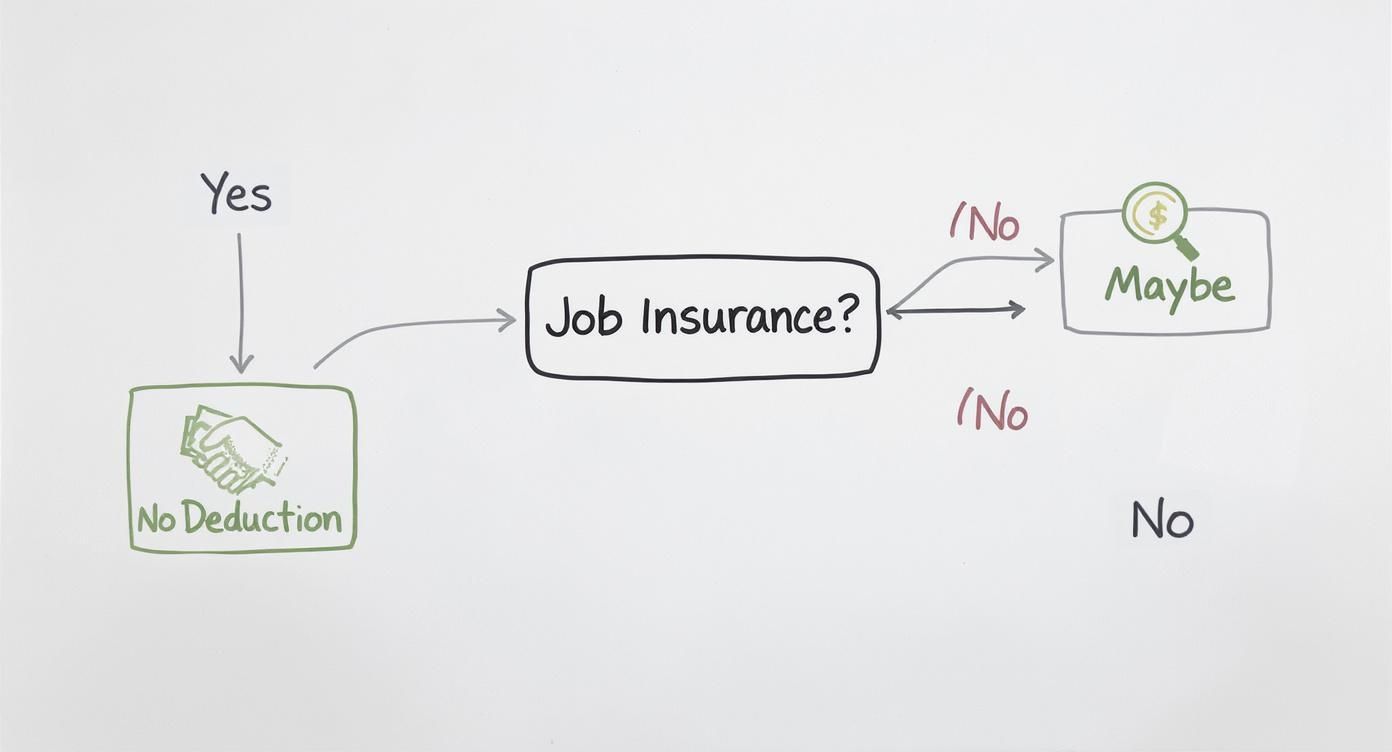
As the chart shows, if your employer provides your insurance, those premiums are usually paid pre-tax, so there's nothing left to deduct. If you're paying on your own, you have to figure out if you meet the requirements for one of these two paths.
Calculating the 7.5% AGI Threshold
That 7.5% rule is the biggest barrier for most people. Let's walk through an example to see how it works in the real world.
Example AGI Calculation
Let’s say your adjusted gross income for the year is $80,000. The first step is to calculate your deduction "floor" by multiplying your AGI by 7.5%.
$80,000 (AGI) x 0.075 = $6,000
Think of that $6,000 as your deductible. It's not what you get to write off; it's the amount of medical expenses you have to cover before you can deduct a single dollar. For a closer look at this crucial number, check out our guide on what is adjusted gross income.
Now, imagine you’ve added up all your qualifying medical costs for the year—after-tax premiums, doctor co-pays, prescriptions—and the grand total is $7,500.
Here's how you find your actual deduction:
- Total Medical Expenses: $7,500
- AGI Threshold (Floor): -$6,000
- Deductible Amount: $1,500
In this case, you could claim a $1,500 medical expense deduction on your itemized return. But if your total expenses were only $5,900, you'd get nothing because you didn't clear that 7.5% hurdle. This high bar is why the itemized deduction is so difficult for many people to use unless they've had a year with very high medical costs.
Why Your Employer-Sponsored Premiums Probably Aren't Deductible
If you get health insurance through your job, you might be wondering if you can deduct the premiums on your tax return. For most people, the answer is no—but for a good reason. You’ve likely already received a tax break for them without even realizing it.

Here's how it works: the vast majority of employers offer health insurance as a pre-tax benefit. This means they take your share of the premium out of your paycheck before they calculate what you owe in federal, state, and even Social Security taxes.
It's essentially an instant tax deduction. By paying with pre-tax dollars, you lower your taxable income right from the start. Since that income was never taxed to begin with, the IRS won't let you claim a second deduction for the same expense when you file. It's a classic rule of thumb in taxes: no double-dipping.
The Power of Pre-Tax Deductions
This pre-tax setup is actually a fantastic, hassle-free way to save money. It happens automatically with every paycheck, so you don't have to track premium payments or save special records for tax time.
Take a look at your paystub. You'll see your gross pay, then the health insurance premium subtracted, and taxes are calculated on the lower amount. Your W-2 reflects this, too. The wages in Box 1 are already reduced by your pre-tax premiums. If you see code DD in Box 12, it shows the total cost of your health plan, but this is just for your information. To learn more, check out our guide on understanding Box 12 codes.
Key Takeaway: When your health insurance premiums come directly out of your paycheck, they are almost always paid with pre-tax dollars. This gives you an immediate tax benefit, but it means you can't deduct those same premiums again on your annual tax return.
The whole system is designed to make health insurance more affordable by lowering your tax bill throughout the year. But it's a benefit that doesn't impact everyone in the same way.
An Uneven Benefit Landscape
The actual value of this pre-tax benefit depends entirely on your tax bracket. An employee in a high-income bracket gets a much bigger tax savings from the exclusion than a lower-wage worker does for the exact same insurance plan. This creates a pretty significant gap in the real-world cost of health coverage.
Research confirms this disparity. An in-depth study looking at data from 1988 to 2019 found that not only do higher-paid workers get a larger tax break, but the financial strain of premiums falls more heavily on minority families. In 2019, for instance, premium costs represented 19.8% of compensation for Hispanic families and 19.2% for Black families, but only 13.8% for White families. You can dig into the complete findings on these health insurance tax disparities online.
So, while the pre-tax system is a great perk for many, it’s not a perfect system and has wider economic effects. That's why figuring out your specific situation—whether your premiums are pre-tax or post-tax—is the essential first step to knowing if a deduction is even on the table for you.
How to Handle Deductions in Special Scenarios
The tax code is rarely simple, and when it comes to medical expenses, the exceptions and special rules can feel endless. While the main ways to deduct health premiums apply to most people, what about situations like being on Medicare, transitioning between jobs with COBRA, or paying for long-term care?
These common life events have their own specific guidelines. Getting them right is the key to maximizing your deductions without making a costly mistake.

Let's walk through these unique cases one by one. We'll break down the rules so you can spot opportunities to lower your tax bill and sidestep common errors.
Can You Deduct Medicare Premiums?
For millions of older Americans, Medicare isn't just a safety net—it's a significant monthly budget item. The good news is that most premiums paid for Medicare coverage can be counted as a medical expense when you're tallying up your itemized deductions.
Here's what typically qualifies:
- Medicare Part B (Medical Insurance): Those premiums for doctor visits and outpatient care, often taken right out of your Social Security check, are deductible.
- Medicare Part D (Prescription Drug Coverage): If you pay for a separate drug plan, those premiums count.
- Medicare Advantage Plans (Part C): Premiums for these private, all-in-one plans are also eligible.
- Supplemental Insurance (Medigap): Paid for a policy to fill the gaps in Original Medicare? You can include those premiums, too.
There’s one big exception: Medicare Part A (Hospital Insurance). The vast majority of people get Part A premium-free based on their work history. If you don't qualify and have to voluntarily pay for Part A coverage, the IRS says you cannot deduct those specific premiums.
How COBRA Premiums Fit In
Losing your job is stressful enough. Then there’s the sticker shock from COBRA, the law that lets you continue your old employer's health plan for a while. You suddenly have to cover the entire premium yourself, plus an administrative fee.
But there’s a silver lining. Because you’re paying these hefty premiums with post-tax dollars, they are a perfect candidate for the itemized medical expense deduction. In fact, their high cost can often be what pushes you over the 7.5% AGI threshold required to start deducting.
Example: Let's say your adjusted gross income (AGI) is $60,000. Your deduction floor is $4,500 (that's 7.5% of $60,000). If your COBRA premiums cost you $600 a month, your annual total is $7,200. You've easily cleared the $4,500 hurdle, and the amount you can deduct is just getting started.
The Special Rules for Long-Term Care Insurance
Long-Term Care (LTC) insurance is a different beast. It's designed to cover services like nursing home stays or in-home care that regular health insurance won't touch. You can include premiums for a qualified LTC policy as a medical expense, but with a major catch: the deductible amount is capped based on your age.
Each year, the IRS sets limits on how much of your LTC premiums you can actually count toward your medical deduction. Anything you pay above that limit for your age group is, unfortunately, not deductible.
Here are the age-based limits for what you can include.
Deductible Limits for Long-Term Care (LTC) Premiums
This table shows the maximum amount of long-term care insurance premiums you can include as a medical expense, based on your age at the end of the tax year. These figures are updated periodically by the IRS.
| Attained Age Before Close of Taxable Year | Maximum Deductible Amount |
|---|---|
| 40 or under | $480 |
| More than 40 but not more than 50 | $890 |
| More than 50 but not more than 60 | $1,790 |
| More than 60 but not more than 70 | $4,770 |
| More than 70 | $5,960 |
Remember, these are the maximums you can include in your total medical expenses, not a separate deduction.
Health Savings Accounts and the No Double-Dipping Rule
A Health Savings Account (HSA) is one of the best savings tools out there. You contribute pre-tax money, it grows tax-free, and you can take it out tax-free for qualified medical costs. It’s a triple tax benefit.
Because HSAs are so powerful, the IRS has a strict rule to prevent "double-dipping." You cannot pay for a health insurance premium with your tax-free HSA funds and then also claim that same premium as an itemized medical deduction.
However, the rules bend in a few very specific situations. You are allowed to use your HSA money to pay premiums for:
- COBRA coverage after leaving a job.
- Health insurance while receiving unemployment benefits.
- Medicare premiums if you are age 65 or older (but not for Medigap).
- Qualified long-term care insurance (subject to the age-based limits we just discussed).
Outside of these four exceptions, the rule is simple: if you use tax-free HSA dollars to pay for it, you can't deduct it again elsewhere. Navigating these special cases correctly is essential, and if you're ever unsure, the team at Allied Tax Advisors can provide the clarity you need.
Common Mistakes That Can Cost You Your Deduction
When it comes to deducting medical premiums, the rules can feel a bit like a maze. It's easy to take a wrong turn, and unfortunately, a simple mistake can lead to a rejected claim or an unwelcome notice from the IRS. Knowing where the most common tripwires are is the best way to file with confidence and make sure you're getting every penny you deserve.
One of the most frequent errors I see is people trying to deduct premiums that were already paid with pre-tax dollars. If you get your health insurance through your job, your portion of the premium is almost always pulled from your paycheck before taxes are calculated. That means you’ve already received a tax benefit upfront, so you can't double-dip by claiming it again on your tax return.
Misunderstanding the Make-or-Break Rules
A lot of the confusion boils down to the two main ways you can deduct premiums—and the specific limitations tied to each. Taxpayers often get tripped up by these thresholds, which can unfortunately wipe out their entire claim.
Here are the big ones to watch out for:
- Forgetting the 7.5% AGI Hurdle: If you’re itemizing medical expenses, you can only deduct the portion that climbs above 7.5% of your Adjusted Gross Income (AGI). Many people tally up their premiums and other medical bills, but they forget they have to clear this significant hurdle first. Anything below that threshold doesn't count.
- Deducting More Than Your Business Earned (Self-Employed): The self-employed health insurance deduction is a fantastic benefit, but it has a hard ceiling. Your deduction cannot be more than the net profit from your business. So, if your business just broke even or ended the year with a loss, you can't take this deduction at all.
- Ignoring a Spouse's Health Plan Offer: This one catches a lot of self-employed people by surprise. You are not eligible for the health insurance deduction if you could have been covered under a health plan from your spouse's employer. This rule applies even if you decided not to enroll in that plan.
Here's the bottom line: The IRS only cares about the availability of a spouse's employer-sponsored plan. The fact that you had access to it is enough to disqualify you from the self-employed health insurance deduction, regardless of whether you actually signed up.
The "Double-Dipping" Trap with Tax-Free Money
Another common mistake is what we call "double-dipping"—essentially trying to get two tax breaks for the same expense. This often crops up when dealing with marketplace health plans and tax-advantaged accounts.
For example, if you get an Advanced Premium Tax Credit (APTC) to lower your monthly insurance payments, that money is a government subsidy. You can only deduct the amount you personally paid out of your own pocket. Claiming a deduction for the full premium before subtracting the subsidy is a surefire way to get a correction notice from the IRS.
The same logic applies to Health Savings Accounts (HSAs). You can't pay for your insurance premiums with tax-free HSA funds and then turn around and deduct those same premiums. That's getting a double tax benefit, which the rules strictly forbid.
Your Simple Filing Checklist for Getting It Right
Being organized is your best defense against making these errors. Good records don't just help you file correctly; they're also the proof you'll need if the IRS ever has questions about your return.
Before you file, do a quick check to make sure you have your ducks in a row:
- Gather Premium Statements: Pull together all monthly or annual statements from your insurance provider, whether it's from the marketplace, a COBRA administrator, or Medicare.
- Collect Proof of Payment: Keep copies of cleared checks, credit card statements, or bank records that show you actually paid the premiums.
- Calculate Your AGI Correctly: Your Adjusted Gross Income is the number that the 7.5% rule is based on, so getting it right is critical.
- Confirm Your Business Profit: If you're self-employed, have your final net profit from your Schedule C handy to make sure your deduction doesn't go over the limit.
- Document Your Eligibility: Be ready to explain why you qualify for a deduction (for instance, showing you were self-employed and didn't have access to a spouse's employer plan).
Juggling all these rules can feel overwhelming, especially when you have a lot going on financially. If you want to be certain you're avoiding these common pitfalls and maximizing your tax savings, the experts at Allied Tax Advisors can review your situation and make sure your filing is done right.
Common Questions Answered
Even when you know the basic rules, real-life situations can throw a wrench into things. Let's tackle some of the most common questions we hear from clients about deducting their medical premiums.
Are Dental and Vision Premiums Deductible?
Yes, absolutely. The IRS lumps premiums for dental and vision insurance right in with your regular health insurance. They all count as qualified medical expenses.
This means they follow the same rules as everything else. If you're itemizing, you'll add them to the total medical costs that have to beat the 7.5% of AGI threshold. And if you're self-employed, you can include them as part of your above-the-line deduction.
What if My Spouse's Job Offers a Health Plan?
This is a huge one for self-employed folks. If your spouse could be covered by an employer's group plan—even if you don't actually sign up for it—you generally can't take the self-employed health insurance deduction.
The key here is eligibility. Just having access to a subsidized plan through your spouse’s job is enough to disqualify you from this specific, very valuable deduction.
If that's your situation, you’re not totally out of luck. You just have to try for the itemized deduction instead, which means clearing that tough 7.5% AGI hurdle.
Can I Deduct Premiums for My Adult Child on My Plan?
You bet. Thanks to the Affordable Care Act, your kids can stay on your health plan until they turn 26. The good news for your tax bill is that you can deduct the premiums you pay for their coverage, even if they aren't your tax dependent anymore.
This works whether you're taking the self-employed deduction or itemizing. The money you spend to cover them is treated just like the premiums you pay for yourself or your spouse. With healthcare costs getting higher every year, this is a rule you want to get right. Health spending in the U.S. hit an eye-watering $13,432 per person in 2023, far outpacing other wealthy nations. You can see how U.S. health spending compares for yourself, which really drives home why every tax break matters.
Figuring out the nuances of these rules can feel like a puzzle. If your situation is tricky, the experts at Allied Tax Advisors are here to give you the clarity you need to file with confidence. Find out more at https://alliedtax.com.