
If you're wondering whether you can write off your mortgage insurance premiums on your 2024 tax return, the short answer is, unfortunately, no. This popular deduction for homeowners expired at the end of 2021, and Congress hasn't renewed it for the current tax year.
But that's not the whole story. Big changes are on the horizon that will bring this tax break back.
The Current Status of the Mortgage Insurance Deduction

For many years, homeowners could treat their mortgage insurance payments just like mortgage interest—as an itemized deduction that lowered their overall taxable income. It was a huge help, especially for first-time buyers who often put down less than 20% and are required to carry this type of insurance.
Before getting into the tax side, it helps to understand what mortgage insurance is and why lenders require it. When this valuable tax deduction disappeared after the 2021 tax year, it left a noticeable hole in the financial planning for millions of American families.
A Look at Recent and Upcoming Tax Years
The good news? The on-again, off-again status of this deduction is finally coming to an end. Recent legislation has made the mortgage insurance premium deduction permanent, which is a big win for long-term tax planning. No more wondering each December if Congress will pass a last-minute extension.
The catch is that this change isn't immediate. You won't be able to claim the deduction for the 2022, 2023, 2024, or 2025 tax years. The permanent reinstatement kicks in starting with the 2026 tax year.
Remember, to take advantage of this deduction when it returns, you'll need to itemize your deductions instead of taking the standard deduction. Deciding which path to take is a critical part of your tax strategy. You can learn more by checking out our guide on the standard deduction vs. itemized deductions.
Key Takeaway: While the mortgage insurance deduction is off the table right now, it's set to return permanently for the 2026 tax year. This gives homeowners a future opportunity to lower their tax bill.
To make this timeline crystal clear, here’s a quick reference guide.
Mortgage Insurance Deduction Status By Tax Year
This table breaks down the deductibility of mortgage insurance premiums for recent and future tax years.
| Tax Year(s) | Deductible Status | Governing Law |
|---|---|---|
| 2021 | Deductible | Consolidated Appropriations Act, 2021 |
| 2022-2025 | Not Deductible | Law Expired |
| 2026+ | Deductible | Permanently Reinstated by New Law |
This simple breakdown shows the "gap years" where the deduction isn't available and confirms exactly when homeowners can start planning to use this tax-saving tool once again.
A Brief History of This On-Again, Off-Again Homeowner Tax Break
To really get why the mortgage insurance deduction is such a big deal for homeowners, you have to look at its rollercoaster history. This tax break was never a permanent part of the tax code. Instead, it felt more like a temporary lifeline that Congress would extend at the very last minute, leaving millions of families in limbo.
Its story is a classic tale of last-minute extensions and frustrating expirations, all driven by shifting political and economic winds.
The deduction first appeared back in 2007, designed to give a little boost to homeownership affordability. The logic was simple: let's treat mortgage insurance premiums the same way we treat mortgage interest, making them deductible for those who itemize. This offered real, tangible relief, especially for first-time buyers and families with smaller down payments—the very people most likely to need mortgage insurance.
For years, though, this tax benefit lived on borrowed time. It was typically bundled into what are known as "tax extenders" packages, which are basically legislative catch-all bills that renew a bunch of expiring tax breaks. This created a frustrating cycle where homeowners never knew if they could count on those savings from one year to the next.
What This Meant for Real Homeowners
Despite its shaky status, this deduction was a powerful tool for middle-class families. When it was active, it delivered meaningful savings that helped make the dream of owning a home feel a little more within reach. The numbers don't lie about how many households came to rely on it.
Between 2007 and its final active year in 2021, an average of 3.4 million homeowners claimed this deduction every single year. All told, an incredible $64.7 billion in deductions were claimed over that period, showing just how widespread its impact was. The average annual deduction was $1,454 per taxpayer, a figure that jumped to $2,364 by 2021 as home prices and insurance costs climbed. You can dig into more of these historical trends on Bankrate.com.
This wasn't just some small tax tweak. For many families, this deduction was a key piece of the puzzle that allowed them to afford their home, directly impacting their monthly budget and long-term financial security.
That cycle of expiration and renewal finally ground to a halt after the 2021 tax year. Congress didn't extend it, leaving a hole in the tax code for 2022 and beyond. This change pulled a valuable benefit that millions had come to depend on, and now, the ongoing legislative chatter about reviving it marks a new chapter in its story—one that hopefully ends with the certainty homeowners have been missing.
What This Means for Your Taxes
The return of the mortgage insurance tax deduction is a huge win for homeowners. For years, we've dealt with a frustrating "will they or won't they" situation, where this popular tax break was only renewed at the last minute by Congress. That uncertainty is finally over.
This change brings some much-needed relief and predictability, especially for middle-class families. The idea is simple but powerful: your mortgage insurance premiums will once again be treated just like your mortgage interest, giving you another way to lower your taxable income when you itemize.
A New Era of Certainty for Homeowners
In July 2025, a new law—the One Big Beautiful Bill Act (OBBBA)—was passed, permanently bringing back this crucial deduction. It officially kicks in for the 2026 tax year.
So, while you can't claim it for your 2024 or 2025 taxes, you can finally plan for this savings in the years to come. This isn't just a small tweak; it's a major financial victory for millions of families.
Just how big is the impact? In 2024 alone, private mortgage insurance helped more than 800,000 borrowers buy a home, and about 65% of them were first-time homebuyers. Looking back, when the deduction was active, it was claimed over 44 million times, helping around 4 million homeowners every single year. These numbers, highlighted in recent industry analysis on MI deductibility, show just how many people stand to benefit.
How the Reinstated Deduction Will Work
So, how does this play out when you actually file your taxes? Starting with your 2026 return, your mortgage insurance premiums will simply be added to the mortgage interest you already deduct.
This means the combined total of your mortgage interest and insurance premiums falls under the existing cap for mortgage debt. Here’s a quick look at the limits:
- The deduction is capped to the interest (and now premiums) paid on up to $750,000 of mortgage debt.
- If you're married filing separately, that limit is $375,000.
The Bottom Line: The new law makes tax planning simpler. Instead of a separate, confusing credit, mortgage insurance is now just part of the familiar mortgage interest deduction. This makes it much easier to calculate your potential savings and lower your tax bill.
Who Qualifies for the Mortgage Insurance Deduction
Just because the mortgage insurance deduction is coming back doesn't mean everyone gets to claim it. Think of it like a series of gates you have to pass through. To unlock this tax break for the 2026 tax year and beyond, you'll need to meet a few key criteria.
First things first: you have to itemize your deductions. If you take the simpler route and use the standard deduction, you can't claim this one. It's a choice—either take the standard amount or tally up individual expenses like state taxes, mortgage interest, and (once again) mortgage insurance premiums.
Next, the property matters. This deduction is only for your primary residence or a second home. You can't write off mortgage insurance for a rental property or a house used purely for business. The whole point of this law is to help individuals and families with their own homes, not to give a boost to real estate investors.
This timeline gives you a quick visual on when the deduction is on and off.
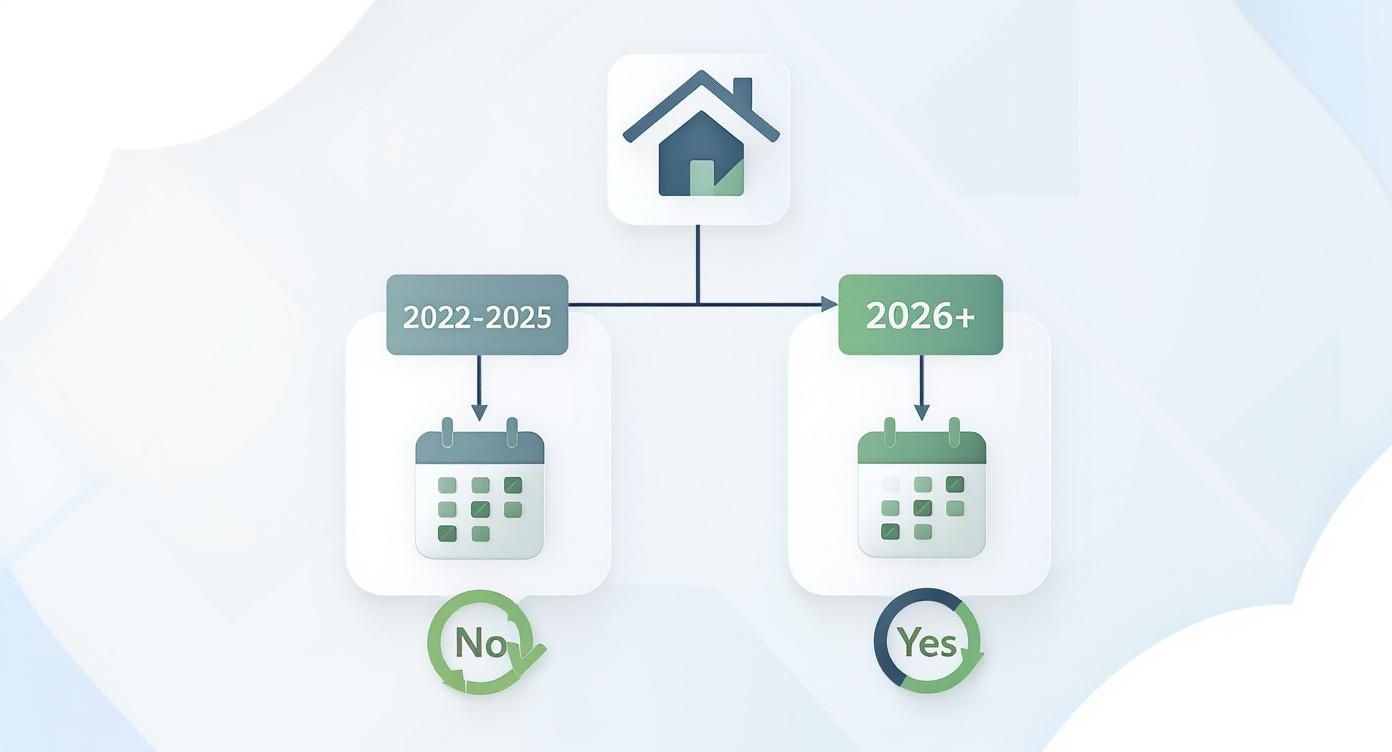
As you can see, we're in a bit of a waiting period before it returns for good.
Understanding the Income Limitations
Here's the biggest hurdle for many homeowners: the income limits. The mortgage insurance deduction was always aimed at helping low- to moderate-income households, so the benefit shrinks and eventually disappears as your income goes up.
The magic number here is your Adjusted Gross Income (AGI). This is your total income minus some specific above-the-line adjustments. If you're not familiar with how it works, our guide explaining what is Adjusted Gross Income can get you up to speed.
Under the old rules, the amount you could deduct was reduced by 10% for every $1,000 your AGI was over a certain threshold. Cross the upper limit, and the deduction was gone completely.
Crucial Insight: Your income level directly determines whether you get the full deduction, a partial one, or nothing at all. It's a sliding scale, not an all-or-nothing benefit for everyone.
While the IRS may adjust the final numbers for 2026 to account for inflation, the previous law gives us a fantastic blueprint for what to expect.
AGI Phase-Out Thresholds for the MI Deduction (Based on Past Law)
The table below lays out the AGI thresholds that were in place before the deduction expired. It’s a solid reference point to see where you might land when the rules come back into effect.
| Filing Status | AGI for Full Deduction | AGI for Partial Deduction (Phase-Out Range) | AGI for No Deduction |
|---|---|---|---|
| Single | Up to $100,000 | $100,001 – $109,000 | Above $109,000 |
| Married Filing Jointly | Up to $100,000 | $100,001 – $109,000 | Above $109,000 |
| Head of Household | Up to $100,000 | $100,001 – $109,000 | Above $109,000 |
| Married Filing Separately | Up to $50,000 | $50,001 – $54,500 | Above $54,500 |
Take a look at your AGI and filing status. Comparing it to these historical numbers will give you a pretty clear idea of whether you'll be able to take advantage of this valuable homeowner tax break when it finally returns.
How to Claim and Document Your Deduction Correctly

Knowing the rules is one thing, but actually putting them to work is what saves you real money. When the mortgage insurance deduction is (hopefully) back on the table for the 2026 tax year, you’ll want a clear plan to claim it properly. The good news is that the process isn't overly complicated, but it does demand attention to detail and good old-fashioned record-keeping.
Think of it as a simple two-step dance: find the right number, then put it in the right spot on your tax return. Luckily, your mortgage lender does most of the legwork for you.
Finding Your Total Premiums Paid
Every January, you can expect to receive Form 1098, the Mortgage Interest Statement, from your mortgage lender. This single document is your key to unlocking several valuable homeowner deductions. It clearly shows how much mortgage interest you paid, and just as importantly, it reports the total mortgage insurance premiums you paid during the previous year.
When you get the form, look for Box 5. This box is specifically labeled "Mortgage insurance premiums." The number you find there is the total amount you can potentially deduct, as long as you fall within the AGI limits we covered earlier.
The Right Form and The Right Line
Once you have that figure from Box 5, you'll report it on Schedule A (Form 1040), Itemized Deductions. This is the same form where you tally up other itemized deductions like your state and local taxes, charitable donations, and medical expenses.
Your mortgage insurance premiums go right alongside your mortgage interest. Specifically, the amount gets entered on Line 8e, labeled "Mortgage insurance premiums." The IRS treats it as a form of home mortgage interest, which keeps the calculation nice and simple. For a deeper dive into optimizing this part of your return, check out our guide on how mortgage interest payments can boost your deduction.
Key Takeaway: The whole process boils down to two official IRS documents. You'll pull the premium total from Box 5 of Form 1098 and transfer it to Line 8e of Schedule A.
The Importance of Good Record-Keeping
While Form 1098 is the official document for this deduction, it shouldn't be the only piece of paper in your file. Think of solid record-keeping as your personal insurance policy against any future IRS questions. Holding onto your monthly mortgage statements gives you a detailed, month-by-month trail of every payment you made, including the portion that went to mortgage insurance.
Here's why this matters so much:
- Verification: Your statements are the perfect backup to confirm the total reported on Form 1098.
- Peace of Mind: If the IRS ever sends a letter asking for clarification, you'll have all the proof you need right at your fingertips. No stress, no scrambling.
This habit extends beyond just your primary home. For anyone building wealth through real estate, understanding the broader investment property tax benefits is crucial, and keeping meticulous records is the foundation for successfully claiming every deduction you're entitled to.
When Should You Call in a Pro?
While you can certainly tackle your taxes on your own, sometimes it pays to bring in an expert. Tax laws can be tricky, and your financial situation has its own unique quirks. Knowing when to hand the reins over to a professional is a key part of smart financial management.
Think of a good tax advisor as a financial strategist. They're trained to look at the whole picture—your income, investments, and expenses—to find savings you might not even know exist. This is especially true when your tax situation gets a little more complicated than the standard W-2 and a few deductions.
Scenarios That Warrant a Professional's Touch
Some situations are definite green lights for seeking professional advice. If any of these sound familiar, it's probably a good time to reach out to a firm like Allied Tax Advisors.
-
You're Close to the Income Limit: If your Adjusted Gross Income (AGI) is getting close to the phase-out threshold (which has historically started around $100,000), an advisor might find ways to legally lower your AGI, helping you qualify for the full deduction or at least a larger portion of it.
-
You've Got More Than One Property: The tax rules for your main home are completely different from those for a vacation home or a rental property. A pro can make sure you’re applying the rules correctly and not claiming deductions on properties where you shouldn't be.
-
You Run a Business From Home: Deducting home office expenses adds a whole new level of complexity. A tax expert can help you correctly allocate expenses between personal and business use, ensuring you get the deductions you're entitled to without raising red flags.
A tax advisor doesn't just plug numbers into a form. They offer peace of mind, making sure your return is accurate, defensible, and structured to save you as much money as possible. Think of it as an investment in your financial well-being.
Common Questions About the MI Deduction
Even with all this information, a few specific questions tend to pop up. Let’s tackle some of the most common ones homeowners ask about deducting mortgage insurance premiums.
Does This Deduction Cover FHA, VA, or USDA Loans?
Absolutely. When the deduction is on the books, it’s not just for the Private Mortgage Insurance (PMI) you see with conventional loans. The rules have historically included the mortgage insurance premiums for FHA loans, guarantee fees for USDA loans, and the funding fees for VA loans.
The key is that the insurance or fee must be tied directly to the mortgage you took out to buy your home.
Can I Go Back and Amend My 2022 or 2023 Tax Returns to Claim This?
Unfortunately, no. The law that allowed homeowners to deduct mortgage insurance premiums expired after the 2021 tax year. It was completely off the table for tax years 2022, 2023, 2024, and 2025.
Since the deduction didn't legally exist for those years, you can't amend your returns to claim it. The good news is that it’s set to return for the 2026 tax year.
The Bottom Line: You can only claim the mortgage insurance deduction for tax years when Congress has specifically authorized it. It's not a permanent part of the tax code.
What if My Lender Forgot to Report My Premiums on Form 1098?
This happens more than you'd think. Your lender is supposed to report the mortgage insurance premiums you paid in Box 5 of Form 1098, but sometimes that box is left empty or has the wrong number.
If you run into this, your first move should be to call your lender and ask them for a corrected Form 1098. This is a perfect example of why hanging onto your own records is so important—your monthly mortgage statements are your best proof of what you actually paid.
Trying to piece together tax rules can be a headache, but you don’t have to figure it out on your own. The team at Allied Tax Advisors is ready to help you make sense of it all and get prepared for every deduction you deserve. Contact us today for a personalized tax consultation.