
Yes, in many cases, mortgage points are tax deductible—but it’s not always a straightforward yes or no. The rules can get a little tricky, and it all comes down to your specific circumstances.
Think of points as a form of prepaid interest. You're essentially paying a chunk of interest upfront to lock in a lower mortgage rate for the long haul. The good news is the IRS often lets you deduct this prepaid interest. The catch? You have to meet a specific set of criteria to deduct the full amount in the same year you paid for them.
Your Quick Guide to Deducting Mortgage Points

When you’re sifting through your closing documents, you'll almost certainly see a line item for "points." The first thing to know is that not all points are the same, especially when it comes to taxes. Figuring out which kind you have is the first step.
You'll generally encounter two main types:
- Discount Points: This is the classic type. You pay these to the lender in exchange for a lower interest rate on your loan. These are the points that are typically fully deductible because they are, in essence, prepaid mortgage interest.
- Origination Points: These are fees the lender charges for the work of creating and processing your loan—things like underwriting and administrative costs. Sometimes these can be deducted, but the IRS treats them differently, and we’ll get into those nuances a bit later.
The Basic Requirements for Deduction
To write off the full cost of your points in the year you paid them, you have to pass a multi-part test laid out by the IRS. It sounds intimidating, but it's really just a checklist of common-sense rules. Of course, all of this starts with the property itself, and it never hurts to know how to accurately determine home value before diving into the financing and tax details.
A critical point to remember: The mortgage points deduction is an itemized deduction. If you take the standard deduction on your tax return, you can't claim this one.
To get a clearer picture, let's look at the IRS's main requirements. Understanding these rules is fundamental, and it ties directly into the larger strategy of maximizing your mortgage interest payment deductions.
Can You Deduct Your Mortgage Points This Year?
Here’s a quick overview of what the IRS is looking for before you can deduct the full cost of your points in the year you paid them.
| Requirement Checklist | What This Means for You |
|---|---|
| Primary Residence | The loan has to be for buying or building your main home. This rule doesn't apply to second homes, vacation properties, or investment rentals. |
| Paid Directly | You must have paid for the points out-of-pocket, not by rolling them into the loan amount. Your down payment must cover the cost of the points. |
| Normal Business Practice | Paying points has to be a standard, established practice for home loans in your geographical area. This is almost always the case. |
| Clearly Itemized | The fee for points must be calculated as a percentage of your loan amount and be clearly listed as "points" on your closing statement. |
Meeting these conditions is your ticket to claiming the full deduction right away. If you don't meet them all, don't worry—you can often still deduct the points, but you'll have to spread the deduction out over the life of the loan.
So, What Exactly Are Mortgage Points?
Before we dive into the tax rules, let's get on the same page about what "mortgage points" even are. When you're staring at a stack of closing documents, the term can feel like just another piece of confusing industry jargon. But the idea behind them is actually pretty simple.
Think of it this way: mortgage points are an upfront fee you pay the lender at closing. Why would you do that? Because paying a little more now can save you a lot of money later. It's like paying for an upgraded annual subscription to get a lower monthly fee for the whole year. You’re essentially prepaying for a better deal on your loan.
Discount Points vs. Origination Points: This Is Key
Here’s where a lot of people get tripped up. There are two main flavors of points, and the IRS treats them very differently. Getting this right is crucial for your tax return.
-
Discount Points: These are the ones we’re most interested in for tax purposes. You can think of discount points as prepaid interest. You’re paying your lender a lump sum to "buy down" your interest rate. This upfront payment secures you a lower rate for the entire life of your loan, which means smaller monthly payments.
-
Origination Points: These are totally different. They aren't prepaid interest at all. Instead, they’re fees the lender charges to cover their administrative costs—things like underwriting, processing paperwork, and just generally putting the loan together. The IRS sees these as service fees, not interest.
This distinction is everything. Because the IRS lets you deduct mortgage interest, discount points (the prepaid interest) are often deductible. Origination points (the loan fees) usually are not.
How Points Are Calculated
The math here is refreshingly simple. One point is always equal to 1% of your total loan amount.
For example, on a $400,000 mortgage, one point would cost you $4,000 at closing. If you wanted two points, you’d pay $8,000. Your lender will show you exactly how much your interest rate drops for each point you buy.
This has been a valuable tax break for homeowners for years. On a $300,000 loan, paying one point costs $3,000. If you meet all the IRS rules—like using the loan for your main home and itemizing your deductions—you could potentially deduct that entire $3,000 in the year you paid it. For a deeper dive into the rules, check out this guide on the mortgage points deduction on HRBlock.com.
Once you get a handle on what points are and why they exist, the logic behind the tax rules starts to make a lot more sense. This foundation is the first step to confidently figuring out your deduction and making sure you get every penny you're entitled to.
Passing the IRS Gauntlet: How to Deduct Your Points in Year One
So, you paid points on your mortgage. Can you just write off the full amount on this year's taxes? Not so fast. The IRS has a specific set of rules—think of it as a gauntlet you have to run—to qualify for that immediate, full deduction.
Getting this right can be a huge win, potentially knocking thousands off your taxable income the year you buy your home. If you miss even one of these requirements, you don't necessarily lose the deduction, but you'll have to spread it out over the entire life of your loan. Let's walk through each of these tests, step-by-step.
This simple flowchart lays out the big-picture questions you need to answer.
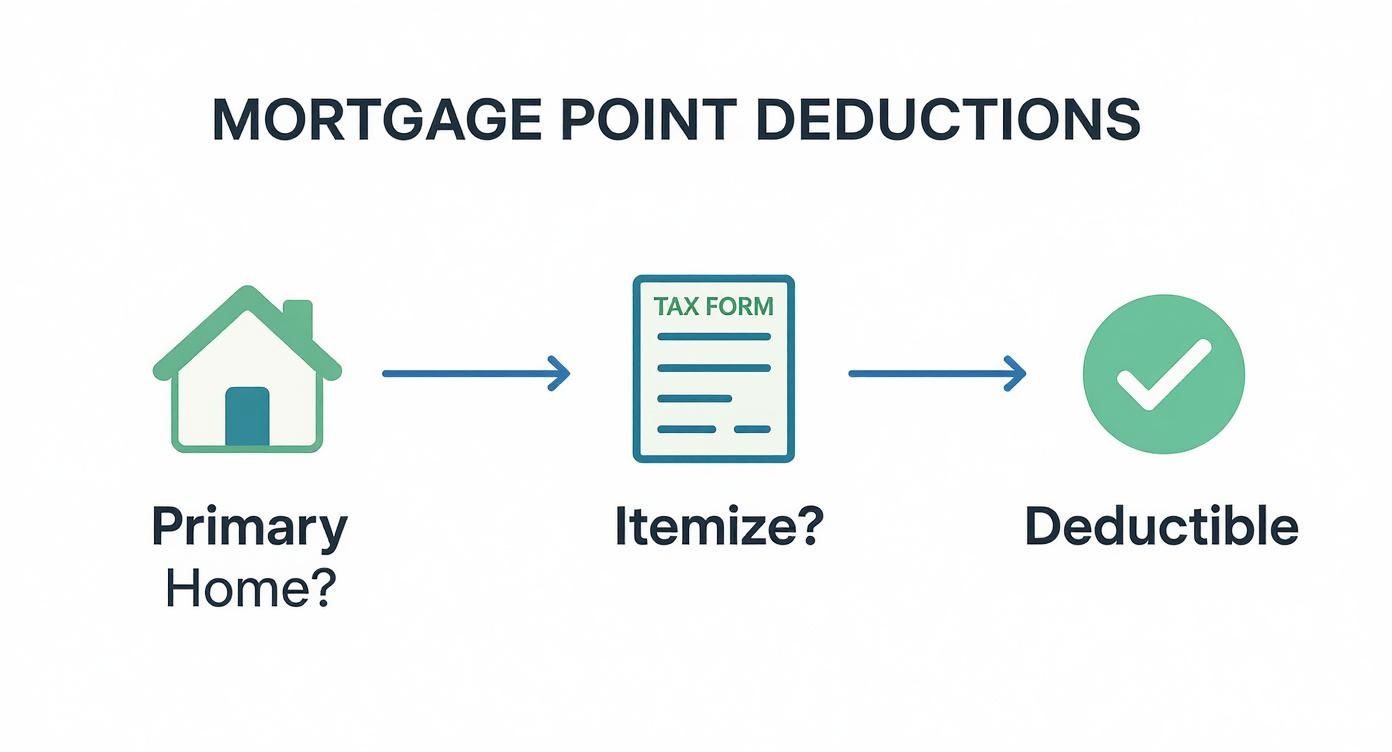
As you can see, it all starts with two key things: the loan has to be for your main home, and you have to itemize your deductions instead of taking the standard deduction.
The Primary Residence Rule
First things first: the loan must be to buy or build your primary residence. This is your main hub, the place you call home most of the year.
This rule is a hard line in the sand. You can't claim the full, immediate deduction for points paid on:
- Vacation homes or second properties
- Rental properties you own as an investment
- A home equity loan or line of credit (HELOC)
The spirit of this tax break is to make primary homeownership more affordable, not to subsidize real estate investing or other financial moves. So if the loan is for that cabin in the woods or a rental unit across town, you'll have to play by a different set of deduction rules.
The "Paid With Your Own Money" Rule
This is where a lot of people get tripped up. To get the full deduction in year one, the IRS requires that you paid for the points with your own funds at closing. You can't have borrowed the money for the points from your lender.
Think of it this way: if your points cost $3,000, the IRS wants to see that you brought at least $3,000 of your own cash to the closing table to cover all your costs.
Here’s a practical example: Your down payment is $40,000 and your total closing costs are $8,000 (which includes $3,000 for points). If you brought a check for $48,000 to closing, you're in the clear. Since the cash you paid out-of-pocket is more than the cost of the points, the IRS considers them "paid directly."
If you roll the cost of the points into your loan principal, you haven't paid for them directly. In that scenario, you’ll have to amortize the deduction over the loan's term. This is a crucial distinction. In 2021 alone, about 4 million homeowners claimed this deduction, leading to $65 billion in tax savings, with an average benefit of roughly $2,364 per household. You can find more details in this guide to deducting mortgage points on TurboTax.com.
The Final IRS Checklist
On top of those two big rules, the IRS has a few other checkboxes to make sure everything is standard and above board. These are usually no-brainers, but you need to make sure you meet them.
1. It's a Standard Practice
Paying points needs to be a common business practice in your geographic area. This is almost never an issue, as charging points is a standard part of the mortgage industry across the United States.
2. The Math Checks Out
The points must be calculated as a percentage of your loan's principal. For instance, one point on a $300,000 loan has to be exactly $3,000. Again, this is standard procedure, but it's good to double-check your documents.
3. It's Labeled "Points" on Your Paperwork
This one is critical. Your closing statement (like the Closing Disclosure form) must clearly identify the charge as "points." If it’s buried in a generic "loan origination fee" or "processing fee," it won't qualify. You need to see the word "points" written on that document.
Running through this checklist ensures you know exactly where you stand. Passing these IRS tests can unlock a powerful tax break the year you buy your home, so it’s well worth taking the time to get it right.
How Refinancing and Rentals Change the Rules
The rules for deducting mortgage points feel pretty straightforward when you're buying your main home. But the game changes completely when you refinance that loan or buy a rental property. Suddenly, the IRS introduces a new key concept you need to understand: amortization.
Instead of getting that big, one-time deduction in the year you pay the points, you have to spread the tax benefit out evenly over the entire life of the loan.
Think of it this way: a home purchase deduction is like getting an instant cash rebate. A refinance or rental deduction is like getting that same rebate, but paid out in small, equal installments over many, many years.
Understanding Amortization for Refinanced Loans
When you refinance your primary residence, the IRS sees the points you pay in a different light. Since this new loan is just paying off an existing debt—not helping you acquire the home—the immediate deduction rule gets tossed out the window.
You're required to deduct the points "ratably," which is just a fancy way of saying you spread the cost evenly over the loan's term. The math is simple: just divide the total cost of the points by the number of months in your loan.
Let's walk through an example:
- Cost of Points Paid: You paid $3,600 in points to secure a better rate on your refinance.
- Loan Term: It's a new 30-year loan, which works out to 360 months.
- Calculation: $3,600 / 360 months = $10 per month.
That $10 is your deductible amount for each mortgage payment you make. For a full calendar year, your total deduction would be $120 ($10 x 12 months). It's not a huge number, but it adds up.
A Special Rule: There is one powerful exception here. If you use part of your refinance cash to make "substantial improvements" to your home (like a kitchen remodel or adding a new room), you might be able to deduct the points tied to that portion immediately. The rest of the points, however, still have to be amortized.
The Rules for Rental and Investment Properties
When it comes to a rental or investment property, the amortization rule is non-negotiable. It doesn't matter if it's a new purchase or a refinance—you must always deduct the points over the life of the loan. The IRS considers the property a business asset, and the points are treated as a capital expense that you expense over time.
Properly managing the tax side of a rental is crucial for any real estate investor. While knowing the rules for mortgage points is a piece of the puzzle, you also need to get a handle on the full scope of the rental property mortgage interest deduction to maximize your write-offs.
And don't stop there. It’s also smart to familiarize yourself with all the other essential rental property tax deductions you might qualify for, as these can have a major impact on your profitability.
Deduction Rules for Different Loan Types
To make this crystal clear, let's put these scenarios side-by-side. This table shows how the type of loan you have dramatically changes your deduction strategy.
| Loan Scenario | How You Deduct | Real-World Example |
|---|---|---|
| Primary Home Purchase | Full amount in the year paid (if you meet all the IRS tests). | You pay $4,000 in points and can deduct the entire $4,000 on that year's tax return. |
| Refinance or Rental | Amortized (spread out) over the life of the loan. | You pay $4,000 in points on a 20-year loan (240 months). Your annual deduction is just $200. |
As you can see, the difference is significant. A home purchase gives you an immediate, powerful tax break, while the others provide a smaller, slower benefit over time.
What if You Pay Off the Loan Early?
Here’s some good news. If you’re slowly amortizing your points and then sell the home or refinance the loan again before it's paid off, you don't lose out on the rest of your deduction.
You get to deduct the entire remaining balance of the points in the year the loan is officially terminated. So, if you had $2,500 in unamortized points left when you sold your house, you could write off that full $2,500 on your final tax return for that property. This little-known rule ensures you eventually get the full tax benefit you paid for.
How to Actually Claim the Deduction on Your Taxes

Knowing you can deduct mortgage points is great, but how do you actually get that money back on your tax return? It comes down to navigating a couple of specific tax forms. The process isn't overly complicated, but you do need to be precise. Think of it like following a recipe—get the steps and ingredients right, and you'll end up with the savings you expect.
Your starting point is a key document that shows up in your mailbox every January: Form 1098, the Mortgage Interest Statement. Your lender sends this out, and it's your official record of all the mortgage interest you paid last year. This form is the cornerstone for claiming your deduction.
Finding the Magic Number on Form 1098
Once you have your Form 1098, scan down to Box 6. This little box is specifically labeled "Points paid on purchase of principal residence." For many homebuyers, the number you see here is the amount you can fully deduct in that tax year, assuming you meet all the IRS criteria.
However, a word of caution: lenders don't always report every last deductible point in Box 6. Points from a refinance or points the seller paid on your behalf often don't make it into that box. If you think the number looks low, pull out your final closing statement from the home purchase to find the actual amount you're entitled to claim.
The Itemization Imperative
Before you get too excited about that number, there's a big decision you have to make. The mortgage points deduction is an itemized deduction. That means you can only take it if you choose to itemize, not if you take the standard deduction.
This is a critical fork in the road. You need to do the math. Add up all your potential itemized deductions—mortgage interest, points, state and local taxes (which are capped at $10,000), and any charitable donations. If that total is less than the standard deduction for your filing status, you're better off taking the standard deduction and forgoing the points write-off.
For many homeowners, the hefty one-two punch of mortgage interest and points is exactly what makes itemizing the smarter financial move. If you're on the fence, it's worth exploring the standard deduction vs. itemized deductions to see which path saves you more.
Putting It All on Schedule A
If itemizing is the clear winner for you, your next stop is Schedule A (Form 1040), Itemized Deductions. This is the form where you officially tell the IRS about your mortgage points.
Here’s exactly how you do it:
- Line 8a: This line is for "Home mortgage interest and points reported to you on Form 1098." Take the numbers from Box 1 (interest) and Box 6 (points) of your Form 1098 and enter the total here.
- Line 8c: What about points that weren't on your 1098, like certain seller-paid points? You'll report those on this line, "Points not reported to you on Form 1098."
- Add Them Up: The form will then guide you to total up all your mortgage-related deductions, which then get combined with your other itemized expenses.
By carefully following these steps, you can make sure those points you paid for a better interest rate also pull double duty by lowering your tax bill. Just be sure to hang onto your Form 1098 and closing documents with your tax records, just in case you ever need to back it up.
Common Mistakes to Sidestep When Deducting Points
Navigating the tax rules for mortgage points can feel tricky, and it’s easy to make a wrong turn. While the tax savings are definitely worth it, a few common slip-ups can cost you the deduction or even trigger a notice from the IRS. Sometimes, knowing what not to do is half the battle.
One of the most common errors I see is when homeowners finance their points. The IRS has a hard rule on this: to deduct the full amount in the year you buy your home, the money for those points has to come out of your pocket at closing. If you just roll the cost into your loan balance, you’re technically borrowing the money to pay the fee. That means you can’t take the big upfront deduction and have to spread it out over the life of the loan instead.
Another classic mistake is lumping other lender fees in with your points. Your closing documents are a laundry list of charges—appraisal fees, document prep fees, title insurance, you name it. But only the fees specifically paid to lower your interest rate and calculated as a percentage of the loan are deductible as points.
Applying Homeowner Rules to a Rental Property
This one is a big deal for real estate investors. The rules for your primary residence are completely different from those for an investment property, and mixing them up can be a costly error.
With your main home, you can often deduct all the points in the first year. But for a rental property? That’s never an option. Points paid on a rental property loan must be amortized—or deducted in small pieces—over the entire term of the loan. Claiming them all at once on a rental is a major red flag for the IRS.
Ignoring Points the Seller Paid for You
Here’s a myth that costs people money: if the seller pays your points, you can’t deduct them. Not true! It’s a fantastic negotiating perk, and you absolutely get the tax benefit. Leaving this deduction on the table is like turning down free cash.
The IRS treats this situation as if the seller handed you the money at closing, and you immediately turned around and used it to pay the points yourself.
You can deduct seller-paid points as long as you meet the other standard tests. Just remember, you also have to subtract that amount from your home's cost basis, which will play a role in how your capital gains are calculated when you sell down the road.
Forgetting the Final Deduction After Selling or Refinancing
Life happens. People sell their homes or refinance their mortgages all the time. If you’ve been dutifully amortizing your points over the years and then pay off the loan early, what happens to the leftover deduction? Many people simply forget about it.
Don't leave that money behind! You are allowed to deduct the entire remaining balance of your unamortized points in the year you pay off the loan. It's a final, lump-sum deduction that you're fully entitled to.
By steering clear of these common blunders, you can make sure you’re confidently and accurately claiming every tax dollar you deserve from your mortgage points.
Common Questions About Deducting Mortgage Points
Even with a good grasp of the rules, a few tricky situations always seem to pop up. Let's walk through some of the most common questions homeowners ask about their mortgage points deduction. Think of this as a quick-reference guide to handle those final, specific scenarios.
Can I Still Deduct Points if I Take the Standard Deduction?
Unfortunately, no. The deduction for mortgage points is an itemized deduction, meaning you can only claim it if you file a Schedule A with your tax return.
This forces a choice every tax season. You need to add up all your potential itemized deductions—your mortgage interest, points, charitable giving, and state and local taxes (SALT, capped at $10,000 per household)—and compare that total to the standard deduction for your filing status.
If your total itemized deductions are less than the standard deduction, you're better off taking the easier, higher deduction and giving up the points write-off for the year.
What if the Seller Paid for My Points?
This is a great question, and the answer is usually yes! The IRS has a helpful way of looking at this. They treat seller-paid points as if the seller handed you cash at the closing table, and you immediately turned around and used that cash to pay the points yourself.
One Important Catch: While you get the tax deduction now, you must subtract the amount of the seller-paid points from your home's cost basis. This will slightly increase your taxable capital gain when you eventually sell the house, so it's a trade-off you need to account for.
Where Can I Find Proof That I Paid Points?
Your proof is sitting in the stack of paperwork you got from your lender and title company. The easiest place to start is Box 6 of your Form 1098, the Mortgage Interest Statement you get in January. This box is specifically labeled "Points paid on purchase of principal residence."
If that box is empty (which is common for a refinance), your next stop is the final Closing Disclosure or Settlement Statement from your loan closing. This document itemizes every single fee, and you'll find the exact amount you paid for "points" listed there. Hang onto this document—it’s the definitive proof you'll need if the IRS ever asks.
At Allied Tax Advisors, we know that getting these details right can make a real difference in your tax bill. Our team is here to help you navigate the complexities of real estate deductions and make sure you're not leaving any money on the table. For personalized tax planning and preparation, learn more on our website.