
You check the business bank account and feel reassured. There's enough cash to cover payroll, vendors, and the next owner draw. Then you open the balance sheet and see owner's equity is much lower than expected, or even negative. The numbers look contradictory, but they're usually describing different parts of the business story.
Balance sheet owner's equity doesn't measure the cash sitting in the bank. It measures the owners' residual claim after the business's assets and liabilities are accounted for. Once you understand that distinction, the balance sheet becomes a practical tool for managing draws, debt, taxes, and long-term business value.
Table of Contents
- Understanding Balance Sheet Owner's Equity
- Core Components of the Equity Section
- Tracking Capital Contributions and Owner Draws
- Why Equity Changes Over Time
- The Hidden Risks of Negative or Fragile Equity
- Tax Reporting and Strategic Business Decisions
- Managing Your Equity for Long-Term Success
Understanding Balance Sheet Owner's Equity
Suppose an LLC has cash, equipment, and unpaid customer invoices recorded as assets. It also has a business loan, credit-card balances, and unpaid vendor bills. The owner may see a healthy bank balance, but creditors have claims against those assets. Owner's equity is what remains after subtracting those liabilities from total assets.
The core formula is:
Assets = Liabilities + Equity
Rearranged for everyday use:
Equity = Assets − Liabilities
The U.S. Securities and Exchange Commission's balance sheet guide describes stockholders' equity as the difference between total assets and total liabilities, or the residual interest in the company. In plain language, equity is the amount theoretically left for owners if the business sold its assets and paid every debt at the balance-sheet date.
Why the equation matters
Double-entry bookkeeping relies on this relationship. Every transaction affects at least two accounts, and the entries must preserve the balance between what the business owns, what it owes, and what belongs to the owners.
If the business acquires an asset without changing its liabilities, equity may rise. If the business takes on debt to acquire that asset, liabilities rise alongside assets, so equity may not change immediately. If the business pays an expense, cash or another asset falls, and the resulting loss reduces equity through the income statement.
Practical rule: A bank balance answers, “How much cash is available now?” Equity answers, “What is the business worth on its accounting records after liabilities?”
That's why a company can have cash but little equity. It may have borrowed the cash, accumulated losses, or distributed prior profits to its owners. A balance sheet is a snapshot, not a market valuation, and it doesn't automatically capture every element that might make a business valuable to a buyer.
Business structure changes the label, not the basic logic. A corporation reports stockholders' equity, an LLC commonly reports members' equity, and a partnership reports partners' capital. Owners who want to see how the full statement fits together can compare this definition with a practical sample balance sheet for a small business. For a broader view of how financial statements are presented across regional business environments, financial reporting for GCC businesses can also provide useful context.
Core Components of the Equity Section
The equity section is a set of accounts, not a mysterious single figure. Reading those accounts helps you distinguish money owners put into the company from profits the company generated and retained.
Contributed capital
Contributed capital records owner funding. An owner might contribute cash, equipment, or another business asset. In a corporation, the related lines can include common stock and additional paid-in capital. In an LLC, the books may use members' capital or members' equity accounts. Partnerships generally track partners' capital separately so each partner's ownership activity remains visible.
Contributed capital answers a specific question: How much did owners put into the business, rather than earn through operations?
That distinction matters when you evaluate how a company financed itself. A business with substantial contributed capital may have received significant owner or investor funding, while a business with growing retained earnings has built more of its recorded equity through operations.
Retained earnings and accumulated results
Retained earnings represent profits kept in the business after dividends. Net income increases retained earnings, while net losses and dividends reduce it. For a small business, the account may appear under a different name, but the underlying idea remains the same. Profits that stay inside the company increase the owners' recorded stake, while distributions take value back out.
Corporations may show additional lines such as treasury stock. Buybacks reduce total equity because the company has used assets to reacquire its own shares. The SEC's residual-interest framework explains why the total still represents the amount attributable to owners after liabilities are considered.
The OpenStax explanation of owners' equity and retained earnings emphasizes the useful analytical split between contributed capital and internally generated profits. That split lets you ask whether equity came mainly from owner funding, operating success, or a combination of both.

| Equity component | What it generally represents |
|---|---|
| Contributed capital | Cash or assets owners invested |
| Retained earnings | Cumulative profits kept after dividends |
| Treasury stock | Repurchased shares recorded as a reduction |
| Total equity | The residual interest after liabilities are subtracted from assets |
Don't confuse book equity with market value. Accounting records may show a company's net assets at an amount far below what buyers or public investors believe the entire business is worth. Brand reputation, customer relationships, intellectual property, and future earning potential can influence market value without appearing fully on the balance sheet.
Tracking Capital Contributions and Owner Draws
Owner transactions are where the theory becomes concrete. A contribution moves personal funds or assets into the business. A draw or distribution moves business value back to the owner. Neither transaction is ordinary revenue or an ordinary operating expense.
Recording a contribution
Assume an owner deposits personal cash into the company's bank account as a capital contribution. The bookkeeper debits cash because the business has more cash. The bookkeeper credits the appropriate owner contribution or capital account because the owners' claim has increased.
The entry looks like this:
- Debit Cash
- Credit Owner Capital or Contributed Capital
The business hasn't earned revenue. It has received financing from its owner. Treating the deposit as sales would overstate income and could create unnecessary tax and reporting confusion.
Recording a draw or distribution
Now assume the owner transfers business cash to a personal account for household use. The bookkeeper debits an owner draw or distribution account and credits cash. The draw reduces equity, but it doesn't appear as rent, wages, advertising, or another deductible operating expense on the income statement.
The entry is:
- Debit Owner Draw or Distribution
- Credit Cash
For a corporation, a dividend or shareholder distribution follows the company's corporate records and tax treatment. For an LLC or sole proprietorship, the account names may differ, but personal withdrawals still need to be separated from legitimate business expenses. A well-organized chart of accounts makes that separation easier because it gives each transaction a defined accounting home.
| Transaction Type | Account Debited | Account Credited | Impact on Equity |
|---|---|---|---|
| Owner contribution | Cash or contributed asset | Owner capital or contributed capital | Increases equity |
| Owner draw | Owner draw or distribution | Cash or other asset | Decreases equity |
| Business profit closing entry | Income summary or equivalent closing account | Retained earnings or owner capital | Increases equity |
| Business loss closing entry | Retained earnings or owner capital | Income summary or equivalent closing account | Decreases equity |
| Dividend or corporate distribution | Retained earnings or dividend account | Cash or payable | Decreases equity |
Keep personal and business activity distinct
An owner can withdraw money even when the company has reported a profit, but the amount and timing still matter. Cash available for withdrawal may need to cover payroll liabilities, sales taxes, loan payments, accounts payable, and upcoming operating needs.
The safest routine is simple. Label every transfer when it happens, reconcile the owner accounts regularly, and ask the tax professional how the transaction should be classified before year-end. A clean ledger protects the accuracy of the balance sheet and gives the CPA a reliable record for tax preparation.
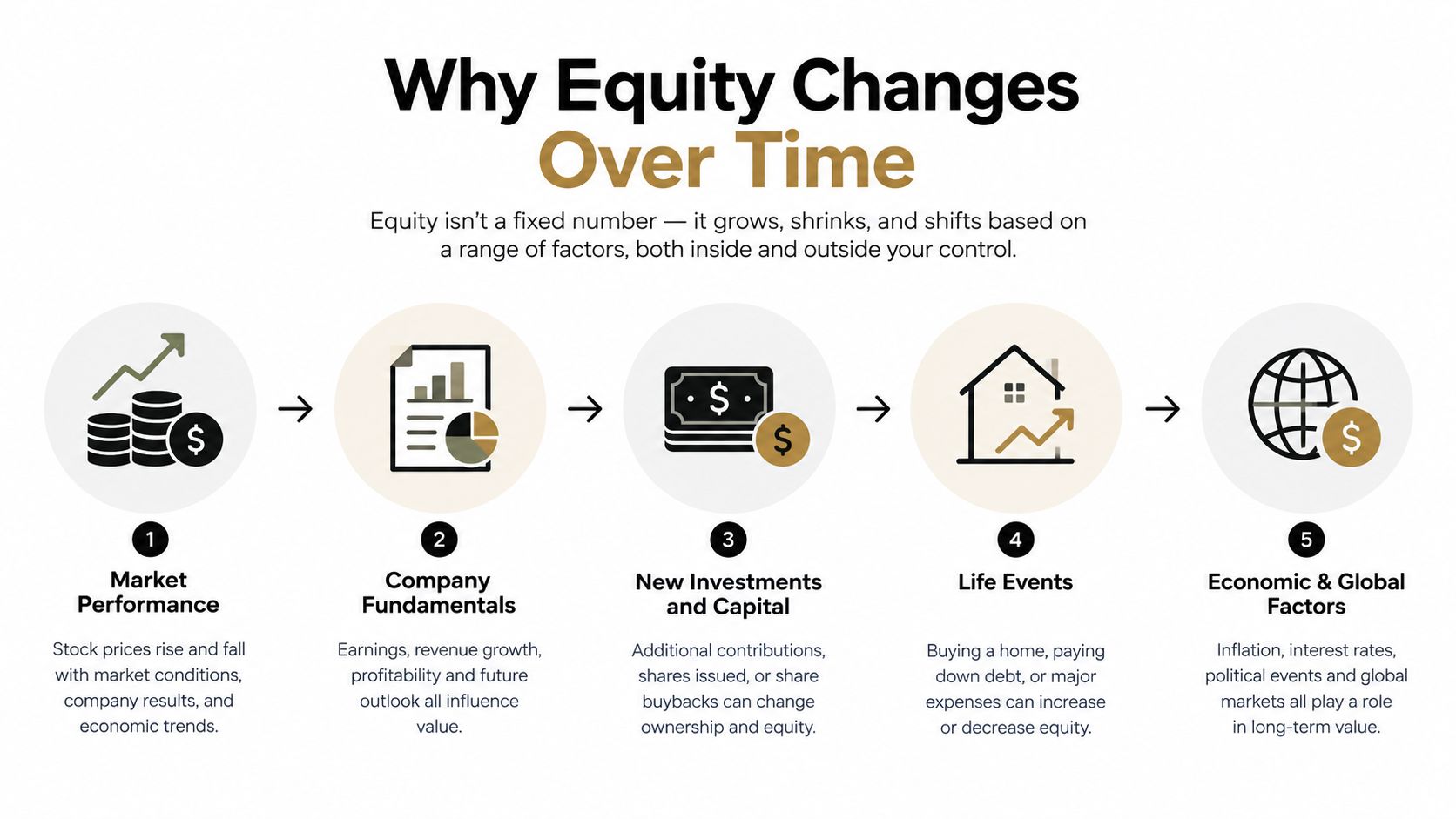
Why Equity Changes Over Time
A balance sheet tells you where equity stands on a particular date. It doesn't, by itself, tell you why the balance changed since the prior period. That explanation comes from a statement of changes in equity, sometimes presented as a statement of owner's equity or a similar equity rollforward.
The basic movement is straightforward:
Beginning equity + contributions + net income − withdrawals or distributions = ending equity
Net income comes from the income statement. Contributions and distributions come from owner activity. The ending amount appears in the equity section of the balance sheet, where it becomes the opening balance for the next period.
Why cash can tell a different story
Cash and equity often move differently because many transactions affect one without producing the same change in the other. A business can borrow cash, collect an old receivable, purchase equipment, pay down debt, or distribute funds to owners. Each event changes the financial picture in a different way.
For example, collecting a customer receivable increases cash but may not change equity because the revenue was recognized earlier. Borrowing money increases cash and liabilities together, leaving equity unchanged at the time of borrowing. Paying down principal reduces cash and liabilities, while the interest portion affects profit and equity.
That's why the question “Why did my equity change this year?” requires more than looking at the bank statement. You need to review net income, owner activity, debt payments, asset purchases, and any corrections posted during the period.
The balance sheet is the photograph. The statement of changes in equity is the conversation explaining how the photograph came to look that way.
Multi-owner businesses need one additional layer of care. Total equity may remain steady while individual partners' or members' capital accounts change because contributions, distributions, or allocations weren't equal. Record those movements by owner, and document the agreement that supports the allocation.
A clear explanation of the difference between a P&L and a balance sheet helps owners connect profitability with financial position without treating the reports as interchangeable. The financial statement template discussion from monday.com also highlights the management value of tracking contributions, profits, losses, distributions, and other equity movements over time.
The Hidden Risks of Negative or Fragile Equity
Revenue growth can create a false sense of security. A company may invoice more customers, report a profit, and still weaken its owner's equity because debt service, distributions, losses, or asset write-downs consume the value created by operations.
Consider a growing S-Corp that finances equipment with debt. The equipment raises assets, but the loan raises liabilities too. As the company makes principal payments, cash declines. Interest reduces profit, and large owner distributions reduce equity directly. If the owner keeps drawing based on revenue rather than sustainable cash flow, the company can look successful on the income statement while its balance sheet becomes increasingly fragile.
Leverage magnifies pressure
Debt can help a business expand, but it creates fixed obligations that don't disappear when sales slow. High interest costs reduce the profit available to retain. Principal payments use cash even though the principal itself isn't an income-statement expense. Together, those pressures can leave an owner with a profitable operation but less liquidity and a thinner cushion.
Asset values can create another complication. Accounting records may not increase just because an owner believes a property, brand, or investment has become more valuable. Conversely, an impairment, loss, or revaluation where applicable can reduce recorded equity without an equivalent cash payment.
The broader wealth picture shows why owners should take this seriously. Recent data place U.S. owners' equity in residential real estate at $35.81 trillion in Q2 2026, while equities represented 39.9% of U.S. household net worth, described as the largest share in Federal Reserve records, according to the cited market analysis. Those figures describe household wealth rather than a particular business, but they illustrate how exposure to asset prices can shape perceived and recorded net worth.
Warning signs to investigate
- Distributions outpace retained profit: Owners take out more than the business can safely support after debt service and working-capital needs.
- Debt rises faster than net assets: Borrowing funds activity without building durable assets or earnings can weaken the capital structure.
- Equity depends on uncertain valuations: A balance sheet tied to volatile property or investment values can change sharply when assumptions change.
- Cash stays tight despite reported profit: Receivables, inventory, principal payments, and owner withdrawals may be absorbing the cash.
- Capital accounts aren't reconciled: Unrecorded personal transfers can make individual ownership positions unreliable.
Real estate owners should separate property-level equity from business operating equity and review the debt attached to each asset. For readers evaluating property opportunities or trying to find undervalued real estate, the same discipline applies. A low purchase price doesn't automatically mean a strong equity position after financing, repairs, taxes, and other obligations.
Tax Reporting and Strategic Business Decisions
Equity records matter at tax time because the tax treatment of an owner's withdrawal depends on the entity, the transaction, and the owner's basis. A bookkeeper can record a distribution correctly in the general ledger, but that entry alone doesn't determine whether the distribution is taxable.
S-Corp shareholders deserve particular caution. Distributions generally interact with stock basis, and a distribution that exceeds available basis can create taxable gain. The bookkeeping should therefore track contributions, income allocations, losses, prior distributions, and other basis-related items in coordination with the tax return. Don't wait until the filing deadline to discover that personal transfers weren't classified consistently.
Separate compensation from distributions
An S-Corp owner who performs services for the company needs a defensible compensation process, including payroll where required. Distributions aren't a substitute for properly handling compensation, and a balance sheet review won't fix a payroll classification problem after the fact.
LLC owners face a different set of rules depending on how the LLC is taxed. A single-member LLC, partnership-taxed LLC, and S-Corp-taxed LLC can use different equity accounts and reporting approaches. The account label may look similar, but the tax consequences aren't interchangeable.
The equity section should also support decision-making outside tax compliance. Lenders review the relationship between debt and equity when assessing solvency and repayment capacity. A loan package with unexplained negative equity, stale capital accounts, or unrecorded related-party balances creates questions that accurate books could have answered before the application. Owners preparing for financing can learn more about how SBA loan brokers work while their accountant prepares the underlying financial information.
Build a year-end review habit
Use a short reconciliation before closing the books:
- Tie retained earnings: Confirm that the balance rolls correctly from the prior period and reflects the finalized income statement.
- Review owner transfers: Match every personal deposit, draw, distribution, and reimbursement to supporting records.
- Separate debt activity: Distinguish principal payments from interest so cash flow and profit are presented correctly.
- Check individual capital accounts: For multi-owner entities, verify that allocations and distributions agree with the operating agreement.
- Ask about basis: Have the tax preparer review whether contributions, losses, and distributions support the intended tax treatment.
The equity section contains multiple components, including contributed capital and retained earnings, and corporate statements may also include common stock, additional paid-in capital, treasury stock, and other lines. As Investopedia's shareholder equity overview explains, those items change as owners invest, companies earn profits, dividends are paid, and shares are repurchased. Treating total equity as one unexplained number hides the decisions that created it.
Managing Your Equity for Long-Term Success
Strong equity management doesn't require complicated forecasting. It requires a repeatable review that connects the balance sheet to operating results, financing, and owner behavior.
A practical quarterly checklist
- Reconcile the equity accounts: Confirm that the ending balance agrees with the balance sheet and the equity rollforward.
- Classify every owner transfer: Decide whether each payment is compensation, reimbursement, contribution, draw, or distribution.
- Compare profit with withdrawals: A profitable period can still leave the business short of cash if owners remove too much.
- Review debt service: Track how principal and interest affect liquidity and the ability to retain earnings.
- Check each owner's capital: Multi-owner companies should verify that individual balances match the governing agreement.
- Prepare for tax planning: Give the CPA current books before making large distributions or year-end transfers.

The accounting equation won't bend. Assets must equal liabilities plus equity. Your strategy can change, though. You can retain more profit, reduce expensive debt, moderate distributions, contribute additional capital, or invest in assets that support durable operations.
Reviewing equity regularly also improves conversations with lenders, partners, and tax professionals. If the balance sheet shows a surprising result, treat it as a question to investigate, not a number to ignore.
Allied Tax Advisors helps small businesses and S-Corp and LLC owners organize bookkeeping, prepare financial statements, plan taxes, and review equity-related transactions before they create compliance problems. Visit Allied Tax Advisors to discuss your balance sheet, owner draws, capital accounts, and year-end tax planning with a qualified advisory team.