
Let's be honest, for most small business owners, "accounting" is just a nicer word for "taxes." But seeing it that way is like using a smartphone only to make calls—you're missing out on its real power. Basic accounting is the financial compass for your business. It's the tool that turns a jumble of numbers into a clear map showing you where you've been, where you are now, and the best path to get where you want to go.
Why Accounting Is Your Business Compass
Too many entrepreneurs treat accounting like a chore they only have to think about once a year. It feels like a report card, a necessary evil to get through tax season. But that perspective completely misses the point.
Think of your accounting records as the dashboard in your car. It gives you real-time feedback, flashes warning lights when something’s wrong, and gives you the data you need to steer with confidence. Driving without it? You’re flying blind. You might be thrilled about a spike in sales, but completely miss the fact that your cash flow is about to run dry. Good accounting brings those hidden, critical details to light.
More Than Just Keeping the Tax Man Happy
Sure, proper accounting keeps you compliant, but that’s just table stakes. Its real value is as a strategic tool that sharpens your decision-making in every part of your business. It gives you the clarity to answer the big questions with certainty.
Here’s how it helps you make smarter moves:
- Nail Your Pricing: Are you actually making money on your flagship product? Accounting breaks down your costs so you can set prices that protect your profit margins.
- Secure Funding: When you're ready to grow and need a loan, banks and investors want to see the books. Clean, organized financial statements prove your business is a good bet.
- Steer Day-to-Day Decisions: Can you afford to hire that new salesperson? Is it the right time to invest in new equipment? Your financials give you the hard data to decide based on reality, not just a gut feeling.
If you feel a little out of your depth here, you're not alone. Research shows that about 60% of small business owners don't feel confident in their accounting knowledge, and 21% admit their bookkeeping skills aren't up to snuff. As reported by Accounting Today, this gap often leads to cash flow problems, missed growth opportunities, and unnecessary stress.
Getting a handle on basic accounting is one of the best investments of time you can make. It’s the language of business, and once you're fluent, you can build something truly resilient and profitable.
At the end of the day, embracing basic accounting for your small business is about taking control. It’s about learning to read the story your numbers are telling you, so you can be the one to write the next chapter—instead of just letting it happen to you. You stop being a passenger and become the pilot of your own business.
Building Your Financial Foundation

Before you can even think about profits, losses, or cash flow, you have to get the basics right. Building a solid financial foundation is the first real step, and it all starts with one non-negotiable rule that protects you and simplifies everything down the road. Nailing this from day one is one of the most important things you can do.
First things first: separate your business and personal finances. This isn’t just a friendly tip for staying organized—it's a critical legal shield. If your business ever faces a lawsuit or racks up debt, this separation is what protects your personal car, your home, and your savings from being at risk.
When you mix personal and business funds, you create an absolute nightmare for bookkeeping. It becomes impossible to see how your business is actually performing, and tax season turns into a massive headache. Do this now: open a dedicated business bank account and get a business credit card. From this moment on, every single dollar your business earns or spends must flow through those accounts.
Create Your Chart of Accounts
With your finances now separate, it's time to set up your Chart of Accounts. It sounds a bit formal, but think of it as the digital filing cabinet for your money. It's simply a complete list of all the categories you'll use to sort your transactions.
Every time money moves in or out, it gets filed into one of these categories. Instead of a shoebox full of messy receipts, you’ll have a clean, organized system that shows you exactly where your money comes from and where it goes. This structure is what accounting software uses to create those powerful financial reports you'll come to rely on.
A basic Chart of Accounts will always include a few key areas:
- Assets: Everything your business owns (Cash in Bank, Computers, Office Equipment).
- Liabilities: Everything your business owes (Business Credit Card Balance, Loans).
- Equity: The owner's stake in the company (Your Initial Investment).
- Income: All the ways your business makes money (Sales, Service Fees).
- Expenses: Everything your business spends money on (Rent, Software, Marketing).
Getting this structure right is the key to accurate reporting. If you want to go a bit deeper, our guide on how to track business expenses offers more detail on setting up categories that will make your life much easier at tax time.
Choose Your Accounting Method
Okay, your accounts are neatly organized. The next big decision is when to record your transactions. This choice comes down to two main methods: cash basis and accrual basis accounting. The one you pick determines how you recognize income and expenses, which directly impacts what your financial statements say about your business's health.
Key Takeaway: Your accounting method isn't just a technical detail—it fundamentally changes the story your books tell. Cash basis gives you a real-time view of your bank balance, while accrual basis provides a more accurate picture of your company's long-term profitability.
The difference is all about timing. Let's say you're a freelance designer. You finish a project in June and immediately send the client an invoice for $2,000. The client pays you in July.
-
Cash Basis Accounting: This is the simple one. You record income only when the money actually lands in your bank account. Using this method, you’d record the $2,000 in income in July, the month you got paid. The same goes for expenses—you record them when the money leaves your account.
-
Accrual Basis Accounting: This method is about when you earn the money, not when you get it. You’d record that $2,000 of income in June, the month you sent the invoice. Likewise, you record expenses when you incur them (like when you receive a bill), not necessarily when you pay it.
Most brand-new small businesses start with the cash method because it’s so straightforward. But as your business grows—especially if you start holding inventory or dealing with clients who take a while to pay—the accrual method almost always gives you a truer picture of your financial health.
How Double-Entry Bookkeeping Keeps You Honest
At the very heart of modern accounting is a brilliantly simple idea: double-entry bookkeeping. It might sound a bit intimidating, but the logic behind it is something we all understand intuitively. Think of your business finances as a perfectly balanced scale. Every single financial event, from buying a coffee to landing a huge contract, has to keep that scale perfectly level.
This is what double-entry bookkeeping does. It works on the principle that every transaction has two equal and opposite effects. For every action, there's a reaction. Money never just materializes or vanishes—it simply moves from one account to another. This system is your ultimate accountability partner, creating a self-checking mechanism that forces your records to be accurate and honest.
The Give and Get of Every Transaction
In the language of accounting, these two effects are called debits and credits. Don't let the jargon trip you up. A really straightforward way to think about them is:
- A debit is what your business gets.
- A credit is what your business gives up.
Let's make this real. Say you buy a new laptop for your business for $1,500 with your company debit card. You get a laptop (an asset), so you debit your Equipment account. At the same time, you give up cash from your bank, so you credit your Cash account. The scale stays perfectly balanced.
The Fundamental Accounting Equation: Assets = Liabilities + Equity. This is the bedrock of it all. Double-entry bookkeeping is the system that enforces this rule with every transaction, ensuring you always have a complete and trustworthy picture of your finances.
This structure creates a logical consistency that simpler methods, like just jotting down expenses in a spreadsheet, can't match. If the two sides of a transaction don't balance out, you know instantly that a mistake has been made. This makes it far easier to find and fix errors before they snowball into bigger problems. It's this built-in error detection that makes it the gold standard for reliable basic accounting for small business.
Double-Entry Bookkeeping in Action
To see how this works in the real world, here's a table showing a few common business scenarios.
Double-Entry Bookkeeping Examples
| Transaction | Account Debited (What you get) | Account Credited (What you give) | Impact on Equation |
|---|---|---|---|
| Get a $10,000 Business Loan | Cash account increases by $10,000 | Loans Payable account increases by $10,000 | Assets increase, Liabilities increase. (Balanced) |
| Receive a $5,000 Client Payment | Cash account increases by $5,000 | Revenue account increases by $5,000 | Assets increase, Equity increases. (Balanced) |
| Pay $1,000 for Monthly Rent | Rent Expense account increases by $1,000 | Cash account decreases by $1,000 | Equity decreases, Assets decrease. (Balanced) |
| Buy $2,000 of Inventory on Credit | Inventory account increases by $2,000 | Accounts Payable account increases by $2,000 | Assets increase, Liabilities increase. (Balanced) |
Each of these examples shows the "give and get" in action, keeping the fundamental accounting equation true every single time. It’s a beautifully logical system.
This concept of interconnectedness is also why your main financial reports—the Income Statement, Balance Sheet, and Cash Flow Statement—all tie together.
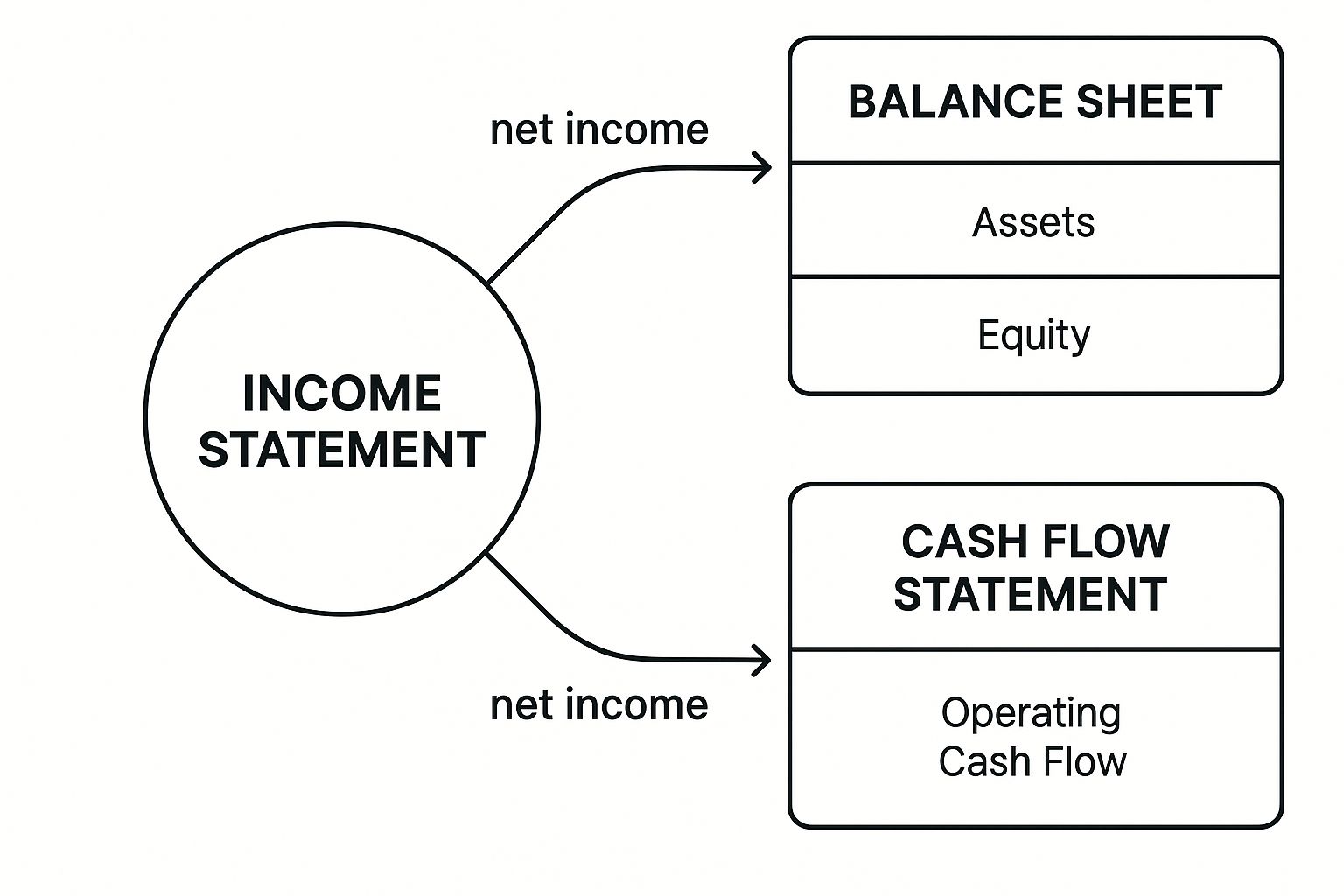
As the visual shows, the net income you calculate on your Income Statement doesn't just sit there. It flows directly into the equity section of your Balance Sheet and is a key component of your Cash Flow Statement. Everything is linked.
When you adopt the discipline of the double-entry system, you're doing more than just keeping records. You're building a dynamic, interconnected financial model of your business—one that is both accurate and full of insight. It’s a method that doesn’t just track your numbers; it validates them with every entry, giving you the reliable data you need to make smart decisions for your company.
Reading Your Financial Story
All that diligent transaction tracking and careful balancing comes together to tell the financial story of your business. This story unfolds across three core financial statements, each giving you a different lens through which to view your company's health and stability. Learning to read them is a non-negotiable part of basic accounting for small business.
I like to think of them as different ways of documenting your business's journey. The Income Statement is the highlight reel, the Balance Sheet is a single, crucial photograph in time, and the Cash Flow Statement is the raw, behind-the-scenes footage. Together, they give you the whole picture.
The Income Statement: Your Performance Report
The Income Statement, which you'll often hear called the Profit and Loss (P&L) statement, is basically your business's report card for a specific period—be it a month, a quarter, or a full year. It’s designed to answer the most important question every business owner asks: "Am I actually making any money?"
It gets to the answer with a beautifully simple formula:
Revenue – Expenses = Net Income (or Net Loss)
Your revenue is every dollar your business earned. Your expenses are all the costs you had to pay to make that revenue happen. The number at the very end, your net income, is the famous "bottom line" that tells you whether you were profitable or not.
For instance, if a freelance graphic designer brings in $10,000 in a quarter but spends $2,500 on software subscriptions, ads, and supplies, their net income is $7,500. This one report is incredibly powerful for judging profitability and making smarter decisions about your budget.
The Balance Sheet: Your Financial Snapshot
While an Income Statement looks at performance over time, the Balance Sheet is a snapshot. It captures your business's financial position at a single, specific moment—like the close of business on December 31st. It clearly lays out what you own and what you owe.
The Balance Sheet is structured around the fundamental accounting equation we talked about earlier:
Assets = Liabilities + Equity
- Assets are all the valuable things your company owns, like cash in the bank, equipment, or inventory.
- Liabilities are everything your company owes to others, such as loans or credit card debt.
- Equity represents the owner's stake—it’s what’s left over when you subtract liabilities from assets.
It’s called a Balance Sheet for a reason: it must always balance. Your total assets must perfectly equal the sum of your liabilities and equity. It’s the ultimate check for accuracy in your books and gives you a solid look at your company's overall financial strength.
Key Insight: Being able to read these statements is more important than ever. Around 73% of accounting firms have seen their profits grow recently, with more than half of them expanding their client lists. This isn't a coincidence—it's driven by small businesses who need expert help turning financial data into smart budgets, forecasts, and strategic plans.
The Cash Flow Statement: Your Money's Journey
Have you ever celebrated a profitable month according to your Income Statement, only to look at your bank account and wonder where all the money went? The Cash Flow Statement solves that all-too-common mystery. It tracks the actual cash moving in and out of your business.
Here’s the thing: profit and cash are not the same. Your Income Statement might show a $5,000 profit because you sent an invoice to a big client, but if that invoice hasn't been paid yet, the cash isn't in your account.
The Cash Flow Statement organizes all this movement into three main activities:
- Operating Activities: Cash generated from your core business, like customer payments and paying suppliers.
- Investing Activities: Cash spent on or received from selling long-term assets, like a new vehicle or computer.
- Financing Activities: Cash from investors or loans, or cash paid out to owners.
Think of this statement as a replay of your bank account activity, showing you exactly where your money came from and where it went. It is absolutely critical for managing your day-to-day financial health and making sure you don't run out of cash. To get a handle on this, our guide on https://alliedtax.com/how-to-prepare-financial-statements/ breaks down the process step-by-step.
Once you’re comfortable reading your financial story, you can start looking ahead. Exploring different cash flow forecasting methods can help you anticipate future needs and seize opportunities. These three reports work in concert, giving you the complete, multi-dimensional view you need to lead your business with confidence.
Choosing Your Accounting Tools and Team

Knowing the principles of accounting is one thing, but having the right setup to actually do it is another ballgame entirely. For most small businesses, the old shoebox full of receipts just won’t cut it anymore. The right mix of modern software and human expertise is what separates the businesses that thrive from those that just get by.
This isn’t just a passing trend. The global accounting services market is on track to hit $735.94 billion by 2025, and there's a good reason for that. By that same year, an estimated 78% of small businesses will be using cloud-based accounting. Business owners are demanding smarter, more accessible ways to manage their money.
Selecting Your Accounting Software
Think of accounting software as the command center for your company's finances. It’s what takes the concept of double-entry bookkeeping and puts it on autopilot. With a few clicks, it can generate financial statements, track your cash flow in real-time, and give you a clear picture of your business's health.
When you're picking a platform, you're really choosing a long-term partner for your business. Here’s what to look for:
- Ease of Use: If the software is confusing, you'll find any excuse not to use it. A clean, intuitive dashboard is non-negotiable.
- Automation Features: The whole point is to save time. Look for tools that can pull in bank transactions, help you categorize expenses, and automatically send out recurring invoices.
- Scalability: The software that fits you as a one-person shop should also be able to handle things when you’ve got a team of five and growing.
- Integrations: Does it play well with others? The ability to connect with your payment processor, payroll system, or online store is a massive time-saver.
Platforms like QuickBooks are a go-to for many small businesses for these exact reasons. If you're leaning that way, our guide on https://alliedtax.com/how-to-set-up-quickbooks/ offers a straightforward walkthrough to get you up and running correctly from day one.
Remember, the best software isn't the one with the most bells and whistles—it's the one you'll actually use consistently. A simple tool used well beats a complex one that sits on the shelf.
DIY vs. Hiring a Professional
So, you have the software. Now, who’s going to run it? In the early days, many founders wear the bookkeeper hat themselves to keep costs down. This DIY approach is perfectly fine when your business is small and your transactions are simple. Honestly, it’s a fantastic way to learn the financial ins and outs of your own company.
But as your business grows, a tipping point arrives. The hours you spend buried in spreadsheets start to cost you more in lost opportunities than you’d spend hiring an expert.
Here are a few signs it’s time to call in a pro:
- It Takes Too Much Time: If you're spending more than a few hours a week on your books, that’s time you’re not spending on sales, marketing, or product development.
- Things Get Complicated: Hiring your first employee, managing inventory, or navigating multi-state sales tax can quickly turn into a headache.
- You Don't Trust the Numbers: If you’re constantly second-guessing whether your reports are accurate, you can't make sound business decisions.
- You Need to Impress: Applying for a loan or pitching investors? They expect pristine, professionally prepared financial statements.
To get a clearer picture of your options, it helps to see them side-by-side.
Comparing Accounting Solutions for Small Businesses
| Solution | Best For | Typical Cost | Key Features / Benefits |
|---|---|---|---|
| DIY (Spreadsheets) | Brand new freelancers or hobby businesses with very few transactions. | Free (or cost of software like Excel). | Total control, no direct cost, and a great way to learn basics. |
| Accounting Software | Most small businesses, from solo entrepreneurs to growing teams. | $15 – $150 per month. | Automation, real-time reporting, accuracy, and scalability. |
| Professional Services | Established businesses with complex needs or founders who want to focus 100% on growth. | $300 – $2,500+ per month. | Expert strategy, tax planning, peace of mind, and time savings. |
Ultimately, the goal is to create a system that works for you, not against you.
Hiring a bookkeeper can handle the day-to-day transaction recording, while a CPA or accountant offers high-level strategic advice on everything from tax planning to business structuring. For some businesses, integrating specialized pay services can also offload a significant chunk of the transaction management workload. Building the right team lets you get back to what you do best: running your business.
Common Small Business Accounting Questions
Alright, we’ve walked through the core principles, tools, and reports. Now, let’s get down to brass tacks and tackle the practical, day-to-day questions that inevitably pop up. This is your quick-reference guide for the real-world hurdles nearly every small business owner hits when they start putting their accounting knowledge into practice.
These are the challenges you face after you've learned the theory. Getting clear answers here can save you a massive amount of time and stress, reinforcing what you've learned and giving you the confidence to manage your company’s finances like a pro.
How Often Should I Do My Bookkeeping?
For most small businesses, the sweet spot for bookkeeping is weekly. This rhythm keeps the task from becoming a monster and ensures your financial data is actually useful. Just set aside an hour every Friday to categorize transactions and check your bank feeds. It's a simple habit that prevents a mountain of work from piling up at the end of the month.
This consistency gives you a huge strategic advantage. You get a real-time view of your finances, which means you can spot cash flow issues long before they turn into full-blown emergencies.
Waiting until month-end to tackle bookkeeping is a recipe for errors. Details from transactions that happened weeks ago get fuzzy, which easily leads to miscategorized expenses and, even worse, missed tax deductions that cost you real money.
Making this a weekly routine keeps the details fresh in your mind and your financial reports accurate. This discipline transforms bookkeeping from a dreaded chore into a powerful tool for managing your business.
What Are the Most Common Accounting Mistakes?
Even with the best intentions, it's easy to make a few missteps. The good news is that most major accounting disasters stem from just a handful of common, preventable errors. If you can steer clear of these, you’ll be well on your way to solid financial health.
Here are the top three mistakes to watch out for:
-
Mixing Personal and Business Finances: This is the cardinal sin of small business accounting. Using your business account for a personal dinner or swiping your personal credit card for business supplies creates a legal and bookkeeping nightmare. It can pierce the "corporate veil" that protects your personal assets and makes it impossible to know how your business is actually performing.
-
Poor Record-Keeping: This is more than just being messy. Failing to save receipts, not logging cash expenses, or keeping inconsistent records can leave you vulnerable in an audit and cause you to miss out on valuable tax deductions. Every single business transaction needs a paper trail. Period.
-
Misclassifying Workers: The line between an independent contractor and an employee is a very serious one, with major legal and tax implications. Trying to classify an employee as a contractor just to avoid payroll taxes can lead to crushing fines, back taxes, and other penalties.
Avoiding these three pitfalls is absolutely fundamental to building a resilient and compliant business. Get them right from the start, and you'll save yourself from enormous headaches down the road.
Do I Really Need Accounting Software From Day One?
It’s tempting to start with a simple spreadsheet to save a few bucks, but it’s a decision that almost always comes back to haunt you. Starting with dedicated accounting software from day one is one of the smartest investments you can make, even when you only have a handful of transactions.
Spreadsheets are incredibly prone to human error—one tiny misplaced decimal or a broken formula can throw off your entire financial picture, and you might not even notice. They also lack the automation and security features of modern software, quickly becoming an unmanageable mess as your business grows.
Good, affordable cloud-based accounting software does more than just hold numbers. It helps you build good financial habits right from the beginning.
- It automatically imports bank transactions, saving you from hours of soul-crushing data entry.
- It generates professional financial statements with just a few clicks.
- It keeps your sensitive financial data secure and backed up.
- It grows with your business, ready to handle things like payroll and inventory when you are.
Making that small investment early on pays for itself many times over in saved time, fewer errors, and a lot less stress. It sets a professional foundation for your entire financial operation.
What Is the Difference Between a Bookkeeper and an Accountant?
People often use the terms "bookkeeper" and "accountant" interchangeably, but they play two very different—yet complementary—roles. Understanding the difference helps you figure out who you need to hire and when.
Think of it like building a house. The bookkeeper is the master carpenter, meticulously handling the day-to-day construction. They are focused on the "now."
A bookkeeper's main jobs include:
- Recording daily financial transactions.
- Categorizing all your income and expenses correctly.
- Reconciling bank accounts to make sure everything matches up.
- Managing who owes you money and who you owe money to.
Their role is to ensure your financial data is accurate, up-to-date, and perfectly organized. They build the strong foundation of data.
The accountant, on the other hand, is the architect. They take the solid foundation built by the bookkeeper and analyze it to see the bigger picture. They are focused on the "what's next."
An accountant's duties often involve:
- Preparing and analyzing key financial statements (like your Income Statement and Balance Sheet).
- Filing your federal, state, and local taxes correctly and on time.
- Offering strategic financial advice and helping with business planning.
- Assisting with budgeting, forecasting, and making sure you're compliant with regulations.
In short, the bookkeeper records your financial history, while the accountant interprets that history to help you plan for a successful future. As your business grows, you'll eventually need both to truly thrive.
Navigating the world of basic accounting for small business can feel complex, but you don't have to go it alone. The team at Allied Tax Advisors is here to provide the expert guidance and support you need at every stage of your financial journey. Whether you need help with bookkeeping, tax planning, or strategic advisory, we're ready to help you achieve clarity and confidence. Reach out to us today to learn how we can support your business's success.