
For the vast majority of married couples, filing a joint tax return isn't just a matter of convenience—it's one of the smartest financial moves you can make. The U.S. tax code is built to reward couples who file together, often resulting in a lower tax bill and access to benefits you simply can't get when filing on your own.
This simple decision can make a huge difference in your household's bottom line.
How Filing Together Unlocks Real Savings
Think of it like this: when you file jointly, the IRS essentially gives you a "team discount." Your two incomes are combined, but the thresholds for tax brackets are much wider. This prevents one spouse's higher income from getting pushed into a steeper tax bracket too quickly. It’s a classic case of the whole being greater than the sum of its parts.
Right off the bat, you get a much bigger standard deduction. For the 2024 tax year, joint filers can take a $29,200 deduction. If you were to file separately, you’d each get just $14,600. That's a massive, immediate reduction in your taxable income.
But the benefits don't stop with deductions. Many of the most powerful tax credits—the ones that reduce your tax bill dollar-for-dollar—are either significantly reduced or completely off-limits if you file separately.
This infographic breaks down the key financial differences between the two filing statuses. It's a clear picture of why joint filing is usually the better route.
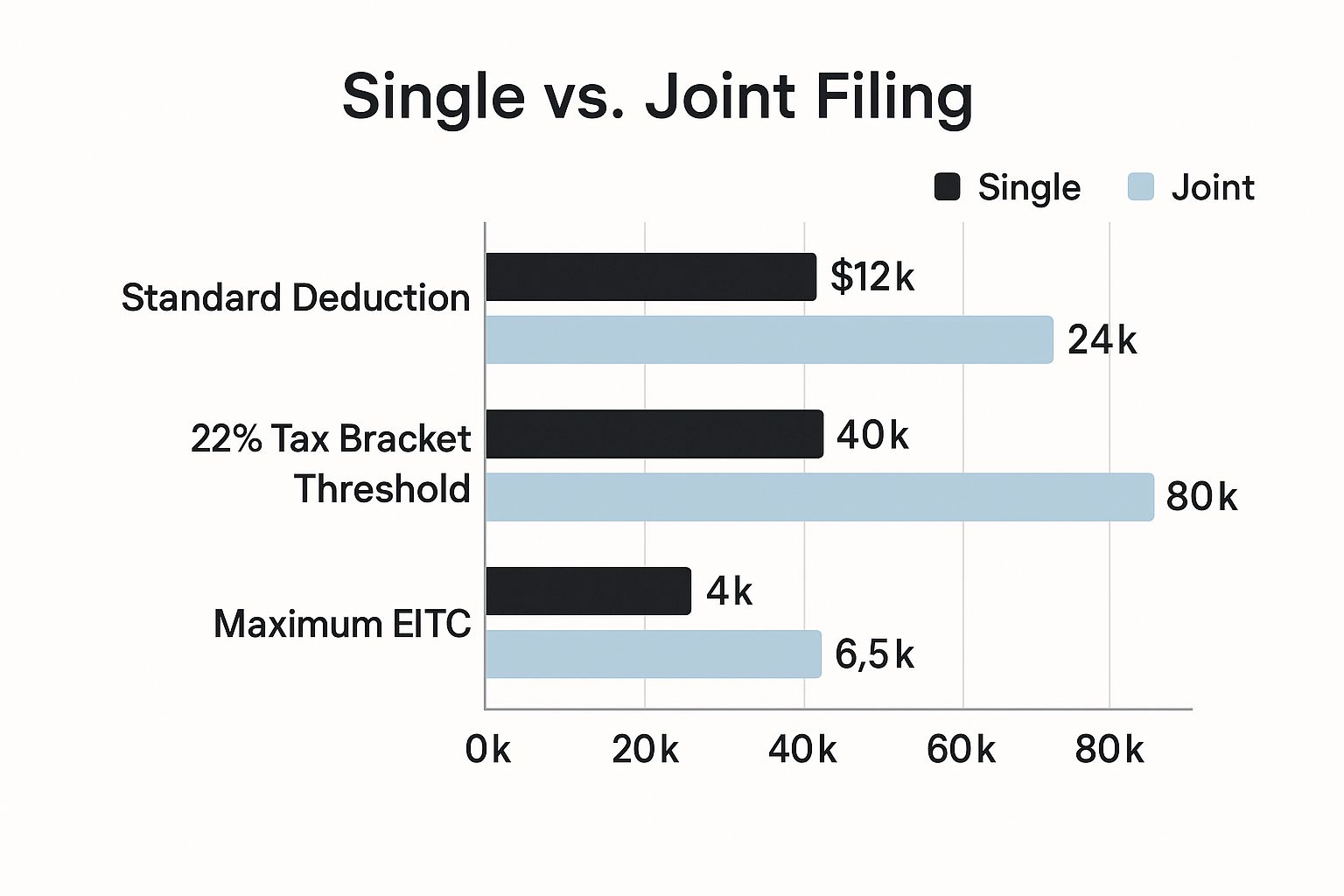
As you can see, the numbers speak for themselves. From doubling the standard deduction to offering wider tax bracket thresholds and greater access to credits like the Earned Income Tax Credit (EITC), the system is designed to provide significant relief to couples who manage their finances as a team. These built-in advantages are what lead to major tax savings year after year.
Unlocking Lower Rates with Joint Tax Brackets

One of the biggest financial wins of filing jointly comes down to how your income interacts with tax brackets. Think of tax brackets as buckets. As your income fills one bucket, it spills over into the next, and the money in that new bucket gets taxed at a higher rate.
When you file a joint return, those buckets get a whole lot bigger. For most brackets, the income thresholds are exactly double what they are for someone filing as single.
This structure can be a massive advantage. It means a much larger chunk of your combined household income stays in the lower-rate buckets. Even if one spouse earns significantly more, their higher salary doesn't immediately push the household into a steeper tax bracket. Instead, your incomes work together to fill up those wider, lower-rate brackets first, sheltering more of your money from higher taxes.
How Joint Brackets Protect Your Income
The magic here is that you're taxed on your total combined income, but you get the breathing room of those expanded brackets. This design is what helps most couples avoid the dreaded "marriage penalty," where simply combining incomes could accidentally result in a higher tax bill.
The tax code essentially treats a married couple as a single economic unit. By providing wider income thresholds, it helps ensure that two moderate incomes aren't hit with the same tax burden as one very high single income. This is the core benefit of filing your taxes jointly.
This idea of pooling income for a tax advantage isn't just a U.S. concept. Germany, for instance, uses a system called "income-splitting." A couple's total income is divided by two, the tax is calculated on that single amount, and then that tax is doubled. This often dramatically reduces the tax burden when there's a significant income gap between spouses. You can find more insights on global tax systems and how they compare.
The table below gives you a clear picture of just how much more room you get in each bracket when filing jointly versus separately.
Comparing Tax Brackets for Joint vs Separate Filing
Notice how the income thresholds for filing jointly are far more generous. This structure allows a couple's combined income to stay in lower tax brackets for longer, which is where the real savings happen.
| Tax Rate | Married Filing Jointly Income Threshold | Married Filing Separately Income Threshold |
|---|---|---|
| 10% | $0 to $23,200 | $0 to $11,600 |
| 12% | $23,201 to $94,300 | $11,601 to $47,150 |
| 22% | $94,301 to $201,050 | $47,151 to $100,525 |
| 24% | $201,051 to $383,900 | $100,526 to $191,950 |
| 32% | $383,901 to $487,450 | $191,951 to $243,725 |
| 35% | $487,451 to $731,200 | $243,726 to $365,600 |
| 37% | Over $731,200 | Over $365,600 |
As you can see, filing separately essentially cuts the bracket widths in half, meaning your income hits those higher tax rates much, much faster.
Unlocking More Powerful Deductions and Credits

Beyond the better tax brackets, one of the biggest wins for joint filers is getting access to a whole slate of powerful deductions and credits. These are the tools that really chip away at your tax bill, but it's crucial to understand how they differ.
Think of a deduction like a coupon you use at the grocery store—it lowers your total bill before the tax is calculated. It reduces your taxable income. A tax credit, however, is more like a gift card applied at the very end. It's a dollar-for-dollar reduction of the final tax you owe. If you want to dive deeper, you can learn more about the critical differences between tax deductions and credits in our detailed guide.
When you choose to file separately, you're often closing the door on some of the most generous tax breaks out there. It’s almost like telling the IRS you’d rather not keep money that you’re otherwise entitled to.
Key Tax Breaks You'll Miss When Filing Separately
For many of the tax code’s most valuable benefits, filing a joint return is the price of admission. If you decide to go it alone and file separately, you generally can't claim these:
- The Earned Income Tax Credit (EITC): This is a huge one for workers with low-to-moderate incomes, often worth thousands of dollars.
- Education Credits: Forget about the American Opportunity Credit or the Lifetime Learning Credit. These valuable breaks for college costs are off the table.
- Student Loan Interest Deduction: You won’t be able to deduct up to $2,500 in student loan interest you paid.
- Adoption Credit: The substantial credit designed to help with the costs of adoption is also unavailable.
Simply put, the tax code is built with a clear preference for joint filers. It's structured to reward married couples who file as a single financial unit by making some of the best tax-saving tools exclusive to them.
This design makes it clear that filing jointly isn't just a matter of convenience; it’s a strategic financial move. For the overwhelming majority of couples, it's the path that leads to a smaller tax bill and more money staying right where it belongs—in your pocket.
Simplifying Your Financial Life Together

Let's look beyond just tax day. One of the biggest, and often overlooked, perks of filing jointly is how it tidies up your entire financial life. You're essentially merging two separate financial stories into one clear, easy-to-read snapshot of your household's health.
This unified view is a fantastic tool for long-term planning. When all your income, investments, and expenses live on one return, it becomes much easier to sit down together and map out your big goals—whether that’s buying a house, starting a business, or saving for retirement. It's about more than just numbers; it builds teamwork.
And this unified approach doesn't just benefit you; it's also a powerful signal to lenders.
Building a Stronger Financial Profile
When you walk into a bank to apply for a mortgage or another big loan, a joint tax return presents a simple, powerful picture of your combined financial strength. Lenders can instantly see your total household income, which can make the approval process go a lot smoother and might even land you better loan terms.
Think about it from their perspective. Instead of sifting through two different sets of documents and trying to piece together your financial puzzle, a joint return tells a single, cohesive story.
A joint return does more than just combine numbers; it demonstrates a unified financial front. This consolidation is a key step in building a cohesive and strategic financial life as a couple.
While the number of married adults in the U.S. has been trending down, married couples remain an economic powerhouse, paying a staggering 74% of all federal income taxes as of 2014. This is partly because joint filing often reflects households with more stable, higher incomes—a factor lenders love to see.
For those of you with more complex finances, such as investments in digital assets, filing jointly can also bring some much-needed order. Understanding things like the tax implications of cryptocurrency trading is easier when all of your financial activities are consolidated into a single, manageable report.
When Filing Separately Is the Smarter Move
While over 95% of married couples find that filing jointly is the best way to go, that’s not a universal rule. For a small but significant number of couples, filing separately isn't just an option—it's a powerful financial strategy.
These situations are definitely the exception, but knowing when to break from the norm can save you a surprising amount of money.
One of the most common reasons to file separately boils down to high medical bills. The IRS lets you deduct medical expenses, but only the amount that exceeds 7.5% of your Adjusted Gross Income (AGI). If you file together, your combined AGI can be so high that this threshold is impossible to meet.
By filing separately, the spouse with the lower income has a much lower AGI. This makes it far easier to clear that 7.5% hurdle and claim a deduction that would have otherwise vanished.
Another major reason to consider filing separately is managing federal student loan payments.
Managing Student Loan Payments
If you're on an income-driven repayment (IDR) plan like PAYE or REPAYE, your monthly payment is tied directly to your income. This is where filing separately can be a game-changer.
By filing your own return, you can often exclude your spouse's income from the IDR calculation.
This simple move can slash your required monthly student loan payment, sometimes saving you hundreds or even thousands of dollars over the course of a year. Often, the savings on your loan payments will far outweigh any extra tax you might pay.
Protecting Against Liability
Filing separately also builds a financial firewall between you and your spouse. If you have any concerns about your partner's tax situation—maybe they have a history with the IRS or run a business with some gray-area deductions—a separate return shields you.
This ensures you aren’t held responsible for their tax debt, protecting your own assets and giving you peace of mind.
Ultimately, the choice comes down to running the numbers. You have to weigh the tax benefits you lose by filing separately against the potential savings you gain. For a deeper comparison, explore our detailed guide on the differences between married filing separately vs jointly to see which path is right for you.
So, Why Is Joint Filing Even a Thing?
Ever stopped to think about why the U.S. tax code pushes married couples toward filing a joint return? It's not just a random rule; it’s built on the idea that a married couple operates as a single financial team.
The whole system is designed around the assumption that spouses combine their income, share the bills, and make money decisions together. The tax laws were written to mirror this reality, looking at the household's total income and expenses as one complete picture. This is the simple reason so many tax breaks are set up to benefit this "all-in" financial approach.
The Family as a Single Financial Unit
This concept is really the foundation of joint filing. When you combine two incomes on one return, the IRS gets a clearer picture of the household's actual ability to pay taxes, instead of viewing each spouse as a siloed individual. This is also where understanding what is adjusted gross income becomes a shared calculation for the couple, not just a personal one.
The entire structure of joint filing—from its wider tax brackets to its exclusive credits—is built on the principle that a family's financial health is best measured as a whole. This is why the system rewards you for filing as one unit.
This philosophy has cemented joint filing as the go-to strategy for millions of couples. Just look at the numbers: in 2022, the IRS handled nearly 55 million joint returns. That’s over 95% of all married filers and roughly a third of all tax returns filed that year. You can dig into more details on this dominant filing trend at the Roosevelt Institute.
It’s clear this isn't just a popular choice—it's how the tax system is fundamentally built to work for married couples.
Got Questions About Filing Taxes Jointly? We've Got Answers
Choosing how to file is a big decision, and it’s natural to have a few questions. Let's clear up some of the most common ones so you can feel good about your choice.
Can We Change Our Minds and Switch Back to Filing Jointly?
Absolutely. If you file separately and later realize a joint return would have been better, you're not stuck. You have up to three years from the original tax deadline to file an amended return and switch to "married filing jointly."
But be aware, this is a one-way street. Once you file a joint return and the tax deadline passes, you cannot amend it to file two separate returns. This makes testing out the "married filing separately" status a pretty low-risk experiment.
Think of it this way: You can always combine separate returns into one joint return later, but you can't unscramble a joint return back into two separate ones after the deadline.
Who's on the Hook for the Tax Bill?
When you sign a joint return, you both agree to what the IRS calls joint and several liability. It’s a formal-sounding term with a simple meaning: the IRS can collect the entire tax debt from either one of you, regardless of who earned the income.
Even if a divorce happens later, the liability for that joint tax return remains. While there are rare exceptions like "innocent spouse relief," the default is that you share the responsibility completely.
What if My Spouse Isn't a U.S. Citizen?
No problem. You can still file a joint return. If your spouse doesn't have a Social Security Number but needs to file U.S. taxes, they'll need an ITIN.
Understanding what an Individual Taxpayer Identification Number (ITIN) is is the key here. It’s a tax processing number issued by the IRS that allows non-citizens to handle their tax obligations, making a joint return possible.