
As tax season approaches, many married couples face a critical decision: should they file jointly or separately? While every couple’s financial situation is unique, the U.S. tax code overwhelmingly favors the Married Filing Jointly (MFJ) status. The benefits of filing taxes jointly extend far beyond simple convenience, often unlocking significant tax savings, higher deduction limits, and greater access to valuable credits that are unavailable to separate filers.
This comprehensive guide moves past the surface-level advice to explore the most impactful advantages of combining your finances on a single tax return. We will provide detailed explanations, practical examples, and actionable insights to help you understand why, for the vast majority of couples, filing jointly is the most strategic financial choice.
This article will break down exactly how this powerful filing status can:
- Lower your combined tax bill.
- Maximize key deductions and credits.
- Enhance retirement and education savings opportunities.
- Simplify long-term financial and estate planning.
By understanding these advantages, you can make an informed decision for the upcoming tax year and position your household for greater financial synergy. Let’s explore the specific ways filing jointly can work for you.
1. Lower Tax Brackets and Reduced Tax Liability
One of the most significant and immediate benefits of filing taxes jointly is the potential to land in a more favorable tax bracket, which can directly lower your overall tax bill. The U.S. progressive tax system uses brackets where income is taxed at increasing rates. For married couples filing jointly, these brackets are substantially wider than those for single filers or those married filing separately.
This structure allows a couple’s combined income to fill a larger, lower-taxed bracket before spilling into a higher one. The advantage is most pronounced when there is an income disparity between spouses. The higher earner’s income is effectively “averaged down” by the lower earner’s, shielding more of it from higher tax rates. This often creates a “marriage bonus,” a core reason why joint filing is the default for over 95% of married couples.
How Wider Brackets Translate to Savings
Consider a couple where one spouse earns $80,000 and the other earns $30,000. Their combined income is $110,000. When filing jointly, their income falls comfortably within the lower tax brackets designed for joint filers. If they were to file separately, the $80,000 earner would quickly hit higher tax brackets on their own, resulting in a greater combined tax liability.
“The progressive tax system is designed to reward joint filers. By combining incomes, couples often avoid the ‘marriage penalty’ and instead reap a ‘marriage bonus,’ especially when one spouse is the primary breadwinner.” – Lead CPA, Allied Tax Advisors
This grouped bar chart below visualizes how the thresholds for joint filers are exactly double those for single filers, providing a clear mathematical advantage.
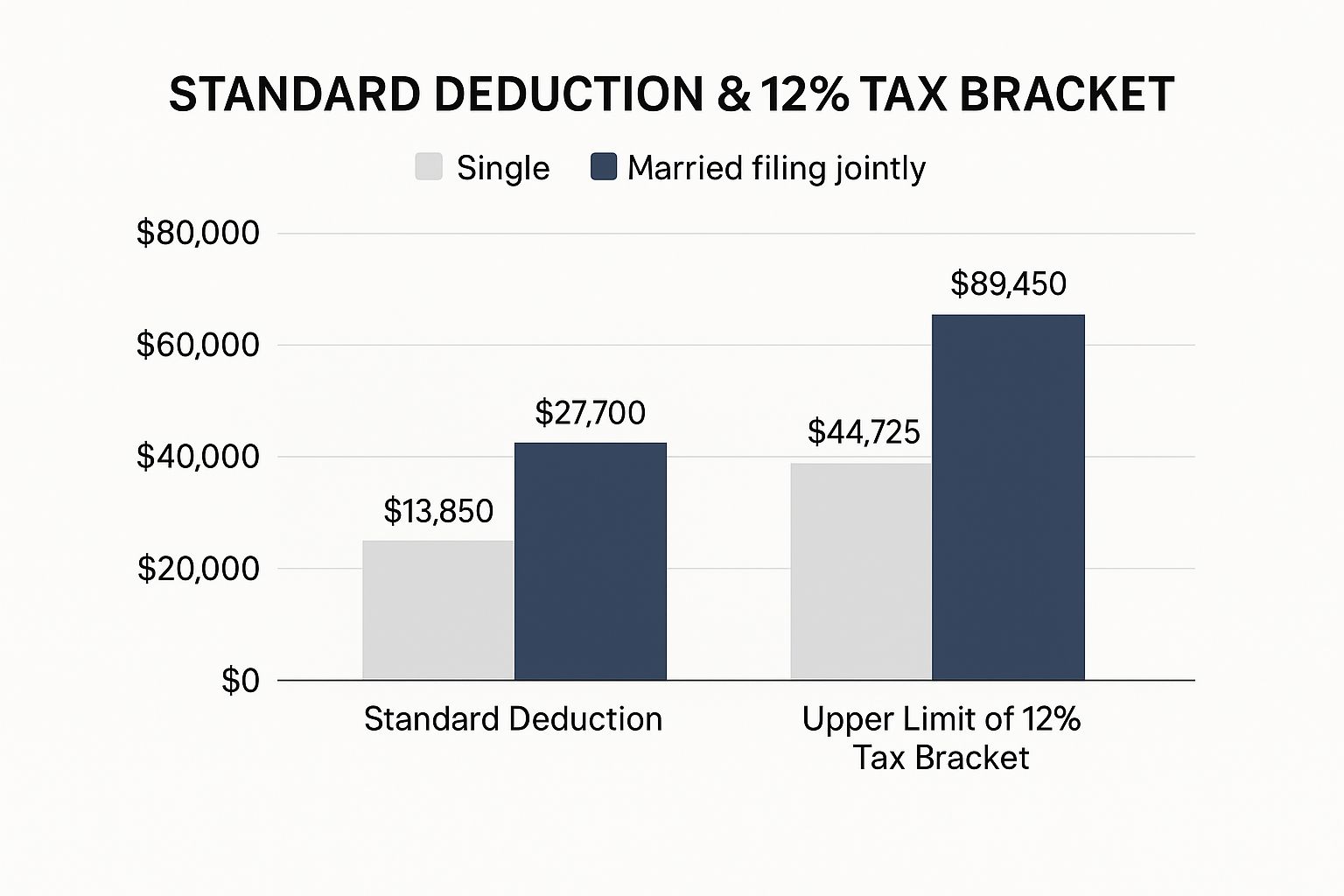
The chart clearly illustrates that joint filers can earn twice the income of a single filer before moving into the next tax bracket, showcasing a primary mechanism for tax savings.
Actionable Tips for Optimization
To ensure you’re leveraging this benefit correctly, consider these strategies:
- Calculate Both Ways: Always run the numbers for both “Married Filing Jointly” and “Married Filing Separately.” While joint filing is usually better, this confirms the optimal choice for your specific financial situation.
- Time Your Income: If you have control over when you receive income (e.g., bonuses or freelance payments), you can time it to avoid pushing your joint income into a higher bracket for a given year.
- Stay Updated: Tax bracket thresholds and standard deduction amounts are adjusted for inflation annually. Review the new figures each year to inform your tax planning.
2. Maximized Standard Deduction
Another primary advantage of filing jointly is the access to a significantly larger standard deduction. The standard deduction is a fixed dollar amount that taxpayers can subtract from their adjusted gross income (AGI) to reduce their taxable income. For married couples filing jointly, this deduction is precisely double the amount offered to single filers or those married filing separately.
This simple but powerful benefit provides immediate tax savings, especially for couples who don’t have substantial deductible expenses like mortgage interest, state and local taxes, or charitable contributions. It simplifies the tax preparation process by allowing you to bypass the often-complex task of itemizing deductions. For the 2023 tax year, the standard deduction for joint filers was $27,700, compared to just $13,850 for single filers. You can learn more about the 2024 standard deduction increases on alliedtax.com.

How the Larger Deduction Translates to Savings
Consider a married couple who rents their home, makes modest charitable donations, and lives in a state with no income tax. Their potential itemized deductions might only total $5,000. By filing jointly and taking the $27,700 standard deduction (for 2023), they reduce their taxable income by an additional $22,700 compared to what they could have claimed by itemizing. This directly lowers their tax liability.
“The doubled standard deduction is a cornerstone of the benefits of filing taxes jointly. It acts as a high-income floor, ensuring that most married couples receive a substantial tax break without the burden of tracking every single deductible expense.” – Senior Tax Strategist, Allied Tax Advisors
Even homeowners might find the standard deduction more advantageous. If a couple has $15,000 in mortgage interest and $8,000 in state and local taxes, their total itemized deductions are $23,000. The joint standard deduction of $27,700 still offers them a larger tax benefit, making it the clear choice.
Actionable Tips for Optimization
To ensure you are making the most of this benefit, follow these key strategies:
- Compare Annually: Always add up your potential itemized deductions (mortgage interest, state/local taxes up to $10,000, medical expenses exceeding 7.5% of AGI, and charitable gifts) and compare the total to the current year’s standard deduction. Choose the one that gives you a larger deduction.
- “Bunch” Your Deductions: If your itemized deductions are close to the standard deduction amount each year, consider “bunching” them. You could, for example, make two years’ worth of charitable contributions in a single year to exceed the standard deduction, and then take the standard deduction the following year.
- Keep Records Anyway: Even if you plan to take the standard deduction, it’s wise to keep records of potentially deductible expenses. A major unexpected medical bill or a large charitable gift could easily push you over the threshold, making itemizing the better option for that year.
3. Enhanced Retirement Savings Opportunities
Filing taxes jointly unlocks powerful strategies for building a robust retirement nest egg, a key benefit that goes beyond immediate tax savings. The IRS provides more generous rules for married couples filing jointly, particularly concerning tax-advantaged retirement accounts like IRAs. This allows couples to save more effectively for their future, especially in situations where one spouse has little or no earned income.
The most significant advantage is the spousal IRA. This rule allows a working spouse to contribute to a traditional or Roth IRA on behalf of a non-working or low-earning spouse. This effectively doubles a single-income family’s ability to save in one of the most popular retirement vehicles, ensuring both partners are building long-term financial security.
How Joint Filing Boosts Retirement Savings
Consider a couple where one spouse is a stay-at-home parent and the other earns $150,000. Under separate filing rules, the non-working spouse would be ineligible to contribute to an IRA because they have no earned income. By filing jointly, however, the couple can open a spousal IRA.
“The spousal IRA is one of the most underutilized benefits for married couples. It recognizes the economic contribution of a non-working partner and allows the family unit to maximize its tax-advantaged savings potential.” – Lead Financial Planner, Vanguard Personal Advisor Services
For 2023, this means the working spouse can contribute up to $6,500 to their own IRA and an additional $6,500 to the spousal IRA, for a total of $13,000 in contributions. Furthermore, income phase-out ranges for contributing to accounts like a Roth IRA are much higher for joint filers, allowing more couples to access these powerful tools.
Actionable Tips for Optimization
To make the most of these retirement benefits of filing taxes jointly, use these strategies:
- Prioritize the Spousal IRA: If one spouse does not work or has low income, make funding a spousal IRA a top priority each year to double your family’s tax-advantaged savings power.
- Coordinate Your Accounts: Develop a unified retirement strategy. Decide how to allocate contributions between each spouse’s 401(k), traditional IRAs, and Roth IRAs to balance tax deductions now with tax-free growth later.
- Plan Roth Conversions: If you anticipate being in a higher tax bracket in retirement, consider converting traditional IRA funds to a Roth IRA during a year when your joint income is temporarily lower, such as during a career change or sabbatical. Learn more about how your filing status impacts your savings with our guide to planning for retirement and its tax effects.
4. Expanded Child and Dependent Care Benefits
For couples with children or other qualifying dependents, one of the most compelling benefits of filing taxes jointly is gaining access to more generous, family-focused tax credits. Filing jointly often unlocks higher income thresholds and larger credit amounts for critical benefits like the Child Tax Credit and the Child and Dependent Care Credit, which are severely restricted or entirely unavailable to those who file separately.
These credits are designed to provide direct financial relief to working families, and the tax code explicitly favors a joint filing status to deliver this support. For many parents, these credits can reduce their tax liability dollar-for-dollar, sometimes resulting in a significant refund. The difference between filing jointly versus separately can mean leaving thousands of dollars on the table.

How Child-Related Credits Favor Joint Filers
The advantage is clear when looking at the phase-out limits. For the Child Tax Credit, joint filers can have a modified adjusted gross income (MAGI) up to $400,000 before the credit begins to decrease. In stark contrast, the threshold for married couples filing separately is just $200,000. A couple with a combined income of $300,000 would receive the full credit by filing jointly but would be completely ineligible if they filed separate returns.
Similarly, the Child and Dependent Care Credit, which helps offset childcare costs for working parents, is generally not available to couples who file separately. To claim this credit, which can be worth up to $1,050 for one child or $2,100 for two or more, you almost always must file a joint return.
“The tax code uses credits like the Child Tax Credit and the Dependent Care Credit to support families. Filing jointly is the key that unlocks the full potential of these benefits, often making it the only viable option for parents who want to minimize their tax burden.” – Family Tax Specialist, Summit Financial Group
For a family with two qualifying children, filing jointly could mean receiving up to $4,000 from the Child Tax Credit alone, directly reducing their tax bill. Forgoing this by filing separately would be a significant financial misstep.
Actionable Tips for Optimization
To maximize these family-oriented benefits, use the following strategies:
- Verify Dependent Eligibility: Ensure each child claimed meets all IRS tests for a qualifying child, including age, relationship, residency, and support. Proper documentation is crucial.
- Track Childcare Expenses: Keep meticulous records of all payments made for dependent care (e.g., daycare, summer camps, after-school programs) to maximize the Child and Dependent Care Credit.
- Coordinate with Your Partner: Both spouses must provide their Social Security numbers on the tax return. Ensure all information is consistent to avoid processing delays or credit denials from the IRS.
5. Education Tax Benefits and Credits
For couples investing in higher education for themselves or their dependents, filing jointly unlocks more generous tax credits and deductions. The IRS provides several education-related benefits, and the income phase-out ranges for these perks are significantly higher for joint filers. This makes it easier for two-income households to qualify for valuable savings that help offset the steep costs of college.
These advantages apply to key benefits like the American Opportunity Tax Credit (AOTC), the Lifetime Learning Credit (LLC), and the student loan interest deduction. By combining incomes under a joint return, couples can often remain below the income thresholds that would otherwise disqualify them if they filed separately, which is a major reason why this is one of the key benefits of filing taxes jointly.
How Higher Income Limits Translate to Savings
Consider a couple where each spouse earns $90,000, for a combined income of $180,000. They are paying for their child’s college tuition. The American Opportunity Tax Credit (AOTC), which offers a credit of up to $2,500 per student, begins to phase out for single filers with incomes above $80,000. If this couple filed separately, neither would qualify. However, by filing jointly, their $180,000 income falls just within the maximum threshold, allowing them to claim the credit.
“Filing jointly is almost always a requirement to claim education credits. The income phase-outs for married couples filing separately are prohibitively low, effectively barring them from these powerful tax-saving tools for education.” – Senior Tax Strategist, University Financial Planners
This same logic applies to deducting student loan interest. A couple can deduct up to $2,500 in student loan interest with a joint income up to $185,000 (for 2023). If they filed separately, they would be completely ineligible for this deduction, regardless of their individual incomes.
Actionable Tips for Optimization
To ensure you are maximizing your education-related tax benefits, implement these strategies:
- Coordinate Credits and Savings Plans: You cannot use the same qualified education expenses to claim an education credit and to justify a tax-free distribution from a 529 plan. Plan your expenses and withdrawals carefully to maximize both benefits.
- Choose the Right Credit: You can claim either the AOTC or the LLC for a student in a given year, but not both. The AOTC is generally more valuable for the first four years of undergraduate education, while the LLC is broader and can be used for graduate studies and courses taken to acquire job skills.
- Time Tuition Payments: If your income is close to the phase-out limit, consider prepaying the next semester’s tuition in December. This allows you to claim the expense in the current tax year, potentially securing a credit you might not qualify for next year.
6. Estate and Gift Tax Advantages
Beyond annual income tax savings, one of the most powerful long-term benefits of filing taxes jointly is the access it provides to significant estate and gift tax advantages. These provisions are crucial for high-net-worth couples focused on preserving their wealth and ensuring a smooth transfer to the next generation. For married individuals, federal law provides powerful tools to pass assets between spouses and to heirs with minimal tax friction.
This advantage stems primarily from two key concepts: the unlimited marital deduction and gift tax portability. The unlimited marital deduction allows you to transfer an unrestricted amount of assets to your surviving spouse at any time, including at death, completely free of federal gift or estate tax. This ensures the surviving spouse has the financial resources they need without immediate tax consequences.
How Estate Planning Benefits Translate to Savings
Consider a couple with a substantial estate. If one spouse passes away, they can leave their entire portion of the estate to the surviving spouse without triggering any estate tax, regardless of its value. Furthermore, couples can combine their annual gift tax exclusions. In 2024, this means they can jointly gift up to $36,000 ($18,000 per person) to any number of individuals each year without filing a gift tax return.
“The concept of ‘portability’ is a game-changer for married couples. It allows a surviving spouse to use the deceased spouse’s unused lifetime exemption, effectively doubling the amount they can pass to heirs tax-free. Failing to make the portability election is one of the costliest estate planning mistakes.” – Ed Slott, CPA and Founder of Ed Slott and Company, LLC
Portability is especially critical. For 2024, the federal estate tax exemption is $13.61 million per person. If the first spouse to die doesn’t use their full exemption, the surviving spouse can elect to add the unused portion to their own, potentially shielding over $27 million from estate taxes. For a deeper understanding of the differences, you can learn more about estate taxes and how they work on alliedtax.com.
Actionable Tips for Optimization
To ensure you are fully leveraging these estate and gift tax benefits, consider the following strategies:
- File for Portability: Even if the deceased spouse’s estate is below the filing threshold, you must file an estate tax return (Form 706) to elect portability. This preserves the unused exemption for the surviving spouse.
- Coordinate Gifting Strategies: Use your combined annual gift exclusion to reduce the size of your taxable estate over time. This is a simple yet effective way to transfer wealth to children or grandchildren tax-free.
- Consult an Estate Planning Attorney: While joint filing provides the framework, complex situations involving trusts, business ownership, or blended families require professional guidance to align your tax strategy with your overall estate plan.
Joint Tax Filing Benefits Comparison
| Benefit Area | Implementation Complexity 🔄 | Resource Requirements ⚡ | Expected Outcomes 📊 | Ideal Use Cases 💡 | Key Advantages ⭐ |
|---|---|---|---|---|---|
| Lower Tax Brackets and Reduced Tax Liability | Moderate – requires income assessment | Low – mostly filing status choice | Significant tax savings for uneven incomes | Couples with income disparity or single-earner households | Lower tax rates, wider brackets, income averaging |
| Maximized Standard Deduction | Low – simple filing choice | Minimal – no itemization needed | Immediate taxable income reduction | Couples without large itemized deductions | Double standard deduction, simplified process |
| Enhanced Retirement Savings Opportunities | Moderate – managing multiple accounts | Medium – retirement accounts and contributions | Increased retirement contribution limits | Couples maximizing IRA contributions, with one non-working spouse | Higher IRA limits, spousal IRA eligibility |
| Expanded Child and Dependent Care Benefits | Moderate – coordination of credits | Medium – documentation for dependents | Greater refundable and non-refundable credits | Families with children or dependents | Higher income limits, multiple child credits |
| Education Tax Benefits and Credits | Moderate – optimize timing and credits | Medium – education expense tracking | Tax credits and deductions for education expenses | Families paying for higher education or student loans | Higher income thresholds, multiple education credits |
| Estate and Gift Tax Advantages | High – complex estate planning | Medium to High – coordination with legal advisors | Significant tax and wealth transfer benefits | High-net-worth couples planning estate transfers | Unlimited marital deductions, portability, doubled exemptions |
Making the Right Choice for Your Financial Future
Navigating the landscape of tax filing as a married couple presents a significant decision point, one that carries substantial weight for your financial well-being. Throughout this guide, we have explored the multifaceted benefits of filing taxes jointly, demonstrating how this single choice can profoundly impact your bottom line. The advantages are not just theoretical; they are tangible, translating into real dollars saved and opportunities gained.
By combining incomes, most couples immediately benefit from more favorable tax brackets, often resulting in a lower overall tax bill than if they were to file separately. This fundamental advantage is amplified by a significantly higher standard deduction, which doubles the amount of income shielded from taxation right from the start. This strategic combination alone makes joint filing the most logical and financially sound option for the vast majority of married taxpayers.
Synthesizing the Benefits for a Stronger Financial Position
The power of filing jointly extends far beyond the initial tax calculation. It unlocks a suite of powerful credits and deductions that are often restricted or completely unavailable under the Married Filing Separately status. Consider the key takeaways from our discussion:
- Retirement Security: Your ability to contribute to Roth IRAs is preserved, allowing for tax-free growth and withdrawals in retirement, a cornerstone of long-term wealth building.
- Family Support: Access to the full Child and Dependent Care Credit, the American Opportunity Credit, and the Lifetime Learning Credit provides direct financial relief for raising children and pursuing higher education.
- Simplified Wealth Transfer: The estate and gift tax exemptions are doubled, creating a more efficient and less taxed pathway for transferring wealth to the next generation.
These elements work in concert, creating a synergistic effect that reinforces your financial stability. The decision to file jointly is more than just a procedural choice; it is a strategic move to leverage your marital status for maximum financial advantage.
Actionable Steps for Confident Filing
While the benefits of filing taxes jointly are clear, the best path forward always depends on your unique financial circumstances. For most couples, the decision will be straightforward. However, it is always prudent to confirm this choice by taking concrete steps. Start by gathering all relevant financial documents for both spouses, including W-2s, 1099s, and records of potential deductions.
Key Insight: The true power of joint filing is realized when you not only choose the right status but also meticulously claim every credit and deduction you are entitled to. A proactive approach ensures you are not leaving money on the table.
Ultimately, mastering your tax strategy is about empowerment. Understanding how these rules apply to your life allows you to make informed decisions that align with your goals, whether that means saving for a down payment, investing in your children’s future, or planning for a comfortable retirement. Choosing to file jointly is often the first and most impactful step on that journey.
Navigating these complex tax decisions shouldn’t be a source of stress. The expert team at Allied Tax Advisors specializes in personalized tax planning, helping you analyze your specific situation to confirm the most beneficial filing status. Let us help you maximize your return and build a strong financial future together. Contact Allied Tax Advisors today for a comprehensive review of your tax strategy.