
At its heart, bookkeeping for a small business is a pretty simple concept: you need to keep track of every dollar that comes in and every dollar that goes out. This isn't just a chore for tax time; it's about creating a clear, up-to-the-minute dashboard of your company's financial health.
When you have that kind of clarity, you can make smarter decisions, notice real opportunities for growth, and build a business that's meant to last.
Why Bookkeeping Is Your Business's Command Center

It’s tempting to see bookkeeping as just another administrative task, but it’s so much more. Think of it as the command center for your entire operation. It provides the critical intelligence you need to steer the ship. Without it, you're flying blind, never quite sure if you have enough fuel to reach your destination.
Many small business owners feel lost in a fog of numbers, but building a simple system is more achievable than you might think. The goal isn't to become an accountant overnight. It's about gaining the confidence to read and understand your company's financial story. That foundation is what allows you to manage cash flow, plan for big expenses, and secure funding when you need it most.
Moving from Stress to Strategy
Let's be honest: a lot of entrepreneurs feel out of their depth with the financial side of things. In fact, around 60% of small business owners admit they don't feel confident in their knowledge of accounting and bookkeeping. That knowledge gap can lead to real problems, like missed tax deductions, poor cash management, and costly filing delays that hold the business back.
By getting a handle on the fundamentals, you can turn your finances from a source of anxiety into your most powerful strategic tool. A well-organized bookkeeping system gives you a few major advantages:
- Better Decision-Making: You can see exactly where your money is going, which means you can invest more in what's working and cut back on what's not.
- Painless Tax Prep: An organized record makes tax season so much smoother and helps you claim every single deduction you're entitled to.
- Stronger Credibility: Whether you're trying to get a loan from a bank or attract investors, clean books show that your business is stable and professional.
To really build that solid financial foundation, it's worth digging a bit deeper. A great starting point is a comprehensive founder's guide to bookkeeping for startups. With the right approach, you’ll gain the clarity you need to navigate your business journey successfully.
Understanding the Building Blocks of Your Finances
Before you can build a solid financial house, you need to know your materials. Getting the bookkeeping basics right from the start is all about understanding a few core ideas. Once they click, everything else falls into place. This isn't about memorizing dry definitions; it’s about getting a gut feel for how money flows through your business.
Let’s use an analogy. Imagine your business is a brand-new food truck.
The truck itself, your cash register, and all that shiny kitchen equipment? Those are your Assets—valuable things you own.
That loan you took out for the top-of-the-line grill? That’s a Liability—money you owe to someone else.
And the cash you put in to start the whole thing, plus any profits you've plowed back in? That's your Equity.
These three pieces are always connected and in perfect balance. They form what’s known as the fundamental accounting equation:
Assets = Liabilities + Equity
This little formula is the bedrock of all bookkeeping. It’s a self-checking mechanism that ensures for every action, there's an equal reaction, keeping your financial records logical and whole. Every single time you buy inventory, pay an employee, or make a loan payment, this equation is at work behind the scenes.
Choosing Your Bookkeeping Method
Now that you have the core equation, you need to decide how you’ll log all your transactions. There are two main ways to do it, and your choice really boils down to how complex your business is.
For a quick comparison, here's a look at how they stack up.
Single-Entry vs. Double-Entry Bookkeeping
A quick comparison to help you decide which method is right for your business.
| Feature | Single-Entry Bookkeeping | Double-Entry Bookkeeping |
|---|---|---|
| How it Works | Like a checkbook register; records income and expenses in a single column. | Every transaction affects at least two accounts (a debit and a credit). |
| Best For | Freelancers, sole proprietors, or very small businesses with simple transactions. | Most businesses, including S-corps, LLCs, and growing companies. |
| Complexity | Very simple to learn and maintain. | Steeper learning curve but provides a complete financial picture. |
| Error Checking | Difficult; errors can easily go unnoticed. | Self-balancing; makes it much easier to spot and fix mistakes. |
| Reporting | Limited to basic income and expense reports. | Generates comprehensive reports like the Balance Sheet and Income Statement. |
So, what's the verdict?
If you're a freelancer with just a handful of clients, single-entry might be all you need to get by for now. But for almost everyone else, double-entry is the way to go. It’s the professional standard for a reason—it builds a clear audit trail and forces your books to stay balanced, which is invaluable as you grow.
Deciding When to Record Transactions
Next up is timing. When does a transaction officially make it into your books? This depends on whether you choose the cash or accrual method of accounting.
Let’s say you’re a consultant. You finish a big project in June and send the invoice, but your client doesn't actually pay you until August.
-
With the cash method, you record the income in August—the moment the cash physically lands in your bank account. It’s simple and gives you a brutally honest look at how much cash you have on hand right now.
-
With the accrual method, you’d record that income back in June, when you actually earned it by finishing the work. This approach gives you a much more accurate picture of your company's performance over time, even if the cash flow is a little lumpy.
While the cash method feels more intuitive at first, most growing businesses eventually switch to the accrual method. It simply provides a more realistic view of your financial health. Getting these concepts down is a huge first step, and you can dig deeper with more accounting tips for small business owners to build on this foundation.
Organizing Everything with a Chart of Accounts
So where do all these transactions, debits, and credits actually live? They get organized in your Chart of Accounts.
Don't let the formal name spook you. A Chart of Accounts is just a list of all the financial accounts in your business, sort of like a digital filing cabinet. Each "file folder" is a specific category.
Your list will be unique to your business, but it will always include the main types:
- Checking Account (Asset)
- Equipment (Asset)
- Business Loan (Liability)
- Sales Revenue (Income)
- Office Supplies (Expense)
- Marketing Costs (Expense)
When you spend $100 at Staples, that transaction gets filed away in the "Office Supplies" folder. This simple act of categorizing makes it incredibly easy to see exactly where your money is coming from and where it’s going. This is the secret to generating financial reports that actually mean something. Setting up a logical Chart of Accounts from day one is one of the smartest things any new business owner can do.
How to Build Your Bookkeeping System From Day One
Now that you've got the core concepts down, it's time to build your financial foundation. Setting up a solid bookkeeping system isn't about finding a magic, one-size-fits-all solution. It's about crafting a process that actually fits your business and your own comfort level, right from the very beginning.
Putting in this effort now saves you from the frantic, late-night scramble to make sense of a shoebox full of crumpled receipts when tax season rolls around. Trust me, you'll thank yourself later.
The first big question you need to answer is whether you’ll handle the books yourself (DIY) or bring in a professional. There's no right answer here—it all comes down to how complex your business is, how much time you have, and where your skills lie.
Deciding Between DIY and Professional Help
The DIY route has never been more accessible. Modern software puts you squarely in the driver's seat, which is a fantastic way to save money and get a gut-level feel for the financial pulse of your business. This is a great starting point for freelancers, solopreneurs, and brand-new businesses with simple, straightforward transactions.
On the other hand, outsourcing to a bookkeeper or an accounting firm buys you back your most valuable asset: time. As your business grows and things get more complicated, a pro ensures everything is accurate and compliant. They can even offer strategic advice that helps you grow smarter. This is usually the best move for businesses with employees, inventory, or those on a fast-growth track.
No matter which path you choose, the first few setup steps are pretty much the same.
Step 1: Open a Dedicated Business Bank Account
This is non-negotiable. It’s the single most important thing you can do to create a clear line between your business and personal finances. Mixing them is one of the most common—and messy—mistakes a small business owner can make. It creates a tangled web that's a nightmare to sort out later.
A separate business bank account and credit card solves three big problems at once:
- It simplifies your record-keeping. Every transaction in that account is clearly for the business, making it a breeze to categorize everything.
- It strengthens your legal protection. For LLCs and corporations, keeping finances separate (what lawyers call the "corporate veil") is crucial for protecting your personal assets if the business ever gets into trouble.
- It creates a professional image. It shows clients, vendors, and banks that you’re running a serious, organized operation.
Think of it this way: You wouldn't store your grocery list in the same file as your company's strategic plan. Your money deserves the same level of organization.
Step 2: Choose and Set Up Your Software
While you could use a spreadsheet for a tiny side hustle, dedicated accounting software is a much more reliable and scalable choice. Platforms like QuickBooks are built from the ground up to handle the bookkeeping basics for small business, automating a ton of tedious tasks you’d otherwise have to do by hand.
When you're picking your software, look for something with a clean interface that makes it easy to categorize transactions, send invoices, and pull basic financial reports. The initial setup is a make-or-break moment. You can even integrate tools like QuickBooks and Airtable to streamline your small business finances to create a powerful, customized system.
If you’re just getting started with QuickBooks, a little guidance can go a long way. To make sure you get it right from day one, check out our guide on how to set up QuickBooks.
Step 3: Gather All Necessary Documents
Okay, your bank account is open and your software is ready to go. Now it's time to collect the raw materials for your bookkeeping system. The key here is organization. Create a simple system—digital folders, physical binders, whatever works for you—and stick to it.
Here’s a quick checklist of the essential documents you'll need:
- Bank and credit card statements
- All sales receipts and invoices you've sent to clients
- Bills and receipts from your vendors and suppliers
- Payroll records (if you have employees)
- Previous tax returns
- Any loan agreements and statements
This infographic breaks down how all this data comes together.
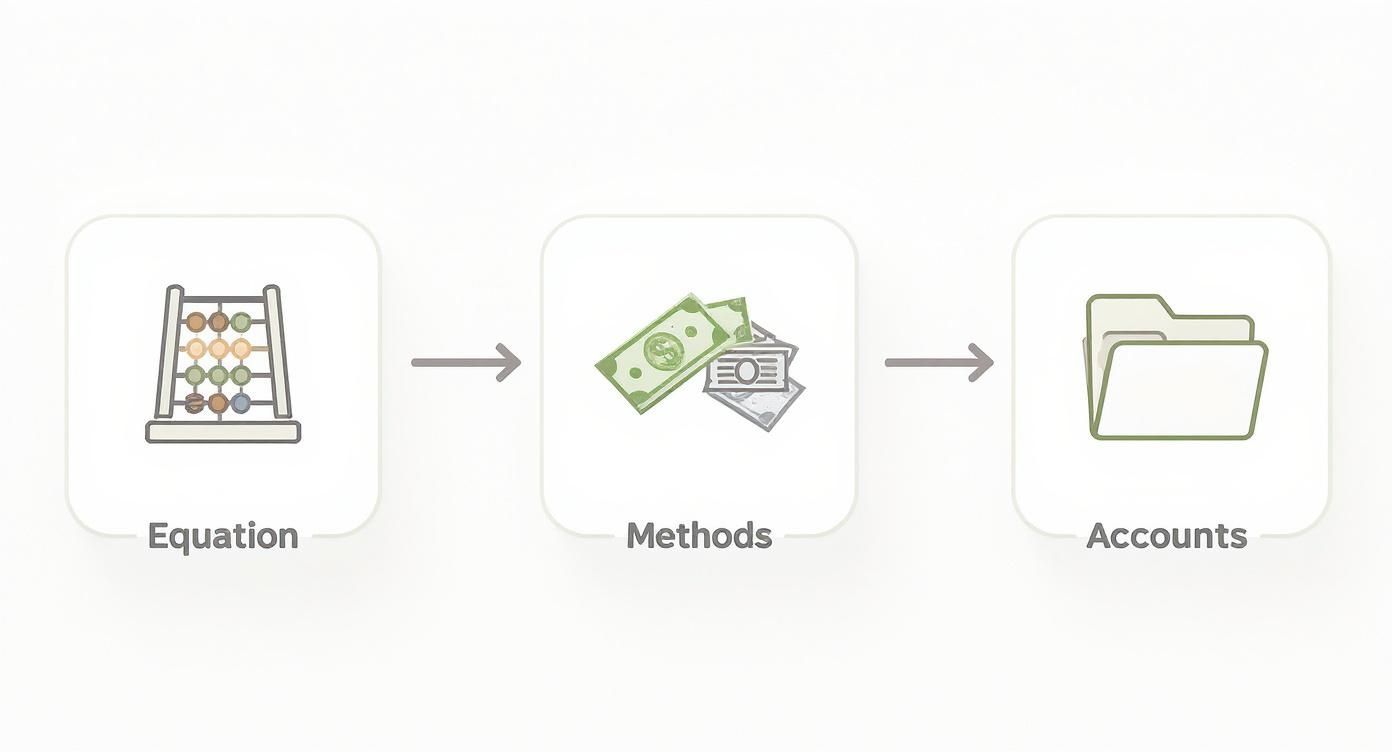
You can see how everything flows from that core accounting equation into specific accounts. This is how a structured system brings clarity and order to your financial world.
Setting Up Your Financial Rhythm
Solid bookkeeping isn’t about heroic, all-night sessions wrestling with spreadsheets. It’s the result of small, consistent habits that become a natural part of your business operations. Let's walk through the daily, weekly, and monthly workflows that will keep your finances in order without completely taking over your schedule.
Think of your books like a well-tended garden. You can't just show up once a quarter with a firehose and expect things to be healthy. A little attention every day or so keeps the weeds at bay and helps everything flourish. Your business finances are exactly the same.
The Daily 15-Minute Check-In
Your daily routine should be fast and to the point—no more than 15 minutes. The goal here is simple: capture financial activity while it's still fresh.
- Log Every Transaction: Every single dollar that comes in or goes out gets recorded. That means every sale, every payment to a vendor, and even that small cash purchase for printer paper.
- Categorize on the Spot: As you log a transaction, give it a home. Was it "Office Supplies," "Marketing," or a "Software Subscription"? Doing this now saves you from a massive, headache-inducing cleanup project down the line.
This simple daily habit is your first line of defense against financial chaos. It turns bookkeeping from a monster you have to battle into a quick, easy checkpoint.
Weekly and Monthly Routines for a Clearer View
While daily entries keep you up-to-date, your weekly and monthly tasks are where you start seeing the bigger picture and take real control over your cash flow. This is where you shift from just recording information to actually managing it.
Here’s a simple rhythm to get into:
-
Weekly To-Dos:
- Chase Your Invoices (Accounts Receivable): Get new invoices out the door and gently nudge clients whose payments are overdue. A consistent follow-up is often all it takes to get paid on time.
- Schedule Your Payments (Accounts Payable): Look at the bills coming due and schedule them for payment. This helps you manage your cash outflow and keeps your suppliers happy.
- Check Your Cash Pulse: Take a quick look at your bank balance and compare it against the payments you have scheduled. Is there enough cash to cover everything? This quick check prevents nasty surprises.
-
Monthly Must-Dos:
- Reconcile Your Bank Accounts: This is a non-negotiable step we'll dive into next.
- Review Your Key Reports: Glance over your Income Statement and Balance Sheet. Are there any surprising trends? Does anything look out of place?
- Handle Payroll: If you have a team, make sure payroll is run correctly and on time.
Thankfully, modern tools have made this routine easier than ever. In fact, about 64.4% of American small and medium-sized businesses now rely on accounting software to handle the heavy lifting. Cloud-based platforms like QuickBooks can sync directly with your bank, automatically pulling in transactions and saving you a ton of manual entry. If you're curious, you can learn more about bookkeeping technology statistics and see just how much of an impact these tools are having.
Mastering the Art of Bank Reconciliation
If you only have time for one monthly financial task, make it bank reconciliation. It might sound intimidating, but it's really just the business version of balancing your checkbook. You're just comparing the transactions you’ve recorded against your official bank statement to make sure everything lines up perfectly.
Here’s what that looks like inside a tool like QuickBooks, which is built for this very purpose.
This dashboard view makes it clear what's come in from your bank and what you still need to categorize and confirm.
Think of bank reconciliation as your financial safety net. It’s the one process that will catch a bank error, spot a fraudulent charge, or confirm that your own records are 100% accurate.
When your books are reconciled, you can trust your numbers completely. You know that the financial reports you're looking at are a true reflection of your business's health. This is what allows you to make smart, strategic decisions with confidence, because you're working with data you can stand behind. This single routine turns bookkeeping from guesswork into a source of undeniable financial truth.
Making Sense of Your Financial Reports

All that careful bookkeeping you've been doing? It all leads to this: creating powerful financial reports. Think of these reports as the story of your business, told in numbers. They take thousands of individual transactions—every sale, every bill, every payroll run—and organize them into a clear picture of your company's health.
Don't let the term "financial report" intimidate you. They aren't just for accountants; they're your guide to making smarter decisions. They show you where you've been, where you are now, and what paths are open for future growth. Let's break down the "big three" reports every business owner needs to understand.
The Balance Sheet: Your Financial Snapshot
First, we have the Balance Sheet. The name says it all—it presents a balanced view of your company's financial standing at a single point in time. It’s like taking a high-resolution photograph of your business’s net worth on a specific day.
The whole report is built on that core accounting equation we talked about earlier:
Assets = Liabilities + Equity
The Balance Sheet lists everything your company owns (its assets) and everything it owes (its liabilities). Whatever is left over is your equity, which is essentially your stake in the business.
For a small coffee shop, the assets side would show the espresso machine, cash in the register, and inventory of beans. The liabilities side would list the loan for that machine and any unpaid supplier invoices. The balance sheet tells you, plain and simple, what your business is worth.
The Income Statement: Your Profitability Over Time
Next up is the Income Statement, often called the Profit and Loss (or P&L) statement. If the Balance Sheet is a snapshot, the Income Statement is a movie. It shows how your business performed financially over a specific period, whether that's a month, a quarter, or a full year.
The concept here is pretty simple. It takes all the money you've earned and subtracts all the money you've spent, leaving you with your net income, or profit.
- Revenue: This is all the money you brought in from selling your products or services.
- Expenses: These are the costs you had to pay to generate that revenue—things like rent, payroll, supplies, and marketing.
The P&L helps our coffee shop owner see if that new latte flavor is actually profitable or if their marketing efforts are paying off. It answers the most fundamental question: "Am I making money?"
The Cash Flow Statement: The Journey of Your Cash
Finally, we have the Cash Flow Statement. This one can seem a little more complex, but for a small business, it might be the most critical report of all. Why? Because a business can look profitable on paper but still fail if it runs out of actual cash to pay its bills.
This report tracks the real movement of cash into and out of your business, separating it into three key areas:
- Operating Activities: Cash from your core business, like customer payments.
- Investing Activities: Cash spent on or received from selling long-term assets, like buying a new delivery van.
- Financing Activities: Cash from investors, loans, or owner contributions.
It helps you see exactly where your money is going and where it's coming from. It answers the urgent question: "Do I have enough cash to keep the lights on?"
To put it all together, these three reports work in tandem to give you a complete financial picture. Each one offers a different but equally important perspective.
The Three Essential Financial Reports
| Financial Report | What It Shows | Key Question It Answers |
|---|---|---|
| Balance Sheet | A snapshot of your assets, liabilities, and equity on a specific date. | What is my business worth today? |
| Income Statement (P&L) | Your revenue, expenses, and net profit over a specific period. | Is my business profitable? |
| Cash Flow Statement | The movement of cash from operating, investing, and financing activities. | Where did my cash go, and do I have enough to pay my bills? |
Ultimately, learning how to prepare financial statements is what turns raw bookkeeping data into real business intelligence. It’s the skill that empowers you to stop guessing and start making confident, data-backed decisions for your company’s future.
Sidestepping Common Financial Landmines
When it comes to your business finances, an ounce of prevention is truly worth a pound of cure. Building good habits right out of the gate is infinitely easier than trying to unravel a tangled mess of transactions months—or years—down the line.
The good news? Most of the stress-inducing bookkeeping nightmares that keep owners up at night are completely avoidable. If you know where others have stumbled, you can gracefully sidestep those pitfalls and keep your books clean from day one.
The #1 Mistake: Mixing Business and Personal Funds
This one is the cardinal sin of small business bookkeeping: mixing personal and business funds. It seems innocent enough—using your personal credit card for office supplies or paying your phone bill from the business account. But in reality, you're creating a chaotic web that's a nightmare to untangle.
This bad habit doesn’t just make bookkeeping difficult; it can also put your personal assets at risk. If your business is an LLC or corporation, mixing funds can "pierce the corporate veil," meaning your personal car, house, and savings could be on the line if the business gets into legal trouble.
The Fix: Before you make your first sale, open a dedicated business bank account and credit card. This is non-negotiable. Every single dollar in and out of your business must flow through these accounts. It creates a crystal-clear trail for you, your accountant, and the IRS.
The Chaos of "I'll Do It Later"
The second major misstep is simply being inconsistent. We’ve all heard of the shoebox-full-of-receipts method. Letting paperwork pile up or only logging expenses when you "get around to it" is a recipe for disaster.
This reactive approach almost guarantees you'll miss out on valuable tax deductions because you can't remember what a purchase was for. It makes your financial reports useless and turns tax time into a frantic, high-stress scramble.
To avoid this, find a simple rhythm that works for you. Set aside a recurring block of time—even 30 minutes every Friday afternoon—to tackle these basics:
- Log every transaction: Get all your sales and expenses into your books.
- Categorize everything: Assign each item to the right account (e.g., "Office Supplies," "Marketing").
- Scan your receipts: Snap a photo or scan every receipt and attach it to the transaction in your software.
This small, consistent effort turns a mountain of a task into a manageable weekly habit.
Costly Errors in Worker Classification and Reconciliation
Getting worker classification wrong can be a painful and expensive lesson. The difference between an independent contractor and an employee is a big deal in the eyes of the law and the IRS.
Classifying someone who should be an employee as a contractor can stick you with a massive bill for back taxes, penalties, and benefits. If you're even slightly unsure how to classify someone, get advice from a legal or tax professional. It’s worth every penny.
Finally, don't put off your bank reconciliations. This is the crucial monthly process where you match your books to your bank statements, line by line. It’s your final accuracy check. Skipping it means small errors, forgotten bank fees, or even fraudulent charges can slip through the cracks, quietly making your financial data unreliable. Make it a non-negotiable part of your month-end routine.
Answering Your Top Bookkeeping Questions
Even with a solid grasp of the basics, a few questions always seem to pop up when entrepreneurs start tackling their own books. Let's clear up some of the most common ones so you can feel confident moving forward.
Can I Really Do My Own Bookkeeping?
Absolutely. Especially when your business is new and the finances are simple, doing your own books is a great way to stay in control and really understand the flow of money in and out. Modern tools like QuickBooks have made DIY bookkeeping more straightforward than ever.
But there often comes a tipping point. As your business gets more complex—maybe you've hired employees, started managing inventory, or have multiple ways you're making money—the DIY approach can start to feel overwhelming.
So, when should you think about calling in a pro?
- You're spending more time on bookkeeping than on running your business. If your books are pulling you away from sales, marketing, or serving customers, it's time to hand them off.
- You're facing an audit or a tricky tax situation. Don't go it alone. A professional can save you a world of headaches (and potentially a lot of money).
- You want more than just data entry. A great bookkeeper or accountant doesn't just record what happened; they offer insights that help you make smarter decisions about the future.
It's no surprise that outsourcing is becoming the go-to strategy. In fact, roughly 78% of small businesses now use outside help for their bookkeeping, finding it more accurate and cost-effective. It's a clear sign that business owners see expert financial management as a real engine for growth. You can dive deeper into these trends by checking out some fascinating bookkeeping marketing statistics.
What Exactly Is a Chart of Accounts?
We've thrown this term around, so let's break it down. Think of your Chart of Accounts as the table of contents for your business's financial story.
It’s just a list of all the financial categories (or "accounts") you use to track your money. Everything from "Sales Revenue" and "Office Supplies" to "Bank Loans" gets its own account. A well-organized chart is the secret to getting clear, accurate financial reports.
Do I Have to Keep All Those Paper Receipts?
Good news: you can ditch the shoebox! In most situations, digital copies of your receipts are perfectly fine for the IRS.
Just snap a quick photo with your phone and upload it directly to the transaction in your accounting software. It's an easy way to create a secure, searchable, and clutter-free record of all your expenses.
At Allied Tax Advisors, we take the complexity out of small business bookkeeping and taxes. Our team provides the expert support you need to keep your finances organized, letting you focus on what truly matters—building your business. Stop by https://alliedtax.com to see how we can help.