
The real heart of the matter is this: business miles are generally tax-deductible trips between two different work locations. On the other hand, commuting miles are your personal, non-deductible trips from home to your main workplace. Getting this distinction right is absolutely crucial for accurate tax filings and making sure you get every vehicle-related deduction you deserve.
Defining the Line Between Business and Commuting
The IRS draws a very clear, firm line between travel that your job requires you to do and the travel it takes just to get to your job. This is a critical concept for anyone who drives for work, from self-employed contractors and gig workers to employees who need to track mileage for reimbursement. If you get it wrong, you could miss out on valuable deductions or, worse, face questions in an audit.
Think of it this way: the IRS views your daily drive to the office as a personal choice and responsibility, much like buying your work clothes. Because of this, those daily commuting miles are almost never deductible.
However, any driving that is an "ordinary and necessary" part of your business operations is considered deductible. This covers a lot of ground, including trips like:
- Driving from your main office to a client meeting.
- Traveling between two of your company's offices or separate worksites.
- Running errands specifically for your business, like picking up office supplies or making a bank deposit.
This careful separation between business and personal travel is a key part of tax compliance. It's conceptually similar to the detailed personal conveyance rules for commercial drivers, which strictly define the difference between on-duty and off-duty driving. In both cases, proper categorization is everything.
Quick Comparison of Mileage Types
To make this crystal clear, let's put the core differences side-by-side. The table below gives you a quick snapshot of what separates a deductible business trip from a non-deductible commute.
| Attribute | Business Miles (Deductible) | Commuting Miles (Non-Deductible) |
|---|---|---|
| Origin & Destination | Travel between two separate workplaces. | Travel from your home to a regular work location. |
| IRS View | An ordinary and necessary business expense. | A personal, non-deductible living expense. |
| Common Examples | Visiting clients, travel between offices, business errands. | Daily drive to and from your primary office. |
| Home Office Rule | Trips from a qualifying home office to clients are deductible. | Trips from home to an office are not, even if you sometimes work from home. |
This table serves as a great starting point, but as you'll see, the real world often has more complex scenarios.
Navigating the Gray Areas
While the basic rules seem straightforward enough, things can get tricky. What happens if you drive to a temporary job site for a few months? And what about the big one—what if your home is your primary place of business?
The most significant exception to the commuting rule involves a qualifying home office. When your home is your principal place of business, your first trip of the day to meet a client often transforms from a non-deductible commute into a deductible business trip.
Understanding these nuances is the key to logging your miles correctly and confidently claiming every deduction you've earned. Let's dig deeper into the specific IRS rules, look at some real-world examples, and break down that powerful home office exception.
How the IRS Sees Your Drive Time
To get your mileage deductions right, you have to think like the IRS. From their perspective, getting from your house to your main workplace is your personal responsibility—not a business cost. That's the simple, foundational rule behind why your daily commute is almost never tax-deductible.
The logic here is pretty straightforward. Everyone has to get to work, and the IRS sees this as a personal expense, just like buying your work clothes or a cup of coffee. It’s what you do before you start earning money, not an expense you rack up while on the clock.
It All Comes Down to Your "Tax Home"
One of the most important concepts the IRS uses is the idea of a tax home. This can be a bit confusing because it’s not necessarily the house you live in. Your tax home is your main place of business or post of duty—the city or general area where your work is centered.
Think of it this way: any drive from your personal residence to your tax home is a commute. But once you're there, any driving away from your tax home for a business reason is typically deductible. Grasping this distinction is the key to separating business miles from commuting miles. You can dive deeper into this topic in our complete guide to deducting vehicle expenses.
So, What Actually Counts as Business Travel?
Once you’ve arrived at your tax home (say, your main office), the meter for deductible mileage can start running. The IRS gives us a clear standard: deductible business travel is any driving that is both "ordinary and necessary" for your business.
This umbrella covers a lot of common work-related driving:
- Meeting Clients: Driving from your office to a client’s location for a meeting.
- Visiting Different Work Sites: Traveling between two of your company's offices or job sites.
- Running Business Errands: Making a trip from your workplace to pick up supplies, head to the bank for a business deposit, or mail a package for work.
- Visiting Temporary Work Locations: Driving from your home to a temporary work site that is outside your normal metropolitan area.
A key insight from IRS Publication 463 is that deductible travel expenses are those you incur while you're away from home for business. In this context, "home" means your tax home, not your personal residence.
The massive shift to remote work has certainly changed the game here. The pandemic dramatically cut down on traditional commutes, with roughly 69% of U.S. employees working from home at one point, a huge jump from the pre-pandemic 4.1%. This shift didn't just slash non-deductible commuting miles; it also changed the very nature of business travel, fundamentally altering how people track their driving.
Real-World Examples of Deductible Trips
Let's put these rules into practice with a few common scenarios. You'll see that the trip's origin, destination, and purpose are what really matter.
Scenario 1: The Sales Consultant
A consultant leaves her corporate office in downtown San Diego to meet a client at their office in La Jolla.
- The Verdict: This is 100% deductible business mileage. She’s traveling from one workplace (her main office) to another (the client’s) for a specific business reason.
Scenario 2: The Multi-Location Manager
A manager is in charge of two retail stores. He starts his day at Store A and then drives to Store B later in the afternoon.
- The Verdict: The drive between the two stores is deductible. It's necessary travel between two distinct business locations.
Scenario 3: The Office Errand
An office administrator drives from her workplace to an office supply store to pick up printer ink and paper for the company.
- The Verdict: This is a deductible business trip. The entire purpose of the drive was to run a necessary errand for the business.
In each of these examples, the travel is a direct part of conducting business, completely separate from the personal act of just getting to work.
Analyzing Real-World Driving Scenarios
It's one thing to read the IRS rules, but it’s another to apply them to your actual, day-to-day drives. The real trick is learning to look at each trip through the eyes of an auditor, focusing on where you started, where you ended up, and why you made the trip in the first place.
Let's break down some of the most common driving situations to build that muscle memory. Once you see the patterns, you'll be able to classify your own trips with confidence and make sure you're getting every deduction you deserve.
This decision tree is a great starting point for quickly visualizing how the IRS views your trips based on where your drive begins.
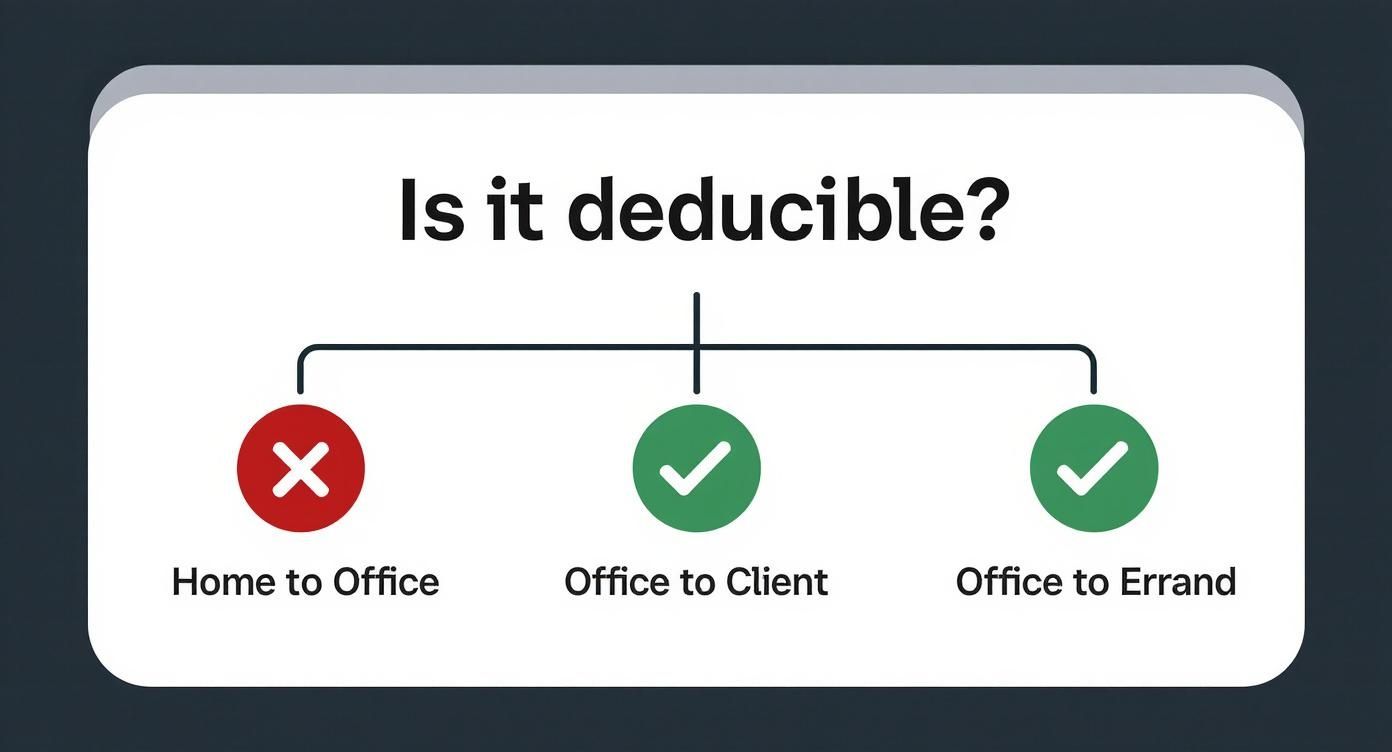
As you can see, a trip from your main office to a client's site is almost always a clear business expense. That first trip of the day, from your front door to that office? Not so much.
Standard Employee at a Corporate Office
We'll start with the most familiar setup: an employee who works at a company office. In this case, the office is considered your "tax home," which makes the rules pretty black and white.
Scenario A: The Daily Commute
An accountant drives 15 miles from her home to her firm’s downtown office each morning and makes the same trip back in the evening.
- Verdict: Commuting Miles. This is the textbook definition of a personal commute. The IRS firmly considers the cost of getting from your home to your primary workplace a non-deductible personal expense.
Scenario B: Midday Client Visit
Partway through her day, the same accountant drives from her office to a client’s headquarters for a meeting. Afterward, she drives back to her office to finish her workday.
- Verdict: Business Miles. This entire round trip is 100% deductible. She traveled between two different workplaces—her main office and a client's location—for a specific and necessary business reason.
The Self-Employed Professional or Freelancer
Things get a little more nuanced for freelancers, consultants, and gig workers who don't have a traditional office. Here, everything often depends on whether you have a legitimate home office that qualifies as your principal place of business.
Scenario C: The Freelance Photographer
A photographer with a qualifying home office drives to a park for a client photoshoot, then heads to a print shop to pick up an order for another client before finally returning home.
- Verdict: Business Miles. Since her home office is her business headquarters, all of this travel is deductible. The drive to the client, the stop at the vendor, and the final leg home are all part of her ordinary and necessary business activities.
Scenario D: The Gig Economy Driver
A rideshare driver leaves his house and drives to a busy downtown area where he plans to start accepting ride requests.
- Verdict: Commuting Miles. Those first miles from his home to his first passenger's location are generally considered a non-deductible commute. However, the moment he accepts that first ride, the clock starts. Every mile driven from that point until he drops off his final passenger for the day is a business mile.
The IRS stance is unwavering: commuting is personal. But when your home office is your principal place of business, that first drive of the day to a client or temporary job site transforms from a "commute" into a deductible business trip.
Navigating Temporary Work Locations
Another area that trips people up is travel to a work location that isn't your permanent spot. The IRS has specific rules for this, and they hinge on the duration of the work.
A location is considered temporary if you realistically expect to work there for one year or less.
- Scenario E: The Construction Contractor
A contractor's main office is in the city, but he's assigned to a suburban job site for a three-month project. He drives directly from his home to this temporary site each day. - Verdict: Business Miles. Travel from your home to a temporary work location outside your regular metropolitan area is generally deductible. Even if the temporary site is within your metro area, the travel can still be deductible as long as you have a regular office you work from.
This rule is a game-changer for anyone in trades or consulting, where moving between various short-term job sites is the norm.
To help put all this into perspective, the table below breaks down these and other common travel scenarios, clarifying the classification and the reasoning behind it.
Common Travel Scenarios Analyzed
| Driving Scenario | Trip Classification | IRS-Based Reasoning |
|---|---|---|
| Home to regular office (W-2 Employee) | Commuting | The IRS defines travel between your personal residence and your main place of work as a personal expense. |
| Regular office to client meeting, then back to office | Business | This is considered travel between two separate workplaces, making the entire round trip deductible. |
| Home office to first client of the day | Business | When your home is your principal place of business, travel to any other work location is deductible. |
| Client A's office to Client B's office | Business | Travel between two different business locations during the workday is always a deductible business expense. |
| Home to a temporary work site (1-year rule) | Business | Driving from home to a temporary work location outside your metro area is not considered commuting. |
| Running business errands (e.g., bank, post office) | Business | Trips made from your office (home or corporate) for specific, necessary business tasks are deductible. |
| Driving from home to "find work" (e.g., rideshare) | Commuting | The miles to your first passenger or service area are non-deductible. Business miles begin with the first work-related stop. |
Ultimately, analyzing each drive is the key to an accurate and defensible mileage log. Always come back to the fundamental question: "Is this trip part of getting to my job, or is it part of doing my job?" The answer makes all the difference.
The Home Office Exception for Mileage Deductions

As a rule, the IRS considers your first trip of the day a personal commute, making it non-deductible. But there's one powerful exception that can completely change the game: the qualifying home office. When your home is your principal place of business, the rules shift dramatically in your favor.
This isn't just a minor tweak. For many self-employed individuals, this exception can convert thousands of miles a year from personal commuting into legitimate, deductible business travel. But be warned: simply working from home isn't enough to qualify. The IRS has strict criteria you must meet.
What Makes a Home Office Qualify
To have your home recognized as your principal place of business, you have to pass two key tests from the IRS. If you fail either one, any travel from your home will likely be classified as a personal commute.
- Exclusive and Regular Use: You must use a specific area of your home exclusively and regularly for your business. This means your "office" can't also be the family den or a guest room. It has to be a dedicated workspace.
- Principal Place of Business: Your home must be the primary location where you handle significant administrative or management tasks. Think billing, scheduling, and bookkeeping. This holds true even if you meet clients or perform services elsewhere.
The big idea here is that if your most important back-office work happens in a dedicated space at home, the IRS can recognize it as your official business headquarters. That recognition is what turns your daily drives into deductible trips.
Getting this right is crucial. You can find a deeper dive into all the requirements by reviewing the complete tax implications of working from home to ensure you're compliant.
How a Qualifying Home Office Changes Everything
Once your home office officially meets the IRS definition of your principal place of business, your "tax home" is now your residence. This simple change has a massive impact on the business miles vs. commuting miles calculation.
Suddenly, the drive from your front door to your first business appointment is no longer a commute. Instead, it’s treated as travel from one workplace (your home office) to another (a client meeting, a job site, or a vendor's location). Every one of those miles becomes deductible.
Putting the Exception into Practice
Let's walk through a couple of real-world scenarios. The key difference isn't where these individuals start their day, but what the IRS considers their principal place of work.
Scenario 1: The Consultant with a Qualifying Home Office
- Situation: Maya, a freelance marketing consultant, uses a spare bedroom exclusively as her office. It's where she manages all her client communications, invoicing, and strategic planning. Her first trip of the day is a 20-mile drive to meet a new client at their office.
- Verdict: Business Miles. Since Maya’s home is her principal place of business, the entire 20-mile round trip is a deductible business expense. It’s not a commute; it’s travel between two separate workplaces.
Scenario 2: The Employee Working from Home for Convenience
- Situation: David is an employee who works from his kitchen table three days a week. His company has a main office downtown, which is his official work location. On a remote day, he drives 15 miles from home to a supplier's warehouse for an inspection.
- Verdict: Commuting Miles. David's trip is non-deductible. Even though he started from home, his home is not his principal place of business—the corporate office is. The IRS sees this trip as functionally the same as driving from home to a temporary work site, which falls under the personal commuting rule.
Mastering Mileage Logs and Record-Keeping

Knowing the difference between business and commuting miles is just the first hurdle. To actually claim your deductions, you need rock-solid, timely records that will hold up under IRS scrutiny. Without a detailed and accurate log, even your most legitimate business mileage claims can be thrown out in an audit.
You have two main paths for claiming vehicle-related deductions: the Standard Mileage Rate and the Actual Expense Method. The standard rate is the simpler option, letting you deduct a set amount for every business mile you drive. The actual expense method is more involved, requiring you to track and deduct a portion of all vehicle costs like gas, insurance, and repairs based on your business-use percentage.
No matter which method you pick, the IRS mandates a detailed log to back up your business use. This isn't just a suggestion—it's the core requirement for taking the deduction.
What Goes Into a Compliant Mileage Log
Whether you use an app or a paper notebook, your mileage log must include a few specific details for every single business trip. If you miss any of this information, you're putting your entire deduction on the line.
For every business trip, your log must show:
- The date of the trip.
- Your starting location.
- Your destination.
- The total miles driven.
- The specific business purpose (e.g., "Meeting with John Smith at XYZ Corp to discuss Q3 proposal," not just a vague "Meeting").
The IRS places a huge emphasis on keeping a contemporaneous log. This means you record the details at or near the time of the trip. Trying to recreate a log from memory months later is a major red flag for an auditor and a fast track to having your expenses disallowed.
Keeping these records for every single business drive can feel like a chore, but it's absolutely non-negotiable. Think of it this way: your mileage log is the receipt for your vehicle deduction. For more tips on keeping your records in order, check out our guide on how to organize business receipts.
Modern vs. Manual Tracking Methods
Thankfully, technology has made mileage logging far less painful and much more accurate than the old pen-and-paper days. While a manual log is perfectly acceptable if you're diligent, modern tools offer some serious advantages.
- GPS Tracking Apps: These smartphone apps are a game-changer. They automatically track your drives using GPS, capturing start and end points, times, and mileage. All you have to do is swipe to classify each trip as business or personal, and the app compiles an IRS-ready report for you.
- Manual Logs: If you're old-school, a dedicated logbook in your car works just fine. The trick is to build the habit of filling it out for each business trip before you even pull out of the parking lot.
The key to either method is consistency. Pick the one you'll actually use every day.
Interestingly, data shows business trips are often much longer than daily commutes. The median one-way distance for business travel is 123 miles, and 81% of these trips are made by personal vehicle. That’s a world away from the average commute of about 16 miles. These longer, less frequent business drives make accurate logging absolutely critical if you want to maximize your deductions. You can dig into more of these travel patterns from the Bureau of Transportation Statistics.
Common Mileage Questions Answered
When you get down to the nitty-gritty of tracking miles, specific scenarios always pop up. Let's tackle some of the most common questions people have about the difference between a business trip and a commute. Getting these details right is crucial for claiming every deduction you're entitled to.
Can I Deduct Mileage to Work as an Independent Contractor?
This is a big one for freelancers and contractors. Generally, your first trip from home to a client is a deductible business expense, not a commute. The key assumption here is that you have a dedicated home office that qualifies as your principal place of business under IRS rules.
But what if you don't have a qualifying home office? If you work from various locations without a central office, the IRS often views your drive from home to your first work site as a non-deductible commute. The same goes for the drive home from your last client of the day.
What if I Drive a Company Car?
If your employer provides a car that you use for both work and personal trips, the rules shift. You personally can't deduct any mileage because you aren't the one paying for the gas, maintenance, or insurance. Your employer handles those deductions.
Keep in mind, your employer is required to calculate the value of your personal use of the car—which includes your daily commute—and add it to your taxable income.
Do Trips to the Bank or Post Office Count?
Absolutely. Any driving you do to run essential business errands is fully deductible. Think about trips from your office to the bank to make a deposit, to the post office to mail invoices, or to an office supply store to restock. These are all legitimate business miles.
The trip's main purpose is what matters. A quick stop at the bank during your personal lunch hour wouldn't qualify, but a dedicated trip to handle business finances does.
It's all about separating your business activities from your personal ones. This distinction is especially important when you realize how much time we spend driving. While business travel might be occasional, commuting is a daily grind for the 85% of U.S. workers who don't work from home. With some "extreme" commutes stretching to 90 minutes or more each way, you can see why properly classifying every work-related trip is so important. You can find more interesting stats on how commutes impact American workers.
What About Travel to a Temporary Work Location?
The IRS carves out a helpful exception for temporary work assignments. A work location is considered "temporary" if you realistically expect to be working there for one year or less.
If you have a regular office but are assigned to a temporary job site, you can deduct the mileage for driving directly from your home to that temporary location. This is a huge benefit for professionals like consultants, construction workers, and anyone else who frequently moves between different projects or sites.
At Allied Tax Advisors, we help individuals and small businesses untangle complex tax rules so you can maximize your deductions and stay compliant. If you need expert advice on vehicle expenses, record-keeping, or your overall tax strategy, our team is ready to help. Visit us at Allied Tax Advisors to see how our personalized services can work for you.