
You start with a side business, sell appreciated stock, collect rent from a property, or finally see meaningful income from consulting work. The cash hits your account, and nothing gets withheld for California. Months later, tax season arrives and the balance due is far larger than expected.
That’s the moment california estimated taxes stop feeling like an abstract rule and start feeling personal.
For a lot of freelancers, investors, and business owners, the confusion isn’t about whether tax is owed. It’s about timing, method, and California’s own rules, which are stricter and stranger than generally expected. The state doesn’t just want the right amount by year-end. It cares when you paid it, how you calculated it, and whether your installment pattern matches what California requires.
Why California Estimated Taxes Catch People by Surprise
A common pattern goes like this. Someone has a regular W-2 job, then picks up freelance work on the side. Or they sell stock after a good run in the market. Or a rental property finally turns a profit after repairs and vacancies. They know they’ll owe tax eventually, but they assume they can sort it out in April.
That assumption is where trouble starts.
California leans heavily on personal income tax collections, especially payments tied to investment income, business income, and other volatile earnings. In the state’s own budget materials, through November of the last fiscal year, California Personal Income Tax receipts exceeded forecasts by $7.3 billion, driven largely by $3.2 billion in higher-than-expected estimated payments according to the California Governor’s Budget revenue estimates.
That tells you something important. Estimated payments are not a side issue. They are a core part of how California collects revenue, and the Franchise Tax Board treats them that way.
Why the system feels harsher here
Federal estimated taxes are already easy to mishandle. California adds more friction because the state front-loads much of the liability into the first half of the year. That creates surprise for people whose income doesn’t arrive evenly, which is common for contractors, real estate investors, and anyone with capital gains.
The confusion usually comes from one of these situations:
- New non-wage income: You’re used to payroll withholding, so you don’t realize California expects separate payments during the year.
- Variable investment gains: Stock, crypto, or business income can jump quickly, then disappear just as fast.
- One good quarter: A strong spring or early summer can create a state tax obligation long before year-end.
- Multiple income streams: W-2 wages, rental income, and 1099 income don’t interact cleanly unless someone is tracking them intentionally.
California estimated taxes work best when you treat them like cash flow planning, not a year-end cleanup project.
The practical mindset shift
The cleanest way to think about estimated taxes is this. If California tax isn’t being withheld as income comes in, you need a separate plan to pay it during the year.
That doesn’t mean you need perfect forecasting. It means you need a workable system. A rough projection updated quarterly is usually far better than ignoring the issue and hoping withholding on your paycheck will somehow cover everything else.
Who Is Required to Pay California Estimated Taxes
A common San Diego scenario looks like this. You have a salary job with taxes withheld, then a side consulting project starts paying real money, or a rental property turns profitable, or company stock vests in a strong market. By the time you realize California expected payments during the year, one due date is already behind you.
The basic rule is straightforward. If you expect to owe California tax that will not be covered through withholding and credits, estimated payments may be required. In practice, that pulls in far more people than they expect, especially freelancers, investors, real estate owners, and S corporation or partnership owners.
W-2 employees with accurate withholding are often fine. The issue starts when income shows up outside payroll, or payroll withholding is too low for the household’s actual California tax bill.
The clearest trigger
Review estimated tax exposure if you receive income such as:
- Freelance or consulting income: 1099 income usually arrives with no California withholding at all.
- Business pass-through income: LLC, partnership, and S corporation owners can owe tax on profit allocated to them even when cash distributions are uneven or delayed.
- Rental property profit: Net rental income creates state tax liability that many owners do not set aside for consistently.
- Capital gains: A stock sale, crypto gain, or sale of appreciated property can create a large California balance due in one event.
- Equity compensation: RSUs, option exercises, and supplemental wages are often under-withheld for higher earners.
- K-1 income with PTET implications: Owners expecting California passthrough entity tax benefits still need to coordinate estimated payments carefully. A PTET credit can help on the return, but poor timing assumptions during the year still cause problems.
What high earners need to know
California is less forgiving once income rises and income sources get layered together. The state’s progressive rate structure means a household with wages, K-1 income, and investment gains can move into a much higher marginal bracket than payroll settings were built for. California’s Franchise Tax Board explains the estimated tax rules, including who generally needs to make payments, in its guidance on estimated tax for individuals.
A frequent mistake is assuming some withholding means you are close enough. In many higher-income cases, that assumption fails quickly. I see it with executives who have RSUs, physicians with partnership income, and business owners whose distributions do not match taxable profit.
A practical self-check
You likely need to review California estimated taxes if any of these apply:
- You received income without California withholding.
- You had a large one-time gain, distribution, or vesting event.
- Your income increased meaningfully from last year.
- You own rental property or an interest in a pass-through business.
- Your paycheck withholding was set before your income mix changed.
- You are relying only on tax preparation software like TurboTax to keep up with quarterly planning for multiple income streams.
One yes does not automatically mean you must pay a huge estimate. It does mean the issue deserves a real calculation instead of a guess.
Situations that fool people
Some patterns come up over and over in California tax planning.
- The side hustle that grew up fast: What started as occasional 1099 income now produces steady profit, but no one updated withholding or set aside cash for state estimates.
- The profitable first half of the year: California’s front-loaded schedule creates pressure early. Taxpayers who earn heavily in spring often get surprised because the state expects a large share of the annual tax before year-end.
- The RSU surprise: Shares vest, taxes come out, and the employee assumes everything was handled. For many high earners, the withholding rate is still too low once all income is combined.
- The married couple with mixed income types: One spouse’s paycheck creates a false sense of coverage while the other spouse generates consulting income, K-1 income, or gains with no withholding behind it.
- The PTET timing problem: Owners hear that the entity-level payment will generate a credit, then assume that solves estimated taxes automatically. Sometimes it helps. Sometimes the timing and the owner’s personal tax picture still leave exposure.
If your income changed, your payment strategy needs to change with it. California estimated taxes are triggered by how the income is taxed, not by whether the cash felt unusual or temporary.
How to Calculate Your Estimated Tax Payments
A lot of California estimate mistakes start with a simple assumption. Last year’s number should be close enough.
That works until income shifts, a business owner has a strong first half, or an investor realizes gains before summer. In my practice, the clients who avoid trouble are not the ones who guess best. They are the ones who build a current-year estimate, then update it before California’s early due dates force the issue.
Start with projected annual income
Use actual income categories and current records. A rough mental estimate usually fails once you mix wages, pass-through income, gains, and credits.
For many California taxpayers, the calculation starts with:
- W-2 wages
- Net self-employment income
- Rental profit
- Capital gains
- Business pass-through income
- Other taxable income California includes
Then subtract deductions and credits you can reasonably support. The goal is a defensible estimate based on what is known today, not a perfect year-end number in March or April.
Build the estimate from tax liability, not from cash received
This distinction matters more than many people expect.
A consultant may collect $80,000 in invoices by June and assume a percentage of receipts is enough. A better method is to project annual net income, calculate expected California tax, back out withholding and known credits, and then decide how much of that liability still needs to be paid through estimates. That approach is less intuitive, but it tracks how penalties are measured.
For California due dates and planning around them, review these California estimated tax payment dates before sending a payment based on old assumptions.
A practical calculation process
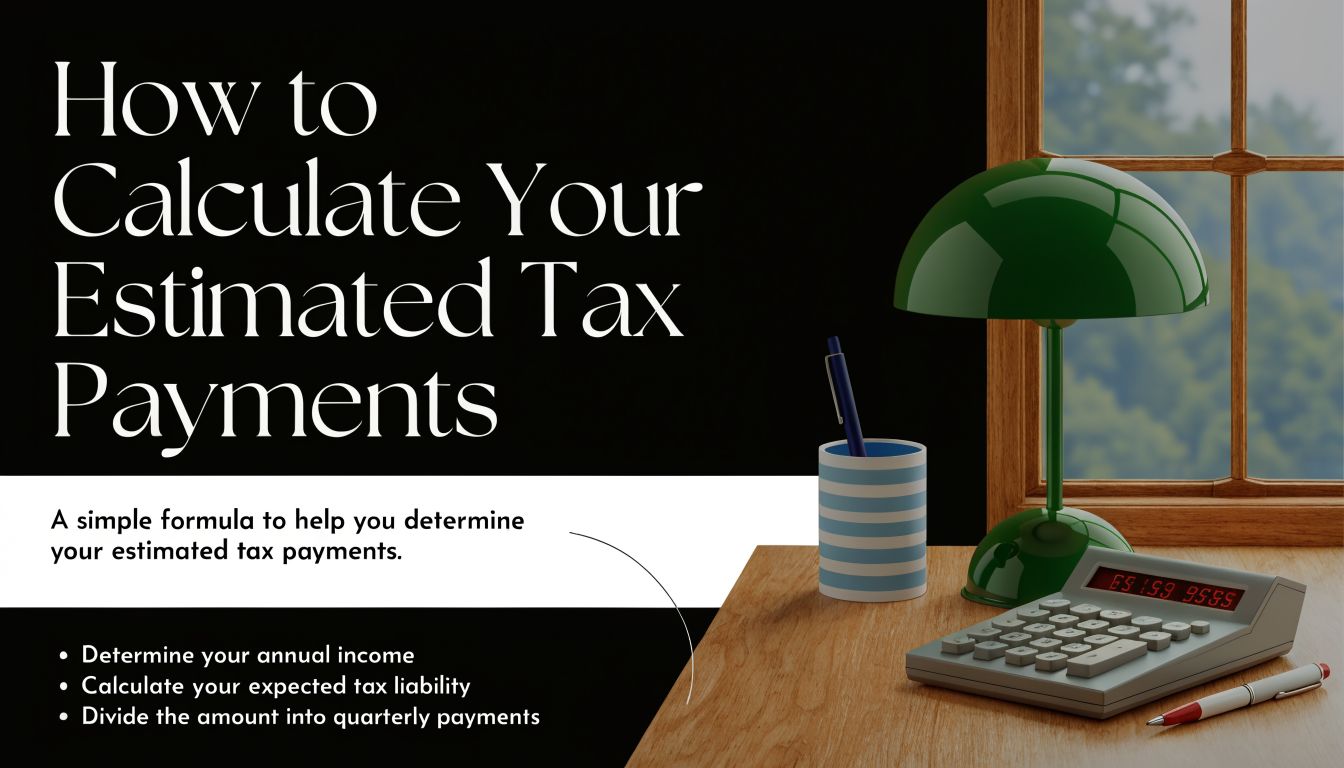
Here is the framework I use with clients:
- Project California taxable income for the full year.
- Estimate the state tax from that projected income.
- Subtract California withholding expected for the year.
- Subtract credits you are reasonably sure will apply.
- Use the remaining balance as the amount estimated payments need to cover.
- Update the projection after major changes in income, gains, or business results.
If you prepare returns yourself, tax preparation software like TurboTax can help organize the math, but the result is only as good as the numbers entered.
Example one, self-employed graphic designer
A San Diego graphic designer with no payroll withholding usually has one advantage. The income picture is easier to isolate.
The challenge is forecasting net profit realistically. Start with year-to-date bookkeeping, subtract ordinary expenses already incurred, and project the rest of the year using signed work, recurring clients, and known slow periods. Then add smaller items that still matter, such as interest income or investment sales.
The common error is using gross receipts in the spring, then overcorrecting later with deductions that never materialize. Estimated tax planning works better when the projection stays tied to actual books.
Example two, tech employee with crypto gains
This fact pattern causes more underpayments than many employees expect.
A Bay Area employee may have salary withholding, RSU income, and one large crypto gain. Payroll withholding may cover the salary portion well enough. It may also fall short once investment gains and equity compensation are layered in. The right calculation combines all income sources into one California projection and compares that tax to total withholding already in the system.
Looking at each income stream separately is where people get misled.
Example three, S corporation owner expecting a PTET credit
This is one of the California-specific areas generic articles often miss.
An owner may hear that the pass-through entity elective tax will create a credit on the personal return and assume that solves the estimate problem. Sometimes it helps a lot. Sometimes the timing does not line up cleanly, the credit is smaller than expected, or the owner still has other income with no withholding behind it. The estimate should reflect the PTET credit only when the payment and expected benefit are reasonably clear. Counting on it too early can create a shortfall by June.
What tends to work, and what usually fails
| Approach | What happens in practice |
|---|---|
| Using current bookkeeping and payroll data | Produces a calculation you can defend if income changes later |
| Recalculating after a large gain or K-1 update | Keeps estimates aligned with real tax exposure |
| Assuming withholding solves everything | Often misses tax on side income, gains, or pass-through profit |
| Relying on last year without checking current income | Can work under a safe harbor approach, but often misstates cash needs for the current year |
One more point matters for high earners, investors, and business owners. California estimated taxes are not just a math exercise. Timing matters. A projection that is technically reasonable for the full year can still create stress if too much tax shows up before June and the payment plan was built too slowly.
Mastering the California Payment Schedule and Options
The most misunderstood part of california estimated taxes is not the amount. It’s the schedule.
California doesn’t follow the federal habit of roughly even quarterly installments. The state uses a front-loaded pattern that catches people off guard, especially those who assume state and federal deadlines work the same way.
The California schedule compared with federal timing
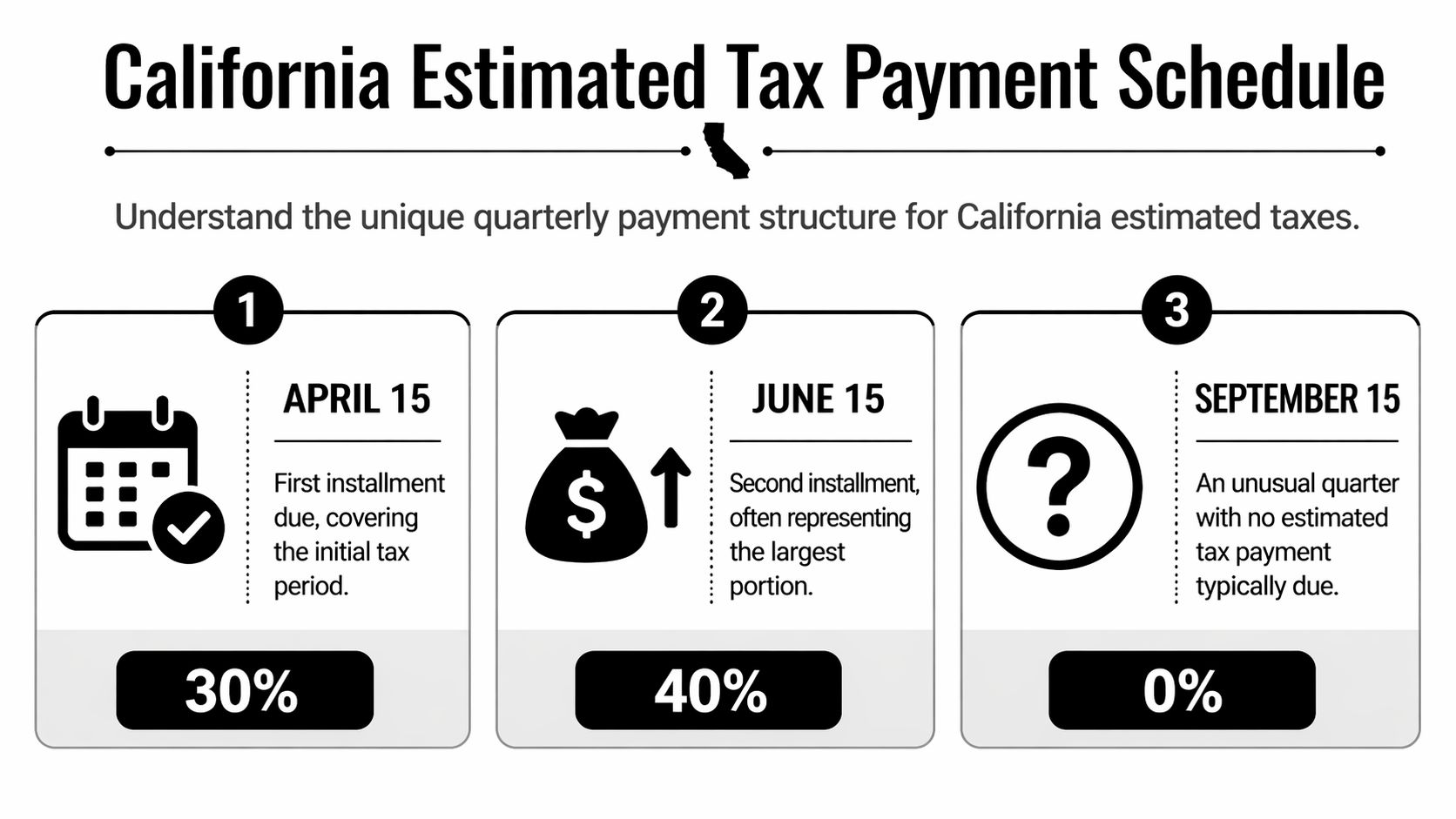
According to the Legislative Analyst’s Office overview of California’s estimated tax system, California’s unique 30/40/0/30 schedule requires taxpayers to have paid 70% of their estimated liability by June 15, while the federal system requires 50% by the same date.
That difference changes budgeting in a real way.
| Payment period | California pattern | Practical effect |
|---|---|---|
| April 15 | 30% | A meaningful payment is due early |
| June 15 | 40% | By midyear, most of the annual amount is already due |
| September 15 | 0% | The “no payment” quarter confuses almost everyone the first time |
| January 15 | 30% | Final catch-up payment for the tax year |
If you want the actual dates in one place, this guide to California estimated tax payment dates is a useful reference.
Why this trips people up
A federal-only mindset causes problems fast. Many taxpayers assume equal quarterly payments are good enough everywhere. California disagrees.
The most common mistakes are:
- Sending equal installments anyway: That can leave you behind in the first half of the year.
- Using the wrong payment system: Federal EFTPS is for federal taxes, not California individual estimates.
- Waiting until fall: California may already consider you short by then.
- Mailing without tracking details: If you mail vouchers, good records matter.
Paying the right total at the wrong time can still create a California problem.
The best payment methods
The cleanest option is usually the FTB’s online payment system. It gives you timing control and immediate confirmation, which matters when a payment is made close to a deadline or after an income event.
A practical hierarchy looks like this:
- FTB Web Pay: Best for most individual taxpayers because it is direct and timestamped.
- Mail with Form 540-ES vouchers: Still workable, but less forgiving if paperwork is incomplete or late.
- Internal accounting workflow: Useful for business owners who want tax payments tied to bookkeeping review dates.
What to do operationally
Keep the process simple:
- Project the annual tax.
- Convert that into California’s installment pattern.
- Put each due date on the same calendar you use for payroll, rent, or vendor obligations.
- Recalculate if income jumps.
- Save confirmation records immediately.
That discipline matters more than people expect. California’s rules are manageable, but only if the payment process is treated as part of normal financial operations.
How to Avoid Underpayment Penalties in California
Most taxpayers think the penalty question is simple. Pay enough by the end of the year and you’re fine.
That’s not always how California works.
The state has safe harbor rules, but those rules interact with timing. A taxpayer can still create a problem if early installments were too low relative to what California expected for those periods.
The safe harbor framework
For many taxpayers, the basic concept is familiar. You generally avoid underpayment penalties by paying enough through withholding and estimated payments under one of the accepted safe harbor paths.
The major categories look like this:
| Taxpayer AGI | Rule 1: % of Current Year's Tax | Rule 2: % of Prior Year's Tax |
|---|---|---|
| Below the higher-income threshold | 90% | 100% |
| Above the higher-income threshold | 90% | 110% |
| AGI of $1 million or more | 90% | Prior-year safe harbor does not apply |
For Californians with AGI of $1 million or more, the prior-year tax safe harbor does not apply. They must pay at least 90% of their current-year liability through withholding and estimated payments to avoid penalties, as explained in this California high-income estimated tax discussion.
The equity compensation trap
This rule creates a recurring problem for executives and employees with stock compensation. Supplemental withholding on RSUs or bonuses often looks substantial on the paystub, but it may still fall short of the person’s actual California marginal rate.
That gap often doesn’t show up until much later, especially if vesting or exercises happen after June.
Warning: Meeting an annual target doesn’t automatically erase a quarterly underpayment issue if the earlier installments were too light.
When the annualized income method makes sense
If your income is uneven, the annualized income installment method can be the smarter route. This is often the case for:
- Realtors whose commissions hit later in the year
- Investors with gains concentrated in one quarter
- Business owners with seasonal revenue
- Taxpayers with a one-time liquidity event
The point of annualizing is fairness. Instead of pretending income arrived evenly, you match installments more closely to when income was earned.
What works well in practice
Taxpayers usually avoid penalties more reliably when they do one of the following:
- Stable income and clean records: Use the safe harbor method and stay disciplined on timing.
- Uneven income with good books: Consider annualizing and document the quarter-by-quarter income pattern carefully.
- W-2 plus variable side income: Increase withholding where possible and supplement with estimates when needed.
- High-income equity compensation: Review vesting schedules during the year, not after year-end.
What tends to fail
These approaches create trouble over and over:
- Assuming prior-year payments are always enough
- Ignoring California’s earlier installment pattern
- Believing RSU withholding solved the issue
- Making a large payment late in the year and expecting it to cure everything
- Estimating from memory instead of actual books, broker reports, and payroll data
A practical decision guide
Use the safe harbor route when income is steady and prior-year comparisons are meaningful. Use annualizing when the year is clearly uneven and your records support that method.
Neither approach is magical. Both depend on timely review. The taxpayers who struggle most are usually not the ones with the most complex finances. They’re the ones who wait too long to look at them.
Advanced Strategies for Business Owners and Investors
Business owners and investors usually face a different california estimated taxes problem. Their issue often isn’t underpayment alone. It’s mismatch. Payments, credits, and entity-level tax choices don’t always line up cleanly on the personal return.
PTET changes the planning conversation
California’s Pass-Through Entity Tax, or PTET, lets qualifying partnerships and S corporations pay tax at the entity level, with owners generally receiving a credit tied to that payment. As the EisnerAmper discussion of California PTET developments notes, a major issue is that owners often fail to reduce their personal estimated tax payments to reflect the expected PTET credit, which can create significant cash flow problems from overpayment.
That’s a very real planning issue. A taxpayer can do everything “responsibly” and still tie up too much cash by paying both at the entity level and again personally without coordination.
Where business owners go wrong
The weak spots are usually operational:
- The entity makes PTET payments, but the owner keeps paying personal estimates as if no credit exists
- Bookkeeping lags, so nobody knows what profit really looks like
- Distributions and taxable income get confused
- Owners focus on federal planning and forget California has its own rhythm
If you own rental property through an entity or report direct rental income, this overview of taxes on rental income is a useful starting point for thinking about state-level timing and compliance.
PTET can help, but only when the personal estimate plan and the entity payment plan are built together.
Investors need a quarterly habit
Real estate and crypto investors share one problem. Income can be irregular, and taxable events don’t always arrive with cash reserved for tax.
For rental owners, the planning issue is often net income drift. Repairs, vacancies, and depreciation can make early-year assumptions unreliable. For crypto investors, the issue is volatility. Gains can appear and disappear quickly, and waiting until year-end to sort transaction history is a poor strategy.
Entity-level discipline matters
For owners of S corporations and other pass-through structures, estimated tax planning works best when it is built into the accounting cycle. That means current books, current payroll information, and regular review of owner-level exposure.
The strongest plans are usually simple. Update the books. Review projected profit. Coordinate entity payments and owner estimates. Adjust before the next deadline, not after the notice arrives.
Staying Compliant and When to Call for Help
California estimated taxes aren’t impossible. They are just less forgiving than many taxpayers expect.
The recurring problem is not ignorance of tax in general. It’s assuming California works like the IRS, or assuming a year-end true-up fixes everything. It doesn’t. A common but overlooked trap is that California can impose penalties when early installments were too low based on quarterly income flow, even if the taxpayer ultimately hits an annual safe harbor by year-end, as explained in this California safe harbor discussion.
Signs you should get professional help
A few situations deserve closer review:
- You crossed into high-income territory
- You have RSUs, options, or large bonuses
- You own an S corporation, partnership interest, or LLC
- You’re using PTET or considering it
- You have rental or crypto income that changes during the year
- You already received an FTB underpayment notice
Quick answers to common questions
What if I move into or out of California mid-year
That usually creates allocation and timing issues. The income may not all be taxed the same way for the same period, so estimates often need to be recalibrated instead of copied from a full-year resident pattern.
Do I owe estimated tax on an inheritance
An inheritance itself typically isn’t the issue. What matters is whether inherited assets later produce taxable income, such as capital gains, rental profit, or business income.
Can I rely on withholding instead of estimates
Sometimes. For taxpayers with wages, increasing withholding can be an efficient fix. It works best when payroll can still be adjusted in time and when income is not wildly uneven.
What if I already missed a payment
Don’t wait for the return to be filed. Recalculate the year based on current facts and decide whether a catch-up payment, annualized method analysis, or notice response strategy makes sense.
If you’re trying to find the right advisor for this kind of planning, this guide on how to find a good CPA lays out what to look for.
The bottom line is simple. If your income changed, your payment plan needs to change too. That’s especially true in California, where timing errors create problems even for taxpayers who eventually pay in full.
If california estimated taxes are creating uncertainty for you, Allied Tax Advisors can help you build a payment strategy that fits your actual income, not a generic template. Whether you’re dealing with freelance income, rental property, crypto gains, equity compensation, or PTET coordination, their San Diego team can help you plan proactively, stay compliant, and avoid surprise balances and penalty notices.