
Yes, the IRS can absolutely garnish your wages. But here’s the crucial part that catches so many people off guard: unlike almost any other creditor, they don’t need to take you to court first.
This powerful collection tool is officially called a wage levy, and it gives the government the legal authority to take a slice of your income directly from your employer to pay off your tax debt.
The Unique Power of an IRS Wage Levy

When most people think of "wage garnishment," they imagine a drawn-out court battle. And for typical creditors—think credit card companies or medical debt collectors—that’s exactly how it works. They have to sue you, win a judgment in court, and then get a judge to sign off on taking money from your paycheck.
The IRS plays by a completely different set of rules.
This authority is what makes an IRS wage levy so potent. It's an administrative action, not a judicial one. This means the IRS has its own internal process, and once they've followed their steps, they have the legal right to order your employer to send a portion of your pay directly to them. They get to bypass the entire court system, which makes the whole process much faster and more direct.
How It All Starts
An IRS wage garnishment is never the first move; it’s the final one in a long collection process. It won't happen out of the blue.
The journey starts simply enough, with a tax bill for what you owe. If you don't pay it, the IRS will begin sending a series of notices, and each letter gets a bit more serious. These notices are your chance to get ahead of the problem and resolve the debt before things get worse.
The process only barrels toward garnishment after the IRS sends a Final Notice of Intent to Levy. If you don't respond or make payment arrangements within 30 days of that notice, the IRS is legally cleared to contact your employer and start the levy. You can find a comprehensive overview of this process from tax law experts to learn more.
The bottom line is this: The IRS has tremendous power to collect unpaid taxes straight from your paycheck. While they have to follow a strict notification process, their ability to levy wages without a court judgment is a critical difference that every taxpayer needs to understand.
Recognizing the Warning Signs from the IRS

Here’s one thing you absolutely need to know: an IRS wage garnishment never comes out of the blue. The government is required by law to follow a very specific process, giving you several chances to settle your tax debt before they take a step this serious.
Think of it less as a surprise attack and more as the last stop on a long road paved with warning signs. This entire process is built around a series of official letters sent to your last known address. Each one is an escalating alert, and learning to spot them is the key to stopping a levy in its tracks.
Ignoring these notices is the single worst thing you can do. It’s like hitting the snooze button on a fire alarm—the problem only gets bigger. By understanding this paper trail, you can take control, know exactly where you stand, and see how much time you have to act.
The Initial Notice and First Reminders
The journey almost always starts with a notice called CP14, Notice of Tax Due and Demand for Payment. This is the first official bill you'll get after filing a return with a balance due or after the IRS figures out you owe them money. It’s a straightforward letter that simply states the amount you owe and asks you to pay up.
If you don't respond to that first notice, the IRS will follow up with a few reminders. These are typically labeled CP501, CP503, and CP504. While the language in these letters gets a little more serious each time, they're still just trying to get your attention and prompt you to resolve the debt.
Key Takeaway: An IRS levy isn't a single event; it's a process. It unfolds through a series of predictable letters, and each one is an opportunity for you to respond. Your first line of defense is simply paying attention to your mail.
The Most Critical Warning Letter
Out of all the mail you might receive, one letter stands out as the final, critical warning before a levy can begin. This is the one you absolutely cannot ignore. You need to be on the lookout for the IRS Final Notice of Intent to Levy.
This crucial notice will show up as one of two specific documents:
- Letter 1058: Final Notice of Intent to Levy and Notice of Your Right to a Hearing
- LT11: A similar final notice that carries the same legal weight
The moment you receive this letter, a 30-day countdown officially starts. You have exactly one month to either pay the debt in full or set up an alternative payment arrangement. If you don't, the IRS legally has the green light to contact your employer and start taking money directly from your paycheck.
This letter is your last, best chance to formally appeal or get a payment plan in place before your income is directly affected.
When you get a notice about a potential wage levy, the first question that probably pops into your head is a scary one: How much are they going to take? It’s a terrifying thought, but the answer isn't just some arbitrary number. The IRS doesn't get to grab whatever it wants; they have to follow a very specific legal formula.
At the heart of this formula is what’s known as the “exempt amount.” Think of this as the portion of your paycheck that’s legally off-limits to the IRS. It's the minimum amount the law says you need for basic living expenses. The IRS can only touch the money you earn above this protected threshold.
This is a world away from how regular creditors operate. For most private debts, like credit cards or personal loans, the Consumer Credit Protection Act (CCPA) sets a strict limit, usually capping the garnishment at 25% of your disposable income. The IRS isn't bound by that rule, which gives them far more power. To get a better sense of their authority, it's helpful to see just how IRS garnishment rules differ from private creditors.
Calculating Your Exempt Amount
So, where does this "exempt amount" number come from? It’s not one-size-fits-all. The IRS figures it out based on a few personal details:
- Your Pay Frequency: How often you get paid—weekly, bi-weekly, monthly—changes the calculation.
- Your Filing Status: Whether you're single, married filing jointly, or head of household makes a big difference.
- Number of Dependents: The more dependents you claim on your tax return, the more money you get to keep.
Your employer doesn't have to guess. The IRS publishes a guide called Publication 1494, which contains tables that spell it all out. Your employer simply looks up your pay period, filing status, and number of dependents to find the exact dollar amount that is protected from the levy in each paycheck.
A Real-World Example:
Let's say you're a single taxpayer with no dependents, and you get paid every week. According to the current IRS tables, your weekly exempt amount might be around $275. If your take-home pay is $800 a week, the IRS can levy the entire difference—a whopping $525—straight from your check.
What the Numbers Look Like
Seeing the math laid out can really drive home how much a wage levy can impact your finances.
This chart gives you a clear example of how much of your income could be garnished based on your weekly earnings, the IRS exempt amount, and the resulting percentage taken.
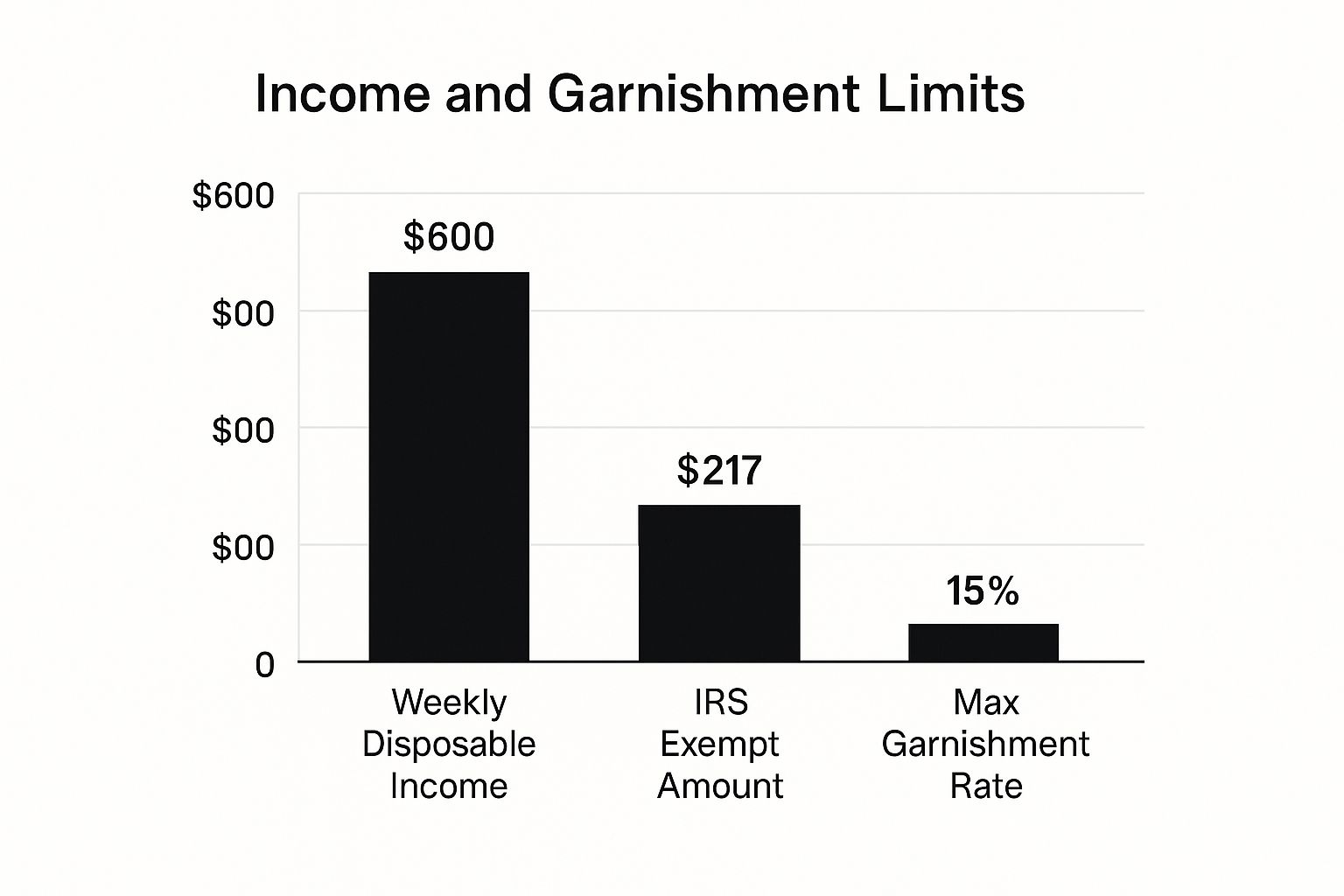
As you can see, while the exempt amount offers a floor, the IRS can still claim a very significant chunk of your earnings above that line.
IRS vs Private Creditor Garnishment Limits
The power the IRS has to collect unpaid taxes is significantly greater than that of a typical private creditor. This table breaks down the key differences in how much they can legally take from your wages.
| Garnishment Aspect | IRS Tax Levy | Private Creditor Garnishment (CCPA) |
|---|---|---|
| Calculation Basis | Based on a statutory "exempt amount" determined by filing status, pay period, and dependents. | Based on "disposable earnings" (gross pay minus legally required deductions). |
| Maximum Limit | Can take 100% of your earnings above the exempt amount. | Limited to the lesser of 25% of disposable earnings or the amount by which disposable earnings exceed 30 times the federal minimum wage. |
| Governing Law | Internal Revenue Code (Title 26) | Consumer Credit Protection Act (CCPA) |
The bottom line is clear: an IRS levy can be far more aggressive and leave a taxpayer with much less disposable income compared to a standard court-ordered garnishment from a private creditor.
It’s also critical to understand that this isn't a one-time event. Once a levy is in place, the IRS will continue taking that amount from every single paycheck. It only stops when one of three things happens:
- Your tax debt is completely paid off.
- You successfully negotiate an alternative payment plan with the IRS.
- The IRS officially issues a release of the levy.
Getting a handle on this formula is your first step toward getting back in control. It demystifies the process and shows you exactly what's on the line, giving you the clarity you need to take action before things get worse.
Proven Strategies to Stop an IRS Wage Garnishment

Getting a Final Notice of Intent to Levy can feel like your world is closing in. It’s a gut-punch, for sure. But this is the moment for clear-headed action, not panic. You have several powerful and proven ways to stop an IRS wage garnishment before it even starts, or to halt one that’s already underway.
The absolute worst thing you can do is ignore it. That guarantees the IRS will move forward. The secret is to open a line of communication with them and proactively find a solution. By engaging, you unlock options that can protect your paycheck and put you on a manageable path back to good standing.
Let’s walk through the three most effective strategies to get back in control of your finances.
Set Up an IRS Installment Agreement
The most direct way to stop a wage levy is to formally agree to pay what you owe over time. This is called an Installment Agreement (IA), and it’s basically a payment plan you set up directly with the IRS. As soon as your IA is approved, the agency immediately stops all collection activities—and that includes wage garnishments.
Think of it like setting up a payment plan for a car. Instead of the bank repossessing your vehicle, you agree to a fixed monthly amount until you’ve paid off the loan. The IRS is often more than willing to arrange these plans because it’s a reliable way for them to collect the money owed.
- Who Qualifies? Most taxpayers who owe a combined total of less than $50,000 (this includes the original tax, plus penalties and interest) can apply for an IA online without ever having to speak to an agent.
- First Step: The quickest way to get the ball rolling is by using the IRS's Online Payment Agreement (OPA) tool on their website.
Submit an Offer in Compromise
But what if you simply can't afford to pay the full amount, even if it’s spread out over several years? For some people, the IRS might agree to settle the tax debt for less than the full amount. This lifeline is known as an Offer in Compromise (OIC).
An OIC is a game-changer, but it isn’t for everyone. The IRS will only accept one if they are convinced it’s the most they could ever realistically collect from you. Be prepared for a deep dive into your finances—they’ll look at your income, expenses, assets, and what you’re likely to earn in the future.
An Offer in Compromise is all about your "ability to pay." If paying your full tax bill would put you in a state of severe financial hardship, the IRS may decide that settling for a smaller, lump-sum amount is their best bet.
To figure out if this is a realistic option for you, it’s a good idea to learn more about how to negotiate with the IRS and understand the detailed process they use to evaluate these offers.
- Who Qualifies? You may be eligible if you can prove that paying the full amount would cause what the IRS calls an "economic hardship."
- First Step: Check out the IRS’s Offer in Compromise Pre-Qualifier tool online. It’s a great way to get a quick, preliminary check on your eligibility.
Request Currently Not Collectible Status
For those in the tightest financial spots, there’s a third option: asking to be placed in Currently Not Collectible (CNC) status. This is essentially a temporary pause button on all collection efforts. If the IRS agrees that you truly can't afford to cover your basic living expenses and pay your tax bill, they'll put your account on hold.
Now, this doesn’t make the debt vanish. The IRS will stop the threatening letters and won't touch your wages or bank accounts. But keep in mind, interest and penalties will keep piling up on your original debt. The IRS will also check in on your financial situation periodically to see if your ability to pay has changed.
- Who Qualifies? People whose income is less than their necessary living expenses, according to the IRS's own internal standards.
- First Step: You’ll need to contact the IRS by phone or mail with your financial information and formally request to be placed in CNC status.
Understanding Your Rights as a Taxpayer
Going up against the IRS can feel overwhelming, like you're in a fight you can't win. But it’s critical to remember you aren't powerless. The government has to follow a strict set of rules, enshrined in the Taxpayer Bill of Rights, designed to protect you. These aren't just helpful guidelines; they are your legal protections.
Knowing these rights is your first line of defense. When a wage levy is on the table, three rights really stand out: the right to be informed, the right to challenge the IRS’s position, and the right to appeal an IRS decision in an independent forum. In short, the IRS can't just act in secret, and you have a formal process to make your case.
Your Right to an Appeal
One of the most powerful tools you have is the right to a Collection Due Process (CDP) hearing. This isn't just a quick phone call—it's a formal proceeding with the IRS Independent Office of Appeals, a completely separate division that exists to review collection actions like wage garnishments.
The moment you request a CDP hearing, the IRS has to pause the garnishment. This gives you valuable breathing room to work out a solution.
During the hearing, you can officially propose alternatives to having your paycheck seized. These options include:
- An Installment Agreement: This lets you set up a payment plan you can actually afford.
- An Offer in Compromise: You may be able to settle your tax debt for less than you owe.
- Currently Not Collectible status: This is an option if you can prove you're facing extreme financial hardship.
This hearing is your opportunity to formally argue why taking your wages is the wrong approach and present a better way forward. For example, you can show how an Offer in Compromise is a more realistic solution, which we cover in our guide to understanding the IRS Offer in Compromise process.
Getting Help from the Taxpayer Advocate Service
What happens when you’re stuck in a bureaucratic loop and nothing seems to be working? That's when you can turn to the Taxpayer Advocate Service (TAS).
The TAS is an independent organization inside the IRS, and its sole purpose is to help taxpayers who can't resolve their problems through normal channels. If an IRS wage levy is causing you serious financial trouble and you've hit a dead end, a TAS case advocate can intervene on your behalf. They have the power to cut through the red tape and make sure your rights are protected.
Common Questions About IRS Wage Garnishments
Dealing with an IRS wage levy can feel overwhelming, but getting clear answers is the first step toward getting back on your feet. Let's tackle some of the most common questions taxpayers have.
Can the IRS Take My Entire Paycheck?
The short answer is no, the IRS can't legally take your entire paycheck. The law requires them to leave you with a certain amount to cover basic living expenses.
This "exempt amount" is calculated based on your filing status, how often you get paid, and the number of dependents you claim. But here's the critical part: they can take 100% of your earnings above that protected threshold. For many people, that can still feel like a huge chunk of their income is just gone.
How Long Does a Wage Garnishment Last?
Unfortunately, an IRS wage levy isn’t a one-and-done deal. It’s a continuous collection process that will hit every single paycheck you receive.
It keeps going until one of three things happens:
- You pay off the tax debt in full.
- You negotiate another solution with the IRS, like an Installment Agreement.
- The IRS officially releases the levy.
Key Insight: A levy is an ongoing collection tool. You must take proactive steps to stop it; it will not resolve on its own.
It's also easy to get different IRS notices mixed up. A wage levy notice is very different from, say, a CP2000 notice, which proposes changes to your tax return. If that's what you've received, you can learn what to do if you receive an IRS CP2000 notice in our other guide.
Facing a potential wage garnishment is stressful, but you don't have to handle it alone. The team at Allied Tax Advisors is here to help you understand your options and find the best path forward. Contact us today to regain control of your financial future at https://alliedtax.com.