
Let's get straight to the point: The answer to “can you deduct property taxes?” isn't a simple yes or no. It's a definite it depends.
For most homeowners, the answer is a qualified "yes," but it comes with a major catch: the $10,000 State and Local Tax (SALT) cap. For real estate investors and businesses, however, the story is entirely different—and much more financially rewarding.
Your Quick Guide to Property Tax Deductions

Understanding property tax deductions is like learning the rules for two completely separate games. The rulebook for your personal home is pretty strict. But for investment properties? That's where you'll find some powerful financial advantages. This guide is your roadmap to navigating both.
It helps to know what you’re up against first. Before diving into the nitty-gritty of deductions, you can get a ballpark figure of your local tax bill using a handy property tax estimator. This gives you a baseline for what you might owe.
Homeowners vs. Investors: A Tale of Two Tax Rules
As a homeowner, your ability to deduct property taxes hinges on a crucial choice. You have to itemize your deductions on your tax return, a move that only makes sense if your total itemized expenses are greater than the standard deduction.
Even if you do itemize, your property taxes get lumped together with your state income or sales taxes, and the total deduction for all of it is capped at just $10,000 per household. We break down this decision in our guide comparing the standard deduction vs itemized deductions.
For investors and business owners, property taxes are not limited by the SALT cap. They are treated as ordinary and necessary business expenses, fully deductible against rental or business income. This distinction is one of the most significant advantages of real estate investing.
To make this crystal clear, here’s a quick summary of how the rules differ depending on who you are and what kind of property you own.
Property Tax Deduction Rules at a Glance
| Taxpayer Type | Can You Deduct Property Taxes? | Key Limitation / Rule | Primary IRS Form |
|---|---|---|---|
| Personal Homeowner | Yes, if you itemize | Subject to the $10,000 SALT cap | Schedule A |
| Renter | No (indirectly paid via rent) | Landlord deducts the tax | N/A |
| Real Estate Investor | Yes | No limit, treated as a business expense | Schedule E |
| Business Owner | Yes | No limit, treated as a business expense | Schedule C, Form 1120, etc. |
This table gives you a bird's-eye view of where you stand. Now, let’s dig into the critical details of each scenario, starting with that restrictive SALT cap that affects so many homeowners.
Navigating The $10,000 SALT Cap for Homeowners

For most homeowners asking "can I deduct my property taxes?" the biggest hurdle today is the $10,000 cap on State and Local Tax (SALT) deductions. This limit, put in place by the Tax Cuts and Jobs Act (TCJA), completely changed the game for how much you can write off on your personal tax return.
Think of it like this: you have a "deduction bucket" for all your state and local taxes, but it can only hold a maximum of $10,000. Every dollar of property tax, state income tax, or state sales tax you pay gets tossed into this single bucket. Once it’s full, any other state and local taxes you pay simply overflow—they can't be deducted.
What Goes into the SALT Bucket?
The SALT deduction isn’t just for property taxes. It’s a combined limit that pulls together several different taxes you pay to state and local governments. In practice, you first have to choose whether to deduct your state income taxes or your state sales taxes. Then, you add your property taxes to that number.
This total is what fills up your bucket. For a lot of people, especially those in high-tax states, state income taxes alone can nearly max out the $10,000 limit, leaving very little room to deduct property taxes.
Just look at the numbers. In Illinois, for example, the average family paid $6,285 in annual property taxes in 2025—that's more than double the national average of $2,969. You can see how quickly residents in states like that hit the ceiling, with property taxes alone eating up most of their available deduction.
Key Takeaway: The SALT deduction combines your property taxes with either state income or sales taxes, and the total deduction is capped at $10,000 per household. This limit is the same whether you file as single or married filing jointly.
Which Property Taxes Are Actually Deductible?
Not every check you write to your local government qualifies as a deductible property tax. The IRS has some specific rules. To be deductible, the tax must be ad valorem—meaning it’s based on the assessed value of your property. It also must be charged uniformly for the general public welfare.
So, what counts and what doesn't when it comes to your home?
- Deductible: Taxes paid on your primary home and any other personal residences, like a vacation home. All of these are subject to that one $10,000 SALT cap.
- Not Deductible: Payments for specific services or local benefits. Things like special assessments for putting in new sidewalks, streets, or sewer lines don't count because they're considered capital improvements that increase your property's value.
- Not Deductible: Homeowners association (HOA) fees. These are payments to a private organization, not a government taxing authority, so they can't be deducted as property taxes.
Knowing the difference is key to getting your taxes right. For a closer look at what makes a state or local tax deductible, check out our guide on whether state taxes are deductible. Getting these details right helps you claim everything you’re entitled to without making a costly mistake.
How Investors Deduct Property Taxes Without The Cap
When we talk about real estate investing, the question of deducting property taxes gets a much better answer. That restrictive $10,000 SALT cap we discussed for homeowners? It doesn't apply to your rental properties. For investors, this is a complete game-changer and a key reason real estate is such a powerful wealth-building tool.
It all comes down to how the IRS sees your property. A personal home is one thing, but a rental property is a business. As such, the property taxes you pay are considered an ordinary and necessary business expense. They fall into the same category as maintenance, insurance, or the fees you pay a property manager.
Business Expenses Have No Ceiling
Remember that $10,000 "bucket" for personal state and local taxes? For your investment properties, you can forget about it. There is no ceiling—no cap whatsoever—on the amount of property taxes you can write off against your rental income.
Let's say you own a rental in a high-tax state and your annual property tax bill is $15,000. You get to deduct the entire $15,000. If it were $25,000, you’d deduct that, too. This unlimited deduction is a foundational part of any smart real estate investment strategy, as it directly slashes your taxable income and, by extension, your overall tax bill.
Key Insight: Property taxes on investment real estate are fully deductible as a business expense. They are reported on Schedule E and are not subject to the $10,000 SALT cap, allowing you to deduct the entire amount you paid.
How Investors Report Property Taxes
While homeowners use Schedule A for their itemized deductions, investors have a different playbook. You'll report the property taxes for your rental real estate on Schedule E (Supplemental Income and Loss). This is the form where you tally up all your rental income and then subtract all your operating expenses—mortgage interest, repairs, insurance, and, of course, your property taxes.
- For Rental Properties: The total property taxes you paid for the year get entered on Line 16 of Schedule E.
- For Other Businesses: If you own a commercial property for your business, like an office or a shop, you'll deduct the property taxes on that business's specific return (e.g., a Schedule C if you're a sole proprietor).
Keeping these categories straight is absolutely essential. By treating your rental as the business it is, you completely sidestep the limits that apply to personal deductions. We cover this and other critical write-offs in our complete guide to rental property tax deductions.
This distinction between personal and investment property is the key to unlocking significant tax savings. It effectively turns what would be a major cost into a powerful tool for building a more profitable real estate portfolio.
A Step-by-Step Guide to Claiming Your Deduction
Knowing you can deduct your property taxes is great, but figuring out how to claim them correctly on your tax return is where things get real. The process is completely different for a homeowner versus a real estate investor, so let's walk through exactly which forms you'll need and where the numbers go.
This chart breaks down the two distinct paths for homeowners and investors.
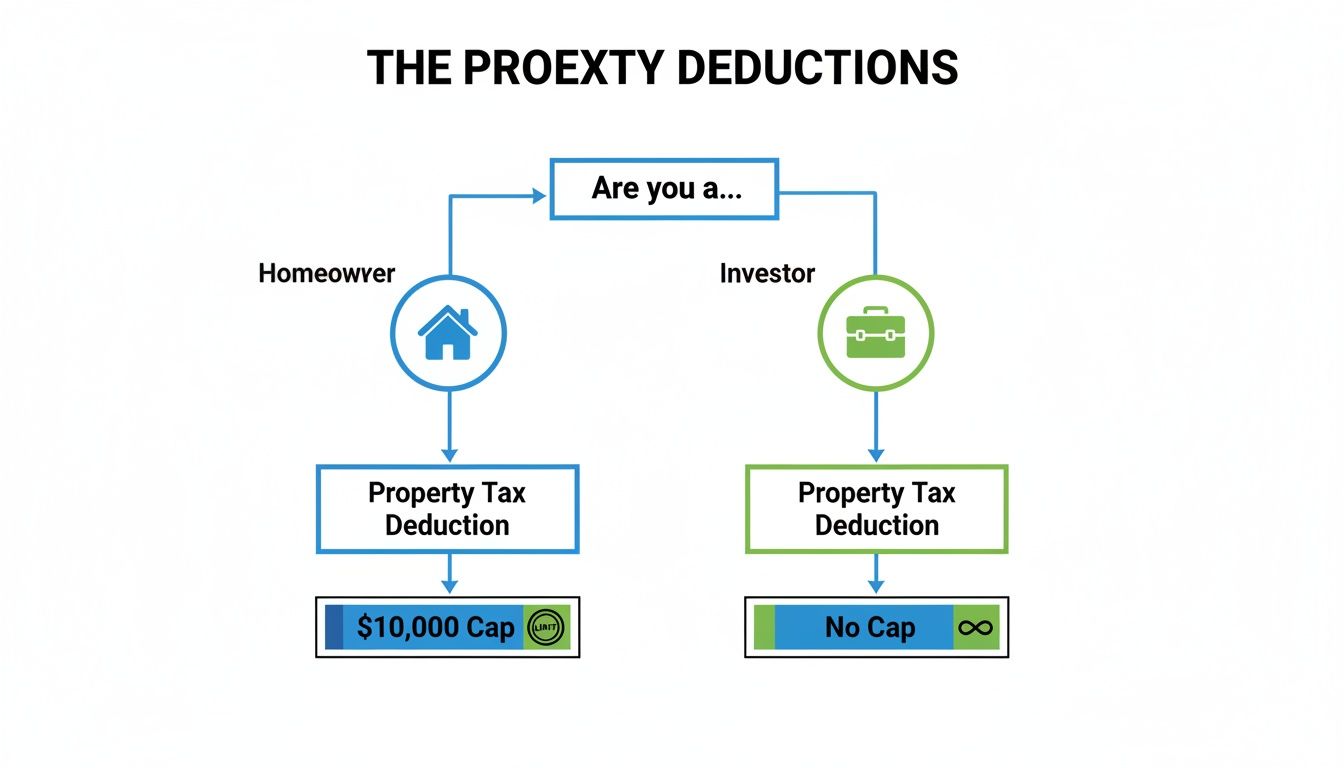
As you can see, the biggest difference is that homeowners are limited by the SALT cap, while investors can deduct their property taxes as an uncapped business expense.
For Homeowners Itemizing on Schedule A
If you own the home you live in, your first decision is a big one: do you take the standard deduction or do you itemize? You can only write off your property taxes if you choose to itemize.
This is only a smart move if your total itemized deductions—think mortgage interest, charitable donations, and state and local taxes—add up to more than the standard deduction for your filing status.
If itemizing is the right call, here’s what to do:
- Gather Your Documents: You'll need proof of what you paid. The easiest place to find this is on your year-end mortgage statement, Form 1098. Look for the amount of real estate taxes your lender paid from your escrow account, which is usually shown in Box 10.
- Fill Out Schedule A: Your property tax amount goes on Line 5b of Schedule A (Form 1040), which is labeled "State and local real estate taxes."
- Mind the SALT Cap: Here's the catch. The total amount you can claim for all state and local taxes combined (property, income, and sales taxes) on lines 5a through 5c is capped at $10,000 per household, per year.
Expert Tip: You can only deduct taxes in the year they were actually paid to the government, not the year they were assessed. Your Form 1098 is the gold standard for getting this timing right.
For Real Estate Investors on Schedule E
For those who own rental properties, the process is much simpler. There's no SALT cap to deal with because property tax is treated as a necessary cost of doing business. It's a direct expense that reduces your taxable rental income.
- Find Your Tax Records: Tally up the total property taxes you paid on the rental property for the year. You might have these in your own files if you pay the county directly, or you can find them on your mortgage statement.
- Report on Schedule E: You'll enter the total amount paid on Line 16, "Taxes," of Schedule E (Supplemental Income and Loss).
That's it. This straightforward entry ensures your taxable profit from the rental is accurately reduced by the full tax amount. Unlike homeowners, you don't have to choose between itemizing or taking the standard deduction—this is a direct, powerful write-off for your real estate business.
Navigating property tax deductions can feel like a minefield. A small misstep on your tax return can unfortunately lead to some major headaches with the IRS. But by knowing what common traps to look out for, you can make sure your return is accurate and avoid any unwanted scrutiny down the road.
Let's walk through some of the most frequent slip-ups we see.
Mistaking Fees for Taxes
One of the easiest mistakes to make is confusing other property-related payments with actual, deductible property taxes. For instance, your homeowners association (HOA) fees are not deductible as property taxes. Think of it this way: you're paying a private organization for services like landscaping or pool maintenance, not a government for public services.
The same goes for special assessments for local benefits, like new sidewalks, streetlights, or sewer lines in your neighborhood. While these are billed by a local authority, the IRS doesn't see them as a tax. Instead, they're considered a capital improvement that adds to your property's value. You should add this cost to your property's basis, which can lower your capital gains tax bill when you eventually sell.
Getting the Timing Wrong
This is a big one. You can only deduct property taxes in the calendar year they are actually paid to the taxing authority. It doesn't matter when you got the bill or when the "tax year" for your county officially begins. The key is the payment date.
This rule often trips up homeowners who pay their property taxes through an escrow account with their mortgage lender. The amount you pay into escrow each month is just an estimate. It’s not necessarily the same amount your lender forwards to the government on your behalf during the year.
The Golden Rule: Always check Box 10 on Form 1098 from your mortgage lender. This box shows the exact amount of real estate taxes they paid out of your escrow account during the year. That's the number you need to use for your deduction.
Sloppy Record-Keeping and Other Pitfalls
Failing to keep good records can unravel your deductions, especially if you're a real estate investor. Around the world, property taxes are a significant cost—making up about 5.1% of total tax revenues in OECD countries as of 2025. With rules changing, precise records are your best friend for smart tax planning. You can explore more about these trends in the OECD's global tax data.
Here are a few other common errors to steer clear of:
- Deducting taxes on property you don’t own: Seems obvious, but it happens. To claim the deduction, you must be the legal owner of the property and the tax must be assessed in your name.
- Ignoring the SALT cap: Many homeowners forget their property tax deduction is bundled with state income or sales taxes and capped at $10,000 per household. This is a crucial limitation.
- Forgetting to split the deduction properly: If you co-own a home with someone you're not married to, you can only deduct the portion of the property tax that you actually paid yourself. You can’t claim the full amount if your co-owner paid their share.
Frequently Asked Questions About Property Tax Deductions
Tax season always seems to bring a wave of familiar questions. Even when the rules seem straightforward, real-world situations like escrow accounts, vacation homes, and unexpected government fees can create plenty of confusion. To help you cut through the noise, let's tackle some of the most common questions we hear from clients about deducting property taxes.
We'll break down the answers in a simple, direct way so you can apply them to your own tax situation with confidence.
What If My Property Taxes Are Paid Through Escrow?
This is probably the number one point of confusion for homeowners, and for good reason. It’s easy to assume the total amount you paid into your escrow account all year is what you can deduct. But that’s not quite right.
You can only deduct the amount your mortgage lender actually paid to the government tax office from your escrow account during the year. Your lender makes this simple. They'll send you a Form 1098, the Mortgage Interest Statement, early in the new year. The exact amount of property taxes they paid on your behalf will be listed right there in Box 10. That's the number you use on your tax return.
Key Takeaway: Think of your monthly escrow payments as an estimate. The real, deductible number is what your lender pays out of the account. Always trust Form 1098.
Can I Deduct Taxes on a Vacation Home or Vacant Land?
Yes, you often can, but how you use the property changes the rules. For a second home or vacation getaway, the property taxes are generally deductible, just like for your main home. The catch? They fall under the same $10,000 SALT deduction cap. All your state and local taxes—from your primary residence, your vacation home, and your income taxes—are bundled together and limited to that single $10,000 total.
Vacant land is a different ballgame entirely:
- Land Held for Investment: If you're holding onto a piece of land hoping to sell it for a profit down the road, you can typically deduct the property taxes as an investment expense on Schedule A. The good news here is that these taxes are not subject to the SALT cap.
- Land for Personal Use: On the other hand, if you own a plot of land just for your own enjoyment—say, for camping or hiking, with no business or investment angle—the property taxes are considered a personal expense and are not deductible.
Are Special Assessments for Sidewalks Deductible?
This is a common "gotcha." The short answer is usually no. When your local government charges you a special assessment for a specific project that increases your property's value—like putting in new sidewalks, paving the street, or connecting sewer lines—you can't write it off as property tax.
Instead, the IRS sees this as a capital cost. You should add the amount you paid for the assessment to your property's cost basis. While you don't get a deduction today, this will lower your taxable capital gain when you eventually sell the house. The only time an assessment might be deductible is if the money is strictly for maintaining or repairing something that's already there.
How Do Unmarried Co-Owners Deduct Property Taxes?
When two or more unmarried people own a home together, the rule is simple: you can only deduct what you actually paid. This makes keeping good records absolutely critical.
Let’s say the total property tax bill is $12,000. If you and your co-owner each pay $6,000 from your own separate bank accounts, you can each claim a $6,000 deduction on your individual tax returns (as long as you don't exceed your personal $10,000 SALT cap). But if one person pays the entire $12,000 bill, only that person gets to claim the deduction. It’s crucial that your tax return reflects the reality of who paid what.
From the SALT cap to investment property rules, navigating the world of property tax deductions requires a sharp eye for detail. If you want personalized guidance on your specific situation, the team at Allied Tax Advisors is here to help. Contact us today for a consultation.