
Selling your home can be one of the biggest financial wins of your life, but many people worry about the taxman taking a cut. The good news? Thanks to a powerful tax break, you might not owe a dime in capital gains tax on a house sale. The IRS has a special provision that lets most homeowners exclude a huge chunk of their profit from taxes, meaning you could walk away with every penny.
Will You Owe Taxes When You Sell Your Home?
When you sell your house for more than you paid for it, the IRS sees that profit as taxable income. This profit is called a capital gain. Before you start getting nervous, it's important to understand how this is calculated, because it’s not as simple as subtracting the original price from the sale price.
Think of your home as an asset. When you sell it for more than you have invested in it, that gain is potentially taxable. The trick is to figure out your actual investment, which tax pros call the adjusted cost basis. This isn't just what you paid for the house; it also includes the money you spent on major improvements over the years—like a new roof or a kitchen remodel.
Your Key to a Tax-Free Profit
Luckily, the tax code has a fantastic benefit built right in for homeowners. The most important rule you need to know is the Section 121 exclusion, often just called the home sale exclusion. This is specifically designed to protect everyday homeowners from getting hit with a massive tax bill.
The Section 121 exclusion is one of the most generous tax breaks out there. It allows homeowners to shield hundreds of thousands of dollars in profit from the sale of their main home, often resulting in zero tax owed.
So, how much can you exclude? Single filers can exclude up to $250,000 of their gain, and that number doubles to $500,000 for married couples filing a joint tax return. The catch is you have to meet the eligibility tests. Generally, you must have owned and lived in the home as your primary residence for at least two of the five years just before you sell it.
To keep things simple, here's a quick look at the exclusion amounts and the basic rules.
Home Sale Tax Exclusion At a Glance
| Filing Status | Maximum Exclusion Amount | Primary Eligibility Rule |
|---|---|---|
| Single | $250,000 | Owned and lived in the home for 2 of the last 5 years. |
| Married Filing Jointly | $500,000 | Owned and lived in the home for 2 of the last 5 years. |
| Married Filing Separately | $250,000 | Each spouse must meet the eligibility rules independently. |
This powerful tax break is the reason the vast majority of people who sell their homes in the U.S. don't pay any capital gains tax at all. Getting a handle on this rule is the first—and most important—step to figuring out what, if anything, you'll owe.
How to Calculate Your Home Sale Profit for Taxes
When you sell your house, figuring out your profit isn't as simple as subtracting what you paid from what you sold it for. To get to the number the IRS actually cares about, you first need to pinpoint two critical figures: your adjusted cost basis and the amount realized from the sale.
Think of the adjusted cost basis as your total investment in the property—what you paid for it, plus all the major improvements you made over the years. The amount realized is your sale price, minus all the costs you incurred to sell it. Your taxable profit, or capital gain, is simply the difference between the two.
Getting this calculation right is the cornerstone of figuring out your potential capital gains tax on a house sale. So, let's walk through the steps to nail down that number.
This simple graphic breaks down the journey: you sell your home, calculate the real profit, and, for many people, end up with zero tax due.
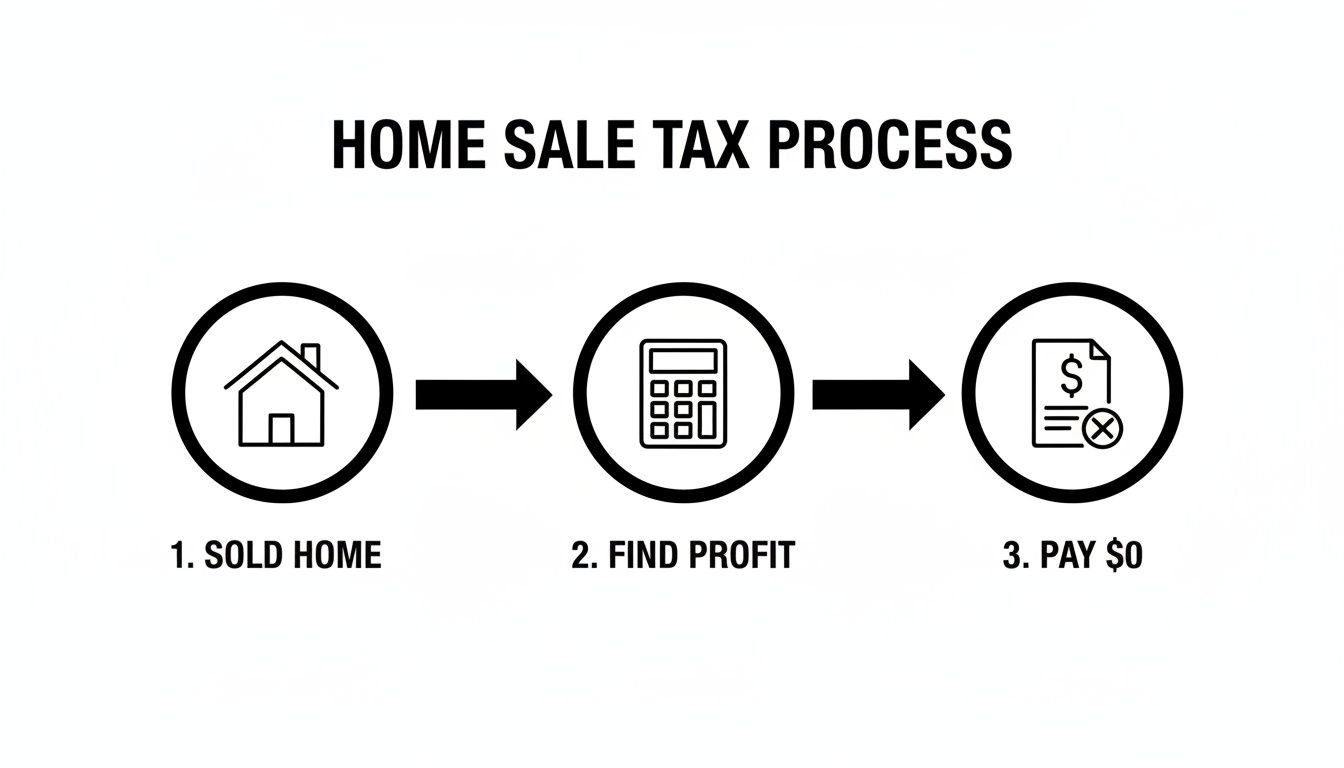
As you can see, the goal for most homeowners is to leverage the tax exclusion to wipe out their tax bill entirely.
Step 1: Find Your Adjusted Cost Basis
Your adjusted cost basis is the true starting point for your home's value in the eyes of the IRS. It’s a crucial number to get right because a higher basis directly translates to a lower taxable gain.
Here’s the formula you’ll use to find it:
Original Purchase Price + Capital Improvements – Depreciation (if any) = Adjusted Cost Basis
Let's break down each piece of that equation.
- Original Purchase Price: This is what you paid for the home, but it also includes some of the closing costs from when you bought it, like title insurance or recording fees.
- Capital Improvements: These aren't your average repairs. We're talking about major projects that add significant value, extend the life of your home, or adapt it for new uses—think a full kitchen remodel, a new roof, or finishing the basement. Fixing a leaky faucet or repainting the living room doesn't count.
- Depreciation: This usually only comes into play if you used part of your home for business (like a home office) or rented it out. You have to subtract any depreciation you've claimed on your taxes over the years, since you've already received a tax benefit from it.
Holding onto every receipt for those major projects is one of the smartest things you can do. Every dollar spent on a capital improvement increases your cost basis, which in turn shrinks your taxable profit down the line.
Step 2: Calculate the Amount Realized from the Sale
Next up, we need to figure out how much you truly pocketed from the sale. This is called the amount realized, and it's not just the sale price. The good news is you get to subtract all the direct costs of selling the property.
The formula here is nice and simple:
Selling Price – Selling Expenses = Amount Realized
These selling expenses can add up and significantly reduce your taxable gain. Common things you can deduct include:
- Real estate agent commissions
- Attorney fees
- Advertising costs
- Title insurance
- Escrow fees
- Home staging costs
So, if you sold your home for $700,000 but paid $42,000 in commissions and another $8,000 in closing costs, your amount realized is actually $650,000. Getting a firm grasp on these figures starts with understanding Fair Market Value and how it applies to real estate transactions.
Step 3: Put It All Together with Real-World Examples
Once you have your adjusted basis and your amount realized, the final step is a breeze.
Amount Realized – Adjusted Cost Basis = Total Capital Gain
Let’s see how this plays out with a couple of common scenarios. For an even more detailed breakdown, you can check out our guide on https://alliedtax.com/how-to-calculate-capital-gains/.
Example 1: A Single Homeowner
Sarah, who files her taxes as single, bought her home years ago for $300,000. Over the last decade, she invested $50,000 in a new kitchen and HVAC system. She just sold the house for $650,000, with $40,000 in selling expenses.
- Adjusted Cost Basis: $300,000 (purchase) + $50,000 (improvements) = $350,000
- Amount Realized: $650,000 (sale price) – $40,000 (expenses) = $610,000
- Total Capital Gain: $610,000 – $350,000 = $260,000
Sarah’s gain is $260,000. Because she qualifies for the $250,000 exclusion for single filers, she only has to pay capital gains tax on the remaining $10,000.
Example 2: A Married Couple
Mark and Emily, who file jointly, bought their house for $500,000. A few years later, they put on a $75,000 primary suite addition. They sold the property for $1.2 million and paid $70,000 in selling costs.
- Adjusted Cost Basis: $500,000 (purchase) + $75,000 (improvements) = $575,000
- Amount Realized: $1,200,000 (sale price) – $70,000 (expenses) = $1,130,000
- Total Capital Gain: $1,130,000 – $575,000 = $555,000
Their total gain comes to $555,000. As a married couple, they can exclude up to $500,000 of that gain from taxes, meaning they'll only owe capital gains tax on the leftover $55,000.
Qualifying for the Home Sale Tax Exclusion
The chance to exclude up to $250,000 of profit from your home sale—or even $500,000 if you're married—is one of the best tax breaks out there. But it’s not automatic. Before you can pocket that profit tax-free, you have to pass a few tests set by the IRS.
Think of these rules as gatekeepers. They’re designed to make sure the tax break is used for its intended purpose: shielding the profit from selling your main home, not a rental property or a house you flipped for a quick buck. The two biggest hurdles you’ll need to clear are the Ownership Test and the Use Test, both of which hinge on a simple "2-out-of-5-years" rule.
Let's walk through exactly what you need to do to qualify for this powerful capital gains tax on a house sale exclusion.

The Ownership Test Explained
This first test is about as straightforward as they come. You simply must have owned the home for at least two years during the five-year period that ends on the date you sell.
That adds up to a cumulative 730 days, but the good news is they don't have to be consecutive. Maybe you owned it from 2018 to 2020, moved out and rented it for a few years, then sold it in 2024. You'd still pass the Ownership Test because you owned it for two full years within that five-year window. For married couples aiming for the full $500,000 exclusion, usually only one spouse needs to have their name on the title to meet this test.
The Use Test: Proving It’s Your Main Home
The Use Test is where things get a bit more personal. This rule requires you to have lived in the home as your principal residence for at least two of the last five years. This is the test that trips people up sometimes.
So, what does the IRS consider a "principal residence"? It's your home base—the address on your driver's license, where you’re registered to vote, and what you list on your tax returns. It's simply the main place you hang your hat.
- Going on vacation? Don't worry. Short-term absences for trips or seasonal getaways won't mess up your residency clock.
- Away for longer? If you were gone for an extended time for work or school, the IRS might take a closer look to confirm the house was still truly your primary home.
To claim the full $500,000 exclusion as a married couple, both spouses must pass the Use Test. If only one of you lived there for the required time, you’ll likely be limited to the $250,000 single-filer exclusion.
The 2-Year Look-Back Rule
Finally, the IRS has a rule to prevent people from using this generous tax break too frequently. In most cases, you can only claim the home sale exclusion once every two years.
This "look-back" rule is all about timing. If you sold another main home and claimed the exclusion within the two-year period right before your current sale, you’re out of luck for this one.
This is a critical detail for anyone who owns multiple properties. Selling two main homes within a two-year span could leave you with an unexpectedly large tax bill on the second sale. Planning your sale dates with this rule in mind is key to making sure you don't accidentally disqualify yourself.
Handling Special Scenarios and Partial Exclusions
Life rarely follows a perfect script, and the IRS gets that. While the "2-out-of-5-years" rule is the gold standard for claiming the full home sale tax exclusion, sometimes life forces your hand and you have to sell early. The good news is that tax law accounts for this.
Even if you haven't lived in your home for the full two years, you might be able to claim a partial, or prorated, exclusion on your profit. The key is whether your reason for selling fits into one of the specific categories the IRS recognizes. Understanding these exceptions is crucial when life throws you a curveball.
Qualifying for a Partial Exclusion
So, what situations let you off the hook? If you sell your main home before hitting the two-year mark, you might still get a reduced exclusion if the sale is due to a change in your job location, a health issue, or certain unforeseen events.
You calculate your partial exclusion based on the portion of the two-year period you did meet. For example, if you lived in the home for 18 months (1.5 years) and had to move for a qualifying reason, you could claim 75% of the full exclusion. That's $187,500 for a single filer or $375,000 for a married couple.
Let's look at the three main reasons that can trigger this tax relief:
- Change in Place of Employment: You likely qualify if you or your spouse has to move for a new job that is at least 50 miles farther from your home than your old job was.
- Health-Related Move: This is a valid reason if you're selling your home to get medical care for yourself or a family member. It also counts if a doctor recommends you move for health reasons.
- Unforeseen Events: This is a broader category that covers situations the IRS considers an "unforeseen circumstance." Think of things like divorce, the death of a spouse, natural disasters, or becoming eligible for unemployment benefits.
The partial exclusion is a safety net. It acknowledges that you can't always control the timing of a sale and provides a fair way to reduce your tax burden during major life transitions.
Special Rules for Divorce and Separation
Selling a home during a divorce adds another layer of complexity. It's common for one spouse to move out while the other stays in the house until it sells. Fortunately, the spouse who moved out can often still count that time away as part of their "use" period, as long as the sale is part of a divorce or separation agreement.
This special rule helps ensure both ex-spouses can potentially qualify for their own $250,000 exclusion, even if one person hasn't physically lived in the home for two of the last five years. The key is to have this documented properly in your separation agreement.
Involuntary Conversions and Military Service
Other unique situations come with their own tax rules. An involuntary conversion happens when your property is destroyed, stolen, or condemned and you receive money in return, like from an insurance payout. In these cases, you may be able to postpone paying tax on the gain if you reinvest the money in a similar replacement property.
Members of the U.S. military, Foreign Service, and intelligence community also get special treatment. They can choose to suspend the five-year test period for up to 10 years while on qualified official extended duty. This allows service members to sell their home and still claim the exclusion, even if they've been stationed somewhere else for years.
Similarly, selling a home that has gone through probate involves its own set of legal and tax rules; this guide to North Carolina probate property sales offers a helpful overview of that specific process.
Finally, if a property was once your main home but you later turned it into a rental, the rules get more complicated, especially around depreciation recapture. You can dive deeper into those details by reading about the tax implications of selling rental property.
How to Report Your Home Sale to the IRS
After the whirlwind of selling your home, the last thing you want is a mountain of confusing tax paperwork. Luckily, there’s some good news. If your profit is completely covered by your exclusion limit—and you didn't receive a Form 1099-S—you probably don't have to report the sale to the IRS at all.
Still, there are a few key situations where you absolutely must report the sale when you file your annual tax return. Knowing when and how to do this is crucial for staying on the right side of the IRS.
When You Must Report the Sale
You’ll need to report the capital gains tax on a house sale if you fall into one of two camps. The first is straightforward: if your profit is more than your maximum exclusion ($250,000 for single filers or $500,000 for married couples), you have to report the entire gain and pay tax on the amount that exceeds your limit.
The second trigger is receiving Form 1099-S, Proceeds From Real Estate Transactions. The closing agent or real estate attorney usually sends this out, and it reports the gross proceeds from your sale directly to the IRS. If this form lands in your mailbox, you have to report the sale on your tax return, even if you owe nothing.
Key Forms You Will Need
If you do need to report the sale, think of it as a two-step process with a couple of specific forms. You’ll first lay out the details of the transaction, then summarize the financial outcome.
-
Form 8949 (Sales and Other Dispositions of Capital Assets): This is where you get into the nitty-gritty. You'll list the date you bought the home, the date you sold it, the final sale price, and your all-important adjusted cost basis.
-
Schedule D (Capital Gains and Losses): This form is the summary sheet. You’ll carry over the totals from Form 8949 to Schedule D, which is where your final net capital gain or loss gets calculated. That final number then flows directly onto your main tax return, Form 1040.
It’s worth noting that the U.S. treats long-term gains quite favorably compared to other parts of the world. For instance, Denmark can tax short-term gains at nearly 60%, and France at up to 45%. It’s a good reminder of how different tax systems can shape real estate decisions. For a wider view, you can dig into PwC’s global summaries on capital gains tax rates.
Important Reminder: Let’s be clear on this: even if your entire gain is excludable, getting a Form 1099-S means you can't just ignore it. You still have to report the sale on Form 8949 and Schedule D to officially show the IRS why you don't owe any tax.
Smart Strategies to Lower Your Home Sale Tax Bill

While the home sale exclusion is an incredible tax break, a little proactive planning can save you even more—especially if your profit is pushing the limits of that exclusion. These aren't complicated loopholes, just smart, practical steps any homeowner can take to keep more of their hard-earned equity right where it belongs: in their pocket.
By thinking strategically about your home's financial history and the timing of your sale, you can significantly reduce what you owe the IRS.
Keep Impeccable Records of Improvements
This is, without a doubt, the most effective way to shrink your taxable gain. Every dollar you spend on capital improvements increases your home's cost basis, and every dollar you add to your basis is a dollar that isn't taxed as profit.
Think of it this way: your original purchase price is just the starting point. All the major projects you undertook to make your house a better home add to your total investment.
- What to Keep: You need to save every invoice, receipt, and contract for projects like a kitchen remodel, a new roof, an HVAC replacement, or finishing the basement.
- Repairs vs. Improvements: It's crucial to know the difference. Basic repairs like fixing a leaky faucet or repainting a single room don't count. Improvements are substantial projects that add tangible value or significantly prolong the life of your home.
Don't just focus on the big-ticket items, either. Smaller upgrades can really add up over the years. A well-organized folder of these records can easily turn a hefty taxable gain into a fully excludable one.
Meticulous records are your best defense against a higher tax bill. A well-organized folder of receipts for capital improvements can be worth thousands of dollars when you sell your home.
Time Your Sale Strategically
When it comes to the capital gains tax on a house sale, timing is everything. If you're getting close to meeting the two-year ownership and use tests, waiting just a few more weeks to close the deal could be the difference between paying zero tax and owing thousands.
Beyond just qualifying for the exclusion, timing also impacts your tax rate. If your profit is large enough to exceed your exclusion limit, you'll want to make sure it's taxed at the much friendlier long-term rates (0%, 15%, or 20%). To lock those in, you must have owned the home for more than one year.
Consider Tax-Deferral Tools for Investment Properties
If the property you're selling was used as a rental or investment, a different set of powerful tax-deferral tools becomes available. The most common and powerful of these is the 1031 exchange.
A 1031 exchange essentially allows you to sell an investment property and roll the entire proceeds into a new, "like-kind" property, deferring the capital gains tax indefinitely. This is a go-to strategy for serious real estate investors who want to grow their portfolios without taking a tax hit on every transaction.
The rules are quite strict and the deadlines are firm, but the benefits can be enormous. To explore whether this is a viable path, you can learn more about the specific 1031 exchange real estate rules and how they might apply to your situation.
Common Questions About Home Sale Taxes
Selling a house brings up a lot of financial questions, and taxes are usually at the top of the list. It can feel like a maze of rules, but you're not alone in wondering how it all works. Most people have the same core questions.
Let's clear up some of the most common points of confusion.
What's the Difference Between Short-Term and Long-Term Capital Gains?
This one is all about timing. The IRS looks at how long you owned the home before you sold it, and that holding period determines your tax rate.
- Short-Term Gain: Did you own the house for one year or less? If so, any profit you make is considered a short-term gain. The catch here is that it gets taxed at your regular income tax rate, which is almost always higher.
- Long-Term Gain: If you owned the home for more than one year, your profit is treated as a long-term gain. This is where you get a break—these gains are taxed at much friendlier rates of 0%, 15%, or 20%, depending on your overall income.
Luckily, most homeowners easily clear the one-year mark and qualify for the lower long-term rates.
Do I Avoid Taxes if I Use the Money to Buy a New House?
This is probably one of the biggest myths out there, and it’s based on a rule that hasn't existed for decades. Back in the day, you could "roll over" the profit from a home sale into a new one to defer taxes. That all changed in 1997.
Today, what you do with the money is irrelevant to the IRS. Your tax bill is based entirely on the profit from the sale and whether you meet the requirements for the home sale exclusion. Buying another house, unfortunately, won't change a thing.
What Happens if My Profit Is Bigger Than the Exclusion?
It’s a great problem to have! If your gain is more than the $250,000 (single) or $500,000 (married) exclusion, you don't lose the whole benefit. You simply pay tax on the amount that's over the limit.
Think of it this way: if you're a married couple with a $550,000 profit, the first $500,000 is completely tax-free. You'd only owe capital gains tax on the remaining $50,000.
Can I Use This Exclusion for a Vacation Home or Rental Property?
Simply put, no. The Section 121 exclusion is a special tax break designed only for your principal residence. That’s IRS-speak for the one home you genuinely live in for the majority of the year.
It can't be applied to a second home, a vacation cabin, or a property that's purely a rental investment.
Every home sale has its own unique financial footprint. If you need a clear strategy to navigate capital gains and make the most of your sale, the experts at Allied Tax Advisors are here to help. Contact us today to make sure you're on the right track.