
One of the first questions people ask when they inherit a property is, “What about the taxes?” It’s a valid concern, but the immediate answer usually brings a sigh of relief: you typically do not owe taxes just for receiving the property. The real tax conversation starts if, and when, you decide to sell the asset.
Do You Pay Taxes on Inherited Property?

Inheriting real estate can feel like a huge responsibility, but the tax code actually has a built-in feature designed to ease the burden on heirs. This concept is called the “step-up in basis,” and it’s the single most important rule to understand. Think of it as a financial reset button for the property’s value.
Instead of being stuck with the original price the home was bought for—maybe decades ago—the property’s value gets a fresh start. For tax purposes, its new value is its fair market value on the date the original owner passed away.
Understanding the Step-Up in Basis
Let’s break this down with a real-world scenario. Imagine your parents bought their family home back in 1990 for $100,000. Over the years, it appreciated significantly. When you inherit it, the home is appraised at $600,000.
Because of the step-up in basis, your “cost” for the property is now officially $600,000. If you turn around and sell it immediately for that exact amount, your taxable gain is zero. You don’t have to pay taxes on the $500,000 of appreciation that happened while your parents owned it. It’s a huge benefit that can save you a fortune.
Key Takeaway: The basis of property you inherit is “stepped up” to its fair market value on the date of the original owner’s death. This effectively erases any capital gains tax on the appreciation that occurred during their lifetime if you sell the asset right away.
Immediate Tax Considerations
The big picture here is that your immediate out-of-pocket tax cost is usually nothing. The U.S. federal government doesn’t levy an inheritance tax, though a handful of states do. It’s also crucial not to mix this up with the estate tax. That’s a tax paid by the estate itself before you ever get the assets, and it only affects very large estates. You can learn more about the differences between a death tax vs estate tax in our guide.
Let’s summarize the tax implications when you inherit property in a clear table.
Tax Implications When Inheriting Property
| Event | Immediate Tax Implication | Key Concept to Understand |
|---|---|---|
| Upon Inheritance | Typically $0 | You do not owe income or capital gains tax just for receiving the property. |
| Upon Future Sale | Tax is calculated on profit | Tax is owed only if you sell for more than the property’s value at the time of death. |
This structure is designed to give you breathing room, so you can make thoughtful decisions about what to do with the property without feeling pressured by an immediate tax bill. Your new “cost” is simply the fair market value at the time of inheritance, which becomes the starting point for calculating any future profit.
How the Step-Up in Basis Rule Saves You Money

The step-up in basis is one of the most powerful—and often misunderstood—provisions in the tax code. It’s more than just technical jargon; it’s a rule that can potentially save heirs thousands, or even hundreds of thousands, of dollars. Let’s walk through a real-world example to see just how impactful it can be.
Imagine a woman named Sarah just inherited the family home. Her parents bought it way back in 1985 for $50,000. Over the years, the neighborhood blossomed, and that modest house is now worth a whopping $500,000.
If the step-up rule didn’t exist, Sarah would be in a tough spot. The IRS would consider her “cost” for the home to be the original $50,000. If she decided to sell it at its current value, she’d be looking at a taxable gain of $450,000. That’s a massive tax bill, and it’s exactly what this rule is designed to prevent.
The Financial “Reset Button” in Action
Thanks to this crucial IRS provision, the property’s tax basis gets a “reset.” Instead of being stuck with the original purchase price, the basis is “stepped up” to its fair market value on the date her last parent passed away. In this case, that’s $500,000.
This simple adjustment changes everything for Sarah.
The Core Principle: The step-up in basis essentially erases all the appreciation a property gained during the previous owner’s lifetime, at least for tax purposes. The heir’s new cost basis becomes the property’s value at the time of inheritance, meaning if they sell it for that price, there’s no taxable gain.
So, when Sarah sells the home for $500,000, her capital gains calculation is suddenly much simpler:
- Selling Price: $500,000
- Stepped-Up Basis: $500,000
- Taxable Gain: $0
Just like that, Sarah owes nothing in capital gains tax on the $450,000 of appreciation. This rule is a cornerstone of how the U.S. tax system treats inherited property. It’s also a key reason why the U.S. doesn’t have a direct federal inheritance tax, unlike some other countries.
Interestingly, many developed nations have been moving away from direct inheritance taxes. Data from the OECD shows that revenue from inheritance, estate, and gift taxes makes up just 0.1% of the average GDP among member countries. In fact, only 17 of the 36 OECD nations still have these taxes. Many, like the United States, opt instead to tax the capital gains when an heir eventually sells the asset. You can dive deeper into these global tax policies in a detailed report from the Ifo Institute.
Why Determining Fair Market Value Is So Important
The entire benefit of the step-up rule hangs on one number: the property’s fair market value (FMV) at the time of the owner’s death. Getting this figure right isn’t just a suggestion—it’s absolutely essential for accurate tax reporting and avoiding future headaches with the IRS.
The IRS has a clear definition for fair market value. It’s the price a property would sell for on the open market between a willing buyer and a willing seller, where neither is under any pressure to act and both have a solid understanding of the relevant facts.
To establish this value properly, you need to hire a licensed, certified real estate appraiser. They will conduct a detailed, impartial evaluation of the property and its local market, producing a comprehensive report that you can use as official documentation. This is not a corner you want to cut.
A formal appraisal gives you three critical things:
- IRS-Proof Documentation: It provides a defensible, professional valuation that stands up to scrutiny, significantly lowering your risk of an audit.
- Financial Clarity: It gives you a firm, unbiased baseline for making smart decisions, whether you plan to sell, rent, or live in the home.
- Peace of Mind: It takes the guesswork out of the equation and ensures you’re claiming the full tax benefit you’re entitled to.
Don’t be tempted to rely on a Zillow estimate or an informal opinion from a real estate agent for your tax forms. An official appraisal is the gold standard. Think of it as a small investment that protects you from a potentially massive tax liability down the road.
Calculating Your Capital Gains Tax Bill
Once you’ve nailed down the property’s stepped-up basis, you have the most critical piece of the puzzle. Now you can figure out what your potential capital gains tax bill might look like. The math itself isn’t complicated, but getting each part right is essential for an accurate estimate.
At its heart, calculating your gain is just a matter of subtraction. The basic formula is:
Selling Price – Stepped-Up Basis – Selling Costs = Capital Gain
Let’s quickly walk through what each of these means. The Selling Price is easy—it’s the final sale price you agree on with the buyer. The Stepped-Up Basis is that all-important fair market value on the date the original owner passed away, which you’ll know from a professional appraisal. The part people often forget, though, is “Selling Costs,” and these can make a huge difference in your final tax bill.
Factoring in Your Selling Costs
Selling a house isn’t free. There’s a whole list of expenses that come along with the transaction. The good news? The IRS lets you subtract these legitimate costs from your gain, which directly lowers the amount you owe in taxes. Think of it as adjusting the “profit” down to what you actually walk away with.
Here are some of the most common deductible selling costs:
- Real Estate Commissions: This is usually the biggest one, typically running 5% to 6% of the sale price.
- Legal Fees: Money paid to attorneys for handling the closing or other parts of the sale.
- Title Insurance: This protects both the buyer and their lender from any hidden problems with the property’s title.
- Advertising Costs: Any funds you spent to market the home.
- Escrow and Closing Fees: These are the administrative costs for finalizing the deal.
- Appraisal Fees: The fee for the appraisal that was done to set the home’s value for the sale.
By carefully tracking every single one of these expenses, you’re essentially increasing your property’s cost basis for tax purposes. A higher basis means a smaller taxable gain.
A Practical Calculation Example
Let’s see how this works in the real world. Imagine you inherited a home that had a stepped-up basis of $400,000. You decide to sell it a year later and get $450,000.
At first glance, it looks like you have a $50,000 gain. But hold on—we haven’t accounted for the selling costs yet.
| Expense Type | Cost |
|---|---|
| Real Estate Commission (6%) | $27,000 |
| Attorney Fees | $1,500 |
| Title Insurance & Escrow | $2,000 |
| Total Selling Costs | $30,500 |
Now we can plug these numbers into the full formula:
$450,000 (Selling Price) – $400,000 (Stepped-Up Basis) – $30,500 (Selling Costs) = $19,500 (Taxable Capital Gain)
Look at that. Factoring in the selling costs slashed the taxable profit from $50,000 all the way down to just $19,500. This is exactly why keeping detailed records is so incredibly important.
The infographic below breaks down the key steps in the process, from valuation to filing your return.
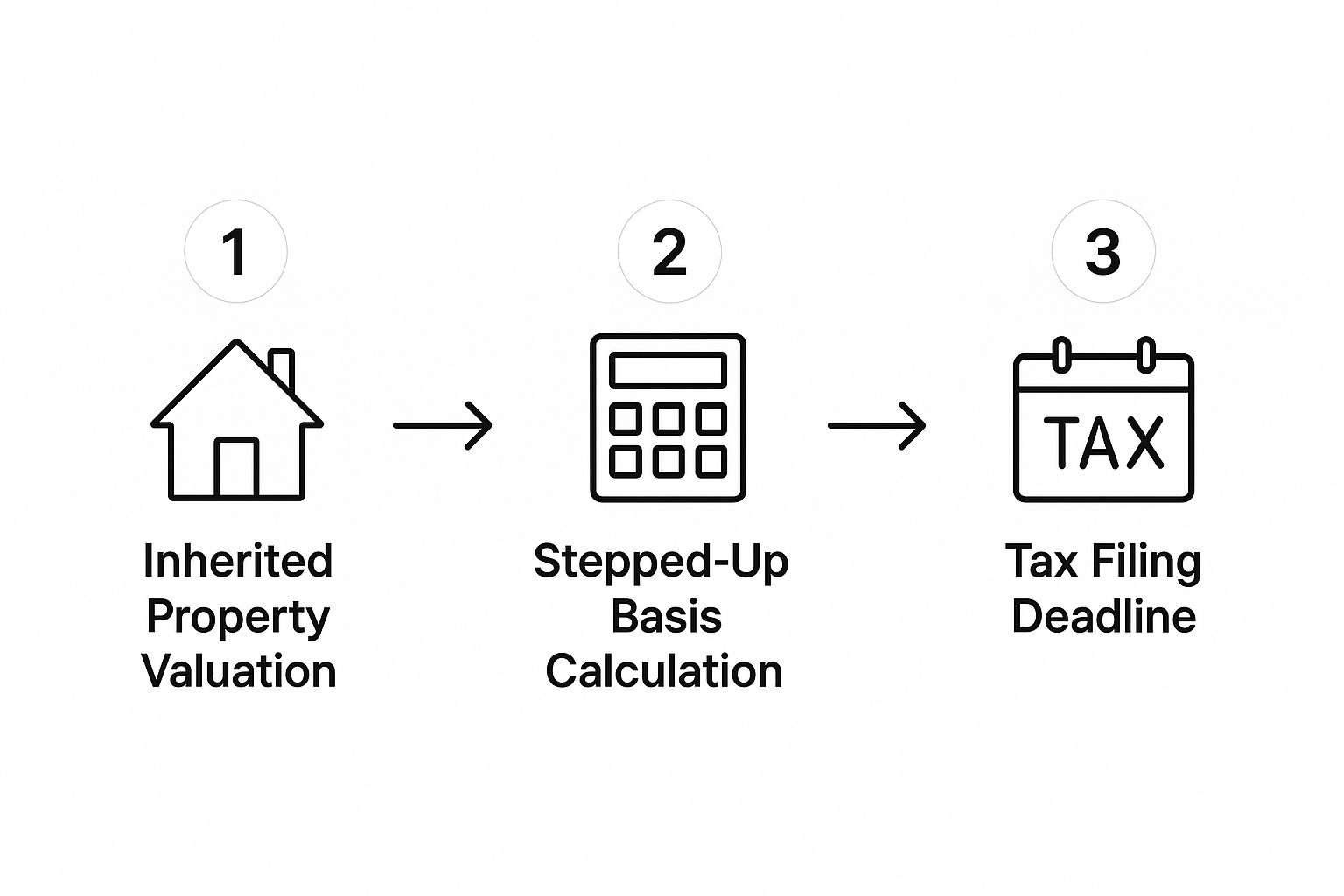
This visual helps tie everything together, showing the logical path from determining the property’s initial value to understanding the final tax impact.
The Long-Term Capital Gains Advantage
There’s one more fantastic piece of news when it comes to the capital gains tax on inherited property. The IRS gives you a special break: any profit from the sale is automatically considered a long-term capital gain.
Normally, you’d have to own an asset for more than a year to get the lower long-term tax rates. But inherited property is the exception to the rule. It doesn’t matter if you sell it a week after you inherit it or wait a decade—your gain will always be taxed at the more favorable long-term rates.
This is a huge benefit, especially for heirs who need to sell a property quickly. It guarantees you won’t get hit with higher, short-term tax rates just because you didn’t hold the asset for a full calendar year.
To get a more detailed look at how these rates work and other strategies for managing your tax bill, you can explore our guide on how to minimize your capital gains tax liability. When you master these calculations and rules, you can handle the sale of an inherited home with confidence, knowing you have a plan to protect your inheritance.
Strategies To Legally Reduce What You Owe

Knowing how to calculate your potential tax bill is one thing; actively working to reduce it is another. Fortunately, the tax code isn’t just a book of rules to follow—it also provides several powerful, completely legal strategies that can significantly lower what you owe on an inherited home sale. Proactive planning is really the key here.
The most powerful tool in your toolbox is often the Home Sale Exclusion, sometimes called the Section 121 exclusion. This rule lets you shield a huge chunk of profit from taxes, but it comes with a big string attached.
To qualify, you have to move into the inherited property and make it your primary residence. The rule is specific: you need to own and live in the home for at least two of the five years right before you sell it. If you can meet that test, you can exclude up to $250,000 of your capital gain from your income. For married couples filing a joint return, that exclusion doubles to a whopping $500,000.
Convert Your Inheritance Into A Tax-Free Home Sale
Let’s walk through how this plays out in the real world. Imagine you inherit a house with a stepped-up basis of $300,000. Instead of selling it right away, you decide to move in and make it your home. Three years later, you sell it for $580,000, which gives you a $280,000 capital gain.
Because you met the two-year residency requirement, you get to use the Home Sale Exclusion. As a single filer, you can exclude $250,000 of that gain. Your taxable profit plummets from $280,000 all the way down to just $30,000. That single move could easily save you tens of thousands of dollars in taxes.
Using Losses And Deferrals To Your Advantage
But what if moving in isn’t in the cards for you? You still have options. If the property has unfortunately lost value since you inherited it, you can turn that loss into a silver lining through a strategy called tax-loss harvesting.
A capital loss from selling your inherited property can be used to wipe out capital gains from other investments, like stocks or mutual funds. If your losses are bigger than your gains for the year, you can even deduct up to $3,000 of the excess loss against your regular income. Any loss left over after that can be carried forward to future tax years.
For those who see the property as more of an investment, another powerful tool is the 1031 exchange.
A 1031 exchange allows you to defer paying capital gains tax on the sale of an investment property if you reinvest the proceeds into a similar “like-kind” property. This is a common strategy for real estate investors looking to grow their portfolio without being slowed down by immediate tax bills.
The rules for a 1031 exchange are notoriously strict and time-sensitive. This isn’t a DIY project; working with a qualified intermediary is absolutely essential to get it right.
The Evolving Landscape Of Inheritance Taxation
Now, it’s always a good idea to keep an eye on the bigger picture. Tax laws, especially those around wealth and inheritance, are frequently part of larger political discussions. For example, proposals to tax unrealized capital gains at the time of death sometimes gain traction as a way to address wealth inequality.
Economists have modeled what this could look like, suggesting tax rates around 23.8% and showing that a tax with a per-person exemption of about $2.22 million could raise significant revenue. You can dive deeper into these policy ideas through research on wealth transfer taxes. While these aren’t the law today, these conversations show why staying informed is so important.
Comparing Tax Reduction Strategies
Choosing the right path depends entirely on your personal situation and financial goals. Here’s a quick overview of the strategies we’ve discussed to help you see how they stack up.
| Strategy | Who It’s For | Key Requirement | Potential Tax Benefit |
|---|---|---|---|
| Home Sale Exclusion | Beneficiaries willing to live in the property. | Own and use the home as a primary residence for 2 of the 5 years before sale. | Exclude up to $250,000 ($500,000 for married couples) of gain. |
| Tax-Loss Harvesting | Anyone selling a property that has lost value. | The property’s sale price must be less than its stepped-up basis. | Offset other capital gains and up to $3,000 of ordinary income. |
| 1031 Exchange | Real estate investors. | Reinvest proceeds into a “like-kind” investment property within a strict timeline. | Defer capital gains tax indefinitely. |
Ultimately, understanding all your available options—from the Home Sale Exclusion to tax-loss harvesting and 1031 exchanges—empowers you to make an informed decision that best suits your financial goals and honors the legacy you received.
How to Report the Sale of Inherited Property to the IRS
Figuring out the tax bill on an inherited property is one thing, but you also have to report the sale correctly to the IRS. This part can feel a little daunting, especially if you’re not used to handling this kind of tax situation. The good news is that it’s mostly a matter of putting the right numbers in the right boxes on two key forms: Form 8949, Sales and Other Dispositions of Capital Assets, and Schedule D, Capital Gains and Losses.
Think of it like this: Form 8949 is your detailed logbook. It’s where you break down the specifics of the sale. Schedule D is the summary page, where you tally everything up before carrying the final number over to your main tax return, the Form 1040.
Filling Out Form 8949
This is where all that careful record-keeping comes into play. You’ll need the numbers from the official appraisal and the final settlement statement from the sale.
Here’s a simple rundown of the crucial columns on Form 8949:
- (a) Description of Property: Be straightforward. Just list the property’s address, like “123 Main St, Anytown, USA”.
- (d) Proceeds: This is simply the sale price of the home before any costs are taken out.
- (e) Cost or Other Basis: Here’s where you’ll put that all-important stepped-up basis—the home’s fair market value on the original owner’s date of death.
- (g) Adjustments: This column is for all your selling expenses. Tally up the real estate commissions, attorney fees, closing costs, and any other deductible expenses and put the total here.
- (h) Gain or (Loss): The form does the math for you, calculating your final taxable gain or loss.
One of the most common questions is what to put for the date you acquired the property. It’s simpler than you think. For inherited property, you don’t need a specific date. Just write “INHERITED” in column (b). This is a special instruction for the IRS that automatically qualifies your sale for long-term capital gains rates, no matter how briefly you actually held the property.
From Your Worksheet to Your Tax Return
After you’ve filled out Form 8949, the next step is to carry those totals over to Schedule D. This form is the master list for all your capital gains and losses for the year, whether from property, stocks, or other investments.
Because inherited property is always treated as a long-term asset, your gain will be reported in Part II of Schedule D, which is specifically for long-term transactions.
Key Filing Tip: The final gain or loss calculated on Schedule D is what directly affects your tax bill. This number gets transferred to your main Form 1040, where it’s added to your other income to determine your total tax liability for the year.
While it might look like a lot of paperwork at first glance, there’s a clear logic to it. You’re just creating a paper trail that connects the sale price, your stepped-up basis, and your selling costs to the final number on your tax return. Getting this right ensures you pay the correct amount of capital gains tax on inherited property and can close this chapter with confidence.
Planning the Future of Your Inherited Asset
We’ve covered a lot of ground, walking through the entire process of handling capital gains tax on inherited property. From the moment you receive the asset to figuring out the complex tax side of things, you should now have a strong handle on how to make smart financial decisions. It all really boils down to a few key ideas.
The absolute cornerstone of this whole topic is the step-up in basis. This is a game-changing tax rule that adjusts the property’s cost basis to whatever its fair market value was on the date you inherited it. Honestly, this one rule can mean the difference between a massive tax bill and paying nothing at all. It’s also why getting a formal, professional appraisal right away is non-negotiable. If you don’t have that documented value, you could easily end up giving the IRS more than you owe.
Charting Your Next Steps
So, what’s next? Whether you’ve just inherited a home or you’re simply planning ahead with your family, the path forward requires thoughtful planning. Smart tax strategies, like the home sale exclusion or even tax-loss harvesting, can shield even more of your inheritance from taxes. The secret to making any of this work is keeping meticulous records from the very beginning.
The best results always come from foresight and preparation. If you treat your inheritance not just as a gift but as the significant financial asset it is, you’ll be in the best position to make responsible decisions that honor the legacy you’ve been given.
Your next moves should be deliberate. Start by gathering every piece of paper you can find—the property’s deed, the official appraisal report, and anything else related to the estate. And don’t be shy about getting help. A qualified tax advisor or an estate attorney can provide guidance tailored to your specific circumstances, which is invaluable when you’re trying to make sense of both federal and state tax laws.
It’s also crucial to understand how capital gains tax differs from other related taxes. To get a clearer picture, check out our guide on understanding inheritance tax and what you need to know. By arming yourself with knowledge and getting the right professional support, you can confidently manage your new property and protect its value for years to come.
Common Questions About Inherited Property & Taxes
It’s natural to have a lot of questions when you’re sorting out the financial side of an inheritance. The rules around capital gains can get tricky, so let’s walk through some of the most common situations you might run into.
What Happens If I Sell The Inherited Property At A Loss?
Selling an inherited property for less than its stepped-up basis might feel like a letdown, but it’s not all bad news. From a tax perspective, this creates a capital loss, which can be a surprisingly useful tool.
You can use that capital loss to cancel out other capital gains you might have. Say you have a $15,000 loss from selling the house but a $10,000 gain from selling some stocks. The loss from the house sale completely wipes out the gain from the stocks, meaning you owe zero tax on that investment profit.
If your losses are bigger than your gains for the year, you can use up to $3,000 of that excess loss to lower your regular taxable income. Any remaining loss doesn’t just disappear; you can carry it forward to offset gains or income in future years. This strategy is often called tax-loss harvesting, and it can save you a bundle.
Does It Matter How Long I Own The Property Before Selling?
Here’s some good news: for inherited property, any profit you make is automatically considered a long-term capital gain. This is a huge advantage.
Normally, you’d have to hold an asset for more than a year to get the lower long-term capital gains tax rates (0%, 15%, or 20%, depending on your income). But the IRS gives heirs a special break. You qualify for these better rates even if you turn around and sell the property just a few weeks after inheriting it.
This automatic long-term treatment is a crucial benefit for heirs. It ensures you won’t get hit with higher, short-term tax rates if you need or want to sell the property quickly.
How Is The Stepped-Up Basis Handled For Jointly Owned Property?
This is where things can get a bit more complex, because the rules often depend on state law and how a married couple owned the property together.
- In most states (Qualified Joint Interest): When one spouse passes away, the surviving spouse typically gets a 50% step-up. The deceased’s half of the property gets stepped up to its fair market value at the time of their death, but the surviving spouse’s original half keeps its initial cost basis.
- In Community Property states: States like Arizona, California, and Texas are much more generous. Here, the surviving spouse often receives a 100% step-up on the entire property’s value—not just the deceased’s share. This can make a massive difference in the potential tax bill down the road.
Given how much this varies, it’s incredibly important to talk to a local tax professional who knows the ins and outs of your specific state’s property laws.
Do I Also Owe State Capital Gains Tax?
Most likely, yes. The vast majority of states with an income tax also tax capital gains. It’s a critical detail to remember when you’re budgeting for taxes, as you’ll probably have a bill at both the federal and state level.
State rules can be all over the map. Some states tax capital gains just like regular income, while others have completely different tax brackets or offer unique credits. Overlooking your state tax liability can lead to some nasty penalties, so make sure it’s part of your overall financial plan.
Trying to piece together the rules on capital gains, stepped-up basis, and state taxes can feel overwhelming. The team at Allied Tax Advisors offers expert guidance to make sure you’re meeting all your obligations while finding every opportunity to reduce what you owe. For personalized help with your inherited property tax situation, get in touch with Allied Tax Advisors.