
When we talk about cash flow management for small business, we’re not just throwing around buzzwords. We’re talking about the hands-on process of watching, understanding, and improving the money that actually moves through your bank account. I’ve seen it time and again—it’s the single most critical discipline that determines whether you can pay your people and your suppliers on time.
Why Cash Flow Trumps Profit for Business Survival
Here’s one of the first and most painful lessons every entrepreneur learns: profit on a spreadsheet doesn’t pay the rent. It’s entirely possible to have a business that looks wildly profitable on paper, with signed contracts and a stack of invoices, yet be teetering on the edge of collapse because the bank account is dry.
That gap between what your books say you’ve earned and the actual cash you have to spend is exactly where thousands of promising businesses stumble and fall.
This is the real core of smart financial leadership. Being ‘profitable’ is an accounting term; being ‘cash-positive’ is a business reality.
- Profit is what’s left after you subtract all your expenses from your revenue. It tells you if your business model is sound over the long haul.
- Cash Flow is the lifeblood—the actual money flowing in from customers and out to cover things like payroll, inventory, and rent.
Think about a small graphic design agency that lands a fantastic $50,000 project. The moment that contract is signed, they’re technically profitable. But there’s a catch: the client’s payment terms are net-90. That means the cash won’t show up for three months. In the meantime, the agency has salaries, software subscriptions, and office space to pay for. Without enough cash saved up, this “profitable” company could easily go under before that $50,000 ever hits their account.
The Sobering Statistics
This isn’t just a story I’m telling—it’s a harsh reality for countless business owners. The numbers don’t lie. A staggering 82% of small businesses that fail do so because of poor cash flow management. It’s a clear signal that the timing of your money is often far more important than the volume of your sales.
What’s more, about 29% of small businesses fail simply because they run out of cash. Digging into these cash flow management statistics really drives the point home.
Shifting your focus from just chasing profits to mastering your cash flow is the difference between constantly putting out financial fires and proactively building a business that can weather any storm.
From Reactive to Proactive
When cash flow is tight, you’re always on the back foot. You’re forced into making last-minute, desperate decisions—like taking on high-interest loans or putting off critical supplier payments—which just digs the hole deeper.
On the flip side, getting a handle on your cash flow puts you firmly in control. It gives you the freedom and flexibility to:
- Jump on growth opportunities, like buying inventory in bulk for a discount.
- Handle unexpected slow months without breaking a sweat.
- Invest in your team and the tools you need to grow.
- Finally get a good night’s sleep, knowing your financial house is in order.
To really get a grip on this, it helps to be crystal clear on the terms we use. These aren’t just accounting jargon; they’re the vital signs of your business’s financial health.
Key Cash Flow Metrics at a Glance
| Metric | What It Means | Why It Matters |
|---|---|---|
| Cash Flow from Operations | The cash generated from your primary business activities, like sales. | This is your company’s pulse. A positive number means your core business is self-sustaining. |
| Free Cash Flow (FCF) | The cash left over after you’ve paid for operating expenses and capital expenditures (like new equipment). | This is your “go-for-growth” money. You can use it to expand, pay down debt, or build a safety net. |
| Accounts Receivable (A/R) | The money your customers owe you for goods or services already delivered. | This represents cash you’ve earned but haven’t collected yet. High A/R can create a cash crunch. |
| Accounts Payable (A/P) | The money you owe to your suppliers and vendors. | Managing A/P is a strategic balancing act—paying too early hurts your cash reserves, while paying too late hurts your reputation. |
| Cash Conversion Cycle (CCC) | The time it takes to turn your investments in inventory back into cash from sales. | A shorter cycle means you get your cash back faster, which is always a good thing. |
Getting comfortable with these metrics is the first real step. Now that we’ve laid the groundwork, the rest of this guide will give you the practical framework and real-world tactics to take command of your business’s financial lifeblood for good.
Getting Your Hands Dirty: Your First Cash Flow Statement
Let’s cut through the accounting-speak. Putting together your first cash flow statement isn’t about complex formulas; it’s about getting a brutally honest look at where your money is actually going. This statement is your financial reality check, showing you exactly what cash came in and what went out over a specific timeframe, like a month or a quarter.
Think of it as a “day in the life” documentary for your business’s bank account. This isn’t some high-level academic exercise. It’s a hands-on tool for smart cash flow management for small business owners. It helps you answer the really important questions, like, “Did my sales this month actually bring in more cash than I paid out for inventory and rent?”
This infographic really nails the core idea: improving your cash flow means getting tactical with your day-to-day financial documents.
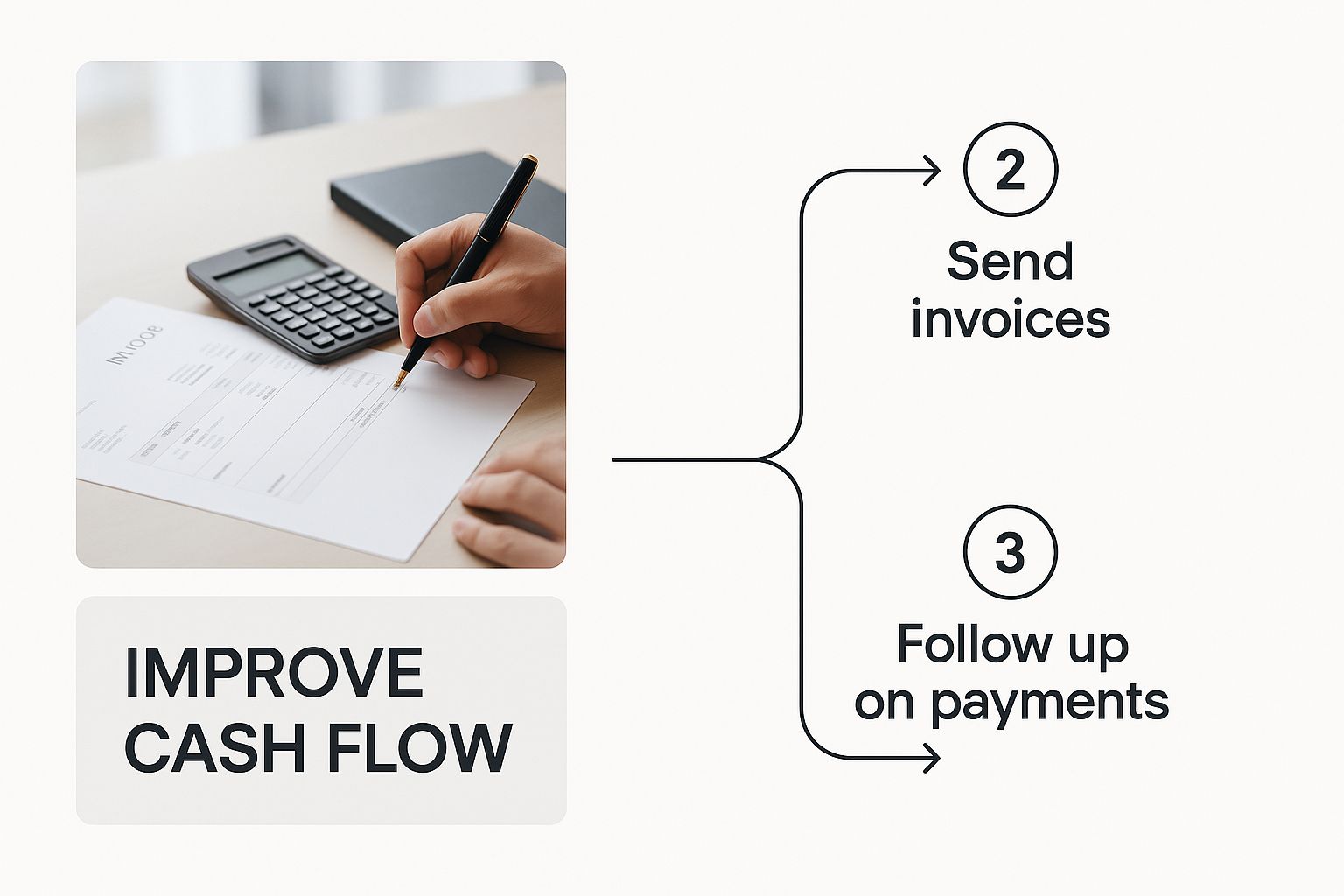
As you can see, it all starts with a close look at the real-world flow of money in and out of your business. To build your statement, we’ll break it down into three core areas. I’ll use a simple coffee shop example to show you how it works in practice.
Nail Down Your Operating Activities
This section is the heart of your statement. It’s all about the cash that your main business activities generate or consume. You’re essentially tracking the real-world cash impact of everything that shows up on your profit and loss statement.
- Cash Inflows: This is the money that actually hits your bank account from customers. For our coffee shop, that means the daily credit card batches and the cash from the till.
- Cash Outflows: These are your day-to-day running costs. Think about payments for coffee beans, milk, employee paychecks, rent, and the electricity bill.
You don’t need a fancy system to find these numbers. Just pull out your bank statements, your credit card processing reports (from a system like Square or Toast), and your payroll records. That’s your starting point.
My Two Cents: This is where so many business owners get tripped up. Sales are not the same as cash. If you sent a catering invoice for $500 but haven’t been paid yet, it doesn’t go here. We’re only counting cash that has actually landed in your account during this period.
Factor In Investing and Financing
These next two parts are usually less complicated for most small businesses, but they’re critical for getting the full story.
Investing Activities track cash you’ve spent on—or received from—long-term assets. If our coffee shop owner buys a shiny new $4,000 espresso machine, that cash payment is an outflow that gets recorded here. On the flip side, if they sold an old delivery van, the cash they got for it would be an inflow.
Financing Activities are all about how you fund the business itself. This bucket includes:
- Cash you receive from taking out a bank loan.
- Money you personally put into the business (an owner’s contribution).
- Loan payments you make (but only the principal part of the payment).
- Money you take out for yourself (an owner’s draw).
When you pull these three pieces together, you get a powerful snapshot of your true cash position. This simple document is one of the best tools you’ll ever have for making smart decisions and catching financial trouble before it snowballs into a full-blown crisis. We’ve even put together a simple template to help you get started right away.
How to Accurately Forecast Your Cash Flow
While a cash flow statement shows you where your money has been, a forecast is your map to where it’s going. This isn’t about reacting to problems after they’ve hit your bank account; it’s about seeing what’s coming down the road. A solid forecast gives you the runway you need to navigate tight spots or confidently jump on a growth opportunity.
This isn’t guesswork or staring into a crystal ball. It’s about using the financial data you already have to build a realistic picture of the future. Think of it as a financial weather report—it tells you whether to brace for a storm or if it’s clear skies ahead for expansion.
The stakes are real. A recent study found that 45% of small business owners in the U.S. have had to skip paying themselves due to cash flow crunches, and 22% couldn’t cover basic operating bills. If you want to dig deeper into these numbers, you can explore the full study on PYMNTS.com.
Creating Your Rolling Forecast
For most small businesses, the most practical tool is a rolling forecast. This typically means looking 30, 60, and 90 days into the future. It’s called “rolling” because as each month closes, you drop it and add a new one to the end, keeping your financial outlook constantly up-to-date.
Let’s imagine you run a seasonal business, like a holiday decor store, to see how this works in the real world.
- Projecting Cash In: Your sales history is your best friend here. Our store owner knows that sales are pretty quiet from January through September, then explode from October to December. The forecast needs to show this, with low income for most of the year and a massive surge in Q4. It’s also crucial to account for when the cash actually lands. If you give corporate clients net-30 terms on a big order in December, you won’t see that money until January.
- Projecting Cash Out: Now, list every expense you can think of. This includes your fixed costs like rent and insurance, but also your variable costs like inventory and hiring seasonal staff. The decor store owner has to place a huge inventory order in August to stock up for the holiday rush. That’s a massive cash-out event that needs to be planned for, right in the middle of a slow sales period.
A great forecast is all about timing. For our store, it means having enough cash from last year’s profits socked away to survive the lean months and cover that giant August inventory bill—before the holiday revenue starts to pour in.
Two Simple Forecasting Methods
You don’t need a finance degree to get started. There are two straightforward methods that work for almost any small business.
- The Direct Method: This is the most intuitive way to do it. You literally list all the cash you expect to come in (customer payments, loan money) and all the cash you expect to go out (payroll, rent, supplier bills) over the next period. It’s a ground-level, line-by-line prediction of your bank account’s activity.
- The Indirect Method: This one starts with the net income from your profit and loss statement. From there, you adjust for non-cash expenses (like depreciation) and changes in your balance sheet (like what customers owe you versus what you owe suppliers). It’s less granular, but it gives you a valuable high-level picture that works well alongside the direct method.
A good forecast also has a direct impact on your tax planning. By getting a handle on your projected income and expenses, you can get a much clearer idea of your tax liability. To dive deeper into this, check out our guide on tax-saving strategies for small business owners.
Here is the rewritten section, designed to sound completely human-written and natural.
Getting Paid Faster: Simple Ways to Improve Your Cash Inflow
Let’s be honest, improving cash flow often boils down to one thing: getting paid faster. The less time between finishing the work and seeing the money in your account, the healthier your business will be. We’re going to walk through some practical, real-world tactics you can put into practice right away.
It’s a common myth that small businesses fail simply from a lack of cash. The reality is a bit more complex. In fact, recent data shows that 53% of small and medium business owners saw their cash position improve last year. This tells us something important: success isn’t just about having cash, it’s about mastering your cash flow. You can read more about how better management outweighs sheer cash volume in this insightful report.
Sharpen Your Invoicing Game
Think of your invoice as the starting line for getting paid. If it’s confusing, incomplete, or late, it’s like a false start—it just delays everything. It’s time to get your invoicing process down to a science.
Get that invoice out the door the moment a job is done or a product is delivered. Don’t batch them up for the end of the month. Every single invoice should be crystal clear and include:
- A unique invoice number
- A clear “due date” in bold letters
- A line-by-line breakdown of what you’re charging for
- Simple instructions for every payment method you accept
One small trick I’ve seen work incredibly well is offering a small early-payment discount. Something like a 2% discount for paying within 10 days can do wonders for speeding up your collections.
Make It Incredibly Easy for People to Pay You
Every ounce of friction a customer feels when trying to pay you is another day you’re waiting for your money. Your job is to remove every single obstacle. Today, that means offering more than just the option to mail a check.
Modern payment tools can get you paid in seconds.
- Online Payment Links: Use a service like Stripe or PayPal to put a “Pay Now” button right on your digital invoices.
- QR Codes: You can easily add a QR code to paper invoices that takes the customer straight to a payment page on their phone.
- ACH/Bank Transfers: For bigger B2B payments, this is a great low-fee option to offer.
The goal? Make it so easy that a customer can pay you from their phone in less than 60 seconds.
Several great tools can help you streamline invoicing and get paid faster. They range from simple payment processors to full-blown accounting platforms that automate the entire process for you.
Comparing Invoicing and Payment Tools
A look at different software options that can help automate and streamline your cash inflow process.
| Tool Category | Key Features | Best For |
|---|---|---|
| Payment Processors | – “Pay Now” buttons on invoices – Accepts credit/debit cards – Simple, fast setup |
Businesses needing a quick way to accept online payments without a full accounting suite (e.g., Stripe, PayPal). |
| Invoicing Software | – Customizable invoice templates – Automated payment reminders – Tracks invoice status (sent, viewed, paid) |
Freelancers and service businesses that want to professionalize their invoicing and follow-ups (e.g., FreshBooks, Wave). |
| All-in-One Accounting | – Full invoicing & payment processing – Expense tracking & bank reconciliation – Comprehensive financial reporting |
Businesses that want a single system to manage all their finances, from invoicing to tax time (e.g., QuickBooks Online, Xero). |
Choosing the right tool depends on your business’s complexity. A simple payment processor might be enough to start, but as you grow, a more integrated system can save you a ton of time and headaches.
Build Predictability with Recurring Revenue
If your business provides ongoing services, shifting from one-off projects to a recurring revenue model is a total game-changer for cash flow. It helps you get off the financial rollercoaster of chasing individual invoices and creates a smooth, predictable income stream.
Think about offering monthly retainers for your services or subscription packages for your products. This approach not only stabilizes your income but also tends to build stronger, long-term customer relationships. Plus, it makes financial forecasting infinitely easier, which is a core part of solid business tax planning.
My best advice is to automate everything you can. Use accounting software to send automatic payment reminders for overdue invoices. A polite, automated nudge is often all it takes to get an invoice paid, and it saves you from the awkward follow-up calls.
When an invoice does become overdue, you need a plan. Don’t just let them sit there. Have a clear, escalating follow-up process that starts with a friendly reminder and gets more direct over time. You want to preserve the client relationship, but getting paid is what keeps your doors open.
Smart Ways to Manage Your Cash Outflow
Getting cash in the door is only half the battle. You also have to be smart about how it goes out. Managing your outflow isn’t about cutting costs to the bone and stunting your growth; it’s about making sure every single dollar you spend is working for you.
Think of it as shifting from a reactive “bill-paying” mode to a proactive strategy. The whole point is to build a leaner, more resilient business that can weather the inevitable financial ups and downs.
Negotiate Better Terms with Your Suppliers
Many business owners treat supplier payment terms as non-negotiable, but that’s rarely the case. Your relationship with your suppliers is a partnership, and there’s often more flexibility than you think. One of the most powerful moves you can make is to align your payment deadlines with your own income cycle.
Here’s a real-world example: Let’s say your biggest client always pays you around the 15th of the month. If your main supplier’s invoice is due on the 1st, you’re in a tight spot. Why not ask them to move your due date to the 20th? This simple change creates a comfortable buffer, letting you use your client’s payment to cover the bill without a scramble.
Don’t be afraid to just ask. Seriously, the worst they can do is say no. I always frame it as a way to build a stronger partnership. Most suppliers would much rather have a reliable customer who pays consistently on a net-45 schedule than one who’s always late on net-30.
Perform a Ruthless Subscription Audit
In the age of Software-as-a-Service (SaaS), it’s incredibly easy for small, recurring charges to pile up unnoticed. They just quietly drain your cash reserves month after month. A subscription audit is one of the fastest ways to plug these leaks.
Comb through your bank and credit card statements line by line. For every recurring payment you find, ask these tough questions:
- Is this absolutely essential? Do we genuinely use this tool every day or week?
- Are we on the right plan? It’s common to pay for premium features you never touch. Downgrading to a lower-cost tier can save you a surprising amount.
- Can we pay annually? If a tool is critical to your operations, see if they offer a discount for paying annually. A 10-20% discount is pretty standard, and it’s a great deal if you have the cash on hand.
Use Business Credit as a Tool, Not a Crutch
Business credit can be a fantastic way to accelerate growth, but it can also become a dangerous trap. The trick is knowing the difference between “good debt” and “bad debt.”
- Good Debt: This is when you borrow money to invest in something that generates more income. Taking out a loan to buy a more efficient piece of equipment that boosts your production capacity? That’s good debt.
- Bad Debt: This is when you use debt to cover up underlying cash flow issues. If you’re constantly relying on high-interest credit cards to make payroll, that’s a massive red flag.
Before you ever take on debt, you need a clear, written plan for how that money will generate more cash than it costs. Focus on building a strong business credit score by always paying your bills on time. This gives you access to better, cheaper financing when you actually need it. Keeping a close eye on your liabilities is a cornerstone of responsible cash flow management for small business owners.
Finding the Right Tools for Modern Cash Flow Management
If you’re still relying on a shoebox full of receipts and a manual spreadsheet, you’re making your life much harder than it needs to be. Honestly, those days are over. To get a real handle on your cash flow, you need to bring in the right technology.
Investing in a few key tools can completely change the game. It moves cash flow management for small business from a frustrating, reactive chore to a streamlined, forward-looking process. And you don’t need a massive budget, either. Many of the best tools out there are surprisingly affordable and pay for themselves almost immediately in saved time and smarter decisions.
Your Accounting Software: The Financial Hub
Think of your accounting software as the command center for all your financial data. Modern platforms have evolved far beyond simple bookkeeping. They’re built to give you a powerful, visual snapshot of your business’s health in real-time.
Take industry-standard platforms like QuickBooks Online or Xero. Their real power comes from connecting directly to your business bank accounts and credit cards. They pull in and categorize your transactions automatically, giving you an up-to-the-minute view of your cash position without you having to lift a finger.
My advice? When choosing a platform, make sure it has a built-in cash flow forecasting tool. The best ones use your own historical data to project future cash balances, which can help you spot a potential shortfall weeks or even months down the road.
Getting this foundation right is non-negotiable. If you’re just starting to organize your finances, our guide on accounting tips for small business is a great place to begin.
Specialized Apps for Forecasting and Invoicing
While your main accounting software is the core, sometimes you need a more specialized tool to tackle a specific cash flow problem. This is where dedicated apps can really shine.
- Deeper Cash Flow Forecasting: For more complex planning, look at tools like Float or Jirav. They sync with your accounting software but let you build incredibly detailed “what-if” scenarios. You can model things like, “What happens to my cash if I hire two new people in May?” or “How would a 15% drop in Q3 sales impact my ability to pay vendors?” That’s the kind of insight that drives smart, strategic growth.
- Smarter, Faster Invoicing: Getting paid on time is one of the fastest ways to improve your cash flow. This is where automated invoicing platforms like FreshBooks or Wave are invaluable. They don’t just create professional-looking invoices; they send automatic payment reminders to clients who are dragging their feet and let you accept online payments instantly. The faster that cash hits your account, the better.
A small investment in the right technology stack gives you incredible control over your business’s finances. By automating the grunt work and having critical data at your fingertips, you can finally stop worrying about day-to-day cash and start focusing on the big picture: growing your business with confidence.
Got Questions About Cash Flow? We’ve Got Answers.
When you’re running a small business, financial questions pop up constantly. It’s only natural. Let’s walk through some of the most common ones we hear from entrepreneurs about the day-to-day reality of managing money. Think of this as a quick reference guide to help you handle those everyday challenges with a bit more confidence.
Ultimately, good cash flow management comes down to making smart, informed decisions every single day.
What’s the Difference Between Cash Flow and Profit?
This is probably the single most common point of confusion, and getting it right is absolutely crucial.
Profit is the number you see on paper after subtracting all your expenses from your total revenue. It’s an important accounting metric that tells you if your business model is sustainable in the long run.
Cash flow, on the other hand, is the actual, tangible money moving in and out of your bank account. It’s the lifeblood of your operation, determining whether you can pay your rent, your team, and your suppliers tomorrow. A business can be wildly profitable on paper but still fail if all its cash is tied up and it can’t cover immediate costs.
An Unexpected Expense Just Hit. What Do I Do?
First off, take a breath. This is exactly why you’ve been working on understanding your cash flow in the first place.
- Tap Your Emergency Fund: This is what it’s for. Ideally, you should have 3-6 months of essential operating expenses set aside for exactly these moments.
- Check Your Forecast: Pull up your cash flow forecast. When is your next big chunk of revenue expected to land? Knowing this tells you how long of a bridge you need to build.
- Talk to Your Vendors: Could you delay a large payment to a supplier? Or maybe switch to a short-term payment plan? You’d be surprised how understanding vendors can be, especially if you get ahead of the problem and communicate openly.
The real power here is visibility. When you truly know your numbers, an unexpected expense is just a problem to solve—not a full-blown crisis that puts your entire business at risk.
What Cash Flow Numbers Should I Be Watching Every Day?
You don’t need to get lost in a sea of spreadsheets. Just a few key metrics will tell you most of what you need to know.
Your top priority is cash on hand—what’s in your bank account right now. Beyond that, keep a very close eye on your Accounts Receivable (A/R), which is the money your customers owe you, and your Accounts Payable (A/P), the bills you owe to suppliers.
The daily game is all about shortening the time it takes to collect your A/R while making strategic, timely A/P payments. Nailing that balance is the core of effective cash management.
How Can I Tell if My Cash Flow is Actually Healthy?
Healthy cash flow is about more than just having a positive bank balance today. It’s about consistency and predictable patterns over time.
One of the surest signs of good health is a consistently positive cash flow from operations. This shows that your primary business activities—selling your product or service—are generating more cash than they use up. It means you aren’t relying on loans or dipping into your personal savings just to keep the lights on.
Another fantastic indicator is your cash conversion cycle. This metric tracks how fast you can turn your investment in inventory or materials back into cash in the bank from a sale. The shorter that cycle, the healthier your business.
Ready to stop putting out financial fires and start building a more predictable future for your business? The team at Allied Tax Advisors provides the expert tax and accounting guidance that helps you build a resilient, cash-positive company. Learn more about how we can support your financial journey.