
Let’s cut right to the chase: you almost never claim your spouse as a dependent. It’s a common misconception, but the IRS rules are crystal clear. Your spouse is your partner in a financial union, not someone you can claim for a dependency credit.
The good news? The tax code offers far better options for married couples, namely filing as Married Filing Jointly or Married Filing Separately. These statuses are designed specifically for your situation and usually provide much bigger tax breaks.
The Truth About Spouses and Tax Dependents

It’s one of the most persistent myths in personal finance. I’ve heard it countless times from new clients: “My spouse doesn’t work, so I can claim them as a dependent, right?” It seems logical, but the tax system views marriage as a unique partnership with its own distinct set of rules and benefits.
The very idea of claiming your spouse as a dependent is a non-starter based on how the IRS defines a dependent. One of the key rules is that a dependent cannot file a joint tax return with their own spouse. Since filing a joint return is the primary way married couples handle their taxes, this rule immediately disqualifies your spouse from being your dependent.
Your Real Tax Filing Options
Instead of a small dependency exemption, married couples get to choose between two powerful filing statuses. These were created specifically to reflect the combined financial picture of a couple, and the benefits they offer are generally far more valuable than any dependent-related credit would be.
You have two main choices:
- Married Filing Jointly (MFJ): This is the go-to for the vast majority of married couples. It combines both spouses’ incomes, deductions, and credits onto a single return. This status almost always results in a lower tax bill because it offers a higher standard deduction and access to a wider range of tax benefits.
- Married Filing Separately (MFS): This status is less common but can be a smart strategic move in specific scenarios. For instance, it might make sense if one spouse has very high medical expenses they want to deduct or is managing federal student loans under an income-driven repayment plan.
Key Takeaway: The tax code doesn’t let you claim your spouse as a dependent because it gives you something much better. The Married Filing Jointly status provides one of the highest standard deductions available, which directly reduces your taxable income far more effectively than a dependency claim ever could.
So, the real question isn’t whether you can claim your spouse as a dependent. The question you should be asking is which filing status will save your household the most money.
Filing Options for Married Couples at a Glance
To make the choice clearer, it helps to see the two main filing statuses side-by-side. Each has a specific purpose, and understanding the core differences is key to making the right decision for your family’s financial situation.
| Filing Status | Key Feature | Common Use Case |
|---|---|---|
| Married Filing Jointly | Combines incomes, deductions, and credits onto one return. Offers a higher standard deduction and more tax breaks. | The vast majority of married couples, especially single-income households, benefit most from this status. |
| Married Filing Separately | Each spouse files their own individual return, reporting their own income and deductions. | Used strategically to isolate one spouse’s income for student loan plans or to separate tax liabilities. |
Ultimately, choosing between MFJ and MFS comes down to running the numbers for your specific circumstances. For most people, filing jointly is the clear winner, but it’s always worth exploring both options.
Why Your Spouse Isn’t a Tax Dependent

It’s a question I hear all the time, and it makes perfect sense on the surface: “My spouse doesn’t work, so can I claim them as a dependent?” The short answer is almost always no, and the reason gets to the heart of how the IRS views marriage.
The tax code doesn’t see your spouse as a dependent; it sees them as your partner in a unique financial unit. This is why you almost never claim a spouse as a dependent. The system is specifically designed to treat a married couple’s finances together, not as one person supporting another in the traditional tax sense.
In fact, the rules for who can be a “Qualifying Dependent” are written to exclude a spouse from the get-go. One of the core rules is that a dependent cannot file a joint tax return. Since filing jointly is the most common and beneficial option for married couples, this rule immediately sets up a conflict. The IRS essentially gives you a better deal through joint filing statuses. Grasping this is vital, as understanding how major life changes impact your taxes is a cornerstone of sound financial management.
The Tax Code Sees You as a Team
The entire tax system is built on the principle that a married couple is a single economic team. Instead of having one partner claim a small credit for the other, the IRS encourages you to file together to get a much larger benefit. This is where the “Married Filing Jointly” (MFJ) status comes in.
The MFJ status gives you one of the most generous standard deductions available, which is a straight reduction of your taxable income. For the 2023 tax year, the standard deduction for joint filers was $27,700. Compare that to the $13,850 deduction for a single person. That single advantage nearly always provides more tax savings than any dependent claim ever could.
Key Takeaway: The tax law doesn’t need to offer a dependent claim for a spouse because it provides a far superior alternative. Filing a joint return honors your financial partnership and unlocks a massive standard deduction that is much more valuable.
How a Spouse Differs From a Dependent
To really drive this home, let’s quickly look at who the IRS actually considers a dependent. Your spouse won’t fit into either of these two strict categories.
- A Qualifying Child: This person has to pass several tests related to their age, where they live, and the support you provide. For instance, they must be younger than you and under age 19 (or 24 if they’re a full-time student).
- A Qualifying Relative: This is a wider net that can include relatives like parents or siblings, or even someone unrelated who lives in your home all year. The key here is that their gross income must be very low (under $4,700 for 2023), and you must be paying for more than half of their living expenses.
Your spouse simply doesn’t fall into these buckets. The tax code gives them a distinct classification: a spouse. This special status is your key to unlocking the powerful Married Filing Jointly and Married Filing Separately options, which are the intended and correct ways to file.
Choosing Your Filing Status: Jointly vs. Separately
This is where your tax strategy really begins. Deciding between ‘Married Filing Jointly’ (MFJ) and ‘Married Filing Separately’ (MFS) has major financial consequences. While you now know you can’t claim your spouse as a dependent, picking the right filing status is your real path to tax savings.
For the vast majority of married couples—over 95%, in fact—filing a joint return is the clear winner. It combines your incomes and opens the door to a wider range of deductions and credits. This almost always leads to a lower overall tax bill, especially in households where one spouse earns significantly more than the other or doesn’t work at all. We have a full guide that dives deep into the benefits of filing taxes jointly if you want to explore that further.
But “almost always” isn’t the same as “always.” There are some specific, important situations where filing separately is the smarter move.
When Filing Separately Makes Sense
Think of filing separately as a strategic tool for unique financial circumstances. It lets you build a legal firewall between your tax liability and your spouse’s. This separation can be crucial in a few key scenarios.
For instance, let’s say one spouse has massive medical expenses. To deduct medical bills, your costs must exceed 7.5% of your adjusted gross income (AGI). When you file a joint return, your combined AGI is higher, which makes it much harder to clear that hurdle. By filing separately, the spouse with the high medical bills has a lower individual AGI, which might allow them to claim a substantial deduction that would otherwise be completely lost.
Another common reason to file separately involves student loan management.
Many federal student loan programs, like Income-Driven Repayment (IDR) plans, base monthly payments on your AGI. Filing separately can prevent a high-earning spouse’s income from drastically inflating the other’s required student loan payment, sometimes saving hundreds of dollars every month.
This infographic simplifies the initial thought process for anyone still puzzling over the dependent question.
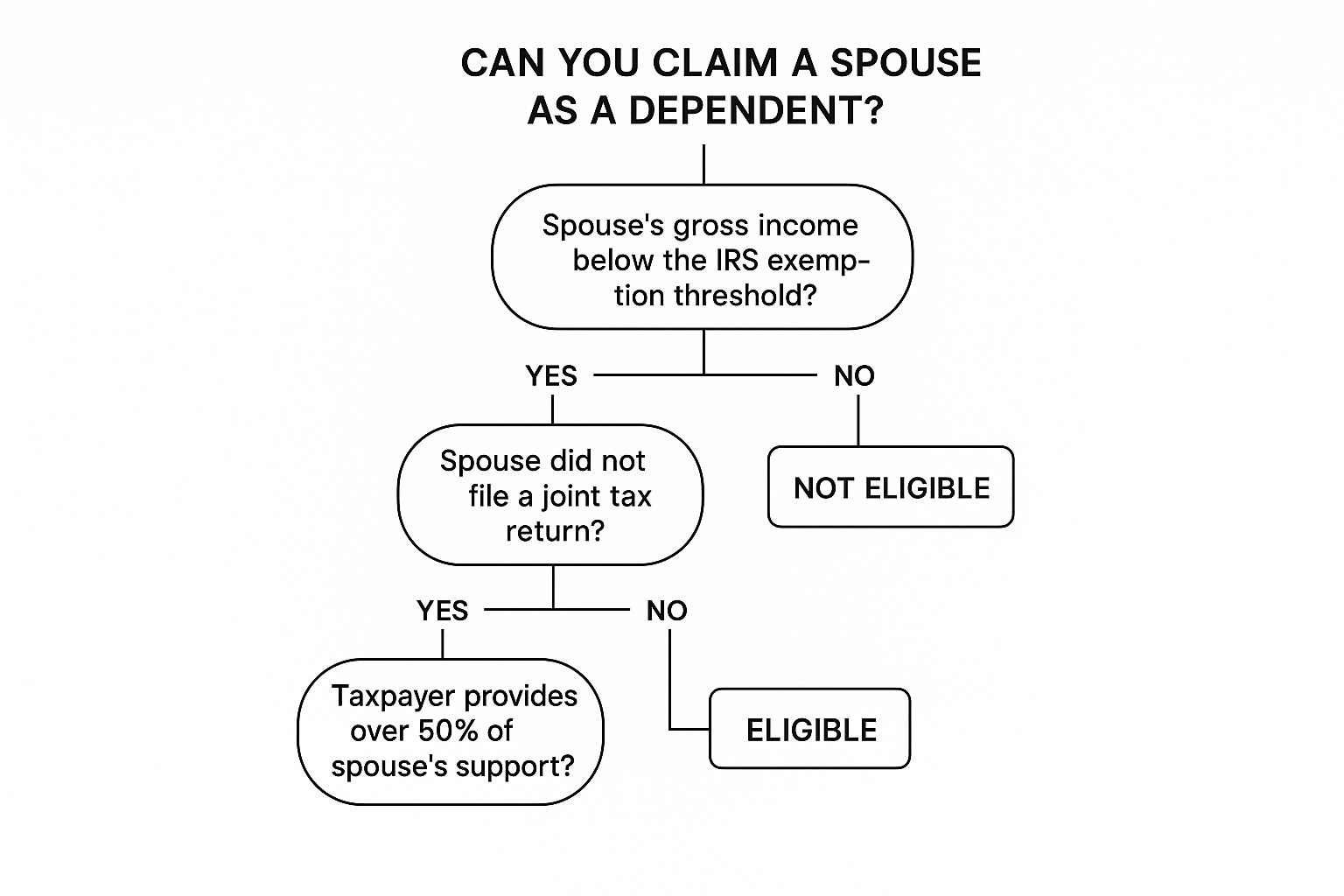
As you can see, the decision tree quickly rules out claiming a spouse as a dependent, reinforcing why your focus should instead be on selecting the most advantageous filing status.
The Downside of Filing Separately
Choosing to file separately isn’t a decision to take lightly. It comes with some significant trade-offs, as the tax code actively discourages this status by limiting or even eliminating many valuable tax breaks.
If you file separately, you generally lose the ability to claim:
- The Earned Income Tax Credit (EITC)
- The American Opportunity and Lifetime Learning Credits for education costs
- The deduction for student loan interest you’ve paid
- The credit for the elderly or disabled
On top of that, your standard deduction is sliced in half, and your capital loss deduction limit is also reduced. The best way to know for sure? Prepare your taxes both ways—jointly and separately—and compare the bottom line. It’s an extra step, I know, but it is the only way to be absolutely certain you’ve made the best choice for your household.
Tax Rules for Couples with a Non-Resident Spouse

Navigating the U.S. tax system gets a lot more interesting when your spouse is a non-resident alien. The standard “married filing jointly” or “separately” decision suddenly has another layer of complexity. But don’t worry—with the right information, you can handle it effectively.
The absolute first step, before anything else, is getting your spouse a valid U.S. taxpayer identification number. Without one, you simply can’t include them on your tax return.
This means your spouse will need either a Social Security Number (SSN) or an Individual Taxpayer Identification Number (ITIN). SSNs are generally for those authorized to work in the U.S. For everyone else who needs to file taxes but isn’t eligible for an SSN, the ITIN is the way to go. Just be aware that the ITIN application process can take around seven weeks, so you’ll want to get started on that early. You can dive deeper into these nuances in this complete guide to filing with a foreign spouse.
The Critical Choice You Must Make
Once your spouse has their ITIN or SSN, you’re at a crossroads. The IRS gives you a unique option: you can make a special election to treat your non-resident spouse as a U.S. resident for tax purposes for the entire year. This is the key that unlocks your ability to file a joint return.
Making this election isn’t just a box you check. It’s a formal process that requires you to attach a signed statement to your joint return for the first year you make the choice. This statement simply needs to say that one of you is a non-resident alien, the other is a U.S. citizen or resident, and you both agree to be treated as U.S. residents for that tax year.
Important Note: This isn’t a casual, year-by-year decision. Once you make this election, it’s binding for that year and all future tax years. It only ends if you formally revoke it, get a legal separation or divorce, or if one of you passes away. It’s a serious commitment.
The Worldwide Income Trade-Off
So, why would you do this? The main advantage is access to the benefits of filing jointly, like a much higher standard deduction and eligibility for certain tax credits you’d otherwise miss. But this benefit comes with a massive trade-off that you absolutely must understand.
When you file jointly under this election, you are required to report your spouse’s entire worldwide income on your U.S. tax return. That means every dollar, euro, or yen they earned from their job, investments, or any other source in their home country—or anywhere else in the world—must be reported to the IRS.
Let’s look at a real-world scenario to see how this plays out:
- Without the Election: A U.S. citizen files as Married Filing Separately. They report only their own income. Their non-resident spouse’s foreign income is their own business and isn’t subject to U.S. tax.
- With the Election: The same couple files as Married Filing Jointly. They must report the U.S. citizen’s income plus every penny the non-resident spouse earned from their job back home.
You may be able to use the Foreign Tax Credit to offset some of the U.S. tax owed on that foreign income, but the reporting requirement is non-negotiable. Before making this choice, you need to run the numbers carefully to see if the tax savings from filing jointly are worth the potential tax hit on your spouse’s global income. This is a situation where talking to a tax professional with international experience isn’t just a good idea—it’s essential.
Can You File as Head of Household if You’re Married?
It’s a common misconception that married individuals are stuck with only two filing options: Married Filing Jointly or Married Filing Separately. But there’s a third, often overlooked possibility that can be a real game-changer for your tax bill: filing as Head of Household.
This isn’t an option for every married person, of course. It’s specifically designed for those in a unique, but not uncommon, situation—being legally married but living apart and financially supporting a household on your own. If you meet the criteria, the IRS essentially allows you to be “considered unmarried” for tax purposes, opening the door to a more favorable filing status than Married Filing Separately.
The “Considered Unmarried” Test: What You Need to Know
To qualify for this special treatment, you have to jump through a few specific hoops set by the IRS. It’s not a gray area; you either meet all the requirements, or you don’t. Think of it as a checklist.
Here’s exactly what the IRS is looking for:
- You file a separate tax return from your spouse. This is non-negotiable.
- You paid more than half the cost of keeping up your home for the entire tax year. This means tallying up expenses like rent or mortgage interest, property taxes, utilities, repairs, and even food eaten in the home.
- Your home was the primary residence for a qualifying child or relative for more than six months of the year. Don’t worry, temporary absences for things like college or a hospital stay usually don’t count against you.
- Your spouse did not live with you at any point during the last six months of the tax year. That’s a strict cutoff: from July 1st to December 31st, your spouse cannot have lived in your home.
Expert Takeaway: The “considered unmarried” rule is a form of tax relief. It acknowledges that your financial reality might not match your legal marital status. If you’re shouldering the household costs alone, the tax code provides this path to a lower tax burden.
One crucial detail: your spouse can never be the “qualifying person” that allows you to claim Head of Household status. That role must be filled by your child or another qualifying relative who meets the specific dependency tests. Thinking through these kinds of scenarios is essential for long-term financial health, much like planning for minimizing taxes in retirement is a core part of building a secure future.
A Real-World Scenario
Let’s put this into practice. Imagine Maria, a U.S. citizen. She’s married to Marco, but he’s a non-resident alien who lives and works in his home country. Their 10-year-old son lives with Maria in the U.S. year-round, and Maria covers 100% of the household bills.
Because Marco is a non-resident alien and hasn’t lived with Maria for the last six months of the year (or ever, in this case), Maria meets the “considered unmarried” test. Her son is a qualifying child, and she pays for more than half the cost of their home.
Boom. Maria can file as Head of Household. This gives her a much larger standard deduction and puts her in more favorable tax brackets compared to filing as Married Filing Separately.
Now, there is another option. U.S. tax law has a special election where couples like Maria and Marco can choose to treat the non-resident spouse as a U.S. resident and file a joint return. This would give them the higher joint standard deduction (recently $25,100 vs. $12,550 for single filers), but it comes with a big catch: they’d have to report Marco’s worldwide income to the IRS. For a deeper dive on this, you can learn more about how U.S. tax law treats foreign spouses. For Maria, the math is simple—filing as Head of Household is the clear winner.
Of course. Here is the rewritten section with a more natural, human-expert tone.
What If My Spouse Doesn’t Work? And Other Common Questions
Once people learn they can’t claim their spouse as a dependent, a whole new set of questions usually pops up. It’s completely understandable—the rules around marriage, income, and filing status can feel tangled. Let’s clear up some of the most common follow-up questions we hear from clients every day.
Think of this as your go-to guide for those lingering doubts. We’ll give you straight, simple answers to help you feel confident about your tax situation as a married couple.
Can I Claim My Spouse if They Have No Income?
No, you can never claim your spouse as a dependent, even if they earned absolutely nothing all year. The IRS rules are crystal clear on this point: a spouse is a spouse, not a dependent.
But don’t worry, the tax code actually gives you a much better deal. In this exact scenario, you’ll want to use the Married Filing Jointly status. This filing status combines your finances and gives you one of the largest standard deductions available—far more valuable than any dependent credit would have been. This is how the system is designed to support single-income married households.
What if My Spouse Is Disabled?
The answer is the same here—even if your spouse is permanently and totally disabled, they can’t be claimed as your dependent. The spousal relationship always comes first in the eyes of the IRS.
However, there are other valuable tax breaks made just for this situation. By filing a joint return, you might qualify for the Credit for the Elderly or the Disabled. This is a powerful credit because it cuts down your actual tax bill, dollar for dollar. It’s the IRS’s way of providing targeted financial relief for couples managing these challenges.
Key Insight: The tax system doesn’t let you claim your spouse as a dependent because it offers much better alternatives. Joint filing and specific credits, like the one for the disabled, are designed to provide more significant financial benefits.
How Do We File if We Just Got Married This Year?
The IRS keeps this one simple, thankfully. Your marital status on the very last day of the year—December 31st—is what counts for the entire tax year.
This means you have to choose a married filing status for that year’s return. Your options are Married Filing Jointly or Married Filing Separately. You can’t file as “Single” for the months you were single before the wedding. This rule actually works in your favor, letting you get the full year’s worth of marriage-related tax benefits, whether you tied the knot in January or on New Year’s Eve.
What About a Non-Working or Foreign Spouse?
Having a non-working spouse opens up some great tax advantages. The main one is using the Married Filing Jointly status, which comes with that big standard deduction to lower your taxable income. Another fantastic perk is the ability to contribute to a Spousal IRA for them, which is a powerful way to essentially double your household’s retirement savings.
Things get a bit more complicated with a foreign spouse. If you, a U.S. taxpayer, decide to file jointly, you have to report your spouse’s worldwide income, including any money they earned overseas. This could raise your total tax bill, but you might be able to offset it with foreign tax credits if they already paid income tax in another country. It’s a big decision with lasting effects, which you can read more about in this helpful discussion on filing with a spouse abroad.
Figuring out the best way to file as a married couple can feel overwhelming, but you don’t have to tackle it alone. The team at Allied Tax Advisors has spent decades helping individuals and families make the smartest tax moves for their unique lives. From filing this year’s return to planning for the future, we’re here to bring you clarity and confidence.
Contact us today to see how we can help you optimize your tax strategy.