
When you receive stock as a gift, the first thing to know is that you're also receiving the original owner's tax history along with it. The IRS rule for this is called carryover basis, which is just a formal way of saying their original purchase price becomes your starting point for calculating capital gains down the road.
It's like being handed the original sales receipt with your present. That receipt is now yours to keep.
Unpacking the Fundamentals of Gifted Stock Basis
Getting stock as a gift is a fantastic head start, but the tax rules are unique and very different from what happens when you inherit property. Getting a handle on these rules right away is key to avoiding any nasty tax surprises when you eventually sell the shares.
The main takeaway is this: the gift giver’s cost basis doesn't just vanish. It literally "carries over" to you.
This is a huge distinction from inherited assets, which usually get a "step-up" in basis to their value on the date of death. Gifting, on the other hand, locks in the donor's original purchase price. This means if your aunt gifts you stock she bought for $1,000 that's now worth $10,000, your cost basis is still $1,000. When you sell, you'll be on the hook for the tax on that entire $9,000 gain. You can learn more about these important differences in this in-depth guide on gifting stock from Greenbush Financial Group.
Key Terms You Need to Know
Before we get into the nitty-gritty of the calculations, let's get the language straight. These are the core terms you'll see again and again:
- Donor: The person giving the stock.
- Recipient: That’s you—the person receiving the gift.
- Cost Basis: The original value of an asset for tax purposes. For stock, this is almost always the purchase price plus any commissions or fees.
- Carryover Basis: The rule that says the recipient of a gift takes on the donor's original cost basis.
- Fair Market Value (FMV): What the stock was worth on the open market on the exact day it was gifted to you.
To help put these concepts into perspective, the table below gives a quick snapshot of the core rules. Think of it as a cheat sheet for figuring out which rule applies to your situation before we walk through the math.
Core Rules for Gifted Stock Basis at a Glance
| Scenario | Governing Rule | Impact on Your Taxes |
|---|---|---|
| Stock Value Increased | Carryover Basis | Your basis is the donor's original purchase price, potentially leading to a larger taxable gain when you sell. |
| Stock Value Decreased | Dual-Basis Rule | A more complex rule where you have one basis for calculating a gain and another for calculating a loss. |
| Gift Tax Was Paid | Basis Adjustment | Your cost basis may be increased by a portion of the gift tax paid by the donor on the stock's appreciation. |
These rules form the foundation for everything that follows. Now, let's explore how they work in the real world with some concrete examples.
The Three Scenarios That Define Your Cost Basis
Figuring out the cost basis for gifted stock isn't a one-size-fits-all deal. The IRS rules all boil down to one simple question: Was the stock worth more or less on the day you received it compared to what the original owner paid? The answer sends you down one of three distinct paths, each with its own way of calculating your basis.
Nailing down which scenario applies to your situation is the critical first step in figuring out your potential tax bill down the road. Let's walk through each one with some real-world examples to make it clear.
This decision tree gives you a quick visual roadmap for which path to take.
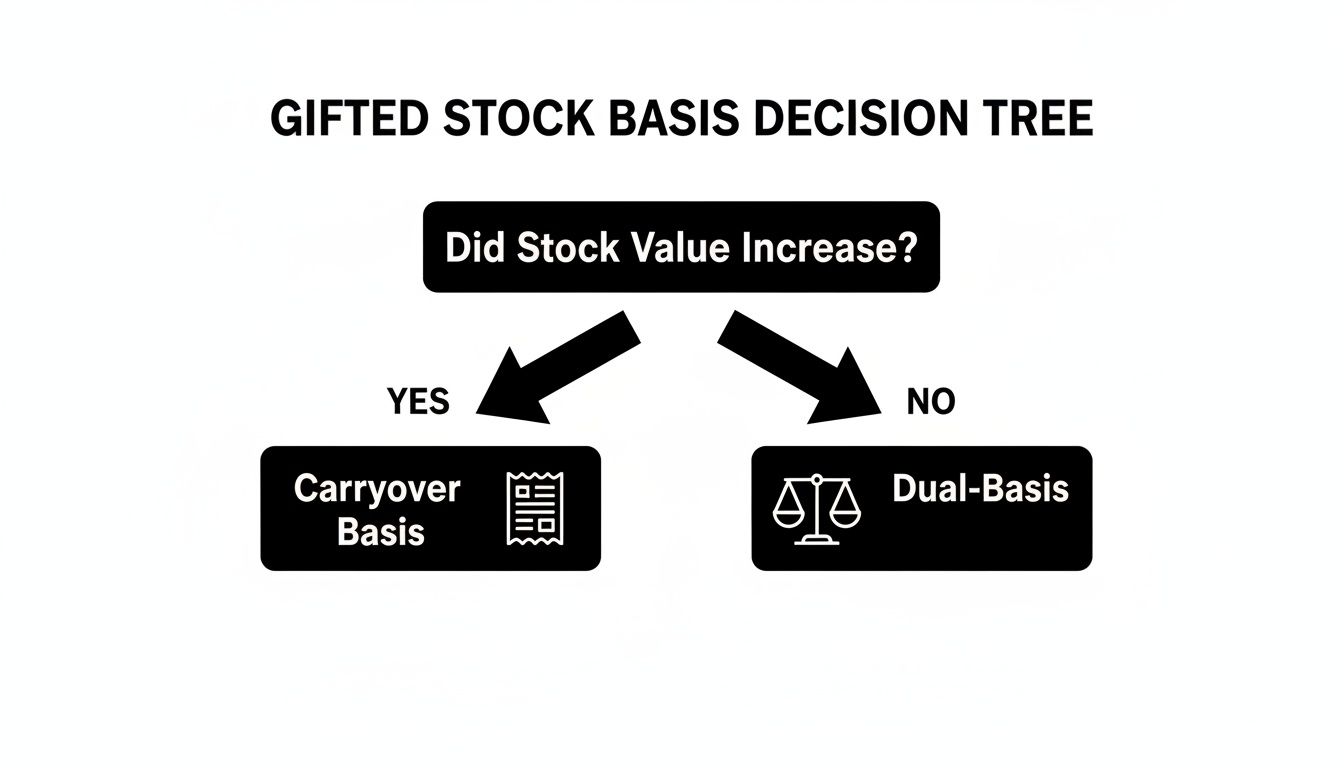
As you can see, the stock's value at the time of the gift is the crucial fork in the road. It determines whether you'll use the straightforward carryover basis or have to navigate the more complex dual-basis rule.
Scenario 1: The Gain Scenario and Carryover Basis
This is the most common and thankfully, the simplest situation. If the stock’s Fair Market Value (FMV) was higher than the donor's original purchase price on the day they gave it to you, you simply use the carryover basis rule.
Think of it like being handed a baton in a relay race. The donor passes their original cost basis—their starting line—directly to you. You just continue the race from where they began.
Key Takeaway: For stock that has appreciated in value, your cost basis is the same as the donor’s. You effectively inherit both their original purchase price and their potential tax bill on the gain.
Example:
- Your uncle gifts you 100 shares of XYZ Corp.
- He bought them years ago for $2,000 (this was his original basis).
- On the day he gifted them to you, the shares were worth a cool $12,000 (the FMV).
Since the FMV ($12,000) is higher than his basis ($2,000), your cost basis is simply his: $2,000. If you turn around and sell those shares for $15,000, your taxable gain is $13,000 ($15,000 Sale Price – $2,000 Carryover Basis).
Scenario 2: The Loss Scenario and Dual Basis
Things get a bit trickier when you receive stock that has lost value. If the stock’s FMV on the gift date was lower than what the donor originally paid, the IRS makes you use a special dual-basis rule.
This means you actually have two different cost bases—one for calculating a future gain and a separate one for calculating a future loss. It’s like an item has two different price tags, and which one you use depends entirely on whether you sell it for more or less than you got it for.
Here’s the breakdown of the dual-basis rule:
- For calculating a gain: You use the donor’s original (higher) cost basis.
- For calculating a loss: You must use the stock's FMV (the lower value) on the date of the gift.
The logic here is to prevent people from passing on their investment losses to someone else to claim. The IRS says the person who actually experienced the loss is the only one who gets to benefit from it.
Example:
- Your aunt gifts you 50 shares of ABC Inc.
- She originally paid $10,000 for them (her basis).
- On the gift date, the market had soured, and the shares were only worth $4,000 (the FMV).
You now have a dual basis: $10,000 for gains and $4,000 for losses. If you later sell the stock for $3,000, you’d use the loss basis ($4,000) and realize a $1,000 capital loss ($3,000 – $4,000).
Scenario 3: Adjusting for Gift Tax Paid
Our third scenario is less of a separate rule and more of an important adjustment. If the gift was valuable enough that the donor had to pay a federal gift tax on it, you might get to increase your cost basis. This adjustment is designed to prevent the same value—the stock's appreciation—from being taxed twice.
You can only increase your basis by the portion of the gift tax that applies to the stock's net appreciation, which is just the amount the stock grew in value while the donor owned it.
The formula for the adjustment is:
(Net Appreciation / Value of the Gift) x Gift Tax Paid
Example:
- A donor gifts you stock they bought for $10,000.
- The FMV on the gift date is $30,000.
- Because of the size of the gift, the donor pays a $4,000 gift tax.
- The net appreciation here is $20,000 ($30,000 FMV – $10,000 Basis).
Let's plug that into the formula: ($20,000 / $30,000) x $4,000 = $2,667.
Your new, adjusted cost basis becomes $12,667 ($10,000 + $2,667). This higher basis will directly reduce your taxable gain when you eventually sell.
How the Holding Period Affects Your Tax Rate
Knowing the cost basis is only half the battle. The other crucial piece of the puzzle is the holding period—how long the stock was owned. This determines whether you pay the lower long-term capital gains tax rate or the much higher short-term rate.
When it comes to gifted stock, the holding period rules can be a huge advantage.

In most situations, the IRS lets you "tack on" the donor's holding period to your own. This means you get full credit for the time they owned the shares before giving them to you.
Let's say your father held a stock for 10 years before gifting it to you. The moment it lands in your account, you are considered to have held it for 10 years. If you turn around and sell it the very next day, any profit is treated as a long-term capital gain, unlocking those favorable tax rates. You can see just how different those rates are in our guide to short-term vs. long-term capital gains.
The Tacking Rule in Action
Think about it this way: your grandmother buys stock on June 1, 2015, and gifts it to you on August 15, 2024. Because of the tacking rule, your holding period is treated as if it started all the way back in 2015.
This is a massive benefit. Normally, you'd have to hold the stock for more than a year yourself to qualify for long-term treatment. Instead, the donor’s history gives you an immediate tax advantage.
Timeline Example:
- Donor Buys Stock: January 10, 2018
- Gift Date: May 5, 2024
- Your Sale Date: May 6, 2024
- Result: The sale qualifies for long-term capital gains rates because you inherited the donor's 6+ year holding period.
When the Holding Period Resets
Now for the exception. Remember the dual-basis rule for stock that has lost value? This is where it comes back into play.
If you have to use the stock's lower Fair Market Value (FMV) at the date of the gift to calculate a loss, the tacking rule gets thrown out the window. In this specific loss scenario, your holding period starts fresh on the day you received the gift. You don't get to inherit the donor's holding time.
A Note on the Kiddie Tax
One final point to keep in mind, especially if you're gifting to children or grandchildren, is the "kiddie tax." While the holding period rules are a great benefit, gifting appreciated stock to a full-time student under 24 can trigger this tax. Any unearned income above a certain threshold gets taxed at their parents' higher rates, which can wipe out some of the intended tax savings. You can find more practical insights on this at Schwab.com.
Calculating Your Gain or Loss Step-by-Step
Reading the rules is one thing, but seeing them in action with real numbers is where it all clicks. Let's walk through three common examples of what happens when you sell gifted stock. Each scenario will break down the donor's original cost, the value of the stock when you received it, and your final sale price to make the math crystal clear.
These examples really show how the carryover basis and the tricky dual-basis rules can change your final tax bill. For a more detailed look at the mechanics, our guide on how to calculate capital gains is a great resource.
Scenario 1: Calculating a Straightforward Gain
This is the classic, most common situation. It happens when the stock was worth more when you got it than what the original owner paid.
Here’s the setup:
- Donor's Original Cost Basis: Your mother bought 100 shares of TechCorp for $5,000.
- Fair Market Value (FMV) on Gift Date: When she gave them to you, the shares were worth $15,000.
- Your Sale Price: You eventually sell all 100 shares for $20,000.
Since the stock's value on the gift date ($15,000) was higher than your mother’s cost basis ($5,000), the calculation is simple. You just inherit her cost basis.
Here's the math:
- Your Cost Basis: It’s the same as your mother’s original cost: $5,000.
- Calculate the Gain: Subtract your basis from what you sold it for.
- $20,000 (Sale Price) – $5,000 (Your Basis) = $15,000
You have a taxable capital gain of $15,000. The holding period "tacks on," too. So, if your mother owned the stock for five years before gifting it, that time counts for you, making this a long-term gain.
Scenario 2: Applying the Dual-Basis Rule for a Loss
Things get a little more complex when the stock has lost value before it was gifted to you. This is where the dual-basis rule comes into play.
Let's look at the numbers:
- Donor's Original Cost Basis: Your uncle purchased shares in RetailCo for $10,000.
- Fair Market Value (FMV) on Gift Date: After a market dip, the shares were only worth $6,000 when he gave them to you.
- Your Sale Price: The stock kept dropping, and you sold the shares for $4,000.
Because the stock was worth less on the gift date ($6,000) than your uncle's original cost ($10,000), you have to use the dual-basis rule. When calculating a loss, you must use the lower of the two values—the FMV on the gift date—as your basis.
Here's the math:
- Your Basis (for a Loss): Your basis becomes the FMV on the gift date, which is $6,000.
- Calculate the Loss: Subtract this basis from your sale price.
- $4,000 (Sale Price) – $6,000 (Your Basis for Loss) = -$2,000
You can report a capital loss of $2,000 on your tax return. One key difference here: your holding period starts fresh on the day you received the gift.
Scenario 3: The No-Gain, No-Loss Middle Ground
The dual-basis rule creates a strange little quirk—a "dead zone" where selling the stock results in neither a taxable gain nor a deductible loss. This happens if your sale price lands somewhere between the donor's original cost and the lower gift-date FMV.
Let’s use the same initial numbers from Scenario 2:
- Donor's Original Cost Basis: $10,000 (this is your basis for a gain)
- Fair Market Value (FMV) on Gift Date: $6,000 (this is your basis for a loss)
- Your Sale Price: You manage to sell the shares for $8,000.
The Logic Behind the Calculation:
- Do you have a gain? You have to compare the sale price to the gain basis ($10,000). Since $8,000 is less than $10,000, there's no gain.
- Do you have a loss? Now, you compare the sale price to the loss basis ($6,000). Since $8,000 is more than $6,000, there's no loss.
Because your sale price got caught in that gap, you simply report $0 as your gain or loss. It’s a strange outcome, but it perfectly illustrates why you have to keep track of both the donor's basis and the FMV on the gift date.
Getting these calculations right relies on having accurate historical data. A critical resource for this information is understanding brokerage statements, which should contain the original purchase details you'll need.
How to Report Gifted Stock Sales to the IRS
So, you’ve sold the gifted stock. Now comes the part everyone loves: telling the IRS about it. This is where a lot of people get into trouble, because the Form 1099-B your brokerage sends you often tells the wrong story. It might list your cost basis as zero or use the stock's value on the day you received it, which isn't what the IRS wants to see.
Don't just run with the numbers on the 1099-B. If you do, the IRS's automated systems will likely flag your return, comparing what you reported to what the broker reported, and send you a notice for a much bigger tax bill than you actually owe. It's your job to get this right, and the key is Form 8949, Sales and Other Dispositions of Capital Assets.

Think of this form as your chance to set the record straight and reconcile the broker’s numbers with the correct ones based on the carryover basis rules.
Navigating Form 8949 Adjustments
Form 8949 is specifically designed to let you correct the information your broker provides. It’s your official way of telling the IRS, "Hey, the 1099-B is missing some crucial context, and here are the right figures."
Here’s how you handle the correction:
- Report What the Broker Sent: First, you have to enter the information from your Form 1099-B exactly as it appears on the form. This means reporting the same sale proceeds and whatever cost basis is listed, even if it's $0.
- Signal the Correction: In column (f) of Form 8949, you'll enter an adjustment code. For gifted stock, the magic code is usually Code B, which tells the IRS that the basis reported by the broker is incorrect.
- Show Your Math: Next, in column (g), you enter the adjustment amount. This is the difference between your correct carryover basis and the incorrect basis your broker reported. This calculation brings the final number to the right place.
Making this simple adjustment ensures your final gain or loss calculation is accurate, which is the best way to avoid those dreaded automated letters from the IRS.
Key Takeaway: You can't just ignore the 1099-B. You must report the sale using the numbers on your 1099-B first and then use Form 8949 to officially correct the cost basis. Simply swapping out the broker's number on your tax return without showing this adjustment is a recipe for problems.
From Form 8949 to Schedule D
After you've sorted everything out on Form 8949, you'll transfer the totals over to Schedule D (Capital Gains and Losses). This is the summary of all your investment sales for the year, and it gets attached to your main Form 1040 tax return.
Properly documenting these adjustments makes for a much less stressful tax season. Once you understand how these forms work together, you can report your gifted stock sale with confidence, knowing you’re only paying what you truly owe. For a deeper look at this topic, our guide where the capital gains tax is explained offers a comprehensive overview. If you're dealing with a tricky dual-basis situation or just want peace of mind, working with a tax professional is always a smart move.
Smart Tax Planning for Gifting Stock
Knowing the rules for gifted stock basis is one thing; using that knowledge to your advantage is another entirely. For both the person giving the gift (the donor) and the one receiving it, a few smart moves can make a huge difference in minimizing taxes and maximizing the gift's value. It really just comes down to a little bit of foresight.
For donors, the strategy usually centers on who gets the gift and which stock you choose to give. For recipients, it’s more about timing the sale and keeping impeccable records. When families coordinate, they can ensure the gift truly has the greatest impact possible.
Smart Moves for the Donor
As the person giving the gift, you're in the driver's seat when it comes to the future tax bill. A little planning now can save your loved ones a lot of money down the road.
-
Gift to Family in a Lower Tax Bracket: This is a classic and highly effective strategy. If you gift appreciated stock to a child or grandchild in a lower tax bracket, they can potentially sell it and pay a 0% or 15% long-term capital gains tax. That’s a much better outcome than if you, in a higher bracket, sold it yourself.
-
Donate Appreciated Stock to Charity: This might be the single most powerful tax move you can make. When you donate stock you've held for more than a year directly to a qualified charity, you can often deduct the stock's full fair market value. The best part? Neither you nor the charity pays capital gains tax on all that appreciation. It's a true win-win, as explained in these insights on charitable giving from the University of Maryland.
-
Never, Ever Gift a Losing Stock: Seriously, don't do it. If you have a stock that's worth less than you paid for it, gifting it is a waste of a good tax loss. Thanks to the dual-basis rule, the recipient won't be able to claim your loss. You're much better off selling the stock yourself, taking the capital loss to offset other gains on your tax return, and then simply gifting the cash.
Smart Moves for the Recipient
Once that stock is in your account, the ball is in your court. Your decisions from this point forward will dictate the final tax outcome.
Your #1 Priority: Get the paperwork right. As the recipient, your most critical job is to get three key pieces of information from the donor: their original purchase date, their cost basis, and the stock's fair market value on the date of the gift. If you can't prove your basis, the IRS can treat it as zero, meaning you'd owe tax on the entire sale price.
Here are a few ways to be strategic with your new asset:
- Time the Sale for a Low-Income Year: If you happen to be in a low-income year—maybe you're a student, taking a sabbatical, or between jobs—that could be the absolute best time to sell. You might be able to realize the gain and pay little to no capital gains tax.
- Hang On for Long-Term Gains: Did the donor hold the stock for less than a year? You can "tack on" their holding period to your own. But if the combined time is still short-term, you might want to hold on until you've personally crossed the one-year mark to qualify for those favorable long-term capital gains rates.
- Weigh Gifting vs. Inheriting: This can be a sensitive but important conversation. From a purely tax standpoint, inheriting appreciated assets is almost always better than receiving them as a gift. That's because of the step-up in basis, which wipes the slate clean by adjusting the cost basis to the market value at the time of death. If an elderly relative is considering a large gift of stock, it may be far more tax-efficient for the family to have that asset pass through an estate instead.
Your Top Questions Answered
Working through the tax rules for gifted stock often brings up some tricky questions, especially when you're digging through records or planning a sale. Let's tackle some of the most common ones with clear, straightforward answers.
What Information Do I Need from the Person Who Gifted Me the Stock?
When you receive a gift of stock, think of yourself as a financial detective. You're gathering crucial evidence for a future tax return. To get your cost basis right, you absolutely must get three key details from the person who gave you the shares:
- Their Original Cost Basis: You need to know exactly what they paid for the stock, including any commissions or fees. This is the starting point for your own basis.
- The Original Purchase Date: This isn't the date they gave it to you, but the date they first bought it. This date tacks onto your holding period.
- The Fair Market Value (FMV) on the Gift Date: This is simply the stock’s market value on the day the shares officially became yours.
It's also smart to ask if they paid any gift tax on the stock's appreciation. If they did, a portion of that tax can sometimes be added to your cost basis, which is a nice little tax-saving bonus.
What Happens If I Can't Find the Original Cost Basis?
Honestly, this is a situation you really want to avoid. If you have no records and there's no way to figure out the donor's original cost basis, the IRS has a simple and rather unforgiving rule: your cost basis is zero.
That’s the absolute worst-case scenario for your tax bill. It means every single dollar you get from selling the stock is considered a taxable capital gain. It’s worth moving heaven and earth to track down the original purchase info from the donor or their old brokerage statements to prevent this.
The Bottom Line: The responsibility for proving your cost basis falls squarely on your shoulders. If you can't produce the records, the IRS defaults to a $0 basis, which guarantees you'll pay the maximum possible tax.
From a Tax Perspective, Is It Better to Gift or Inherit Stock?
When we're talking purely about tax efficiency for the person receiving the asset, inheriting appreciated stock is almost always the better deal. Inherited assets get a powerful tax break called a “step-up in basis.” This rule adjusts the stock's cost basis up to its fair market value on the date of the original owner’s death.
This "step-up" can wipe out a lifetime of built-up capital gains. An heir could potentially sell the stock the next day and owe little to no tax.
Gifted stock, on the other hand, comes with a “carryover basis,” which is like inheriting the donor's future tax bill along with the shares. While gifting assets during one's lifetime is a great strategy for other estate planning goals, the step-up in basis makes inheriting a much better outcome for minimizing capital gains tax.
Figuring out the ins and outs of capital gains, especially with gifted assets, takes serious attention to detail. The experts at Allied Tax Advisors can help make sure your tax reporting is spot-on and works in your favor. Visit us at https://alliedtax.com to see how we can help.