
Crypto tax loss harvesting is a savvy move every serious crypto investor should have in their playbook. In simple terms, it's the strategy of intentionally selling a cryptocurrency at a loss to create a "tax asset." You can then use that realized loss to offset the taxable gains you’ve made on other, more profitable trades.
The result? You directly lower your overall tax bill for the year. It's one of the most effective ways to manage your tax exposure in the crypto market.
What Is Crypto Tax Loss Harvesting Really?

Don't think of it as giving up on a bad investment. Instead, view crypto tax loss harvesting as a calculated financial maneuver. In the wild world of digital assets, where prices can swing wildly, it's inevitable that some of your positions will dip into the red. This strategy is all about turning those paper losses into tangible tax savings.
When you sell a cryptocurrency for less than you paid for it (your cost basis), you "harvest" that loss. It’s no longer just a negative number on your screen; it becomes a real, recognized loss that you can put to work on your tax return.
A Practical Scenario
Let's walk through a quick, real-world example to see this in action.
Imagine you invested $10,000 in Ethereum (ETH) and later sold it for $15,000. That's a nice $5,000 capital gain. But in that same year, you also bought $8,000 of an altcoin that has since tanked and is now worth only $4,000.
Instead of just holding that losing altcoin and hoping for a comeback, you could sell it. By selling, you officially realize a $4,000 capital loss. Now, here's where the magic happens: you can use that loss to offset your ETH gain.
Your $5,000 taxable gain is immediately reduced by your $4,000 loss. This means you only have to pay capital gains tax on $1,000 of profit, not the full $5,000. That’s a massive drop in your tax liability.
This isn’t some obscure loophole; it’s a standard investment strategy. The process involves identifying assets in your portfolio that have dropped in value, selling them to lock in the loss, and then applying that loss against your realized gains from winning investments.
Better yet, if your losses are greater than your gains for the year, you can deduct up to $3,000 of those excess losses against your ordinary income. Any remaining loss can even be carried forward to future tax years. To dig deeper into how this could work for you, platforms like Koinly offer great resources.
The Core Principles
To do this right, you need to understand the fundamental concepts it's built on. The goal is to be strategic and proactive, not just reacting when the market moves against you.
To make it clear, here's a quick summary of the core ideas behind tax loss harvesting.
Core Principles of Tax Loss harvesting
| Concept | How It Works | Primary Benefit |
|---|---|---|
| Realizing a Loss | You must actually sell the asset to "lock in" the loss for tax purposes. An unrealized loss on paper doesn't count. | Creates a tax-deductible event. |
| Offsetting Gains | The realized loss is first used to cancel out capital gains of the same type (short-term vs. long-term). | Directly lowers your taxable income. |
| Year-Round Strategy | It's most effective when done proactively throughout the year, not just in a December rush. | Allows you to react to market volatility. |
Ultimately, a good tax loss harvesting strategy is a must-have for managing your portfolio's tax efficiency. By getting a handle on these principles, you can take much greater control over your tax situation.
For a more detailed breakdown, be sure to check out our complete guide on crypto tax solutions.
Navigating The Crypto Tax Rules You Must Know

Before you can effectively use tax loss harvesting, you have to know the rules of the game. This isn't about looking for loopholes. It's about working within the guidelines set by tax authorities like the IRS to make sure every move you make is compliant and actually saves you money.
The most critical concept to get right from the start is the difference between short-term and long-term capital gains. The amount of time you hold onto a crypto asset before selling it completely changes how much tax you'll owe on your profits. It's that simple.
In the U.S., the IRS is very clear on this. If you hold a crypto asset for more than one year, you get the benefit of lower long-term capital gains tax rates, which sit between 0% and 20%. But if you sell within a year, it's considered a short-term gain. Those are taxed just like your regular income, which can be as high as 37%.
You can get a deeper sense of how these brackets work by exploring how capital gains taxes work.
The Wash Sale Rule: A Major Point of Confusion
One of the most debated topics in crypto tax is the wash sale rule. In the world of stocks and traditional securities, the rule is crystal clear. It stops you from selling a stock at a loss, only to buy it (or something nearly identical) back within 30 days.
If you violate this rule, the IRS won't let you deduct that loss on your taxes for that year. Instead, that disallowed loss gets tacked onto the cost basis of the new asset you just bought.
So, does this apply to crypto? This is where it gets murky. The IRS hasn't explicitly labeled crypto as a "security" for the purposes of this specific rule. Because of this gray area, many tax professionals and experienced investors play it safe.
The smartest move is to simply act as if the wash sale rule applies to crypto. Waiting at least 31 days before repurchasing the same asset you sold at a loss is the most conservative and risk-free approach. It practically guarantees your harvested losses won't be challenged later.
Short-Term vs. Long-Term Capital Gains
Really grasping this distinction is the key to a smart tax loss harvesting strategy. You always want to use your losses to cancel out your highest-taxed gains first, which are almost always your short-term ones.
Here's a quick comparison of the two to keep things straight.
Short-Term vs. Long-Term Capital Gains
| Attribute | Short-Term Capital Gains | Long-Term Capital Gains |
|---|---|---|
| Holding Period | One year or less. | More than one year. |
| Tax Rate | Taxed as ordinary income (10%–37%). | Favorable rates (0%, 15%, or 20%). |
| Harvesting Priority | These are the first gains you should target with your losses. | Use losses here only after you've offset all short-term gains. |
As you can see, the tax difference is huge. Offsetting a 37% gain provides a much bigger financial benefit than offsetting a 15% gain.
Meticulous Records Are Non-Negotiable
A successful tax strategy lives and dies by its records. Without clean, accurate data, all your hard work is for nothing—and you could even put yourself at risk of an audit.
For every single transaction you make, you absolutely must track the following:
- The exact date you acquired the asset
- Your cost basis (what you paid for it, including fees)
- The exact date you sold it
- The sale price
- The final capital gain or loss
This information is the bedrock of your tax return. It's the proof you need to back up every loss you claim.
While the rules can seem overwhelming, they are entirely manageable with the right approach. It’s also important to remember that tax laws vary by country. For example, investors in Australia can find a great breakdown in The Ultimate Guide to Australian Crypto Tax.
A Practical Framework for Harvesting Losses
Alright, let's move past the theory and get our hands dirty. This is where a smart crypto tax loss harvesting strategy really takes shape. It’s not about using some complicated algorithm; it’s about creating a repeatable process for checking your portfolio, spotting opportunities, and making smart moves without letting market panic guide your decisions.
The first thing you need to do is get into a rhythm of scanning your portfolio regularly. Don't wait until the December chaos. Make it a habit to look over your holdings every month or quarter. A good crypto tax software or even a well-organized spreadsheet can show you exactly which assets are currently trading below your cost basis—what you originally paid for them.
When you're proactive like this, harvesting becomes just another part of managing your portfolio, not some stressful year-end chore. It means you can react strategically to market volatility, like a sudden flash crash, instead of being forced to sell at a terrible time.
This visual breaks down the key steps to follow when you're ready to execute your strategy.
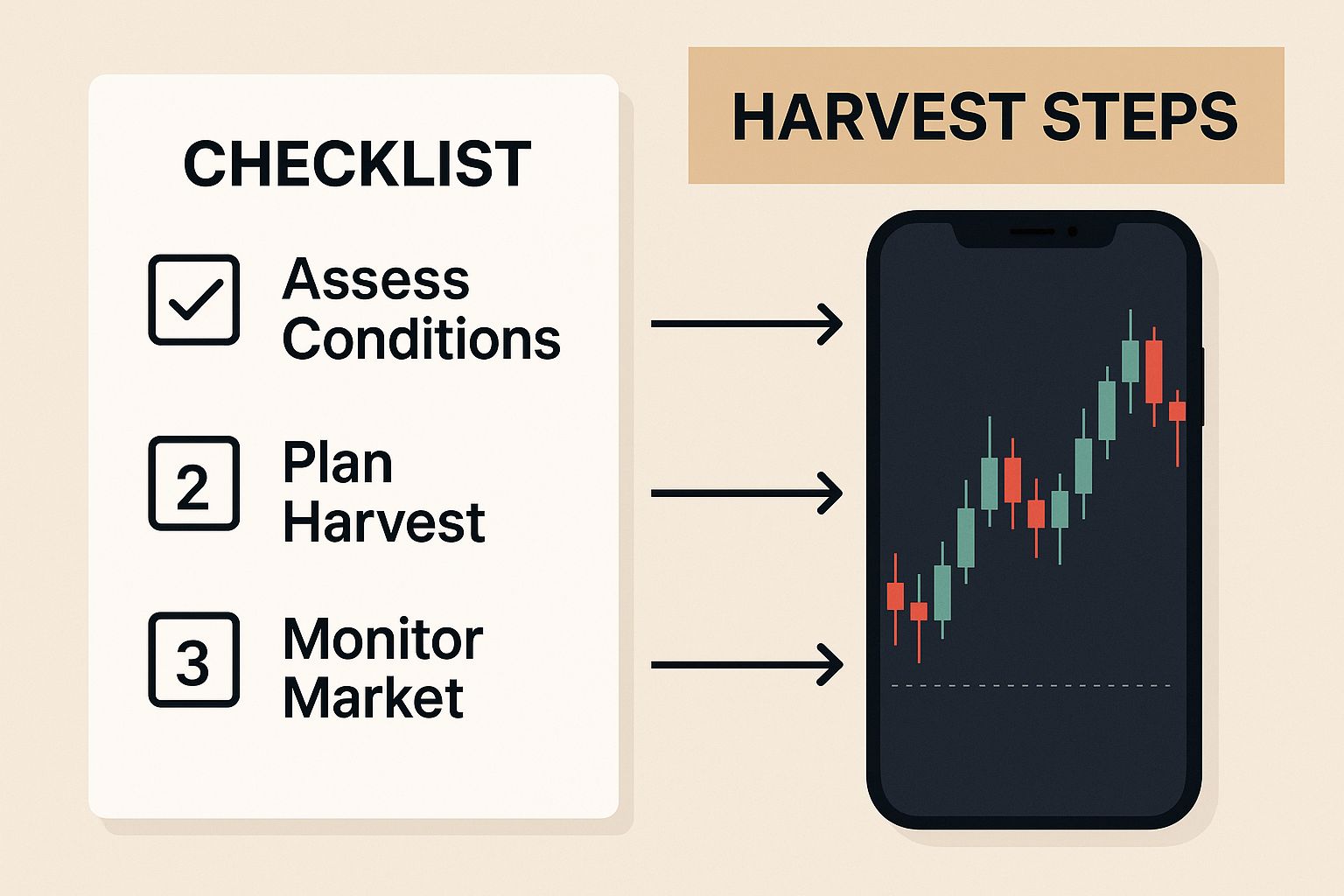
As you can see, the flow is pretty logical: you find the assets that are in the red and then use those realized losses to knock down your taxable gains.
The Decision-Making Process
Finding an asset with an unrealized loss is easy. The real skill is deciding which of those assets you should actually sell. This decision isn't just about the numbers; you have to weigh a few critical factors.
First, look at the size of the unrealized loss. A tiny loss probably isn't worth the trading fees and hassle. But a substantial loss? That can become a major tax asset, creating a significant shield against your tax bill and making it a prime candidate for harvesting.
Next, you have to honestly assess the asset's future potential. Is this a project you still believe in that's just caught in a market-wide slump, or has its long-term outlook genuinely soured? Selling a potential 10x coin for a small, short-term tax break is a classic rookie mistake.
A core rule I always follow: never sacrifice your long-term investment goals for a short-term tax win. The whole point is to optimize your tax situation without derailing your portfolio's growth.
Finally, think about your portfolio diversification. Selling an asset might leave a hole in your allocation, reducing your exposure to a sector you want to be in. If that’s the case, you could plan to reinvest the proceeds into a similar, but not "substantially identical," asset to maintain your desired market exposure.
Executing the Harvest
Once you’ve made the call to sell, the execution itself is simple, but you need to be precise. You'll sell the asset on your chosen exchange, which officially "realizes" the loss for tax purposes. Immediately—and I mean immediately—document the transaction details: sale date, price, and the total loss amount.
With the loss now realized, you can use it to offset your capital gains. The order you do this in is incredibly important for maximizing your savings:
- First, wipe out short-term gains. Your number one priority is to use your losses to cancel out short-term gains, since those are taxed at your higher, ordinary income rate.
- Next, apply them to long-term gains. Once all your short-term gains are gone, any leftover losses can be used against your long-term capital gains.
- Then, deduct against ordinary income. Still have losses left? You can deduct up to $3,000 per year against your regular income (like your salary).
- Finally, carry forward what's left. Any loss that exceeds that $3,000 limit isn't lost. You can carry it forward into future tax years to offset gains then.
Following this step-by-step process ensures you’re squeezing every last drop of tax-saving value out of the losses you harvest.
Advanced Harvesting Strategies and Pro Tips
Once you've got the hang of the basics, you can start using some more sophisticated techniques to really dial in your tax strategy. These aren't just for day traders; they're smart financial moves that can give you a serious advantage over time.
A powerful but often overlooked strategy is to flip the script and do some tax-gain harvesting. This is a bit counterintuitive, but stick with me. It involves selling assets that have small, long-term gains, specifically during a year when you find yourself in a low tax bracket. For some, this could even be the 0% long-term capital gains bracket.
After selling, you can immediately buy the asset right back. So, what's the point? You pay little to no tax on that gain, but you've now reset your cost basis to the new, higher price. This simple move can slash your future tax bill when you eventually sell that asset years down the road, especially if its value—and your income—has climbed significantly.
Broaden Your Harvesting Horizon
A truly effective tax plan doesn’t just look at your crypto wallet in isolation; it considers your entire financial world. One of the most impactful tips I can give is to harvest across different asset classes. Your crypto losses aren't stuck in the crypto ecosystem.
You can use realized losses from your digital assets to directly cancel out capital gains from your stock portfolio, mutual funds, or even the sale of property. This flexibility makes crypto tax loss harvesting an incredibly versatile tool for managing your total tax liability.
Let's say you locked in a $10,000 short-term gain from selling a hot tech stock. If you also have a $7,000 loss sitting in a crypto position, you can sell that crypto and use the loss to shrink your taxable stock gain to just $3,000. It's a game-changer.
This cross-asset approach turns your crypto portfolio into a tax-reduction engine for your entire net worth, not just a siloed part of it. It’s a holistic way to view tax optimization.
Smarter Ways to Repurchase Assets
To steer clear of any potential wash sale rule issues, you have to be clever about how you get back into the market after selling for a loss. The standard advice is to wait 31 days before buying the exact same coin again. But a month can feel like an eternity in crypto, and you might not want to sit on the sidelines.
A more advanced tactic is to immediately reinvest into a similar but not "substantially identical" asset. This way, you stay exposed to the market's potential upside while still successfully booking the tax loss.
Here are a few examples of what these smart swaps might look like:
- You sell your Ethereum (ETH) at a loss and immediately put the money into another major layer-1 blockchain token, like Solana (SOL) or Avalanche (AVAX).
- If you harvest a loss on a decentralized exchange token like Uniswap (UNI), you could pivot to a competitor like PancakeSwap (CAKE).
This approach takes a bit of research. You want to make sure the new asset has a comparable risk profile and growth potential to the one you just sold. For those looking to refine their timing, reading a comprehensive guide to the Cryptocurrency Fear and Greed Index can provide valuable insights into market sentiment, which often highlights periods ripe for finding and harvesting losses. These advanced techniques transform tax loss harvesting from a simple defensive maneuver into a proactive wealth-building strategy.
Common Mistakes to Avoid When Harvesting Losses
Tax loss harvesting is a fantastic way to turn a down market into a tax advantage, but it's surprisingly easy to mess up. A few simple mistakes can not only wipe out your potential savings but could even land you in hot water with the IRS. Think of this as a field guide to the most common traps I've seen investors fall into over the years.
The absolute biggest and most frequent mistake? Sloppy record-keeping. It’s not the exciting part of crypto, but it's the foundation of this entire strategy. Your ability to harvest a loss depends entirely on proving your cost basis—what you paid for the asset, plus any fees. If your records are a mess, you can't accurately calculate anything, and your claimed losses won't stand up to scrutiny.
Getting the Rules Wrong
Another major pitfall is stumbling over the tax rules, especially the wash sale rule. Now, its application to crypto has been a gray area for a while, but let's be realistic: the IRS is looking closer than ever. The smartest, safest play is to act as if the rule applies to crypto.
What does that mean for you? Don't sell an asset for a loss and then buy it—or something "substantially identical"—back within 30 days (before or after the sale).
- The Consequence: If you violate this, the IRS can disallow the loss. All your effort is wasted.
- The Simple Fix: Just wait out the 31-day period before buying back in. Or, if you want to stay in the market, swap into a different asset that isn't identical. For example, sell your ETH at a loss and buy BTC instead.
A disallowed loss is a frustrating and entirely avoidable outcome. I always tell my clients to take the conservative route here. Patience is your best defense. Just wait the 31 days or swap into a clearly different asset to keep your market exposure without taking the risk.
Inaction and Poor Judgment
Beyond the black-and-white rules, I see a lot of behavioral mistakes that are just as costly. One of the most common is classic ‘analysis paralysis.’ An investor sees a coin in the red and knows they should harvest the loss, but they hesitate, waiting for the "perfect" bottom.
The crypto market moves at lightning speed. By the time they finally decide to pull the trigger, the asset has often bounced back, and the opportunity to book a meaningful loss is gone. Indecision is expensive.
But maybe the most important mistake to avoid is letting the tax tail wag the investment dog. It's tempting to get so focused on tax savings that you sell a great long-term asset you truly believe in just to capture a loss.
Before you sell, ask yourself one critical question: has my fundamental belief in this project changed? If the answer is no, holding on might be the much smarter financial move, even if it means passing up a small tax break this year. To get a better handle on the bigger picture, it's worth understanding how to minimize your capital gains tax liability without sacrificing your core investment strategy.
Answering Your Top Harvesting Questions
Even with a solid plan, you're bound to have questions when you start putting crypto tax loss harvesting into practice. Let's walk through some of the most common ones I hear from investors to clear things up and help you move forward with confidence.
When Is the Best Time to Harvest Crypto Losses?
Most people think about tax loss harvesting in November or December, but that’s a rookie mistake. With crypto, the real answer is this: the best time to harvest is whenever a major downturn gives you the opportunity.
The crypto market is famous for its wild swings, and big price drops can happen in March, July, or October—not just at year-end. If you're only looking in Q4, you could miss the best chances.
It’s far better to keep an eye on your portfolio throughout the year. Selling into a dip when it happens is much smarter than scrambling to find a loss in December, especially if the market has already bounced back. A year-round strategy will always beat a last-minute panic.
Can I Use Crypto Losses to Offset Stock Gains?
Yes, and this is where the strategy gets really powerful. The IRS first requires you to net losses against gains of the same type (short-term against short-term, long-term against long-term).
But after that, things get flexible. If you have a net loss in one category, you can absolutely use it to offset a gain in another. For instance, a $5,000 net short-term loss from selling some of your crypto can completely erase a $5,000 long-term gain you realized from selling stocks.
This flexibility makes crypto tax loss harvesting an incredible tool for managing the tax bill on your entire investment portfolio, not just your crypto holdings.
Think of your capital losses as a versatile tax shield. They aren't stuck in one silo. You can deploy them across different asset classes—crypto, stocks, even real estate—to get the biggest tax reduction possible.
What Happens If My Crypto Losses Exceed My Gains?
So, you’ve tallied everything up and your realized losses are bigger than your realized gains for the year. This is called a net capital loss, and it’s still incredibly valuable from a tax perspective.
Here’s how you can use it:
- First, you can apply up to $3,000 of that net loss directly against your ordinary income, like your salary from your day job. This provides an immediate, dollar-for-dollar reduction in your taxable income.
- What about the rest? Any loss beyond that initial $3,000 isn't wasted. You get to carry it forward to future tax years, indefinitely.
That carried-forward loss becomes a powerful asset. In the following years, you can use it to offset future capital gains or continue taking that $3,000 deduction against your ordinary income until it's all used up.
Navigating the details of crypto taxation takes more than just basic knowledge; it requires proactive planning and expertise. At Allied Tax Advisors, our team lives and breathes this stuff. We specialize in giving crypto investors clear, strategic guidance to optimize their tax position and stay compliant. Let us help you turn market volatility into a financial advantage.