
When you're working with independent contractors, there's one date you absolutely need to circle on your calendar: January 31. This is the non-negotiable deadline for issuing 1099 forms like the 1099-NEC and 1099-MISC to your contractors. Think of it as the starting gun for their tax season—and missing it can cause a real headache for everyone involved.
Understanding Your Core 1099 Deadlines
Keeping track of tax deadlines can feel like juggling. Some dates have a little give, but others are set in stone. The January 31 deadline to get those 1099s into the hands of your recipients is a hard deadline. There's no wiggle room here. It's designed to give contractors plenty of time to get their own taxes filed accurately.
But here's where it gets a little more complex: the date you need to file those same forms with the IRS isn't always the same. This little detail is crucial for staying compliant and keeping your vendors happy.
The main forms you'll be dealing with are:
- Form 1099-NEC: This is strictly for payments you made to independent contractors for their services.
- Form 1099-MISC: This is for other "miscellaneous" payments, like rent, prizes, or awards.
- Form 1099-K: For payments processed through credit cards or third-party networks like PayPal.
The Unmovable January 31 Deadline
The IRS is serious about that January 31 date, especially for the 1099-NEC. The deadline to send the form to both your contractor and the IRS is January 31, whether you file by mail or electronically. This rule was put in place to get contractor income reported early and accurately.
Dropping the ball here gets expensive fast. The IRS penalty starts at $60 per form if you're just a few weeks late, and the fines only go up from there. You can get more details on IRS deadlines and penalties to see how quickly it can add up.
The infographic below breaks down these key dates clearly.
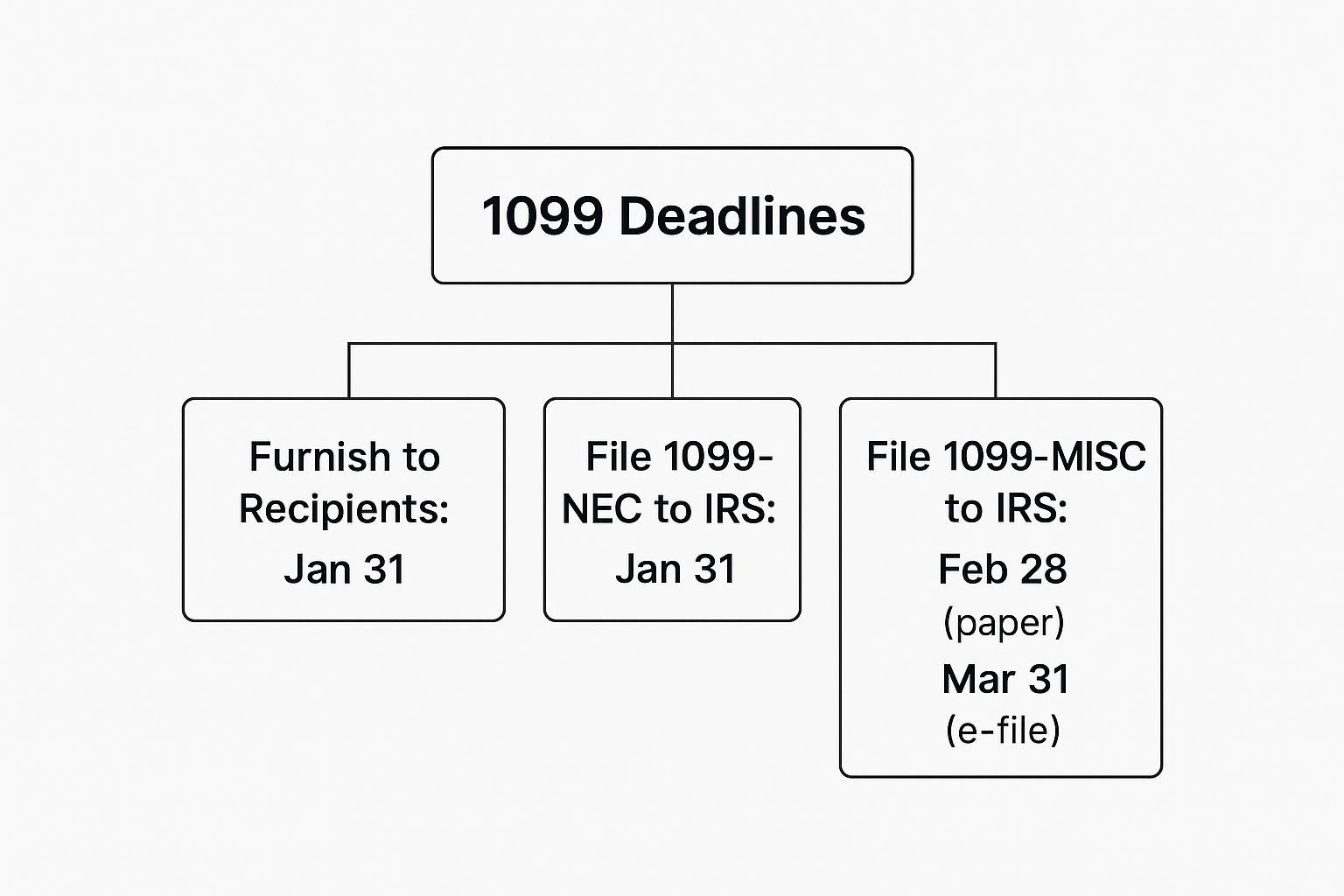
As you can see, the recipient deadline is the same for everyone, but the IRS filing deadlines for the 1099-MISC give you a bit more breathing room—especially if you file online.
Key Takeaway: If you only remember one date, make it January 31. That's your deadline to send 1099s to the people you paid. Even if you have a little extra time to file with the IRS, your contractors are depending on you to meet that first cutoff. A late form from you can delay their entire tax filing process and put a strain on your professional relationship.
Why 1099-NEC and 1099-MISC Deadlines Differ

It’s easy to lump all 1099 forms together, but the IRS draws a sharp line between the 1099-NEC and the 1099-MISC. Getting the deadlines right means understanding why they’re treated so differently.
Think of it like this: the 1099-NEC is an express train, and the 1099-MISC is a local train. Both are heading to the same final destination—the IRS—but one is on a much tighter, more urgent schedule.
The 1099-NEC's single purpose is to report what you paid independent contractors. Because this type of income is a major focus for the IRS in its efforts to combat tax fraud, they want that information fast. No delays, no exceptions.
That’s why the deadline for Form 1099-NEC is a hard and fast January 31. This isn't just the date to send it to the contractor; it's also the deadline for filing it with the IRS. Everything is due at once.
The Different Roles of Each Form
The 1099-MISC, our local train, makes a lot more stops. It's a catch-all form used for a variety of other payments that don't fit neatly into other categories.
You'll reach for a 1099-MISC when you pay for things like:
- Rent for your office or commercial space.
- Prizes and awards you've given out.
- Royalties.
- Certain payments to an attorney.
Because these payments usually aren't a person's primary source of income in the same way contractor pay is, the IRS gives you a little more breathing room. You still need to get the 1099-MISC to the recipient by January 31, but you have a bit longer to get your copies filed with the government.
Key Distinction: The 1099-NEC’s aggressive, unified deadline is a direct response to its critical role in tracking contractor income. The 1099-MISC covers a wider, less fraud-prone range of payments, so it has a more relaxed IRS filing schedule.
This staggered approach is a classic IRS strategy to manage the flow of information. While the 1099-NEC deadline stands alone, other common forms like the 1099-MISC, 1099-DIV, and 1099-INT often have phased deadlines. For the 2024 tax year, the IRS filing due date for most of these is February 28 for paper filers and March 31 for those who file electronically—a clear nudge to encourage online submission. You can find more details about these 2024 tax year deadlines on aafcpa.com.
A Practical Business Scenario
Let's see how this plays out in the real world. Imagine your small business had a busy year and made a few different types of payments.
- You hired a marketing consultant: You paid them $10,000 for a big branding project. This is a payment for services, which means you need to issue a Form 1099-NEC.
- You ran a customer contest: The winner received a $1,000 cash prize. This falls squarely into the "prizes and awards" category, requiring a Form 1099-MISC.
- You paid your office rent: Your landlord received $24,000 over the year. Since landlords are often individuals or partnerships, this also requires a Form 1099-MISC. You can dive deeper into the rules for reporting rental income with a 1099-MISC in our dedicated guide.
For the marketing consultant, you have to get that 1099-NEC to them and file it with the IRS by January 31.
For the contest winner and your landlord, you still send them their 1099-MISC forms by January 31. However, you have until February 28 (if filing by mail) or March 31 (if e-filing) to submit your copies to the IRS. Understanding this difference is absolutely crucial for staying compliant and avoiding a last-minute scramble.
Navigating the Changing 1099-K Thresholds

Of all the 1099s, Form 1099-K has been the source of the most headaches and confusion lately. If you're an online seller, a gig worker, or basically anyone who gets paid through platforms like PayPal, Stripe, or Venmo, this is the form that reports those payments.
The main issue? The reporting rules have been a moving target. It feels like every time you get a handle on them, they change again, leaving a lot of people scratching their heads about what they actually need to report.
The Story Behind the Shifting Thresholds
For a long time, the bar for getting a 1099-K was pretty high. Payment processors only had to send one if you had over $20,000 in payments and more than 200 transactions. Most people doing a little side work never came close.
Then, the American Rescue Plan Act of 2021 tried to drop that threshold all the way down to just $600, with no transaction minimum. That plan caused a major uproar, and thankfully, the IRS has pumped the brakes. For the 2024 tax year, they've set a much higher transitional threshold of $5,000. You can get a great breakdown of what a 1099-K means for your taxes at hcjcpa.com.
This phased approach is designed to give everyone—taxpayers and payment companies alike—time to adjust. The plan is still to lower that number in the future, but for now, there's some breathing room.
One Deadline Remains Constant
While the reporting amount has been all over the place, one critical date has stayed the same. The deadline for issuing 1099-K forms is, and has always been, January 31.
No matter what the threshold is for a given year, you should have that form in hand by the end of January. This consistency is a lifesaver for tax planning, ensuring you have what you need to file accurately and on time.
Key Insight: Don't let the drama around the changing thresholds distract you from the fixed deadline. If you're expecting a 1099-K, mark your calendar for January 31. If it doesn't show up, you need to reach out to the payment processor and find out why.
And here’s something crucial to remember: even if your income doesn't hit the 1099-K threshold, you still have to report all of it. The form is just a reporting tool for the IRS. Not getting one doesn't give you a pass on reporting what you earned.
The Real Cost of Missing a 1099 Deadline

Missing the deadline for issuing 1099s isn't just a minor administrative slip-up. It's a costly mistake with a ripple effect that can hit your finances, strain your business relationships, and put you on the IRS's radar. The consequences are much more serious than a simple slap on the wrist.
The most direct hit comes from IRS penalties, and they aren't a flat fee. The fines are tiered, meaning they get progressively more expensive the longer you wait to file. Time is literally money here.
This system is built to strongly encourage filing on time. A delay of a few weeks is one thing, but letting that deadline blow past by several months can lead to thousands of dollars in avoidable costs that come straight out of your profits.
The Escalating Penalty Structure
Think of the IRS penalty system as a ticking clock where the price goes up at set intervals. The fines are calculated on a per-form basis, so the more contractors you have, the faster the costs multiply.
The penalties below show how quickly a small mistake can become a major financial headache.
IRS Penalties for Late 1099 Filing
This table breaks down the tiered penalty structure. Notice how the cost per form—and the potential maximum penalty—jumps significantly over time.
| Time of Filing After Deadline | Penalty Per Form | Maximum Penalty (Small Business) | Maximum Penalty (Large Business) |
|---|---|---|---|
| Within 30 days | $60 | $239,500 | $685,500 |
| More than 30 days late, but before August 1 | $130 | $685,500 | $2,056,500 |
| On or after August 1 | $330 | $1,371,000 | $4,113,000 |
As you can see, what starts as a manageable fee can quickly spiral out of control. For a small business with just five contractors, waiting until August to file could mean a penalty of $1,650 ($330 x 5). If you have dozens of contractors, those fines can easily reach five figures. You can learn more about how to navigate IRS penalties for late tax filing and protect your business from these fees.
A Note on Intentional Disregard: If the IRS believes you intentionally chose not to file, the gloves come off. The penalty jumps to a minimum of $660 per form, and there is no maximum cap. This is a severe consequence reserved for cases of willful non-compliance.
Hidden Costs Beyond the Fines
The financial sting from the IRS is bad enough, but the true cost of missing a 1099 deadline often goes much deeper. These "hidden" consequences can cause long-term damage to your business and reputation.
First and foremost, it can destroy your relationships with your contractors. They need their 1099s to file their own taxes on time. When you're late, you throw a wrench in their financial planning and create a ton of unnecessary stress. It’s a surefire way to sour an otherwise great working relationship.
Beyond that, consistently filing late can raise red flags with the IRS, increasing your odds of an audit. It suggests sloppy record-keeping, which might make them want to take a closer look at your books. This kicks off a cascade of administrative headaches, forcing you to spend time and money on damage control instead of actually running your business.
Let's be honest—sometimes, life gets in the way. Even the most organized business owner can hit a snag that throws their tax filing timeline off course. If that happens, you need to know how to properly ask for an extension.
But first, let's clear up a common misconception. When you get an extension, it only gives you more time to file your 1099 forms with the IRS. It does not move the January 31 deadline to get those forms into the hands of your contractors. That date is set in stone, so your first priority should always be making sure your payees get their copies on time.
After you’ve taken care of your contractors, you can then turn your attention to getting a little more breathing room from the government. The official way to do this is by filing IRS Form 8809, Application for Extension of Time to File Information Returns.
Securing an Automatic 30-Day Extension
For most common information returns—think forms like the 1099-MISC, 1099-DIV, and 1099-INT—getting an extension is surprisingly straightforward. Filing Form 8809 before the deadline grants you an automatic 30-day extension.
You can think of it as a grace period the IRS offers to filers who just need a bit more time to get their ducks in a row. You don’t even need to give a specific reason.
Here’s how simple it is:
- Fill out Form 8809: You’ll provide your business information and check off the forms you need an extension for.
- File it on time: Make sure the IRS receives your Form 8809 by the original due date of the returns (February 28 for paper filers, March 31 for e-filers).
- That's it! As long as your form is submitted correctly and on time, the extra 30 days are yours.
The Big Exception: Form 1099-NEC
Now for the crucial part you can't afford to miss. The rules are completely different for Form 1099-NEC. Because this form is so important for tracking nonemployee compensation and preventing tax fraud, the IRS is much stricter.
There is no such thing as an automatic extension for the 1099-NEC.
To even have a chance at getting an extension for Form 1099-NEC, you still file Form 8809, but you have to meet a much higher standard. You must provide a detailed written explanation showing that the delay is due to a catastrophic event or some other serious hardship that was completely out of your control.
Being short-staffed or having a busy season won't cut it. We're talking about justifications like a fire destroying your office records or a sudden, debilitating illness affecting the person responsible for payroll. The bar is incredibly high. For all practical purposes, you should treat the January 31 deadline for filing Form 1099-NEC with the IRS as absolute.
Stay Ahead of the Game: Your Year-Round 1099 Strategy
The smartest way to deal with the 1099 deadline is to make it a total non-issue. Forget the frantic January scramble. With a solid system in place all year long, filing just becomes another smooth, predictable part of your business rhythm. This isn't just about saving time; it's about eliminating stress and staying compliant without the last-minute panic.
If you adopt only one habit, make it this: get a completed Form W-9 from every single contractor before you cut their first check. Seriously. This one simple step ensures you have their correct legal name, address, and Taxpayer Identification Number (TIN) right from the get-go. No more chasing people down for information when the clock is ticking.
Expert Tip: Make the W-9 a non-negotiable part of your payment process. A firm "no W-9, no payment" policy works wonders. It gives contractors a real incentive to get you their details right away, making your life infinitely easier at year-end.
When you bake this step into your standard vendor onboarding, you're building a rock-solid foundation for a hassle-free tax season.
Build a System for Year-Round Compliance
Collecting W-9s upfront is a great start, but integrating a few other key habits into your daily operations will keep you way ahead of the curve. These practices mean that by the time January rolls around, you've already done most of the heavy lifting. A well-oiled system also makes other financial tasks, like tracking expenses, much simpler. We have more tips on that in our guide on how to organize business receipts.
Put these strategies to work for a stress-free filing season:
- Lean on Your Accounting Software: Modern tools like QuickBooks are built for this. They automatically track every dollar you pay to contractors throughout the year. Come tax time, the software can pull all that payment data and generate your 1099s with just a few clicks.
- Run a December Check-Up: Take a few minutes in early December to run a quick report on all your contractor payments. This gives you a chance to spot anyone getting close to the $600 threshold and double-check that you have a valid W-9 on file for them. It’s the perfect time to tie up any loose ends before the holidays.
- Go Digital with E-Filing: Electronic filing is a game-changer. It's faster and more secure than paper, and the IRS often gives you a little more breathing room on the deadline for forms like the 1099-MISC. Better yet, most e-filing services can handle sending the copies to your contractors, too.
To really dial in your efficiency and slash the potential for mistakes, look into ways of automating data entry. By making these simple, proactive moves, you can turn a dreaded deadline into just another item you calmly check off your list.
Got Questions About 1099 Deadlines? We’ve Got Answers.
When you're dealing with the nitty-gritty of 1099 deadlines, a few practical questions always seem to pop up. Getting these sorted out ahead of time is the key to staying compliant and avoiding that last-minute scramble.
Let’s walk through a couple of the most common scenarios business owners run into.
What Happens if January 31 Lands on a Weekend?
This is a great question, and the IRS has a straightforward rule for it. If the January 31 deadline falls on a Saturday, Sunday, or a legal holiday, the due date simply rolls over to the next business day.
So, if January 31 is a Sunday, you actually have until Monday, February 1, to get those forms out. This handy little grace period applies to both getting copies to your contractors and filing the forms with the IRS.
Do I Really Need to Send a 1099 for Payments Under 600 Dollars?
In short, no. For both the 1099-NEC and 1099-MISC, the magic number is $600. If you paid an independent contractor or an unincorporated business less than that amount for the entire year, you generally don't have a reporting requirement.
That $600 threshold is the trigger. This is why it’s so important to track your payments throughout the year, so you don't accidentally miss someone who crosses that line.
A Quick Word on Sending 1099s Electronically: While you can send 1099s digitally through email or a secure portal, you can't just fire them off. You absolutely must get the recipient's consent first. They need to formally agree to receive their form electronically and confirm they can actually access it. Without that documented permission, you have to stick to paper copies.
Keeping up with tax deadlines is a critical part of running a healthy business. At Allied Tax Advisors, we specialize in making complex tax rules simple, helping you meet every deadline with confidence. See how our personalized tax solutions can help your business by visiting us at Allied Tax Advisors.