
The real difference between cash basis and accrual basis accounting boils down to one simple thing: timing. Cash basis accounting is straightforward—it recognizes revenue and expenses only when money actually changes hands. Accrual accounting, on the other hand, recognizes them the moment the transaction happens, regardless of when the cash follows.
Understanding the Core Difference in Accounting
The method you choose completely shapes how you read your company's financial health. Think of cash basis as a real-time check of your bank balance. It’s direct and to the point. When a client pays you, that’s revenue. When you pay a bill, that’s an expense. Simple as that. This gives you an immediate, clear picture of your cash on hand.
Accrual accounting, however, paints a much bigger picture of your company's profitability over time. It’s built on the matching principle, which means revenues are paired with the expenses that helped generate them. For example, if your marketing agency finishes a project in December, you record that revenue in December, even if the client doesn't pay their invoice until January. This approach gives you a truer sense of your financial performance and what you owe.

Cash vs Accrual At a Glance
To really get a handle on the differences between these two methods, it helps to see them side-by-side. While cash basis offers undeniable simplicity, accrual provides the more detailed financial story that most growing businesses need—and it’s the one that aligns with Generally Accepted Accounting Principles (GAAP).
Here's a quick breakdown of how they stack up.
| Attribute | Cash Basis Accounting | Accrual Basis Accounting |
|---|---|---|
| Transaction Timing | Recorded only when cash is received or paid out. | Recorded when the transaction occurs (earned or incurred). |
| Financial Picture | Gives a real-time snapshot of your cash flow. | Provides a more accurate, long-term view of profitability. |
| Complexity | Much simpler to manage; great for sole proprietors. | More involved, as you have to track receivables and payables. |
| Reporting Accuracy | Can be misleading about overall financial health. | Offers a more complete and accurate picture of performance. |
| GAAP Compliance | Does not comply with Generally Accepted Accounting Principles. | Required standard for most companies under GAAP. |
Ultimately, accrual basis accounting has been shown to give businesses a major leg up in financial reporting, especially when it comes to forecasting future revenue and staying on top of financial obligations. For a deeper dive into these methods, check out these cash vs. accrual accounting insights from Bank of America.
How Cash Basis Accounting Works in Practice
At its heart, cash basis accounting is as simple as it sounds. You record a transaction only when cash changes hands. It’s a lot like managing your personal checkbook: money in is revenue, money out is an expense. End of story.
This method gives you a direct, real-time look at your cash flow. If you haven't received the money for a job, you don't have revenue. If you haven't paid a supplier's invoice yet, you don't have an expense. It’s this straightforward approach that makes it the go-to choice for freelancers, sole proprietors, and small businesses with very simple operations. You don't get bogged down tracking accounts receivable (who owes you) or accounts payable (who you owe). Your books are basically a clean summary of your bank activity.
A Real-World Example of Cash Basis
Let’s imagine you run a small local bakery. Your entire financial world revolves around the cash register and your bank account.
- Daily Sales: At the end of a busy Tuesday, you tally up the day's sales from cash and credit card transactions. You brought in $1,200. Under the cash basis method, that entire $1,200 is recorded as revenue for Tuesday because the money is in your hands.
- Supplier Payments: The next morning, you write a check for $300 to your flour supplier for a delivery you received last week. That $300 gets recorded as an expense on Wednesday—the day you paid it—not the day the flour showed up at your door.
This system gives you an immediate, no-nonsense snapshot of your cash position. You know exactly what you have available to cover rent, pay your employees, and handle other operating costs. The focus is purely on the here and now.
Key Takeaway: The single biggest advantage of the cash basis method is its absolute clarity on cash flow. It answers the most critical question for any small business owner: "How much money do I have right now?" That visibility is crucial for day-to-day survival.
But this simplicity has a trade-off. By ignoring unpaid bills and outstanding customer invoices, cash basis accounting can sometimes paint a misleading picture of your company's actual financial health. A business might look incredibly profitable one month just because a few large, overdue invoices were finally paid, masking what might have been a slow sales period.
Benefits and Drawbacks in Context
Deciding whether to use cash basis accounting really boils down to your business's size, complexity, and future goals. While it's a perfect fit in some scenarios, it can become a real handicap as a business starts to grow.
Situational Benefits:
- Simplified Bookkeeping: Because you aren't tracking receivables or payables, your record-keeping is much faster and easier. It’s perfect for founders who aren't accounting experts.
- Clear Cash Visibility: You always have a firm grip on your cash balance, which is essential for preventing overspending and managing day-to-day expenses.
- Tax Simplicity: In many cases, you don't pay tax on income until the cash is in your bank account. This can offer a nice tax deferral benefit and is a core part of effective tax planning for small businesses.
Significant Drawbacks:
- Inaccurate Profitability Picture: This method doesn't match revenues to the expenses that generated them, making it tough to see how profitable a specific job or time period truly was.
- Not GAAP Compliant: Cash basis accounting does not follow Generally Accepted Accounting Principles (GAAP). If you ever plan to get a bank loan or seek outside investors, this is a deal-breaker, as they will demand GAAP-compliant financials.
- Limited Scalability: Once you start managing inventory, offering credit to customers, or dealing with more complex projects, this method quickly becomes inadequate. It just doesn't offer the financial depth needed for smart, strategic decisions.
Ultimately, cash basis accounting is a fantastic tool for the right kind of business—usually a small, service-based operation with minimal inventory and straightforward transactions. For these companies, the simplicity and directness are well worth the trade-offs in financial reporting.
A Practical Guide to Accrual Basis Accounting
Accrual accounting offers a much more sophisticated look at your business than its cash-based cousin. Instead of just tracking money in and money out, it records financial events as they happen. This gives you a far more complete, long-term picture of your company's health, which is precisely why it's the standard required by Generally Accepted Accounting Principles (GAAP) for most businesses.
The whole system hinges on one key idea: the matching principle. In simple terms, this means you record revenues when you earn them and expenses when you incur them, regardless of when cash actually changes hands. This links the effort directly to the reward within the same time frame, painting a much truer picture of your company's profitability.
The Mechanics of Accrual Accounting
To get accrual accounting right, you need to track two things that the cash method completely ignores: accounts receivable and accounts payable.
- Accounts Receivable (AR): This is the money customers owe you for products or services you’ve already delivered. It’s revenue you've earned, but the check isn't in the mail yet.
- Accounts Payable (AP): This is the flip side—the money you owe your suppliers for goods or services you've already received. It’s an expense you've incurred, but you haven't paid the bill yet.
By keeping a close eye on these accounts, your financial statements will show all your obligations and assets, not just what's sitting in your bank account today.
A Real-World Accrual Example
Let's walk through an example. Think about a B2B software company that sells annual subscriptions—this is a perfect scenario to see the power of accrual accounting in action.
Imagine your company signs a new client on December 1st for a $12,000 annual subscription, and they pay the entire amount upfront. If you were using cash accounting, you'd record all $12,000 as revenue in December. Your books would show a massive, but totally misleading, spike for that month.
With accrual accounting, the approach is different. Because the service is delivered over 12 months, you've only truly earned one month's worth of that fee in December. So, you record just $1,000 ($12,000 / 12 months) as December revenue. The other $11,000 goes on the balance sheet as "unearned revenue," which is technically a liability because you still owe the client 11 more months of service. Each month, you'll move another $1,000 from unearned to earned revenue.
Key Insight: Accrual accounting smooths out revenue recognition over the period the service is delivered. This provides a stable, predictable, and accurate measure of ongoing business performance, which is vital for forecasting, budgeting, and strategic planning.
This methodical approach prevents wild swings in your financial reporting and gives everyone—from your team to your investors—a reliable view of the company's health. It's a system built on accuracy, and its value is recognized globally. In fact, by the end of 2020, about 30% of governments worldwide had adopted accrual accounting to get a more complete financial picture. You can read more about this global shift in public sector accounting to understand its impact in complex environments.
Evaluating the Benefits and Drawbacks
While the accrual method offers a superior financial view, it’s not without its challenges. You need to weigh the good against the bad.
Primary Benefits:
- An Accurate Financial Picture: By matching revenues to the expenses that generated them, you get a realistic look at your actual profitability for any given period.
- Better Decision-Making: This clarity helps you make smarter strategic calls on everything from budgets and hiring to new growth initiatives.
- Compliance and Credibility: Sticking to GAAP makes your financial statements credible to lenders, investors, and regulators. This is absolutely essential if you ever plan to seek outside financing.
Notable Drawbacks:
- It’s More Complex: Let's be honest, managing receivables and payables takes more work and a solid grasp of accounting principles. It's not as simple as checking your bank balance.
- Disconnect from Cash Flow: This is a big one. Your company can look wildly profitable on paper but be strapped for cash because you're recording revenue before the money comes in. You have to manage cash flow vigilantly.
- Higher Administrative Cost: The added complexity often means you'll need better accounting software or the help of a professional bookkeeper or accountant to keep things straight.
Comparing The Impact On Your Financial Statements
The real difference between cash and accrual accounting isn't just theory—it comes alive when you see how each one tells a different story on your financial statements. The timing of when you recognize revenue and expenses creates two completely different pictures of your company's performance and financial health. This isn't just for bookkeepers; it directly impacts how lenders, investors, and even you see your business.
Let’s walk through a common scenario. Imagine a small consulting firm lands and completes a project in the first quarter (Q1). They invoice their client for $10,000 in March but don't actually get paid until April, which is in Q2. During that first quarter, the firm also paid out $3,000 for project-related expenses.
How does this simple transaction play out on the books? It depends entirely on the accounting method you choose.
The Income Statement: A Tale Of Two Profits
Your income statement, often called the Profit and Loss (P&L), is where the contrast is most glaring. Its job is to show how profitable you were over a set period.
- Under the cash method, the Q1 income statement shows $0 in revenue. Why? Because the cash hadn't hit the bank yet. It does show $3,000 in expenses because that money was paid out. The bottom line is a $3,000 net loss for the quarter, which makes the business look unprofitable.
- The accrual method, however, tells a truer story of the business's activity. Since the $10,000 was earned in March, it's recorded as Q1 revenue. The $3,000 in related expenses are also matched to that same period. The result? A $7,000 net profit, which accurately reflects the work completed and its profitability.
This visual breaks down the core difference in how each method recognizes the transaction.
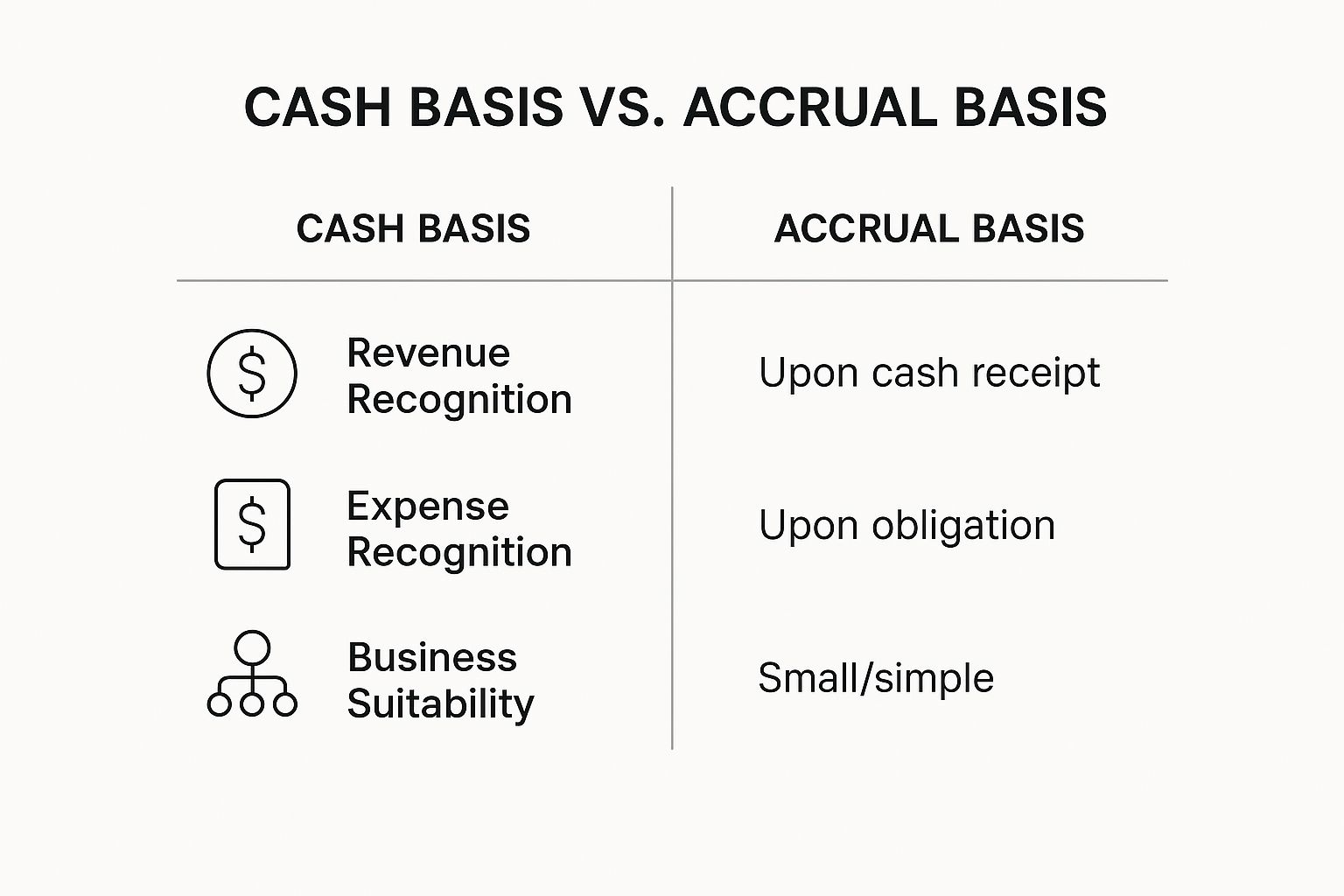
As you can see, the accrual method's approach of matching revenues with the expenses incurred to earn them provides a much more logical and complete financial narrative.
Let’s look at how this single transaction impacts the key financial statements under both accounting methods for Q1.
Sample Transaction Impact on Financial Statements
| Financial Statement Item | Cash Basis Impact (Q1) | Accrual Basis Impact (Q1) |
|---|---|---|
| Revenue | $0 | $10,000 |
| Expenses | $3,000 | $3,000 |
| Net Profit / (Loss) | ($3,000) | $7,000 |
| Accounts Receivable | $0 | $10,000 |
| Cash | ($3,000) | ($3,000) |
This table clearly shows that while the cash impact is identical, the accrual method provides a far more accurate picture of Q1 profitability and the assets earned during that period.
The Balance Sheet: A More Complete Financial Picture
The balance sheet is a snapshot of your assets, liabilities, and equity at a specific moment. Here again, the accrual method gives you—and anyone else looking—a lot more detail.
At the end of Q1, a cash basis balance sheet would be pretty simple: it would just show a lower cash balance because of the $3,000 expense payment. That's it.
The accrual basis balance sheet, on the other hand, reveals much more:
- It lists $10,000 under Accounts Receivable, which is an asset. This line item represents the money your client owes you.
- This gives a far more accurate view of the company’s total assets, not just the cash sitting in the bank.
This distinction is absolutely critical. It shows that the company has future cash flow on the way, a vital piece of information the cash basis method completely ignores. If you want a deeper dive into building these reports correctly, our guide on how to prepare financial statements is a great resource.
The accrual basis balance sheet paints a comprehensive picture by including non-cash assets like receivables and liabilities like payables. This is precisely why it’s the standard required by banks for loans and by serious investors.
The Cash Flow Statement: The Great Equalizer
Finally, there's the Statement of Cash Flows. This is where both accounting methods find common ground. This statement tracks the actual cash moving in and out of your business, plain and simple.
No matter which accounting method you use for your main books, the cash flow statement for Q1 will show the same thing: a net cash outflow of $3,000.
This statement acts as a reality check. Its whole purpose is to reconcile the net income from an accrual-based P&L back to the actual cash you have. It shines a light on the fact that a company can be highly profitable on paper but still face a serious cash crunch if customers are slow to pay. That makes the cash flow statement an absolutely essential tool for any business using the accrual method.
How to Choose the Right Accounting Method
Picking between cash and accrual accounting isn't just a bookkeeping detail—it’s a strategic choice that fundamentally shapes how you see your business's financial health, manage taxes, and plan for the future. There’s no single right answer here. The best method truly depends on the DNA of your company: its size, industry, complexity, and where you want to take it.
Making the right call starts with a straightforward look at how you operate. Do you carry inventory? Do you let customers pay you later? Are you gearing up to find investors? The answers to these questions are your first clues, pointing you toward the method that makes the most sense.
When Cash Basis Is the Smart Choice
The sheer simplicity of cash accounting makes it a perfect match for businesses with uncomplicated financial lives. It gives you a clean, immediate snapshot of your cash flow without the headache of tracking what you're owed or what you owe others.
Think about these scenarios where the cash basis method really shines:
- Solo Freelancers and Consultants: A freelance photographer or writer with a handful of clients can easily run their books by just tracking payments as they hit the bank. The bookkeeping is minimal, and their financial report is a direct reflection of their bank balance.
- Small Service-Based Businesses: A local handyman service or a small tutoring company that gets paid on the spot (cash, check, or instant transfer) thrives on this simplicity. There's no need to juggle complex invoices or follow up on payment terms.
- New Startups with Minimal Transactions: A brand-new startup just getting off the ground might stick with cash basis to keep things lean while they pour their energy into building a product.
Key Consideration: Cash basis is your best friend when the most important financial question you ask is, "How much cash do I have in the bank right now?" If your operations are simple and you aren't trying to impress outsiders with detailed financial statements, its ease of use is a massive plus.
When Accrual Basis Becomes Essential
As a business grows, its finances inevitably get more complicated, and the straightforward nature of cash accounting starts to feel less like a feature and more like a limitation. At this point, switching to the accrual basis isn't just a good idea; it's often a necessity for sound financial management and staying compliant. This is where the difference between cash basis and accrual basis really matters for long-term planning.
Accrual accounting is the clear winner—and often mandatory—in these situations:
- Businesses Managing Inventory: If you sell physical goods, whether in a retail shop or through an e-commerce site, you have to use the accrual method. It's the only way to properly account for inventory costs and match them to the revenue they generate.
- Companies Seeking Financing or Investment: Good luck getting a loan or attracting investors with cash-basis books. Lenders and VCs demand financial statements prepared according to Generally Accepted Accounting Principles (GAAP), which requires accrual accounting. They need the full story, including assets like accounts receivable and liabilities like accounts payable.
- Businesses with Long Sales Cycles: For firms in architecture, engineering, and consulting (AEC), accrual accounting helps predict revenue by recognizing it as it's earned, not just when an invoice is paid. Many in this space even integrate a work-in-progress (WIP) method for a more granular view of project finances.
- Meeting IRS Requirements: The IRS mandates the accrual method for businesses with average gross receipts over a certain threshold—currently $29 million for 2024, a figure that's adjusted for inflation. Some business structures are also required to use it, regardless of revenue. That's why understanding your entity type by comparing an S Corp vs. an LLC for your small business is such a critical early step.
At the end of the day, if your eyes are set on growth, scale, and bringing in outside capital, the rich, accurate financial narrative told by accrual accounting is non-negotiable. It delivers the clarity you need to make smart strategic moves, forecast accurately, and build trust with stakeholders. When in doubt, a quick chat with a CPA can help you lock in the right choice for your specific journey.
Common Questions About Cash vs. Accrual Accounting
Even after you've got the basics down, a few practical questions always pop up when you're deciding between cash and accrual accounting. Let's tackle the ones I hear most often from business owners, so you can make your choice with confidence.
Can I Switch from Cash to Accrual Later On?
Yes, you can, and it's a very common move for businesses on a growth trajectory. You might switch because you're starting to manage a lot of inventory, offering credit terms to customers, or you've simply crossed an IRS revenue threshold that makes the change mandatory.
But it’s not as simple as just flipping a switch in your books. The IRS sees this as a formal change and requires you to file Form 3115, Application for Change in Accounting Method. This form is no walk in the park; most business owners get help from a tax professional to get it right.
When you make the change, you'll have to make a one-time adjustment to get your books caught up. This means:
- Adding accounts receivable for all your unpaid customer invoices.
- Adding accounts payable for all the bills you owe but haven't paid yet.
- Adjusting for any prepaid expenses or unearned revenue.
The whole point is to get a more accurate financial picture, which is essential for scaling a business. Just be sure to plan it out carefully.
What are the Tax Implications of Switching Methods?
This is a big one. Switching your accounting method definitely has tax consequences, which is exactly why the IRS is so involved. The main difference boils down to the timing of when you recognize income and expenses.
When you jump from cash to accrual, you suddenly have to account for all the income you've earned but haven't received yet (your new accounts receivable). This can cause a one-time spike in your taxable income for the year you make the switch. For example, if you have $50,000 in outstanding invoices, that money could be counted as income right away.
The good news is the IRS knows this can create a huge tax hit. They typically allow you to spread that "catch-up" income adjustment over a period of up to four years. This keeps you from getting slammed with a massive tax bill all at once.
On the flip side, you also get to recognize all your accrued expenses (accounts payable), which helps offset some of that new income. Since this can get complicated fast, talking to a CPA before you decide to switch isn't just a good idea—it's essential.
Can a Business Use a Hybrid Accounting Method?
In certain situations, yes. The IRS allows for a hybrid method that blends parts of both cash and accrual accounting. Typically, a business will use the accrual method for inventory and sales (which is often required) but stick with the cash method for other income and expenses.
This is a popular route for small businesses that sell physical products but don't have super complex finances. Think of a local retail shop: they would use the accrual method to track their cost of goods sold and sales revenue, which gives them an accurate view of their inventory. But for day-to-day operating costs like rent and utilities, they might just record them on a cash basis when the money leaves their account.
It can be a practical compromise—simplifying your daily bookkeeping while still handling inventory correctly. The key is to be consistent and make sure you're following IRS rules for your specific situation.
How Does Accounting Software Handle Both Methods?
This is where modern technology really saves the day. Today's accounting software—platforms like QuickBooks or Xero—is built to manage both cash and accrual systems effortlessly. One of the best features is the ability to generate reports on either basis with just a click.
This means you can run your daily operations on a cash basis to keep a simple, real-time pulse on your bank balance. But when a lender or investor needs to see GAAP-compliant financial statements, you can instantly generate an accrual-based P&L and balance sheet. The software tracks receivables and payables in the background, making the difference between cash basis and accrual basis reporting as easy as picking an option from a menu. It takes the manual work out of it and gives you the financial insight you need, when you need it.
Figuring out the right accounting method is a critical step for your business's financial health. At Allied Tax Advisors, our team is here to give you the personalized guidance you need to choose the right system, stay compliant, and build a financial strategy that fuels long-term growth. Learn more about our comprehensive accounting solutions.