
At its core, the difference between an invoice and a receipt comes down to timing and purpose. Think of it this way: an invoice is a request for payment that you send to a client before they pay you. A receipt is proof of payment you give them after the transaction is complete.
Invoice vs Receipt: The Core Differences
Getting this sequence right—invoice first, payment second, receipt last—is fundamental to managing your business finances. Globally, businesses send a staggering 550 billion invoices annually, making them an essential tool for tracking what you're owed and keeping cash flow healthy. The Billentis e-invoicing report offers more detail on this. This distinction is also crucial for accurate bookkeeping, especially when considering the difference between cash basis and accrual basis accounting.
An invoice asks for money, while a receipt confirms money was received. Mixing them up is a surefire way to create accounting headaches down the road.
This infographic lays it all out visually, clearly separating the two documents. The invoice is the pre-payment request, and the receipt is the post-payment proof.
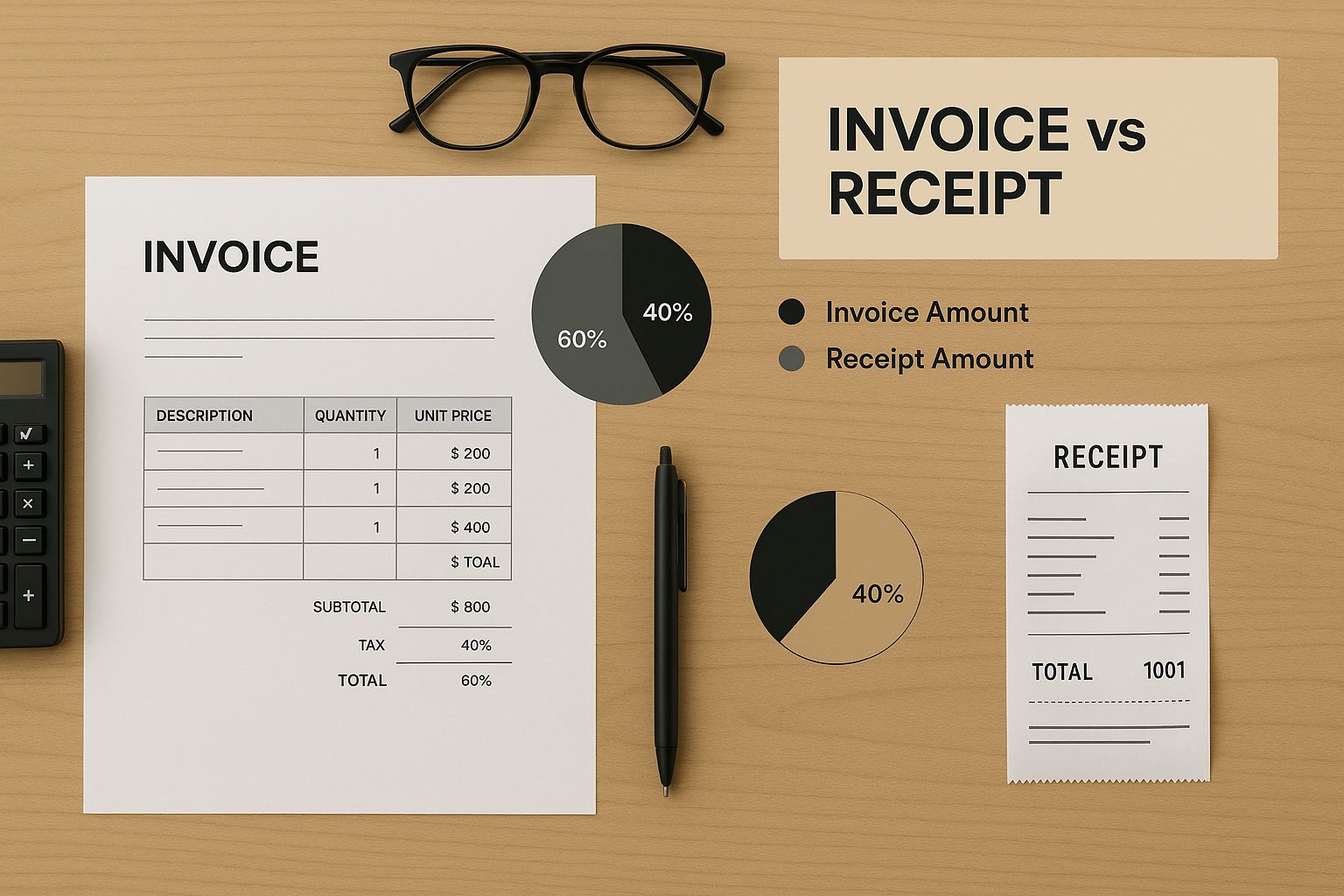
As you can see, each document plays a distinct, non-interchangeable role in a transaction. Let’s break down their attributes side-by-side for a clearer picture.
Key Differences Invoice vs Receipt
This table offers a quick, at-a-glance comparison of what sets these two critical documents apart.
| Attribute | Invoice | Receipt |
|---|---|---|
| Purpose | To request payment for goods or services. | To provide proof that a payment was made. |
| Timing | Issued before payment is made. | Issued after payment is received. |
| Function | Tracks accounts receivable; initiates payment. | Confirms transaction completion; acts as a record. |
In short, one document starts the payment process (the invoice), while the other officially closes it (the receipt).
What Is an Invoice? Breaking Down the Payment Request
Think of an invoice not just as a bill, but as a formal request for payment that kicks off the entire financial transaction. It’s a detailed, professional document that clearly spells out what a customer owes for the products you've sold or the services you've provided. Essentially, it's the foundation of your accounts receivable, setting clear expectations right from the get-go.
For instance, a freelance writer sends an invoice after submitting an article, breaking down the word count and rate. A wholesaler will send an invoice to a retailer for a large shipment of goods. In every scenario, the invoice is the official record that exists before any money is exchanged, turning a handshake deal into a documented financial agreement.
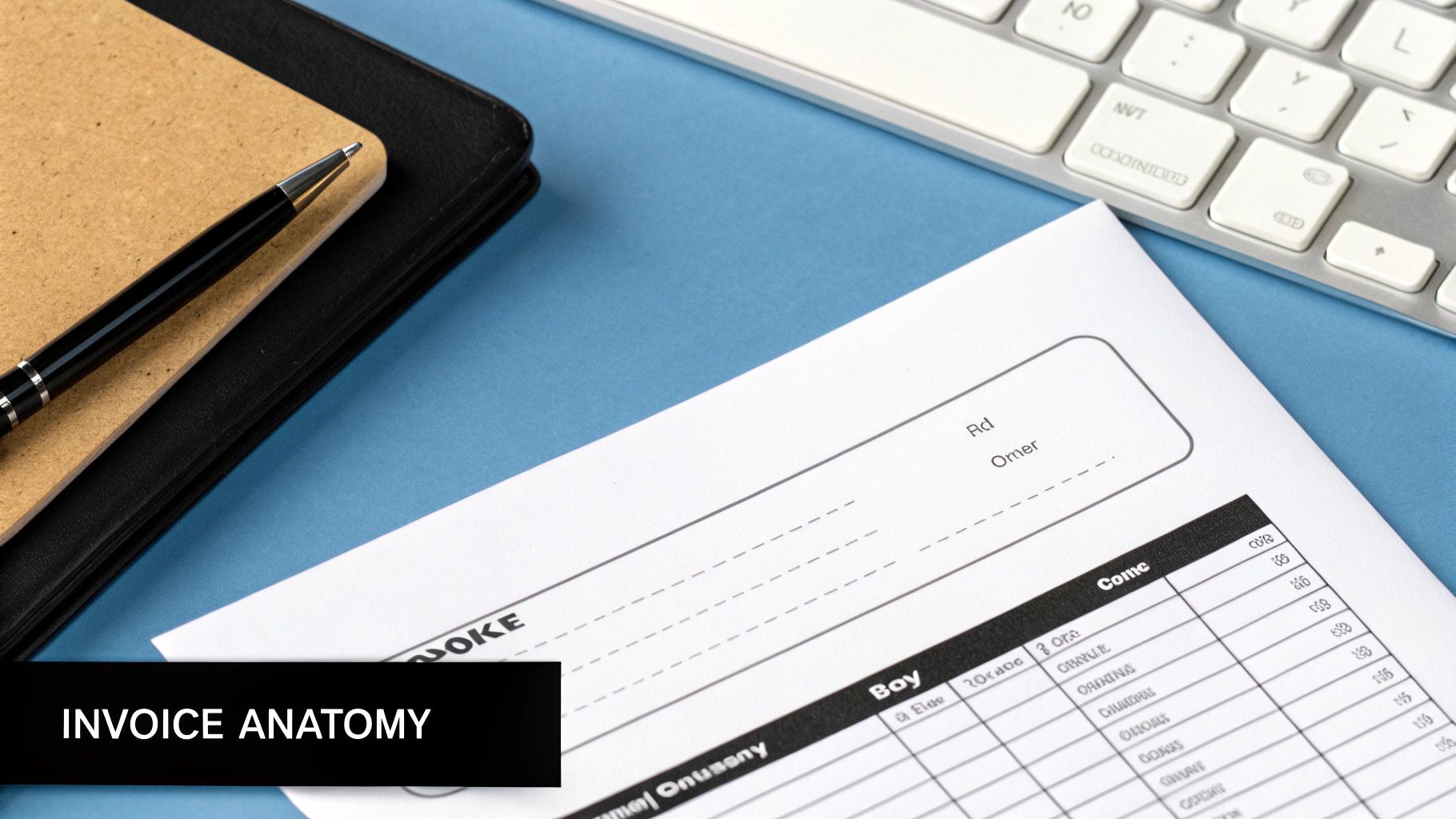
The Must-Have Components of Any Invoice
To get paid on time and avoid confusion, every invoice needs to include a few key pieces of information. Leaving these details out is a surefire way to cause payment delays and back-and-forth emails with your client.
A solid invoice will always have:
- A Unique Invoice Number for easy tracking and reference.
- Contact Information for both you and your client, including names and addresses.
- Key Dates, specifically the date the invoice is issued and the payment due date.
- An Itemized List of services or products, with quantities, rates, and individual totals.
- The Total Amount Due, which includes any taxes, shipping fees, or applied discounts.
An invoice's core job is to create an undeniable record of what is owed. It solidifies a verbal agreement into a formal financial document, which protects both you and your customer.
Why Clear Payment Terms Matter
An invoice does more than just list what things cost; it also communicates your payment expectations. This is where you lay out the ground rules for how and when you need to be paid.
This section is critical for clearly stating the payment due date—whether that's "Due upon receipt" or "Net 30"—and the payment methods you accept, like credit cards or bank transfers. Getting these details right is crucial for maintaining a healthy cash flow. Accounting software makes this much easier; if you need help, you can learn more about how to set up QuickBooks to make your invoicing seamless. After all, a clear invoice is the first step to getting paid promptly.
Anatomy of a Receipt: Proof the Deal is Done
If an invoice is the "please pay," a receipt is the "thank you, we're all settled." It's the final, official confirmation that a transaction is complete. Think of it as the handshake that closes the deal, providing undeniable proof that money has changed hands from buyer to seller.
The main job of a receipt is to act as proof of purchase. For your customer, it's their golden ticket for returns, warranty claims, or reimbursement. For your business, it’s a critical piece of the puzzle for verifying sales, simplifying your bookkeeping, and keeping your tax records straight.
What Makes a Receipt Official?
Unlike an invoice, which is all about what’s owed, a receipt focuses squarely on what was paid. Its components are straightforward and built around confirmation.
Every proper receipt should have:
- Your Business Info: Name and contact details.
- Transaction Date & Time: The exact moment the sale was finalized.
- What Was Purchased: A clear list of the items or services paid for.
- Total Amount Paid: The final number, including all taxes and any tips.
- Payment Method: How they paid you—cash, credit card, bank transfer, etc.
This simple set of details creates a transparent, complete record for both you and your customer.
A receipt isn't just a slip of paper. It’s a legal document confirming that ownership has been transferred and a debt has been paid. It protects everyone by creating a clear, unambiguous record of a finished transaction.
Receipts in the Real World
Receipts come in all shapes and sizes, from a crumpled cash register printout for a cup of coffee to a detailed email confirmation for a software subscription. Despite the different formats, their function is identical: they confirm a sale is complete.
For any business, keeping meticulous receipt records is non-negotiable for clean accounting. In fact, learning how to organize business receipts is a fundamental skill that makes bookkeeping and tax season so much easier. At the end of the day, a receipt is what separates an open tab from a closed sale.
Putting It All Together: Real-World Transaction Scenarios

Knowing the definitions is a good start, but seeing how invoices and receipts play out in the real world is where it all clicks. These documents aren't just paperwork; they're the critical steps that take a business deal from a simple request to a successfully closed transaction.
Let's follow a freelance graphic designer to see this in action. After delivering a fantastic new logo for a client, the designer’s next move is to send an invoice. This document lays everything out: the service provided ("Logo Design Package"), the final cost, and when the payment is due. In essence, the invoice kicks off the payment process by officially telling the client what they owe.
The Key Moment: The invoice is always sent before payment to formally request the money. It's the official starting gun for the client's payment process.
Once the client sends the money, the job isn't quite done. The designer now needs to issue a receipt. This document is the final handshake, confirming the payment has landed safely. It shows the date, the amount paid, and how it was paid. For the designer, the books are now balanced. For the client, it’s their official proof of purchase.
From B2B Deals to Advanced Finance
This exact same flow works just as well for much larger business-to-business (B2B) deals. Think about a wholesale supplier shipping a big order to a retail store. An invoice goes out with the goods, listing every single item and its price. The store's finance team gets this invoice and queues up the payment. Once paid, the supplier sends a receipt, and both companies can officially close the loop on that transaction in their records.
This is why the details matter. In some complex financial services, like factoring, invoices actually become assets that can be sold for immediate cash flow. Having a solid grasp on how they're structured is crucial. You can find more insights into financial factoring challenges and see just how important these documents are in high-level business finance.
Even as technology moves forward, the fundamental roles of these two documents haven’t changed. The cost of processing an invoice manually can still hit an average of $22.75, which is exactly why so many businesses are automating the process. But even the smartest AI needs to understand the basic distinction: an invoice asks for money, and a receipt confirms it’s been paid.
Why Getting This Right Really Matters for Your Business
It might seem like a small detail, but understanding the difference between an invoice and a receipt is absolutely fundamental to your company's financial health. This isn't just about picky bookkeeping—it's about having an accurate picture of your money.
When you mix these two up, you can wreck your financial statements. Think about it: an invoice is a request for payment, a signal of money you expect to get. A receipt is proof that the cash is in the bank. Confusing them gives you a warped view of your company's actual performance and compromises the integrity of your accounting from the ground up.
The Foundation of Financial Tracking
An invoice is the core of your accounts receivable. It's how you track who owes you what and when, making it essential for forecasting your future income. On the other hand, a receipt is the final word; it confirms a sale is complete and the money has landed.
This clarity is the key to effective payment reconciliation, which is simply the process of matching the money that comes in to the invoices you sent out. Without that clear distinction, you're just guessing.
Staying Compliant with Tax and Legal Rules
When auditors or tax authorities come knocking, they need to see clean, clear records. They rely on the separation between invoices and receipts to verify your income and your expenses. An invoice supports your claim to future revenue, while a receipt provides the concrete proof of a completed transaction that holds up under scrutiny.
An invoice is an IOU from your customer, and a receipt is your confirmation that the debt is paid. From a compliance perspective, one represents an unfulfilled promise, while the other represents a completed transaction.
Even as we move toward digital everything, this distinction is a common stumbling block. It's surprising, but 37% of businesses still handle paper invoice receipts. This old-school method doesn't just add storage costs; it opens the door to human error, which can muddle your financial records and make tax time a nightmare. You can explore accounts payable statistics to see just how common these challenges are. Getting it right from the start keeps your books clean, compliant, and ready for anything.
Common Questions About Invoices and Receipts
Even with a clear understanding of the basics, some practical questions always seem to pop up when dealing with invoices and receipts. Let's tackle some of the most common ones that small business owners and freelancers run into.
Can a Bill Be Used as an Invoice?
Essentially, yes. In casual conversation, people often use "bill" and "invoice" as if they're the same thing, and they do serve the same purpose: requesting payment.
However, in the world of business and accounting, invoice is the more formal and professional term. You'll almost always see it used in B2B transactions and for official record-keeping. Sticking with "invoice" keeps your documentation looking professional.
Do I Need to Issue a Receipt if I Already Sent an Invoice?
Yes, absolutely. This is a crucial step that can't be skipped. The invoice is just the request for payment; it doesn't prove the payment was actually made.
Once the money is in your account, sending a receipt confirms the transaction is complete. It provides a clean record for both you and your client, officially settling the debt. It’s a small step that makes a big difference in professional bookkeeping.
Think of it this way: The invoice opens the conversation about money owed. The receipt officially closes that conversation by confirming the money has been paid.
Can an Invoice Serve as a Receipt?
Not on its own, no. An invoice simply shows what’s owed. For it to even come close to acting as a receipt, you would need to update the original document and clearly stamp it as "Paid", making sure to add the payment date and method.
While you can do this, issuing a separate, dedicated receipt is the standard. It's cleaner, less confusing, and far better for maintaining accurate financial records.
What About Other Documents Like Purchase Orders?
It’s easy to get these mixed up, but they all play different roles. It's important not to confuse invoices or receipts with other common documents you'll encounter.
- A Purchase Order (PO) is a document sent from the buyer to the seller, officially authorizing a purchase before it happens.
- A Pro Forma Invoice is like a preliminary bill sent to a buyer before the goods are delivered, so they know what to expect.
Neither of these is a final request for payment like an invoice, nor are they proof of a completed transaction like a receipt. They are simply steps along the way.
We've covered the most common mix-ups, but here's a quick reference table to answer a few more frequent questions.
| Question | Answer |
|---|---|
| Why do I need to keep both invoices and receipts? | For complete financial records. Invoices show your income earned (accounts receivable), while receipts confirm your cash flow and provide proof of payment for tax purposes. |
| Is an email confirmation a valid receipt? | It can be, as long as it contains key details like the vendor's name, transaction date, amount paid, and a description of the items. However, a formal PDF receipt is always better. |
| How long should I keep invoices and receipts? | The IRS generally suggests keeping records for 3 years, but it can be up to 7 years in some cases. It's best to check with an accountant and digitize everything for easy storage. |
| What if a client pays an invoice in cash? | You should still issue a formal, dated receipt immediately. This is crucial for your records and provides the client with proof of their cash payment. |
Hopefully, this clears up any lingering confusion about these essential documents.
At Allied Tax Advisors, we help businesses and individuals master their financial documentation for seamless tax and accounting management. Get in touch with our expert team today!