
At its core, the difference between real and personal property boils down to one simple question: can you move it? Real property is the stuff that’s fixed in place—it’s immovable. Think of land and anything permanently built on or attached to it, like a house, a barn, or an in-ground swimming pool.
On the other hand, personal property is everything else you own that’s movable. This covers a huge range of items, from the couch in your living room and the car in your driveway to your business’s computers and that antique watch you inherited.
Understanding The Core Property Classifications
Getting this distinction right is more than just a legal technicality; it’s the foundation of smart asset management. How an asset is classified as real or personal property ripples through your entire financial world. It dictates everything from what you pay in annual taxes to how your assets are passed down to your family.

The two categories aren't even in the same league when it comes to value. A comprehensive analysis of global balance sheets revealed that real estate makes up about 69% of all real assets. This really drives home its central role in building long-term wealth. Personal property like machinery and equipment represents a much smaller slice of the pie, playing a completely different role in an investment portfolio.
Key Distinctions at a Glance
Let's quickly break down the fundamental differences between the two. The following table gives you a clean, side-by-side view to help you see how these asset types stack up against each other.
Quick Guide Real Property vs Personal Property
| Characteristic | Real Property | Personal Property |
|---|---|---|
| Mobility | Immovable (fixed to a location) | Movable (can be easily transported) |
| Examples | Land, buildings, houses, fences | Cars, furniture, computers, jewelry |
| Proof of Ownership | Deed or title | Receipt or Bill of Sale |
| Primary Taxation | Property Taxes | Sales Tax (on purchase), potential personal property tax |
| Transfer Method | Formal legal process (deed recording) | Simple delivery or bill of sale |
Thinking about these distinctions is a great starting point, but a complete financial picture also requires understanding how certain assets are handled during estate planning. For example, it's crucial to know the role of non-probate assets, which pass to beneficiaries outside of a will and can significantly influence your overall strategy.
Key Takeaway: The "attachment" or "mobility" test is the quickest way to tell the difference. If you can pick it up and move it without causing damage to the land or structure, it's almost certainly personal property.
How Property Type Shapes Your Tax Strategy

The line between real and personal property might seem like a minor legal detail, but for taxpayers, it's a critical distinction that directly impacts your wallet. Getting it right is fundamental to building a smart financial strategy, whether you're a business owner, a real estate investor, or simply managing your personal assets.
One of the most immediate differences you'll notice is how these assets are taxed annually. Your local government levies property taxes on your real property—the land and buildings you own. On the other hand, personal property is usually hit with sales tax when you buy it, and for businesses, certain states will also charge an annual personal property tax on assets like equipment and machinery.
Depreciation Schedules and Deductions
Depreciation is where the financial strategies for these two property types really diverge. The IRS allows you to write off an asset's cost over its "useful life," but the timelines couldn't be more different. This is a game of patience versus speed.
- Real Property: This is the long game. The IRS sets a lengthy recovery period for real estate. We're talking 27.5 years for residential rental properties and a full 39 years for commercial buildings.
- Personal Property: Here, you get much faster gratification. Assets like computers, business vehicles, furniture, and machinery have much shorter recovery periods, typically between 3 to 10 years, which accelerates your tax deductions.
This screenshot from IRS Publication 946 lays it out clearly, showing the different property classes under the General Depreciation System (GDS).
As you can see, the table confirms much quicker write-offs for personal property (like 5-year office equipment) compared to the decades-long schedule for real estate. Even better, personal property often qualifies for special treatment like the Section 179 deduction, which can let a business write off the entire purchase price of an asset in the year it was bought and put into service.
Key Insight: The faster depreciation on personal property gives you a more significant tax break right away, lowering your taxable income much sooner. Real property, in contrast, provides a smaller but consistent annual deduction that stretches out over decades.
Capital Gains and Tax Deferral Strategies
When it comes time to sell an asset for a profit, its classification once again dictates your tax-planning options. While both property types are subject to capital gains taxes, real estate has a powerful ace up its sleeve that personal property doesn't.
A 1031 exchange is a huge advantage for real estate investors. This IRS code section allows you to sell an investment property and defer paying all capital gains taxes, provided you reinvest the proceeds into another "like-kind" property. This powerful tool is exclusively for real property, making it an incredibly effective vehicle for building wealth over the long haul. Understanding the nuances is key, and our guide on the taxes on investment property digs into these strategies in more detail.
This isn't just a local phenomenon; the financial weight of real estate is a global constant. Data from 60 economies often shows residential property values on a steady upward climb, proving its role as a reliable store of value. This stability, paired with exclusive tax benefits like the 1031 exchange, is why real property remains a cornerstone of so many successful investment portfolios.
Navigating Ownership Transfers And Estate Planning
The line between real and personal property isn't just an academic exercise for accountants; it has major real-world consequences for how you transfer assets, both during your life and after. The legal hoops you have to jump through for gifting, selling, or inheriting property are entirely dictated by this classification, shaping everything from the paperwork you’ll need to whether your assets get tied up in court.
How Ownership Changes Hands
Transferring ownership of real property is a formal affair, and for good reason. It demands a legally sound document, almost always a deed, which has to be properly signed, witnessed, and then recorded with a government office, like the county clerk. This creates a public, traceable history of ownership—the chain of title—which protects everyone involved.
Personal property, on the other hand, is usually far less formal. For many everyday items, simply handing them over is enough to transfer ownership. For something more substantial, like a vehicle or expensive equipment, a bill of sale acts as the proof of transfer. It’s essentially a detailed receipt, but it rarely requires the official public filing that a real estate deed does.
Structuring Your Estate Plan
These differences become critically important when you're planning your estate. Real estate is often the biggest asset people own, so it's frequently placed into trusts to sidestep the costly and public process of probate court. By titling your home or rental properties in the name of a living trust, you can ensure they pass directly to your heirs without a judge's involvement.
Personal property can also go into a trust, but the mechanics are different. You don't record a deed for an art collection; instead, you'll list it on an inventory of trust assets. For any personal property with significant value, clear documentation is absolutely key. When thinking about how to pass these items on, it's smart to learn how to include physical assets like gold and silver in your estate plan.
Strategic Insight: Real estate transfers are public and high-value, so they face intense legal scrutiny in estate settlements. Personal property transfers are more private, but without clear instructions in a will or trust, they can easily become a source of conflict among heirs.
Gifting strategies also follow different paths. You can give your daughter a valuable piece of jewelry with little fanfare, but gifting her a parcel of land requires a new deed to be drafted and recorded, which could also trigger gift tax considerations.
Likewise, powerful tax-deferral strategies are available for real estate that simply don't apply to personal property. If you're selling an investment property, you owe it to yourself to understand what is a 1031 exchange and how it can help you roll your gains into a new property without an immediate tax hit.
Analyzing The Gray Areas and Fixture Classifications
While the line between real and personal property often seems clear, it gets surprisingly blurry in practice. This is where the concept of a fixture comes into play—an item that starts its life as movable personal property but becomes part of the real estate after being permanently attached.
Getting the classification right is more than just a legal technicality. Misclassifying an item can create major financial headaches, affecting everything from property sale agreements and rental contracts to your tax strategy.
The Legal Test for Fixtures
So, how do you decide what's a fixture and what isn't? Courts and tax authorities don't just guess. They rely on a set of legal tests, often remembered by the handy acronym MARIA, to figure out if an item has crossed the line from personal to real property.
When you're trying to make a call, running an item through these five tests is the best way to get a clear answer.
| Fixture or Personal Property: How to Decide |
| :— | :— | :— |
| Decision Factor (The MARIA Test) | Guiding Question | Example |
| Method of Annexation | How is the item attached? Would removing it cause significant damage to the property? | A built-in bookshelf that is part of the wall structure (fixture) vs. a freestanding bookshelf (personal property). |
| Adaptability | Is the item custom-built or uniquely suited for this specific property? | Custom-made draperies and rods designed for an unusually shaped window (fixture) vs. standard curtains. |
| Relationship of the Parties | What is the relationship between the person adding the item and the property owner? | A commercial tenant’s specialized kitchen oven is often a “trade fixture” and remains personal property. |
| Intention of the Parties | What was the original intent when the item was installed? Was it meant to be permanent? | A satellite dish bolted to the roof is intended to stay (fixture), while a portable AC unit is not. |
| Agreement between the Parties | Does a written contract (like a sales agreement) specify how the item is treated? | If the purchase contract explicitly states the backyard hot tub is included, it becomes real property for the sale. |
Ultimately, a clear agreement in writing can override all the other tests, which is why it's so important to be specific in contracts.
This decision tree helps visualize the simple, top-level process of how different property types are handled in a transfer.
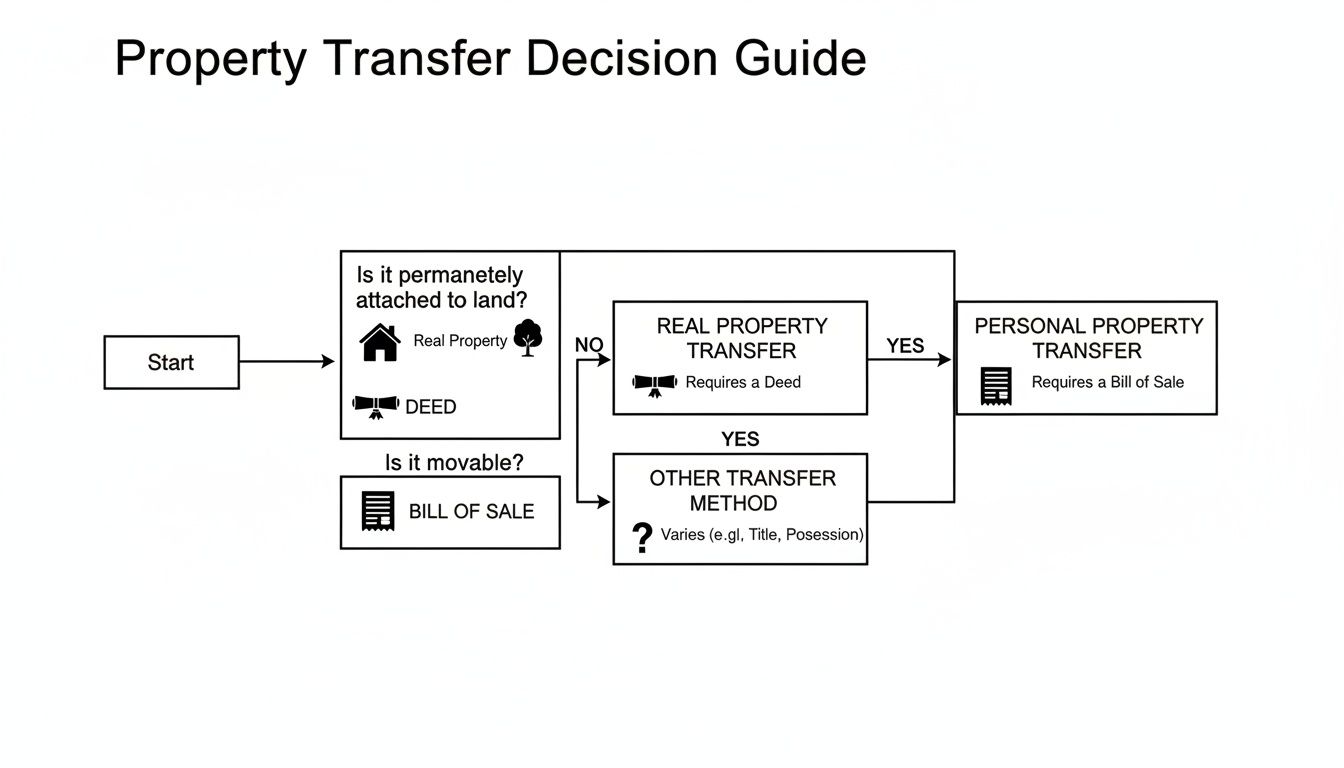
As the graphic shows, the documentation you need—a deed for real property versus a bill of sale for personal property—is a direct result of how the asset is classified.
Real-World Scenarios and Tax Implications
Let's walk through a common situation for investors. Imagine you own a rental unit and install a new, high-end refrigerator. Is it personal property or a fixture?
If it's a standard, freestanding fridge that just plugs into the wall, it remains personal property. But if it's a built-in, panel-ready model that's fully integrated into the custom cabinetry, it's almost certainly a fixture—and therefore part of the real property.
Key Insight: This classification directly impacts your tax strategy. As personal property, the standard fridge could be depreciated over just 5 years. The built-in fridge, as part of the real property, must be depreciated over the much longer 27.5-year schedule for residential rentals.
This distinction is a cornerstone of powerful tax strategies like cost segregation studies, where engineers identify building components that can be reclassified as personal property to accelerate deductions. Understanding the rules around depreciation on rental property is the critical first step. Getting the classification right from the very beginning ensures your financial records are accurate and your tax strategy is built on solid ground.
Getting Your Paperwork in Order: Documentation and Asset Management
Knowing the difference between real and personal property is one thing, but being able to prove it is where the real work begins. Without the right paperwork, you're setting yourself up for lost deductions, compliance headaches, and expensive mistakes when it's time to sell or face an audit. Smart asset management isn't just a "nice-to-have"—it's a financial shield.
The foundation for any business is a well-maintained fixed asset schedule. Think of this as more than just a list; it's a living document that tracks every asset's cost, the date you bought it, and its depreciation. This schedule is your command center, giving you a crystal-clear view of all your property for tax purposes and future planning.
Keep Every Receipt, Every Time
Holding onto original purchase documents is absolutely critical. These papers are your first line of defense, proving an asset's cost and how you've classified it.
- For Real Property: You'll want to keep deeds, closing statements, and every single invoice for capital improvements. This is how you prove you made a value-adding upgrade (real property) versus a simple repair (an expense).
- For Personal Property: Bills of sale, receipts, and purchase orders are your best friends. In a business context, these are vital for claiming depreciation deductions, especially under rules like Section 179.
Losing these records can hit your wallet hard. If an auditor comes knocking and you can't produce a receipt, that asset or expense will likely be disallowed, leaving you with a bill for back taxes and penalties.
Expert Tip: For any major purchase, scan the receipt or invoice and attach it directly to the transaction in your accounting software, like QuickBooks. This creates a digital backup that’s easy to find and won’t get lost or fade over time.
Make Physical Inventories a Habit
Documentation isn't a "set it and forget it" task. You need to conduct a physical inventory at least once a year to make sure your records match what you actually own. This simple process helps you spot "ghost assets"—items still on your books that you've already sold, scrapped, or lost. Finding them means you can stop paying taxes and insurance on property that's long gone.
If you're a real estate investor, this practice is just as important. Regularly tracking the condition of fixtures and any significant personal property inside your rentals gives you the evidence you need. It helps you distinguish between a capital improvement (which depreciates slowly) and a repair (which you can often expense right away).
Ultimately, disciplined record-keeping turns asset management from a painful chore into a powerful strategy. It makes every classification defensible and ensures your financial decisions are built on a solid foundation.
Why Bring in a Pro for Property Classification?
Knowing the textbook difference between real and personal property is one thing. Applying it correctly across tax returns, estate plans, and business asset schedules? That's a completely different ballgame. It can be incredibly tricky, and the stakes are high. A simple misclassification can lead to you overpaying on taxes, missing out on valuable depreciation, or facing some hefty compliance penalties down the line.
This gets even more complicated when you're staring at ambiguous items like "fixtures" or trying to sort through the dense tax code for your rental properties.
Trying to figure all this out on your own often leaves you guessing, which is a big financial risk. You need a solid grasp of federal, state, and even local rules that seem to change constantly. For business owners, the pressure is even more intense, since getting it wrong can throw a wrench in everything from your S Corp filings to sales tax obligations.
A Tax Advisor Turns Confusion into Confidence
This is where working with a good tax advisor can completely change the game. Instead of wrestling with whether a new HVAC system counts for accelerated depreciation or how to document a major renovation, you get clear answers that apply directly to you. A professional brings clarity and confidence to the table in a few key ways.
- Smarter Tax Strategy: An expert can spot opportunities you might miss. Think about cost segregation studies, where they can help reclassify parts of a building as personal property. This move can massively speed up depreciation deductions and free up your cash flow.
- Keeping Your Rentals Compliant: They'll make sure every part of your rental investment, from the appliances to the landscaping, is classified correctly. This helps you maximize every available deduction while staying on the right side of complex landlord-tenant tax laws.
- Spot-On Business Filings: For businesses like S Corps and LLCs, an advisor makes sure your assets are recorded perfectly on the balance sheet. This means accurate tax returns and fewer red flags that could trigger a costly audit.
Getting professional advice isn't just about dodging mistakes. It’s about being proactive and structuring your assets in a way that legally shrinks your tax bill and helps you build wealth for the long haul.
At the end of the day, expert guidance gives you a clear roadmap. With a firm like Allied Tax Advisors, you're not just hiring an accountant; you're gaining a partner. We're here to translate confusing property rules into simple, actionable strategies that protect what you've built and help you reach your financial goals.
Got Questions? We've Got Answers.
When you get down to the nitty-gritty of real versus personal property, some common questions always seem to pop up. We hear them from clients all the time. Let's tackle a few of the most frequent ones to clear up the confusion in some real-world situations.
Is a Mobile Home Real or Personal Property?
This one is all about how permanent the home is. If your mobile home is set on a permanent foundation on land you own, it's almost always treated as real property. Think of it this way: it has become part of the land.
On the other hand, if it’s sitting in a mobile home park on a rented lot with its wheels still on, it’s generally considered personal property. Why? Because it's still movable. Keep in mind that state laws can have their own quirks on this, so it's always smart to double-check.
The Bottom Line: For a mobile home, look at the foundation and who owns the land. A permanent connection to land you own is the key that usually flips the switch to real property.
How Does the Section 179 Deduction Come into Play?
Ah, Section 179—a fantastic tax break for businesses. It allows a business to deduct the full purchase price of qualifying assets in the year they're put to use, rather than depreciating them over time.
But here’s the crucial part: Section 179 is designed almost exclusively for tangible personal property. We're talking about things like machinery, computers, work vehicles, and office furniture. It does not apply to real property like land or buildings, which is a massive strategic difference in tax planning.
Can I Do a 1031 Exchange with Personal Property?
Not anymore. Since the Tax Cuts and Jobs Act of 2017, the popular 1031 "like-kind" exchange is available only for real property. Before the law changed, you could do certain exchanges with personal property, but that door has closed.
Today, this powerful tax-deferral tool—which lets you postpone capital gains taxes by rolling the proceeds from a sale into a similar property—is a benefit reserved strictly for real estate investors.
Trying to make sense of these rules can feel like a puzzle, but you don’t have to piece it together by yourself. The team at Allied Tax Advisors is here to offer the clear, strategic advice you need to feel confident in your financial decisions. Learn how we can help you build a smarter tax strategy by visiting us at our official website.