
As an S-corp owner, you can absolutely deduct the health insurance premiums you pay for yourself and other shareholders who own more than 2% of the company. But there's a catch, and it's a big one: the IRS requires these payments to be reported as wages on the shareholder's Form W-2.
This might sound counterintuitive at first, but it's a specific process that allows both the business and the shareholder to get a tax deduction.
Solving The S Corp Health Insurance Puzzle
Figuring out the S-corp health insurance rules can feel like a headache, but the solution is actually pretty elegant once you see how the pieces fit together. I like to call it the "Benefit Boomerang."
The money leaves your S-corp as a tax-deductible business expense. It then travels to you, the shareholder, as taxable wages. Finally, it boomerangs right back as a personal tax deduction on your Form 1040 for self-employed health insurance. This little loop is the key to making sure everyone gets the maximum tax benefit the law allows.

The Right Way vs. The Wrong Way
Here's the most common mistake I see business owners make: they treat health insurance like any other reimbursement. But for S-corp shareholders, you can't just pay for a personal policy with a personal credit card and have the business reimburse you.
For the deduction to be valid, the health insurance plan must be established by the business. This means the S-corp either pays the premiums directly or reimburses the shareholder, and—this is the critical part—includes that amount in the shareholder's wages on their W-2.
The bottom line is that for a shareholder to claim the valuable self-employed health insurance deduction, the premiums must ultimately be paid by the S corporation and reported as taxable compensation on their W-2.
Getting these benefits right is a big deal. The global health insurance market was valued at USD 2.32 trillion in 2025 and is expected to rocket to USD 5.5 trillion by 2034. North America makes up a huge piece of that pie with a 62.41% share, partly because corporate structures like S-corps are so common here.
To make this crystal clear, let’s look at how to handle this correctly versus the common shortcuts that can land you in hot water with the IRS. Nailing this process is fundamental to your tax strategy, especially when you factor in the nuances of the S corp tax rate.
Correct vs. Incorrect Handling Of S Corp Shareholder Premiums
This table breaks down the IRS-compliant method versus the common mistakes that can jeopardize your deductions.
| Action | Incorrect Method (High Audit Risk) | Correct IRS Method (Compliant) |
|---|---|---|
| Payment | Shareholder pays for a personal policy and takes a business distribution to cover it. | S-corp pays the premium directly to the insurance provider OR shareholder pays and is reimbursed by the S-corp. |
| W-2 Reporting | Premiums are not included on the shareholder’s W-2. They are recorded only as a business expense. | The full premium amount is added to Box 1 (Wages) and Box 14 (Other) of the shareholder’s W-2. |
| Business Deduction | The S-corp deducts the premiums as a general business expense but fails the W-2 test. | The S-corp deducts the premiums as part of officer/employee compensation. |
| Shareholder Deduction | Shareholder tries to deduct the premiums on their personal return without the W-2 inclusion. | Shareholder takes the above-the-line deduction for self-employed health insurance on their Form 1040. |
Sticking to the "Correct IRS Method" ensures you stay compliant and get the full tax benefit you're entitled to. The "Incorrect Method" is a recipe for disallowed deductions and potential penalties during an audit.
The 2% Shareholder Rule: What's the Big Deal?

Before you can even think about deducting S-corporation health insurance premiums, you have to get one thing straight: who does the IRS consider a "2% shareholder"? This status is the linchpin for all the special W-2 reporting and tax treatment we're about to cover.
On the surface, it seems simple enough. A 2% shareholder is anyone who owns more than 2% of the company’s stock or more than 2% of its voting power. But as with many things involving the IRS, the devil is in the details—specifically, the “family attribution” rules.
These rules look beyond your personal stock certificate and consider the combined ownership of your entire family unit. It’s a crucial detail that can trip up even savvy business owners.
It's All in the Family: Understanding Attribution
The concept of family attribution means you're treated as owning any stock held by specific relatives. This can easily tip someone with only a small direct ownership stake over that critical 2% line.
The IRS considers stock owned by the following family members to be your stock for this rule:
- Your spouse
- Your children (including adopted children)
- Your grandchildren
- Your parents
Think of it like this: the IRS views your immediate family’s shares as being in one big pot. If you own 1% and your son owns 1.5%, the IRS says you effectively own 2.5%. Suddenly, you're a 2% shareholder, and your health insurance needs to be handled in a very particular way on your W-2.
Let's walk through a quick example.
Scenario: Jane owns 1% of an S-corp, and her husband, Tom, owns 1.5%. Individually, neither of them crosses the threshold. But because of family attribution, the IRS adds their shares together. Jane is now considered a 2.5% owner (1% + 1.5%). As a result, she's officially a 2% shareholder, and the S-corp must report her health insurance premiums as wages on her W-2.
This rule is there to prevent owners from sidestepping the regulations by simply spreading stock ownership among close family members.
Who Isn't Part of the Family (According to the IRS)
Just as important as knowing who is included is knowing who isn't. The attribution rules are very specific and don't apply to every relative.
Stock owned by these family members is not attributed to you:
- Brothers or sisters
- Grandparents
- In-laws
- Aunts, uncles, nieces, nephews, or cousins
So, if you own 1.5% of the company stock and your brother owns 10%, his shares don't count toward your total. You’d remain under the threshold, and your health benefits would be treated like any other regular employee's—as a non-taxable fringe benefit.
Getting this calculation right from the start is absolutely foundational. If you misidentify who is (and isn't) a 2% shareholder, your payroll will be incorrect, and your deductions could be disallowed in an audit. This one determination sets the stage for the proper tax treatment for every owner-employee in your S-corp.
Alright, you've figured out who your 2% shareholders are. Now for the fun part: picking the right health plan for your S corporation. This isn't just a line item on your budget; it's a decision that affects your team's well-being and your ability to attract great people.
You're essentially looking at two main paths. You can go the traditional route with a group health plan, or you can explore a more modern, flexible approach with a Health Reimbursement Arrangement (HRA). Each has its own set of pros and cons, so let's break them down to see what makes the most sense for your business.
Traditional Group Health Plans
This is the classic "company health insurance" most people are familiar with. Your S corp buys a single policy from an insurance carrier, and that policy covers all your eligible employees, owners included. You pay a hefty chunk of the premium, and your employees usually chip in a smaller portion through payroll deductions.
It’s straightforward, predictable, and saves your team the headache of shopping for insurance on their own. This is a massive market—valued at $744.04 billion in 2021 and on track to hit $1.8 trillion by 2031, according to some reports. As an S corp, you’re tapping into this established system. You can get a deeper look at the group health insurance market on alliedmarketresearch.com.
For an S corp owner, this is often the most direct way to get tax-advantaged health coverage for yourself and your family.
Health Reimbursement Arrangements (HRAs)
Think of HRAs as a special bank account your company funds. You give employees tax-free dollars, and they use that money to buy their own health insurance or pay for medical expenses. Instead of picking a one-size-fits-all plan, you're empowering your team to choose what works for them.
For small businesses, two HRAs really stand out: the QSEHRA and the ICHRA.
QSEHRA (Qualified Small Employer HRA): This one's built for businesses with fewer than 50 full-time employees. You set a monthly allowance (up to an annual IRS limit), and your team gets reimbursed for their individual health plan premiums. It's a fantastic way to offer benefits without the administrative weight of a group plan. But here's the catch: 2% S corp shareholders cannot participate.
ICHRA (Individual Coverage HRA): The ICHRA is the most flexible of the bunch. There are no company size limits and no caps on how much you can contribute. You can really customize the benefit. However, just like the QSEHRA, the IRS says 2% shareholders are not eligible to participate in an ICHRA.
So, what’s the bottom line? For S corporations, HRAs are an excellent tool for providing health benefits to your non-shareholder employees. You get budget control, and they get to pick their own policy. But for the owners themselves, a group plan is the only game in town if you want to get that tax-advantaged health coverage through the business.
Your health plan is a core part of your overall employee benefits packages. Getting it right helps you stay competitive and keep your team happy and healthy.
Comparison Of Health Plan Options For An S Corporation
Choosing the right structure can feel complicated, especially with the unique rules for S corp owners. This table lays out the key differences between the most common options to help you see which path makes sense for your company.
| Feature | Group Health Plan | QSEHRA | ICHRA |
|---|---|---|---|
| Best For | Companies wanting a traditional, all-in-one benefit that includes owner-employees. | Businesses under 50 employees who want to offer a simple reimbursement benefit. | Businesses of any size seeking maximum flexibility in allowance amounts and employee classes. |
| 2% Shareholder Eligibility | Yes. Shareholders can participate, with premiums reported as W-2 wages. | No. 2% shareholders are ineligible to participate in a QSEHRA. | No. 2% shareholders are also ineligible for an ICHRA. |
| Contribution Limits | No specific dollar limit, but tied to the cost of the chosen group plan's premiums. | Yes, subject to annual inflation-adjusted limits set by the IRS. | No. Employers can set any tax-free reimbursement amount they wish. |
| Employee Choice | Limited to the specific plan(s) offered by the employer. | High. Employees can choose any individual plan that meets MEC standards. | High. Employees choose their own ACA-compliant individual market plan. |
As you can see, the decision often hinges on one critical question: do you, the S corp owner, need to be covered by the company plan? If the answer is yes, a group health plan is your most direct and compliant route. If you're primarily focused on providing benefits to your non-owner employees, an HRA offers fantastic flexibility.
A Practical Guide To Payroll And W-2 Reporting
Knowing the rules is half the battle; the other half is getting it right in your payroll software. This is where the rubber meets the road for compliance. Let's walk through exactly how to handle payroll and W-2 reporting for a 2% shareholder's health insurance, making sure your S-corp gets its deduction without any headaches.
The main idea is simple: you need to add the health insurance premium amount to the shareholder's wages. But it’s not treated like a regular salary. While the premium bumps up the shareholder's taxable income for federal and state purposes, it's completely exempt from FICA (Social Security and Medicare) and FUTA (federal unemployment) taxes.
This flowchart gives you a bird's-eye view of the different health plan options you have as an S corporation.
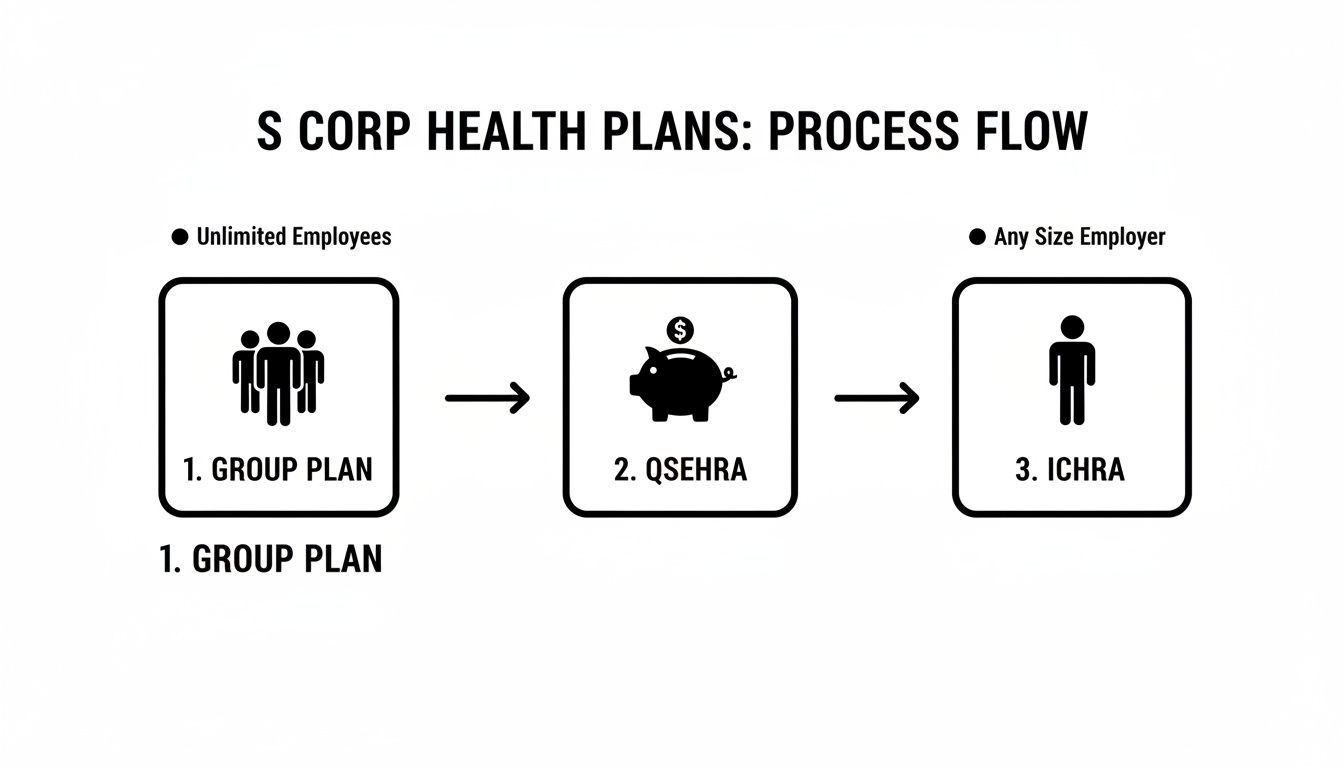
As you can see, each plan has a different role. For getting health insurance to a 2% shareholder, the Group Plan is the most direct route.
Step-By-Step W-2 Reporting Example
Let's ground this with a real-world example. Say you're a 2% shareholder with a health insurance policy that costs $12,000 a year ($1,000 per month). The S-corp pays this premium directly to the insurance company.
Here’s a breakdown of how that $12,000 has to show up on your annual Form W-2:
- Box 1 (Wages, tips, other compensation): The $12,000 premium gets added to your regular salary. So, if your salary was $80,000, Box 1 would report $92,000.
- Box 3 (Social Security wages): This is the crucial part—the $12,000 premium is NOT included here. Box 3 would only show the $80,000 salary.
- Box 5 (Medicare wages and tips): Same deal. The $12,000 is NOT included, so Box 5 would also show $80,000.
- Box 14 (Other): This is a great place to add a note for clarity. You could use a label like "S CORP MED" and list the $12,000 amount.
- Box 16 (State wages, tips, etc.): Most states follow the federal rules, so you'll include the $12,000 here, bringing the total to $92,000.
This special handling makes sure the amount is subject to income tax withholding but saves both the S-corp and the shareholder from paying extra payroll taxes on it. Getting these details right is a fundamental part of running your payroll correctly. For a deeper dive, check out our guide on how to do small business payroll.
Sample Accounting Journal Entry
For those of you managing your own books, seeing the actual journal entries can make everything click. It shows you precisely how the money moves through your company's accounts.
When you're dealing with payroll for health benefits, it's vital to define health insurance premium costs properly so they are booked correctly from the start. Let's stick with our $1,000 monthly premium example. First, here’s the journal entry for when the S-corp pays the insurance provider:
| Account | Debit | Credit |
|---|---|---|
| Health Insurance Expense | $1,000 | |
| Cash | $1,000 |
To record payment of monthly health insurance premium.
Simple enough. Now for the magic trick. When you run payroll, you need to reclassify that expense as wages to make it a deductible fringe benefit.
| Account | Debit | Credit |
|---|---|---|
| Officer Compensation | $1,000 | |
| Health Insurance Expense | $1,000 |
To reclassify health insurance as shareholder wages.
The key takeaway is that the net effect on your profit and loss statement is a $1,000 compensation expense. The premium starts its life as a health expense but gets moved over to wages to satisfy the IRS rules. Following this two-step accounting process keeps your books clean and your S-corp compliant.
How Shareholders Claim The Tax Deduction
So, we've walked through how the S corporation handles the health insurance premiums on the business side and gets them onto your W-2. Now for the best part: seeing that "Benefit Boomerang" come full circle and land a major tax advantage right back in your pocket.
This final step happens on your personal tax return, and it's what makes this whole setup so valuable for S corp owners.
Once those premiums are correctly reported on your W-2, you get to claim the self-employed health insurance deduction on your Form 1040. This isn't just any old deduction—it's an "above-the-line" deduction, which is tax-speak for "extra valuable."
The Magic of an Above-The-Line Deduction
What does "above-the-line" even mean? It means the deduction lowers your Adjusted Gross Income (AGI). Your AGI is the master number that the IRS uses as the starting line for calculating your final tax bill.
Lowering your AGI does more than just shrink your taxable income. It can also help you qualify for other tax breaks, like certain credits and deductions, that have income limits. It's a powerful ripple effect.
You’ll claim this deduction on Schedule 1 of your Form 1040. The number you put here should be an exact match to the health insurance premium amount your S corp paid for you.
Let's say your S corp paid $12,000 for your health plan. That $12,000 gets added to your W-2 wages, and then you turn around and deduct that same $12,000 on your personal return. The income is completely wiped out for income tax purposes, and you still get the FICA tax savings.
The key to unlocking this benefit is following the rules to the letter. The S corporation must establish the plan and pay the premiums (directly or through reimbursement). That amount must be included in your W-2 wages. There are no shortcuts.
The Cost Of Getting It Wrong
What if you just pay for your health insurance personally and don't run it through the S corp? Unfortunately, you lose out completely on this powerful tax break.
The IRS is incredibly strict here. If the plan isn't established under the business, the shareholder-employee simply can't take the self-employed health insurance deduction. Period.
That means you'd be stuck paying for your health coverage with after-tax dollars, which is a far more expensive way to do it. For a deeper dive into what qualifies in different scenarios, you can learn more about whether medical premiums are tax deductible.
By sticking to the process for your S corp health insurance, you get the best of both worlds: a full deduction for the business and a tax-efficient benefit for you. It's a true win-win that properly rewards you for the work you put into your company.
Common Compliance Mistakes to Avoid
Getting S-corp health insurance right isn't rocket science, but a few small missteps can create some big headaches. We're talking lost deductions, IRS penalties—the whole nine yards. Knowing where other business owners trip up is the best way to make sure you stay on the straight and narrow.
Think of it like this: ignoring a small rattle in your car can eventually lead to a massive repair bill. It's the same with your payroll. Overlooking a seemingly minor detail with health insurance premiums can cause a major tax problem down the road. Let's walk through the most common mistakes so you can sidestep them completely.
Mistake 1: Forgetting to Report it on the W-2
This is, without a doubt, the number one error we see. A business owner will correctly deduct the health insurance premium on the business side but then completely forget the second, absolutely critical step: reporting it as wages on the 2% shareholder’s W-2.
If you make this mistake, you completely wipe out the shareholder's ability to take the personal deduction for self-employed health insurance. The IRS is crystal clear on this: if it's not on the W-2, you don't get the personal deduction. You've just turned a tax-advantaged benefit into a costly oversight.
How to Fix It: This is a simple one to get right. Just loop in your accountant or payroll service. Make sure the total annual premium is added to Box 1 (Wages) and Box 16 (State Wages, if applicable) on the shareholder’s W-2. It should not be included in Boxes 3 and 5 (Social Security and Medicare wages).
Mistake 2: Using the Wrong Reimbursement Method
The next trap people fall into is how the premiums actually get paid. You can't just hand a shareholder cash and call it a day. Any reimbursement has to be run through payroll and officially recorded as compensation.
The reverse is also a problem. If a shareholder pays for their policy with personal funds and the S-corp never makes them whole, the business loses its deduction, and the shareholder loses their personal one. You’ve effectively broken the chain that connects the benefit to the business.
How to Fix It: The plan needs to be formally established by the business. From there, the S-corp should either pay the insurance company directly or reimburse the shareholder. The key is that any reimbursement must be included in the shareholder's W-2 wages.
Here’s the main principle to tattoo on your brain: The S-corporation has to be the one footing the bill for the health insurance premium. If that direct financial link is missing, the whole tax-saving strategy falls apart.
Mistake 3: Ignoring the "Plan Establishment" Rule
For any of this to work, the health insurance plan has to be established by the business. This doesn't mean you're forced into a group plan, but it does mean the S-corp has to be the entity that formally puts the benefit in place. A policy bought by a shareholder on their own, with zero involvement from the business, just won’t cut it.
Getting these details right is more important than ever. With projections showing that global medical costs could jump by 10.3% in 2026, every business owner needs to structure their benefits perfectly to squeeze every last drop out of the available tax advantages. You can read more about these rising medical cost trends on WTW's website.
To keep yourself out of hot water, just run through this simple three-point checklist for any premium payment for a 2% shareholder:
- Is the plan established by the S-corp? The business has to be formally tied to the policy.
- Did the S-corp pay for it? The money has to come from the business, either directly to the insurer or through a proper reimbursement.
- Was it included on the W-2? The premium amount must be added to the shareholder’s wages for income tax purposes.
If you can answer a firm "yes" to all three, you're well on your way to keeping your S-corp's health benefits perfectly compliant with the IRS.
Got Questions? We've Got Answers
Even with a good roadmap, you're bound to have some specific questions about how all this works in the real world. Let's tackle a few of the most common scenarios we see from S corp owners.
Can My S Corp Pay For My Family's Health Insurance?
Yes, absolutely. This is one of the great perks of the S corp structure. If you, as a 2% shareholder, are on a family plan, the business can cover the entire premium.
Just remember the process: the full cost of that family plan gets added to your W-2 wages. This allows you to then take the self-employed health insurance deduction for the entire family premium on your personal Form 1040. It’s a fantastic benefit that extends the tax savings to cover your spouse and dependents.
Do These Rules Also Apply To Dental And Vision Insurance?
They sure do. When the IRS talks about "health insurance" in this context, they're including medical, dental, and vision coverage.
So, any premiums your S corp pays for your standalone dental or vision plans follow the exact same rules. The cost must be added to your W-2 wages, and you can then include that amount as part of your self-employed health insurance deduction.
The IRS treats medical, dental, and vision premiums the same way for 2% S corp shareholders. To be deductible for both the business and you, the premiums have to be reported as W-2 wages.
Help! I Forgot To Report The Premiums On My W-2. What Now?
Don't panic—this is a pretty common mistake, and it's fixable. If you missed including the premiums on a W-2 from a prior year, the correct way to handle it is by amending the payroll tax returns for that year.
You'll need to file a Form 941-X, Adjusted Employer's QUARTERLY Federal Tax Return or Claim for Refund, for each quarter that needs correcting. You also have to issue a Form W-2c, Corrected Wage and Tax Statement, to the shareholder. This process makes sure your records are clean and, more importantly, protects the shareholder's personal deduction. We highly recommend looping in your accountant to make sure this is done right.
Making sense of S corp rules and payroll is what we do all day, every day. At Allied Tax Advisors, we help business owners like you use these strategies to their full advantage while keeping everything compliant. Learn how our accounting and tax solutions can help you build a stronger financial future.