
For most people, the question "Are my HOA fees tax-deductible?" has a simple, and often disappointing, answer: no. If the property is your primary home, the IRS sees those regular payments as personal living expenses. They fall into the same category as your utility bills or the cost of painting your living room—necessary for your home, but not a write-off on your taxes.
The Straightforward Rule for Your Primary Residence
When you pay your monthly or quarterly HOA dues, that money goes toward maintaining the community you live in. Think of the landscaping in common areas, the upkeep of the community pool, or the cost of snow removal from shared roads. These are all things that enhance your personal living environment and enjoyment.
From the IRS's perspective, because these expenses don't help you generate income, they aren't deductible. It’s the same logic that prevents you from deducting the cost of mowing your own lawn. The expense is personal, so the tax benefit doesn't apply.
Why the IRS Says No
The Internal Revenue Service is crystal clear on this. For the vast majority of homeowners, HOA fees for a primary residence are considered personal expenses and cannot be deducted on your federal tax return. It doesn't matter what the fees cover—from security guards to clubhouse maintenance—the rule stands firm.
This blanket non-deductibility means you won't find a spot for them on Schedule A or any other personal tax form. You can get a more detailed look at these IRS classifications in SmartAsset's guide for homeowners.
This simple visual breaks down the core question you need to ask.
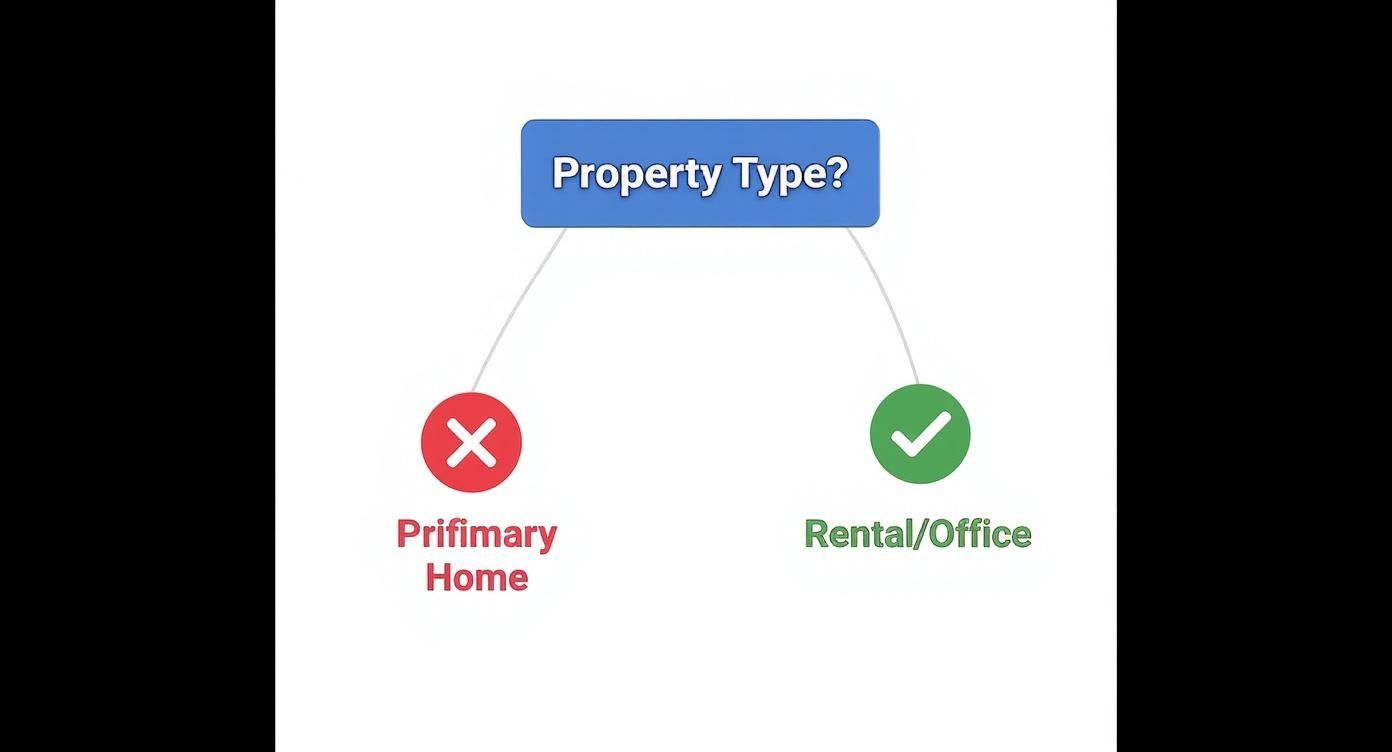
As you can see, everything hinges on one thing: how you use the property. Is it strictly for personal living, or is it tied to generating income?
HOA Fee Deductibility at a Glance
Before we dive into the exceptions where you can deduct these fees, let’s get a clear, high-level view. This table summarizes the basic rules of the road.
| Property Use Case | Are HOA Fees Tax Deductible? | Key Consideration |
|---|---|---|
| Primary Residence | No | It's considered a personal, non-deductible living expense. |
| Rental Property | Yes | It's treated as an ordinary and necessary business expense. |
| Home Office | Partially | A portion may be deductible based on the business use percentage. |
While this table gives you the quick-and-dirty summary, the real savings are found in the details of those exceptions. The "no" for a primary home is pretty rigid, but the moment your property starts acting like a business—as a rental or a home office—the door to deductions swings wide open. We'll explore exactly how that works next.
Turning HOA Fees into Deductions with a Rental Property

The moment you switch your property from a personal home to a rental unit, the entire financial rulebook changes in the eyes of the IRS. This is the single biggest and most common way the answer to "are my HOA fees tax deductible?" becomes a firm "yes."
Your property is now a business, and the costs to run that business get treated just like any other.
Think of it like owning a small shop. You have to pay for electricity, cleaning, and general upkeep to keep the doors open and attract customers. Those aren't luxuries; they are ordinary and necessary expenses to generate income. For a landlord, HOA fees are exactly the same thing.
The fees you pay go toward the maintenance, safety, and curb appeal that help you find and keep good tenants. Because of this, the IRS sees those dues as a fully deductible business expense, not a personal one.
Your Property as a Business Asset
Once you start renting out your condo, townhouse, or house in a managed community, your HOA dues take on a new role. They're no longer just for your personal enjoyment of a clean pool or trimmed hedges. They become an essential cost of doing business.
These fees directly fuel your rental activity by maintaining the property’s value and making sure the common areas are attractive to renters. In fact, the Community Associations Institute found that homes in well-run HOAs can sell for up to 4% more than similar properties outside of them. That’s a direct benefit to your investment.
Key Takeaway: For a rental property, HOA fees are a legitimate business expense—just like advertising, insurance, or repairs. You can deduct them from your rental income to lower your overall tax bill.
This shift in thinking is fundamental for any real estate investor. Every dollar you pay in HOA dues for your rental is a dollar that can chip away at your taxable income.
Reporting HOA Fees on Your Tax Return
To actually claim this deduction, you need to report your rental income and expenses properly. The go-to form for this is IRS Schedule E (Form 1040), Supplemental Income and Loss.
This is the form where you lay out all the numbers for your rental properties. You’ll put your gross rental income at the top, and then you get to subtract your expenses. While there isn't a line item specifically labeled "HOA Fees," you will include them under "Other Expenses" on Line 19.
It's smart to be specific here. Instead of lumping them into a vague "miscellaneous" category, write in "HOA Dues" or "Condo Fees" on the form. That clarity helps the IRS understand what you're deducting and can save you from future headaches.
Handling Partial Rental Scenarios
But what if you didn't rent the property out for the full year? The IRS is clear: you have to split the expenses between rental and personal use. You can only deduct the portion of the HOA fees that applies to the time the property was either rented or available for rent.
Here’s a simple way to figure it out:
- Count the Days: Figure out the total number of days the property was used for rental purposes and the number of days you used it personally.
- Find the Percentage: Divide the rental days by the total days of use (rental + personal). This gives you your rental-use percentage.
- Apply to Your Fees: Multiply your total annual HOA fees by that percentage to get your deductible amount.
Example Calculation:
- Let’s say you own a condo and paid $3,600 in HOA fees for the year.
- You rented it out for 9 months (274 days) and used it yourself for 1 month (30 days). The other two months it was vacant but available for rent, which counts as rental use.
- Total usage days: 274 + 30 = 304 days.
- Rental Percentage: 274 / 304 = 90%.
- Deductible HOA Fees: $3,600 x 0.90 = $3,240.
Getting this proration right is key to accurate reporting. And remember, HOA fees are just one piece of the puzzle. You can learn more about the full range of rental property tax deductions to make sure you’re not leaving money on the table. For an even deeper look, this comprehensive guide to tax deductions for landlords can help you spot every possible saving.
Claiming HOA Fees Through the Home Office Deduction

If you're self-employed or run a business out of your home, you've stumbled upon the second major exception to the HOA dues rule. For you, the answer to "is my hoa fee tax deductible?" can be a resounding "partially, yes!"
When a portion of your home serves as your place of business, the IRS sees things differently. Your home is no longer just a personal residence; it's also a business asset. This means you can deduct a percentage of your indirect home expenses, and that absolutely includes your HOA fees.
Think of it this way: your business is "renting" space from your home. Just as a commercial tenant's rent covers a portion of a building's operating costs, your business can deduct its share of running the home. This includes a slice of the mortgage interest, utilities, property taxes, and—you guessed it—HOA dues.
Calculating Your Home Office Deduction
Now, how you claim this deduction matters. The IRS gives you two paths, but only one lets you write off a piece of your HOA fees. It's critical to know which is which.
- The Simplified Method: This is the no-fuss option. You get a standard deduction of $5 per square foot for your office space (up to a 300-square-foot maximum, or $1,500). It's easy, but it's an all-or-nothing deal—you can't add on a portion of your actual expenses like HOA fees.
- The Actual Expense Method: This route takes a bit more paperwork but is the only way to make your hoa fee tax deductible with a home office. You'll figure out the percentage of your home dedicated to your business and apply that ratio to all your eligible home expenses.
To use the Actual Expense Method, you first have to calculate your business-use percentage. The most straightforward way is to divide your office's square footage by your home's total square footage.
A Practical Example of the Calculation
Let's walk through what this looks like for a freelance graphic designer working from home.
- Measure Your Office: Your dedicated workspace is a 150-square-foot room.
- Measure Your Home: Your home's total area is 1,500 square feet.
- Find the Percentage: Divide the office space by the total space: 150 sq. ft. / 1,500 sq. ft. = 10%.
That 10% is the key. It's the portion of your indirect home expenses you can attribute to your business. So, if you paid $4,000 in HOA fees for the year, you could deduct $400 ($4,000 x 10%) as a business expense. This gets reported on IRS Form 8829, Expenses for Business Use of Your Home.
Important Note: The IRS is strict about this. To qualify, your home office must be your principal place of business and used exclusively and regularly for your work. A corner of the living room or a desk in the guest bedroom won't cut it.
Getting a handle on these rules can make a real difference to your bottom line. To learn more, it's worth exploring the full tax implications of working from home and making sure you're not leaving any money on the table.
How Special Assessments Impact Your Home's Tax Basis
It’s completely natural to lump your regular HOA dues and those dreaded special assessments into the same mental bucket. But when it comes to your taxes, they live on entirely different planets. While your monthly dues for community upkeep are a no-go for deductions on a primary home, a special assessment for a major capital improvement tells a different financial story.
Instead of an immediate write-off, this kind of payment can increase your home's tax basis—a critical number that comes into play when you eventually sell.
Your Home’s Cost Basis: More Than Just the Purchase Price
Think of your home's cost basis as its starting financial value in the eyes of the IRS. It kicks off with what you paid for the property, but the story doesn't end there. Certain costs, like a special assessment for a significant, long-term upgrade, get added to this original price.
It’s like making a major engine upgrade to a classic car before selling it. You can't deduct the cost of the new engine in the year you buy it, but that expense definitely increases the car's overall value. This matters a lot when you calculate your profit from the sale. A special assessment for a capital improvement does the exact same thing for your home.
Capital Improvements vs. Simple Repairs: The IRS Cares About the Difference
The crucial distinction here is between a true capital improvement and a routine repair or maintenance project. This difference is everything when determining if an assessment adds to your home's basis.
- Capital Improvement: This is a major undertaking that adds substantial value to the property, extends its life, or adapts it to new uses. Think bigger, rarer, and more structural.
- Maintenance or Repair: This is all about routine upkeep—the small-scale work needed to keep the property in its current condition. These are your everyday fixes and preventative measures.
For instance, an assessment to repave all the community roads is a capital improvement. An assessment to patch a few potholes? That's just a repair. The first one adds to your basis; the second one doesn't.
A special assessment for a capital improvement is an investment in your property's long-term value. While it doesn't give you an immediate hoa fee tax deductible benefit, it can save you a bundle in capital gains taxes down the road.
Let’s lay out some clear examples to make this distinction obvious.
| Type of Project | Classification | Impact on Tax Basis |
|---|---|---|
| Replacing the entire community roof system | Capital Improvement | Increases your basis |
| Repainting the clubhouse exterior | Maintenance/Repair | No impact on your basis |
| Building a brand-new community pool | Capital Improvement | Increases your basis |
| Paying for seasonal landscaping services | Maintenance/Repair | No impact on your basis |
| Installing a new central security gate system | Capital Improvement | Increases your basis |
How an Increased Basis Puts Money Back in Your Pocket
So, how does this actually save you money? When you sell a property for more than its adjusted cost basis, that profit is called a capital gain, and you usually owe taxes on it. By adding the cost of that special assessment to your basis, you increase your starting value, which directly shrinks the size of your taxable profit.
Let's walk through a real-world scenario.
Example Without a Special Assessment:
- You bought your condo for $400,000.
- Years later, you sell it for $650,000.
- Your capital gain is $250,000 ($650,000 – $400,000).
Now, let's see what happens when we factor in a special assessment for a major improvement.
Example With a Special Assessment:
- You bought your condo for $400,000.
- Five years later, your HOA issues a $15,000 special assessment per unit to replace all the windows and siding.
- Your new adjusted cost basis is now $415,000 ($400,000 + $15,000).
- You sell the condo for $650,000.
- Your new capital gain is $235,000 ($650,000 – $415,000).
Just like that, by adding the assessment to your basis, you’ve cut your taxable gain by $15,000. Understanding how to figure capital gains is a must for any homeowner, as it directly impacts your tax bill when you sell. This simple but often overlooked step can translate into thousands of dollars in tax savings.
Documenting Your HOA Deductions for the IRS
Claiming a tax deduction is one thing; proving it to the IRS is another game entirely. Once you've figured out that your rental property or home office makes your HOA fees deductible, your job shifts to becoming a meticulous record-keeper. Think of it this way: good documentation is your best (and only) defense in an audit.
It helps to see your tax return as the final product. The real work is in the records you keep all year long—your bank statements, invoices, and logs. Without that paper trail, the numbers you claim are just that: numbers on a page, with nothing to back them up.
Your Essential Document Checklist
To build a rock-solid case for your deductions, you need to have your proof ready. Don't wait until April to dig through a year's worth of bank statements. Get in the habit of organizing these documents as they come in.
Here’s a practical checklist of what you absolutely need to keep on file:
- Proof of Payment: This is non-negotiable. Keep copies of canceled checks or bank statements that clearly show you paid the HOA dues.
- HOA Annual Budget: While not strictly required for the deduction itself, this document provides great context by showing how the association spends its money.
- Invoices for Special Assessments: If you're capitalizing a special assessment (adding it to your home's cost basis), you must have the official invoice that details exactly what the project was for.
- Rental Agreements: Your signed leases are the ultimate proof that the property was a rental during the period you're claiming deductions.
- Home Office Measurements: You don't need a professional blueprint, but a simple sketch showing your office dimensions and your home's total square footage is crucial for justifying your business-use percentage.
A simple, effective strategy? Keep digital copies of everything in a dedicated folder on your computer or cloud drive.
Navigating the Right Tax Forms
With your documents in order, the last step is putting the numbers in the right boxes on your tax return. Where you report the expense depends entirely on why it's deductible—for a rental property or a home office.
Pro Tip: Whatever you do, don't just lump your HOA fees into a vague "miscellaneous" category. Label the expense clearly as "HOA Dues" or "Association Fees." This transparency can head off potential questions from the IRS down the road.
If you're a landlord, your go-to form is Schedule E (Form 1040), Supplemental Income and Loss. This is the central hub for all your rental income and expenses. Your deductible HOA fees will fit neatly on Line 19, under "Other Expenses."
If you’re claiming the home office deduction, you'll be working with Form 8829, Expenses for Business Use of Your Home. Here, you’ll calculate your home office percentage and apply it to indirect costs like HOA fees. The final, deductible amount from Form 8829 then flows over to your Schedule C.
Getting this process down turns tax time from a stressful scramble into a simple financial task. It’s all about making sure every dollar you claim is backed by solid proof, which protects you and ensures you get the savings you're entitled to.
The Financial Squeeze of Rising HOA Fees
Figuring out if your HOA fee is tax deductible has gone from a casual question to a pretty urgent one for a lot of people. These fees keep climbing, and for most, they’re just another big bill that squeezes the household budget without providing any tax relief on a primary home.
It's a nationwide problem. Everything from insurance premiums to the cost of landscaping labor is going up, and that forces associations to raise their dues. You feel it right away when you pay more for gas or groceries, but the slow creep of HOA fees can be just as damaging to your finances over time.
The Growing Burden on Homeowners
The numbers really tell the story here. The national median monthly HOA fee hit $135 in 2024, but that’s just an average—it can be way higher depending on where you live and what kind of property you have.
According to the U.S. Census Bureau, about 3 million homes (that’s 14% of households paying these fees) are shelling out more than $500 a month. And it's not slowing down. A staggering 91% of community associations have had to hike their fees because of inflation and higher operating costs. Since these fees aren't deductible for your main home, the financial pressure just keeps building without any way to offset it on your tax return. You can dig deeper into these findings on condo and HOA fees from the Census Bureau.
This is exactly why the exceptions we've covered are so important. If you can deduct these fees as a rental expense or for a home office, you get a powerful tool to fight back against these rising costs. It turns a dead-end personal expense into a legitimate business deduction, which can make a real difference.
Taking Proactive Steps to Manage Costs
You can't single-handedly change the tax laws, but you're not helpless when it comes to rising fees. The best thing you can do is get involved with your HOA. You have every right to know how your money is being spent and to push for smarter financial decisions.
Takeaway: Your voice matters in your community. Actively participating in your HOA can lead to smarter financial decisions that benefit everyone and help keep dues manageable.
Here are a few practical things you can do:
- Attend Board Meetings: It's the simplest way to keep up with budget talks, upcoming projects, and any proposed fee increases.
- Review the Annual Budget: Ask for a copy of the budget and actually read it. See where the big money is going and don’t be afraid to ask questions.
- Advocate for Smart Spending: Encourage the board to get multiple quotes for big projects. Sometimes prioritizing essential maintenance over purely cosmetic upgrades can save a lot of money.
- Volunteer for a Committee: If you really want to make an impact, join the finance or budget committee. You'll get a direct hand in shaping your community's financial future.
Beyond just HOA fees, it's also worth looking into other ways to reduce your homeownership costs, like finding potential property tax savings. By staying informed and engaged, you can get a better handle on the financial realities of owning a home today.
Common Questions About Deducting HOA Fees
When you get down to the nitty-gritty of taxes, the details really matter. Let's tackle some of the most common questions homeowners and landlords have about writing off their HOA fees. These real-world scenarios will help clarify the rules we've discussed.
Can I Deduct HOA Fees if I Work From Home but Don't Have a Dedicated Office?
I hear this one a lot, and the answer is almost always no. The IRS is a real stickler for its "exclusive use" rule when it comes to the home office deduction. Your office space has to be just that—an office, and nothing else.
If you're working from your dining room table or a desk tucked into a corner of the living room, you simply don't meet that strict standard. Because the foundational requirement isn't met, you can't deduct any portion of your HOA fees.
What if My HOA Dues Cover Utilities Like Water or Trash?
For your primary home, it makes no difference. The IRS lumps the entire HOA payment together as a personal expense, full stop. Even if your statement breaks out costs for water, trash collection, or sewer, you can't carve those out and deduct them separately.
But flip the script for a rental property, and everything changes. The entire HOA fee, including any portion that covers utilities, is considered an ordinary and necessary business expense. You can deduct the full amount on your Schedule E.
The Bottom Line: For your personal residence, what the fee covers is irrelevant—it's not deductible. For a rental, the entire fee is a deductible cost of doing business.
Will a Special Assessment for Repainting Increase My Home's Basis?
It’s highly unlikely. To get that bump in your cost basis, a special assessment needs to pay for a true capital improvement—something that materially adds value to the property or substantially extends its useful life. Routine maintenance, like repainting the community buildings, almost never qualifies.
Think bigger. A capital improvement would be something like replacing all the roofs in the complex, repaving the roads, or constructing a brand-new clubhouse.
How Do I Calculate Deductible HOA Fees for a Rental I Bought Mid-Year?
You can only deduct expenses for the period the property was available for rent. It’s all about prorating. If you closed on a rental on July 1st and it was ready for tenants right away, your deduction is straightforward: just add up all the HOA fees you paid from July 1st through December 31st.
Navigating the complexities of rental property deductions or capital gains can be challenging. The team at Allied Tax Advisors is here to provide the expert guidance you need to ensure compliance and maximize your savings. Contact us today for personalized tax solutions.