
Selling your home for a profit is a huge financial win, but it's essential to get your head around the home sale capital gains tax. This is simply a tax on the profit you make, not the entire sale price. The good news? A generous IRS exclusion means most homeowners won't pay a dime.
Demystifying the Tax on Your Home Sale Profit

It helps to think of your home as a major investment. When you sell stocks for more than you paid, you have a "capital gain," and the same principle applies here. The government is interested in the profit you make when you sell your property.
This is a common point of confusion—the tax isn't on the sale price itself. It’s calculated on the gain, which is the difference between what you sold it for and its original cost basis. For example, if you bought your house for $300,000 and later sold it for $500,000, your potential capital gain is $200,000. That's the number the IRS cares about.
Short-Term vs. Long-Term Gains
How long you've owned the home makes a massive difference in your tax rate. The IRS splits gains into two categories, and knowing which one you fall into can save you a bundle.
- Short-Term Capital Gains: If you own the home for one year or less, any profit is taxed as ordinary income. That means it gets lumped in with your salary and taxed at those higher rates, which can climb as high as 37%.
- Long-Term Capital Gains: If you own the home for more than one year, the profit is taxed at the much friendlier long-term rates. For most people, these rates are 0%, 15%, or 20%, depending on your income.
This system is designed to encourage long-term homeownership rather than quick "flipping" for a profit. To get a closer look at how these rates work, you can check out our guide to understanding capital gains taxes for 2024.
The single most powerful tool for homeowners is the primary residence exclusion. This one rule allows most people to completely avoid paying taxes on their home sale profits.
So, who actually ends up paying this tax? It generally affects people who sell a home they haven't lived in for very long, homeowners with exceptionally large profits, or those selling a second home or investment property.
For the average person selling their main home, the outlook is very bright. In the next section, we’ll break down exactly how you can qualify for a huge exclusion and potentially wipe out your tax bill entirely.
How to Calculate Your Capital Gain
Before you can figure out if you owe any tax on your home sale, you first need to calculate your profit—or what the IRS calls your "capital gain." It might sound complicated, but it really boils down to three straightforward steps.
To make this crystal clear, let's walk through an example with a fictional couple, the Jacksons. They're getting ready to sell a house they've called home for the past decade and want to get a handle on their potential tax bill.
Step 1: Determine Your Initial Basis
The starting point for everything is your home's basis. For most homeowners, this is simply the price you paid for the property. But it's not just the price on the sales contract; there's a bit more to it.
Your initial basis includes the purchase price plus certain closing costs you paid when you first bought the place. Think of things like:
- Abstract and recording fees
- Legal fees (like for a title search)
- Surveys and transfer taxes
- Charges for installing utilities
Let's say the Jacksons bought their home for $350,000. They also paid $5,000 in qualifying closing costs. That makes their initial basis $355,000. It's important to note that simple repairs you might have done right after moving in don't count here—only the costs directly tied to acquiring the property.
Step 2: Calculate Your Adjusted Basis
This is where all the hard work and money you've put into your home over the years really pays off. Your adjusted basis is your initial basis plus the cost of any major capital improvements you've made. This step is a big deal because every dollar you add here directly reduces the profit you'll be taxed on later.
So, what's a capital improvement? It’s any work that substantially adds value to your home, extends its useful life, or adapts it for new uses. This is different from a simple repair, like fixing a leaky pipe or painting a room.
Key Takeaway: Think of it this way: capital improvements are investments in your home, while repairs are just the cost of maintaining it. Keeping detailed records of your improvements is one of the smartest things you can do to minimize your tax bill.
Some common examples of capital improvements include:
- Adding a new room or a deck
- A full kitchen or bathroom remodel
- Putting on a new roof
- Installing a new central air system
- Paving the driveway
Over their 10 years in the house, the Jacksons did a major kitchen renovation that cost $30,000 and replaced the entire roof for $15,000. Both are clear-cut capital improvements. So, we add that $45,000 to their initial basis of $355,000, bringing their new adjusted basis to $400,000.
Step 3: Figure Out the Final Gain
You're on the home stretch! The last step is pretty simple. Just take the final sale price of your home and subtract both your selling expenses and your adjusted basis. Selling expenses are things like real estate commissions, advertising costs, and any legal fees you paid to close the sale.
The Jacksons sold their home for $725,000. Their real estate agent's commission was 6%, which comes out to $43,500.
Here’s how their final math works out:
- Sale Price: $725,000
- Subtract Selling Expenses: -$43,500
- Equals the Amount Realized: $681,500
- Subtract Adjusted Basis: -$400,000
- Total Capital Gain: $281,500
Their total profit on the sale is $281,500. This is the number that could potentially be taxed.
To help you visualize this for your own situation, here is a simple worksheet.
Capital Gain Calculation Worksheet
| Component | Description | Example Amount |
|---|---|---|
| Sale Price | The final price your home sold for. | $725,000 |
| – Selling Expenses | Commissions, legal fees, advertising, etc. | -$43,500 |
| = Amount Realized | Your net proceeds from the sale. | $681,500 |
| Purchase Price | The original price you paid for the home. | $350,000 |
| + Buying Costs | Closing costs you paid when you purchased. | +$5,000 |
| + Improvements | Cost of major additions and renovations. | +$45,000 |
| = Adjusted Basis | Your total investment in the home. | $400,000 |
| Capital Gain | Amount Realized – Adjusted Basis. | $281,500 |
This worksheet gives you a framework for plugging in your own numbers to see where you stand.
While these calculation steps are fairly standard, tax laws can vary by location. For more on the core principles, you can see our guide on how to calculate Capital Gains Tax in the UK.
Now that the Jacksons know their gain is $281,500, the next big question is: do they have to pay tax on it? The infographic below shows the simple test homeowners can use to find out.
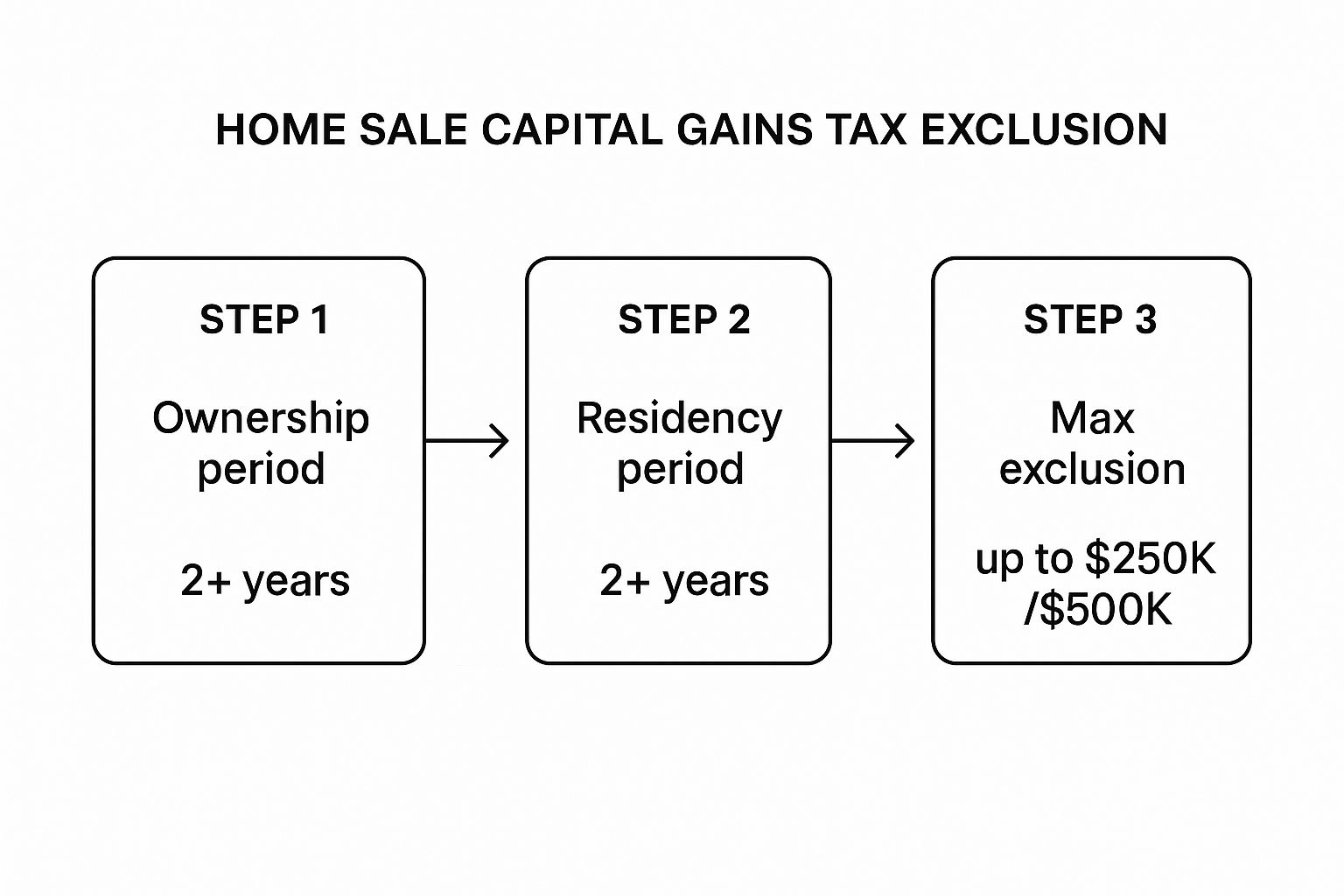
As you can see, it all comes down to meeting the ownership and use tests to qualify for the IRS's generous tax exclusion. For married couples like the Jacksons, that exclusion is $500,000. Since their gain of $281,500 is well below that threshold, they'll owe nothing in capital gains tax. If a single person met the tests, they could exclude up to $250,000 of gain.
Qualifying for the Primary Residence Exclusion

When it comes to managing the home sale capital gains tax, homeowners have an incredibly powerful tool in their corner: the primary residence exclusion. This isn't just a minor deduction; it's a game-changer that can completely wipe out the tax bill for most people selling their main home.
Think of it this way: if your capital gain is a massive tax liability, this exclusion—also known as the Section 121 exclusion—is the ultimate get-out-of-jail-free card. For single filers, it lets you shield up to $250,000 of your profit from taxes. For married couples filing jointly, that amount doubles to a staggering $500,000.
Of course, to unlock such a significant benefit, the IRS has a few rules you need to follow. Thankfully, they boil down to two simple ideas: you need to have owned the home for a decent amount of time, and you need to have actually lived in it. These are known as the Ownership Test and the Use Test.
The Ownership Test Explained
First up is the Ownership Test, and it’s pretty straightforward. You must have owned the home for at least two of the five years leading up to the date you sell it.
Imagine a five-year window that ends on your closing day. The IRS just wants to see that you held the title to the property for a total of 24 months within that window.
Here's the breakdown:
- The Look-Back Period: This is the five-year stretch of time right before the sale is finalized.
- The Requirement: You need a cumulative total of two years (or 730 days) of ownership during that period.
- It Doesn't Have to Be Continuous: This is a key point people often miss. The two years of ownership don't need to be consecutive. You could own it for 18 months, rent it out, move back in, and own it for another 6 months—as long as it adds up to two years within the five-year window, you’re good.
The Ownership Test is designed to make sure this tax break goes to long-term homeowners, not real estate investors who are flipping properties for a quick profit.
Let’s say Sarah bought a condo on June 1, 2021. She decides to sell, and the deal closes on July 15, 2024. Her five-year look-back period runs from July 15, 2019, to July 15, 2024. Since she owned the condo for more than three years inside that window, she passes the Ownership Test with flying colors.
The Use Test Explained
The second, equally important rule is the Use Test. This one is all about proving the house was genuinely your primary home, not just an investment property you owned. To pass, you must have lived in the home as your main residence for at least two of the five years leading up to the sale.
The mechanics are identical to the Ownership Test:
- The Look-Back Period: It’s that same five-year window ending on your sale date.
- The Requirement: You need to have lived there for a total of two years (730 days) within that timeframe.
- It Doesn't Have to Be Continuous: Just like ownership, your two years of living there don't have to be in one solid block. Short-term absences, like extended vacations or a temporary work assignment, usually don't break the clock on your residency.
Let's look at Mark's situation. He bought a house on May 1, 2019. He lived there until May 1, 2021, when he took a year-long job assignment overseas and rented the place out. He moved back in on May 1, 2022, and eventually sold the house on June 1, 2024.
Even with that one-year gap, Mark easily meets the Use Test. In the five years before the sale, he lived there from 2019 to 2021 (two years) and again from 2022 to mid-2024 (over two years). That's more than enough to qualify.
Passing Both Tests Is Mandatory
Here’s the critical part: you absolutely must pass both the Ownership Test and the Use Test. Passing just one isn’t enough, and this is a common tripwire for homeowners who haven't planned ahead.
Consider this frequent scenario: A couple rents a home for three years, loves the neighborhood, and decides to buy it from their landlord. A year after purchasing it, they get a great job offer in another state and decide to sell.
Let's see how they fare:
- Use Test: They pass easily. They've lived there for a total of four years.
- Ownership Test: They fail. They've only owned the property for one year.
Because they failed the Ownership Test, they can't claim the exclusion. This really shows how important it is that your ownership and residency periods overlap correctly within that five-year window. You have to check both boxes to unlock that powerful $250,000/$500,000 tax break.
What If You Have to Sell Early? Partial Exclusions and Special Cases
Life doesn't always go according to plan. You might buy a home fully intending to stay for years, only to have a new job, a health issue, or a family change force you to move. The good news is the IRS doesn't leave you high and dry if you have to sell before hitting that two-year mark.
Instead of a strict all-or-nothing rule, you might qualify for a partial exclusion. Think of it as getting partial credit. You won't get the full $250,000 or $500,000 exclusion, but you can exclude a portion of your gain based on the time you did spend in the home.
Qualifying for a Partial Exclusion
To get a partial exclusion, you have to show the IRS that you sold your home because of a specific "unforeseen circumstance." They generally group these valid reasons into three buckets: a job change, a health crisis, or other unexpected life events.
Let's look at what typically qualifies:
- Change in Place of Employment: This is the big one. If a new job requires you (or your spouse) to move, and the new workplace is at least 50 miles farther from your home than the old one was, you’re usually in the clear.
- Health Reasons: Selling your home to either receive or provide medical care is another qualifying reason. This could mean moving closer to a specialized hospital for yourself or a family member, or finding a home that's better suited for a new health condition.
- Other Unforeseen Circumstances: This is a catch-all category for major life events you couldn't have predicted when you bought the house. It often includes things like divorce, the death of a spouse, or a natural disaster that significantly damages your home.
The Big Picture: The partial exclusion is designed to help homeowners who were on track to meet the two-year rule but were derailed by a significant, unavoidable life event. It prevents you from being unfairly penalized for something you couldn't control.
How to Calculate a Partial Exclusion
Figuring out your partial exclusion is actually pretty straightforward. You just calculate what percentage of the two-year requirement you met and apply that percentage to the maximum exclusion you’d normally get.
Here’s a simple example. Let's say a single homeowner, Alex, lived in his house for exactly 12 months before his company transferred him across the country. He met the ownership and use test for one year, which is half of the required two years (24 months).
Alex can claim half of the standard $250,000 single-filer exclusion. The math is simple: 50% of $250,000 = $125,000. He can now shield up to $125,000 of his profit from taxes—a massive savings compared to getting no exclusion at all.
Other Special Scenarios to Keep in Mind
Beyond the basic partial exclusion, a few other life events have their own unique tax rules when it comes to selling a home.
Divorce and Home Sales
When a marriage ends, the $500,000 joint exclusion doesn't necessarily disappear. If the home is sold as part of the divorce, the couple can often still claim the full amount. There are even provisions that allow a spouse who moves out to count the time their ex-spouse continued to live there towards their own two-year use test, as long as it's outlined in the divorce agreement. This keeps the departing spouse from losing a major tax benefit.
Death of a Spouse
Losing a spouse is devastating, and the tax code provides a bit of breathing room. If you sell your home within two years of your spouse's death, you can still use the full $500,000 joint exclusion, assuming you met the qualifications as a couple before they passed away. This gives you a grace period to make tough decisions without a looming tax bill. The rules around inherited property can also get tricky, so it's worth understanding the "step-up in basis," which we cover in our guide to capital gains tax on inherited property.
Selling a Former Rental Property
Did you rent out your home before moving in and making it your primary residence? Be careful. The IRS has specific rules for this. Any time the property was used as a rental after 2008 is considered "nonqualified use," and this can shrink the amount of gain you’re allowed to exclude. This rule prevents real estate investors from simply moving into a rental for two years to erase a decade's worth of taxable investment gains.
These scenarios really show why it's so important to be aware of the rules. Life happens, and knowing how these events affect your taxes can save you a serious amount of money.
Strategic Planning to Minimize Your Tax Bill

Knowing the rules of the home sale capital gains tax is one thing. Actually using them to your advantage is a whole different ballgame. Smart planning—the kind that starts long before a "For Sale" sign ever touches your lawn—is the key to legally shrinking, or even completely wiping out, what you might owe.
This isn't about shady loopholes. It's about making smart, informed decisions that align with well-established tax principles. The most powerful moves often happen years before you sell, giving you time to meet the primary residence exclusion requirements and maximize every deduction available.
Meticulous Record-Keeping Is Your Best Defense
Think of your home's adjusted basis as your first line of defense against a big tax bill. Every dollar you can legitimately add to that basis is a dollar of profit you won't be taxed on. This makes keeping meticulous records an absolute must for any homeowner.
From the day you get the keys, start a dedicated folder—whether it’s a physical file or a digital one on your computer—for every single capital improvement. I'm not just talking about huge renovations; even smaller projects add up significantly over the years.
So, what should you hang on to?
- Receipts and Invoices: Keep detailed records for materials and labor for any project that adds value to your home.
- Contracts: File away any signed contracts with contractors, roofers, or other pros.
- Permits: Building permits are fantastic proof that major, value-adding work was done correctly.
- Photos: Before-and-after pictures can provide powerful visual proof of the upgrades you’ve made.
A well-documented history of improvements can be worth tens of thousands of dollars in tax savings. Don't rely on memory; save the proof as you go.
This simple habit turns a fuzzy memory of a kitchen remodel into a concrete $30,000 increase in your home’s cost basis, which in turn reduces your taxable gain by that exact amount.
Timing Your Sale and Leveraging Your Marital Status
When it comes to taxes, timing is everything. To get the full $250,000/$500,000 exclusion, you have to nail the two-year ownership and use tests. Selling just a few weeks too soon could be a very expensive mistake. Always double-check your calendar to make sure you’ve crossed that 24-month finish line before you close the deal.
Your marital status when you sell is also a huge factor. A married couple can exclude up to $500,000 of gain. But if you sell after a divorce is finalized, you might each only get to claim $250,000. Some strategic planning during divorce proceedings can be critical to preserving that higher exclusion amount.
Advanced Planning for Complex Situations
For homeowners with more complicated financial lives, planning is even more important. If you’re turning a rental property into your primary residence, you need to be aware of the "nonqualified use" rules. Any time the home was used as a rental after 2008 can chip away at the amount of gain you’re allowed to exclude, so calculating this precisely is vital.
It always pays to explore every avenue for reducing your tax burden. For a deeper dive, you can learn more about how to minimize your overall tax liability on our blog.
And while your home is a major asset, a truly solid financial plan looks at the whole picture. Understanding concepts like the tax implications of dividends versus return of capital can help you make smarter decisions across your entire portfolio.
A Global View on Real Estate Capital Gains
It's easy to get laser-focused on the U.S. rules for capital gains, but taking a quick trip around the world reveals just how differently other countries handle taxes on home sale profits. This global perspective is more than just trivia; it helps American homeowners truly grasp how good we have it with our primary residence exclusions.
Think of each country’s tax system as having its own unique philosophy. Some are built to reward long-term stability, while others see real estate profits as just another paycheck to be taxed. These different approaches completely change the game for investors and homeowners from one border to the next.
Comparing Tax Approaches
For example, some countries come down hard on property flippers. In Malaysia, you could face a Real Property Gains Tax (RPGT) as steep as 30% if you sell a property within just a few years. That’s a serious deterrent to short-term speculation. Over in Europe, a country like Luxembourg simply lumps your real estate profits in with your regular income for tax purposes.
This is a crucial point to remember: The U.S. homeowner exclusion—up to $500,000 for a married couple—isn't some universal standard. It's a massive financial advantage unique to our system.
And the variations don't stop there. Lithuania treats property gains as corporate income, while a place like Macau has no dedicated capital gains tax, folding profits into other tax calculations instead. These differences are exactly why you can't assume anything when dealing with property abroad.
If you're curious to dive deeper into how these international tax laws play out, Bright!Tax offers a great overview on what it all means for foreign real estate sales.
Common Questions About Home Sale Capital Gains Tax
Even with a good grasp of the basics, some of the finer points of the home sale capital gains tax can be tricky. Let's walk through a few of the most common questions that pop up for homeowners.
Can I Use the Exclusion on a Vacation Home?
Unfortunately, no. The Section 121 exclusion is a tax break designed specifically for your primary residence. This means it has to be the home you actually live in for the majority of the time.
That’s why this powerful tax benefit doesn't apply to a second home, a weekend getaway cabin, or any rental property that wasn't your main home for at least two of the last five years.
What if My Gain Is More Than the Exclusion?
This is a great problem to have! If your profit is larger than the $250,000 (for single filers) or $500,000 (for married couples) exclusion, you don't lose the benefit. You simply pay capital gains tax on the amount that goes over the limit.
Think of it this way: if a married couple sells their home and realizes a $550,000 gain, they get to shield the first $500,000 from taxes completely. They only owe tax on the remaining $50,000.
Key Insight: You are never taxed on the amount covered by the exclusion. You only pay tax on the profit that exceeds your eligible exclusion amount, which keeps your bill much lower.
Do I Need to Report the Sale if I Don't Owe Tax?
This is where it gets a little nuanced. If your entire gain is covered by the exclusion, you often don't have to report the sale on your tax return.
The big exception is if you receive a Form 1099-S from the closing agent. If that form shows up in your mailbox, you must report the sale, even if you owe zero tax. When in doubt, it’s always smart to check with a tax pro. For other common questions about buying, selling, and owning property, resources like these general real estate FAQs can be a helpful starting point.
At Allied Tax Advisors, we specialize in helping homeowners navigate complex tax situations like these. Contact us to ensure you're making the smartest financial decisions for your home sale. Learn more at https://alliedtax.com.