
The profit you see on paper from a flip is never what actually hits your bank account. House flipping taxes are almost always treated as ordinary business income—not the lower-rate capital gains many investors hope for—which can take a huge bite out of your take-home pay. If you want to succeed in this game, proactive tax planning isn't just a good idea; it's non-negotiable.
Your Profit Is Not Your Paycheck

The single biggest mistake new house flippers make is confusing their gross profit with their final earnings. Seeing a $70,000 difference between what you bought a property for and what you sold it for feels like a massive win. But that number is dangerously misleading until you account for your silent partner in every deal: the IRS.
It helps to think of it like running any other business, say, a restaurant. The owner doesn't just pocket all the cash from the register at the end of the night. First, they have to pay for food costs, rent, utilities, and their staff's wages. What's left over is the real profit. House flipping works the exact same way; your "costs" just look a little different.
The Real Cost of Doing Business
Before you can even begin to calculate your true profit, you have to subtract every single one of your expenses. This goes way beyond the obvious costs of drywall and paint. Every dollar you spend on the project chips away at that initial gross figure.
Your main costs will fall into a few key buckets:
- The Property Itself: This is your starting point—the initial purchase price.
- Renovation Expenses: All the materials, labor, permits, and contractor fees land here.
- Holding and Selling Costs: Don't forget property taxes, insurance, utilities while you own it, and real estate agent commissions when you sell.
- A Significant Slice for Taxes: This is the big one, the expense that surprises and sinks most newcomers.
To get a clearer picture, it's smart to research the potential kitchen renovation's return on investment, as this is often one of the largest and most impactful project expenses.
Understanding Your Tax Obligation
Here’s the critical distinction: unlike profits from long-term rental investments, gains from a property you buy and sell within one year are typically taxed as ordinary income. This means the money you make is simply added on top of your other earnings (like your day job salary) and taxed at your standard federal income tax bracket.
The IRS generally views house flippers as "dealers," which means your profit is taxed as ordinary income, with federal rates ranging from 10% to 37%. If you're in the highest bracket, you could watch over a third of your hard-earned profit disappear to federal taxes alone, not to mention state taxes.
This tax treatment really puts the pressure on having a solid strategy. Because you're effectively running a business, you'll also likely need to make quarterly estimated tax payments to the IRS throughout the year. You can learn more about this in our guide on what https://alliedtax.com/what-is-estimated-tax-payments/ are. Thinking about taxes this way frames it as a core business skill—just as crucial as your renovation plan.
Quick Look Ordinary Income vs Long-Term Capital Gains
The difference between these two tax treatments is massive. Holding a property for just one day over a year can completely change your tax picture. This table breaks down the core differences.
| Tax Type | Holding Period | Typical Tax Rate | Best For |
|---|---|---|---|
| Ordinary Income | Less than 1 year | 10% – 37% (plus self-employment tax) | Standard house flips; treated as business income. |
| Long-Term Capital Gains | More than 1 year | 0%, 15%, or 20% (based on income) | Buy-and-hold strategies; investors seeking tax efficiency. |
As you can see, the tax savings from holding a property longer can be substantial. While most flips won't qualify, understanding this distinction is key to developing smarter, more profitable investment strategies over the long run.
Are You an Investor or a Dealer?
How the IRS sees your house-flipping activity is the single most important factor that will shape your final tax bill. It’s not about what you call yourself; it’s about what your actions tell them. And getting this distinction wrong can lead to a nasty surprise when you see how much you owe on your hard-earned profits.
To get your head around this, think about the difference between a classic car collector and a used car dealership. The collector might find a vintage Mustang, spend a year or two lovingly restoring it, enjoy it for a while, and eventually sell it for a profit. For them, it's a rare, occasional event. The IRS would almost certainly see this person as an investor.
Now, picture the used car lot down the street. Their entire business model is buying cars, giving them a quick clean-up, and selling them as fast as possible to make money. They do this over and over, all year long. That's a dealer. In the world of real estate, the exact same logic applies to your house flipping taxes.
Key Factors the IRS Considers
The IRS doesn't have a single, black-and-white rule for this. Instead, they look at the whole picture of what you're doing—what they call the "facts and circumstances." A few key factors carry a lot of weight in their decision, and knowing them will help you figure out where you stand.
They'll look at things like:
- Frequency and Continuity of Sales: How many houses did you flip this year? An investor might sell one property every few years. A dealer, on the other hand, is likely selling several properties every single year.
- Purpose of Acquisition: Why did you buy the property in the first place? If you bought it with the clear, immediate goal of reselling it for a quick buck, that screams "dealer."
- Duration of Ownership: How long did you hold onto the property? Holding a property for over a year points toward an investment. A holding period of just a few months is classic dealer behavior.
- Level of Personal Effort: How much work did you put into the sale itself? If you were heavily involved in marketing, staging, and sales efforts, it looks a lot more like you're running a business.
This decision tree gives you a great visual of how different expenses in a flip are generally treated for tax purposes.
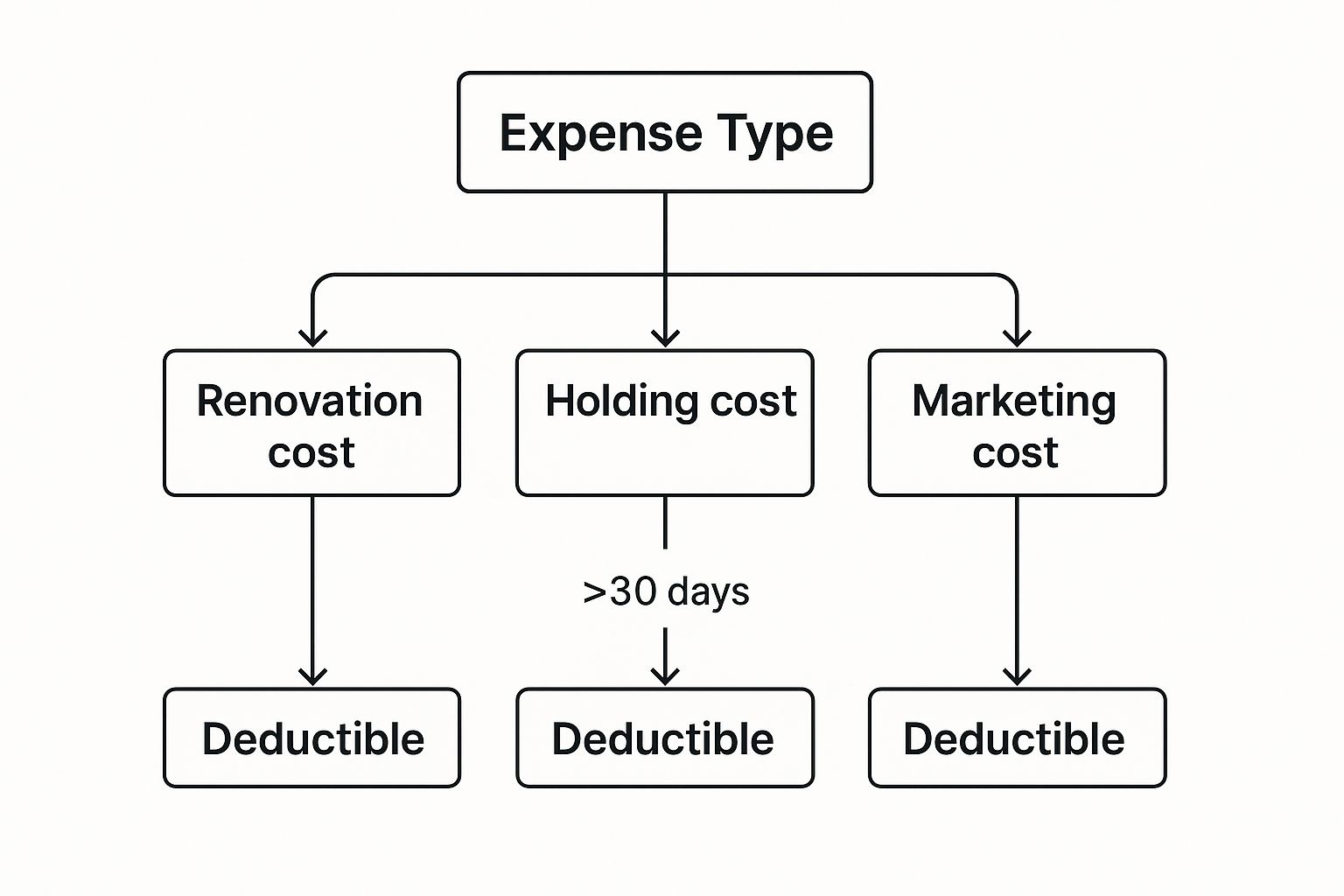
As you can see, costs for renovations, marketing, and holding the property are typically deductible, which reinforces the idea that flipping is treated as a business activity.
The Tax Consequences: Investor vs. Dealer
So, why does this label matter so much? It all comes down to the money. The tax treatment for an investor and a dealer are worlds apart, and the difference directly hits your bottom line.
Being classified as a dealer means your profits are hit with both ordinary income tax AND self-employment taxes. This is the double-whammy that catches so many flippers off guard. Self-employment tax covers your Social Security and Medicare contributions (a combined 15.3% on the first chunk of your earnings) that you have to pay as a business owner.
An investor, however, often gets a much better deal. If you hold a property for more than a year, your profit is typically taxed at the much lower long-term capital gains rates. Depending on your total income, these rates are 0%, 15%, or 20%. Even better, investors don't pay any self-employment tax on that profit.
Let's break it down with a quick example.
Scenario A: Dealer
You clear a $50,000 profit on a flip. That money is subject to your regular income tax rate plus the 15.3% self-employment tax.
Scenario B: Investor
You make that same $50,000 profit, but you held the property for 13 months. Now, that profit is only subject to long-term capital gains rates, and you pay zero self-employment tax. The savings here could easily be thousands and thousands of dollars.
Figuring out your likely classification is the first step to getting a handle on your house-flipping taxes. It impacts every decision you make—from how long you hold a property to how you structure your business—and it's absolutely essential for building a profitable, sustainable career in this industry.
The Two Main Taxes Flippers Cannot Ignore

Once the IRS decides you're operating as a "dealer," your tax situation gets very real, very fast. Your profit is hit by two major taxes that can take a serious bite out of your bottom line. Getting a handle on these isn't just a good idea—it's absolutely essential for anyone serious about making money flipping houses.
Think of them as the final hurdles you have to clear. Let's break down exactly what they are and how they work.
Ordinary Income Tax
First up is ordinary income tax. This one is pretty straightforward. Any net profit you make from a flip is simply added to your other income for the year, like the salary from your 9-to-5.
Imagine your income is a big bucket. Your day job salary fills it up to a certain level. When you close on a successful flip, that profit gets poured right in on top. The whole amount is then taxed based on the standard federal and state brackets, which can climb as high as 37% at the federal level alone.
This is a world away from how other investments are treated. A long-term stock investor might get a break with lower capital gains rates, but the IRS views a house flipper as an active business owner. That’s why a $50,000 gross profit can seem to evaporate once your highest marginal tax rate is applied. It's also why you must track every single expense to get that taxable profit figure as low as legally possible. You can get a deeper dive into these differences by understanding capital gains taxes and what you need to know for 2024.
The Self-Employment Tax Squeeze
The second tax, self-employment tax, is the one that blindsides a lot of new flippers. It’s basically how the government collects Social Security and Medicare taxes from people who work for themselves.
If you have a traditional job, you pay half of these FICA taxes (7.65%), and your company pays the other half. But when you’re flipping houses, you’re the boss. The IRS sees you as both the employee and the employer, which means you’re on the hook for both halves.
This results in a flat 15.3% self-employment tax on your net flipping profits (up to an annual limit). This is on top of your regular income tax. It's a powerful one-two punch that can dramatically shrink what you actually take home.
This tax treatment shows that the government views frequent flipping as a full-fledged business. In fact, some places are even cracking down on it. The Canadian province of British Columbia, for example, is rolling out a new house-flipping tax in 2025 that slaps a 20% rate on profits from homes sold within a year.
A Real-World Tax Example
Let's walk through a simplified example to see what this looks like in the real world.
Suppose you clear a net profit of $50,000 on a flip. We'll also assume you're in the 24% federal tax bracket and your state has a 6% income tax.
Here’s a rough breakdown of your house flipping taxes:
-
Self-Employment Tax: First, we calculate the FICA equivalent.
- $50,000 Profit x 15.3% = $7,650
-
Income Tax: Next up are your federal and state obligations.
- $50,000 Profit x 24% (Federal) = $12,000
- $50,000 Profit x 6% (State) = $3,000
-
Total Tax Bill: Now, we add it all together.
- $7,650 (Self-Employment) + $12,000 (Federal) + $3,000 (State) = $22,650
Just like that, your $50,000 profit is down to $27,350. In this case, more than 45% of your earnings went straight to taxes. This makes one thing painfully clear: without a solid plan to maximize your deductions, you could be working twice as hard for half the pay.
Your Ultimate Checklist of Tax Deductions
After watching taxes take a huge bite out of your profit, you quickly learn that maximizing your deductions is the name of the game. Every single deductible expense acts like a shield, legally protecting your hard-earned cash from the IRS. This isn't about finding sketchy loopholes; it's about being a savvy business owner who tracks everything meticulously.
A solid tax strategy for flipping hinges entirely on one thing: good records. Every receipt, every invoice, every bank statement is your proof. Ditch the old shoebox full of crumpled papers—get a receipt-scanning app and digitize everything on the go. Trust me, staying organized from day one is what separates the pros from the amateurs.
To make things simple, you can group almost every dollar you spend on a flip into four main buckets. Thinking this way helps you track expenses as they happen and makes sure nothing gets missed.
Acquisition Costs
These are all the upfront costs you pay just to get the keys to the property. Think of them as the price of admission before you even pick up a sledgehammer. Most of these pop up on your settlement statement at closing, so they're pretty easy to spot.
- Attorney and Escrow Fees: Paying the pros to handle the paperwork and make sure the title is clean.
- Inspection and Appraisal Fees: The money you spend to figure out what the house is really worth and what problems you're inheriting.
- Title Insurance: Your protection against any nasty surprises, like old liens or ownership claims.
- Property Survey Costs: The fee to have someone officially map out your property lines.
Improvement and Repair Costs
This is where the real money gets spent. This category covers everything you do to boost the property's value, from the foundation to the rooftop. It’s the direct cost of taking a house from "before" to a market-ready "after," and tracking it perfectly is non-negotiable.
You've got your big-ticket items here, but don't forget the small stuff—it adds up fast. It helps to know the typical costs for common projects, like the cost to remodel a shower, since these are all standard deductions.
Your biggest expenses will likely include:
- Materials and Supplies: Every 2×4, gallon of paint, light fixture, and appliance you buy.
- Labor and Contractor Fees: What you pay your plumbers, electricians, roofers, and other skilled trades.
- Permit Fees: The cost of keeping the city happy and ensuring your work is done to code.
- Landscaping Costs: The money you spend on curb appeal—new sod, mulch, plants—that helps the house sell.
Holding Costs
These are the sneaky costs that bleed your budget dry while you own the property. From the day you close the purchase to the day you close the sale, these expenses are ticking away. A project that drags on can get very expensive, very fast, but at least every penny is a deduction.
Think of holding costs as the "rent" you pay on your inventory. Even though you own the house, it's costing you money every single day it sits. Tracking these monthly bills is absolutely crucial.
Common holding costs include:
- Property Taxes: The prorated share of taxes you owe the local government for the time you own the property.
- Insurance: Your builder's risk or vacant home insurance policy premiums.
- Utilities: The lights, water, and gas needed to keep the project going.
- Loan Interest and Points: All the interest you pay on your hard money or conventional loan is a major deduction.
Selling Costs
Finally, these are the costs you pay to get the property off your books and turn it into cash. They’re the final hurdle between you and your profit.
You can expect to see:
- Real Estate Agent Commissions: Usually the biggest expense, typically running 5-6% of the sale price.
- Staging Costs: The fee to furnish the home so buyers can picture themselves living there.
- Advertising and Marketing Fees: Paying for professional photos, online listings, and flyers.
- Seller's Closing Costs: Your share of the fees to finalize the sale, which can include things like transfer taxes or attorney fees.
To help you stay on top of it all, here is a quick-reference table organizing these common deductions.
Common House Flipping Tax Deductions by Category
| Expense Category | Examples of Deductible Items | Record-Keeping Tip |
|---|---|---|
| Acquisition Costs | Attorney/Escrow Fees, Inspection Fees, Appraisal Fees, Title Insurance, Property Survey Costs | Keep your final closing settlement statement in a dedicated folder. It lists most of these costs clearly. |
| Improvement & Repair | Building Materials, Contractor Labor, Permit Fees, Landscaping, Appliances, Fixtures, Paint, Flooring | Use a separate bank account or credit card for the project. It makes tracking renovation spending much easier. |
| Holding Costs | Property Taxes, Insurance Premiums, Utilities (electric, water, gas), Loan Interest, HOA Fees | Set up a spreadsheet to track these recurring monthly expenses. Log them as soon as you pay the bill. |
| Selling Costs | Real Estate Agent Commissions, Staging Fees, Seller-Paid Closing Costs, Marketing/Ad Costs | Your final selling settlement statement is key here, but also keep separate invoices for staging and marketing. |
By diligently tracking every expense in these four categories, you're not just doing bookkeeping—you're building a powerful defense against a massive tax bill. For a more exhaustive list, be sure to check out our detailed guide on tax deductions for real estate investors.
Smart Strategies to Lower Your Tax Bill

Knowing your deductions is like playing good defense—it stops you from overpaying. But the real pros know how to play offense, too. This means proactively using strategies to shape your tax outcome from day one, not just reacting when the bill comes.
These methods take some planning and a bit of foresight, but the payoff can completely transform the profitability of a project. Let's walk through three of the most powerful strategies you can use to significantly reduce your house flipping taxes.
The Hold and Wait Strategy
Sometimes, the simplest move is the most effective. In the world of house flipping taxes, that move is often just a game of patience. If you can hold onto your property for more than one year, you can potentially shift your profit from being taxed as ordinary income to the much lower long-term capital gains rates.
Just how big is the difference? It's huge. Your tax rate could plummet from as high as 37% all the way down to 0%, 15%, or 20%, depending on your income bracket. For a flip with a healthy profit, we're talking about a move that can easily save you tens of thousands of dollars.
Of course, it’s not a free lunch. Holding a property longer means more carrying costs—more insurance payments, property taxes, and mortgage interest. The market could also shift while you wait. You have to run the numbers and weigh the potential tax savings against these very real risks.
Forming a Business Entity
Going it alone as a sole proprietor is simple, but it’s like driving without insurance. It leaves your personal assets on the line and gives you very little room to maneuver on taxes. Structuring your flipping business as a Limited Liability Company (LLC) or an S Corporation builds a financial and legal firewall around your work.
An LLC, first and foremost, separates your personal life from your business life, which is critical if something goes wrong. Tax-wise, it’s incredibly flexible. By default, the profits "pass through" to your personal return, but you can also elect to have it taxed as an S-Corp, which unlocks a major tax-saving opportunity.
Why an S-Corp Election Matters: When you choose S-Corp status, you can split your income. You pay yourself a "reasonable salary," and then you take the rest of the profit as a distribution. Here's the kicker: only the salary is hit with the 15.3% self-employment tax. The distributions are not. For a busy flipper, this can lead to massive savings on Social Security and Medicare taxes.
Yes, there are setup costs and some extra paperwork involved in maintaining a business entity. But for anyone doing more than one or two flips, the protection and tax benefits are almost always worth it.
Using a 1031 Exchange
The 1031 Exchange is one of the most powerful wealth-building tools in the real estate investor's entire toolkit. Think of it as hitting the pause button on your tax bill. It allows you to sell a property and "roll" all the proceeds directly into another "like-kind" property, deferring the capital gains tax you would have owed.
Executing a 1031 exchange requires following some very strict rules:
- Identify a Replacement Property: You have just 45 days from the date you sell your property to officially identify the next property (or properties) you plan to buy.
- Close on the New Property: The clock is ticking. You must close on that new property within 180 days of selling the first one.
- Use a Qualified Intermediary: You can't touch the money from the sale. The funds must be handled by a neutral third-party—a qualified intermediary—who manages the transaction for you.
A 1031 exchange lets you keep your capital working for you, growing your portfolio with what is essentially an interest-free loan from the IRS. This is a long-term play, ideal for investors committed to continuously reinvesting. It’s not a DIY project, though; you'll need expert guidance to navigate the rules correctly.
With flipping margins getting tighter, every dollar you can save counts. High acquisition costs have squeezed profitability, and according to one report, the average gross profit on a flip has dropped significantly. You can read the full report on flipping profit margins on latimes.com to see just how much high prices are impacting investors. Choosing the right strategy—whether it's holding longer, incorporating, or deferring gains—is no longer just a good idea; it's essential to protecting your bottom line.
Frequently Asked Questions About House Flipping Taxes
When you're deep in the trenches of a flip, thinking about taxes can feel like the last thing you want to do. But getting these details right is what separates a profitable venture from a costly mistake. Let's break down some of the most common questions that trip up both new and seasoned flippers.
Do I Really Need to Pay Estimated Taxes?
Yes, absolutely. This is a non-negotiable for anyone serious about flipping. When you flip houses as a business, the IRS views you as self-employed. That means you can't just wait until April to settle your tax bill.
You're required to pay as you go through estimated tax payments, which are typically due four times a year. These payments cover both your regular income tax and your self-employment taxes (think Social Security and Medicare). Ignoring this can lead to some nasty underpayment penalties, so it's a critical piece of your cash flow management.
Pro Tip: Don't get caught off guard. As soon as a property goes under contract, talk to your accountant. They can help you project your profit and calculate how much you need to set aside for your next quarterly payment.
What if I Live in the House While I Renovate It?
It's a tempting thought, right? Move into the property, fix it up, and then sell it, hoping to cash in on the primary residence exclusion. This incredible tax break lets you exclude up to $250,000 in profit (or a whopping $500,000 if you're married) from taxes.
But here’s the catch: the rules are iron-clad. To qualify, you must have owned and used the home as your main residence for at least two of the five years just before you sell it.
For a house flipper, that timeline is almost always a deal-breaker. Most flips are done and dusted in a matter of months, not years. So, while you can definitely live on-site, you almost certainly won't meet the two-year residency test. The profit will still be taxed as regular business income.
How Do I Handle a Flip That Ends Up Losing Money?
Not every project is a home run. Sometimes the market turns, or you uncover a nightmare repair that blows your budget. The silver lining is that a financial loss on a flip can often soften the blow on your tax return.
If you’re operating as a real estate "dealer" (the typical classification for a flipper), your loss is considered an ordinary business loss. This is actually much better than a capital loss.
Here's the difference:
- No Cap: You can deduct the entire loss against other income you have, like a W-2 salary or profits from another successful flip.
- More Power: Unlike capital losses, which are capped at $3,000 per year against ordinary income, there's no such limit here.
Let's say you lost $20,000 on a tough project but earned $80,000 from your day job. You can use that full loss to knock your taxable income down to $60,000. To make this work, you need meticulous records of every single expense—that paperwork is your proof.
Can I Pay Myself for My Own Labor and Deduct It?
Many flippers roll up their sleeves and do a ton of the work themselves. It's natural to wonder if you can deduct the value of all that "sweat equity."
The answer, unfortunately, is no. The IRS doesn't let you put a price tag on your own time and then write it off as a business expense. Your reward for that labor comes in the form of a higher net profit when you sell. The real financial benefit of doing the work yourself is simply keeping more cash in your pocket by not having to hire it out.
Juggling the demands of a flip is hard enough without having to become a tax expert overnight. At Allied Tax Advisors, our team of experienced CPAs and enrolled agents lives and breathes real estate tax strategy. We specialize in helping flippers like you find every legal deduction, stay compliant, and structure your business for maximum tax efficiency. Stop guessing and start protecting your hard-earned profits. Contact Allied Tax Advisors today to see how we can help.