
So, you've realized you made a mistake on a past tax return. Don't panic. The IRS gives you a window to make things right, but it's not open forever. For most people, the key number to remember is three.
The IRS Three-Year Rule for Amending Taxes

Generally, you have three years from the date you filed your original tax return to file an amendment and claim a refund or credit. Think of this as the standard "return policy" for your taxes. It's the primary statute of limitations the IRS uses, and it's the rule that applies to most common scenarios.
But when does that three-year clock actually start ticking? It's not always the day you hit "submit."
How the Timeline Works
If you're an early filer who gets your taxes done well before the April deadline, the IRS gives you a little extra grace. The clock doesn't start on your early filing date. Instead, it starts on the official tax deadline for that year (usually April 15th).
This policy ensures everyone gets at least a full three years. For example, let's say you filed your 2023 tax return on March 1, 2024. The three-year countdown would begin on the tax deadline, April 15, 2024. This gives you until April 15, 2027, to submit a Form 1040-X for that specific tax year.
The three-year rule is your foundational guide. It provides a clear and consistent deadline for the most common amendment scenarios, such as correcting income, dependents, or filing status.
To give you a quick reference, here’s a simple breakdown of the standard deadlines.
Standard Tax Amendment Deadlines at a Glance
| If You Filed Your Return… | Your Deadline to Amend Is… |
|---|---|
| On or before the tax deadline (e.g., April 15) | 3 years from the original tax deadline |
| After the tax deadline (with an extension) | 3 years from the date you actually filed |
This table covers the most frequent situations you'll encounter.
This three-year window is the first and most important timeline to understand. It covers most corrections, but it's not the only rule on the books. As we'll explore, certain situations can change this deadline. If you want to dive deeper into the basics, check out our guide on what an amended tax return entails. Knowing these timelines is the critical first step to fixing a past mistake and possibly getting a refund you deserve.
When The Three-Year Rule Doesn't Apply
While the three-year rule is a great guideline, it's not the final word on how far back you can amend taxes. The tax code has several important exceptions that can dramatically extend your filing window. Think of them as special provisions for unique, and often more complicated, financial situations.
These exceptions exist because the standard timeline just isn't enough for certain issues. For instance, figuring out that a business loan has gone bad or an investment is officially worthless can take a long time. The same goes for sorting out foreign tax credits. Knowing if your situation fits into one of these categories is key to getting back money you're rightfully owed.
This infographic breaks down the typical amendment deadlines and shines a light on these key exceptions.
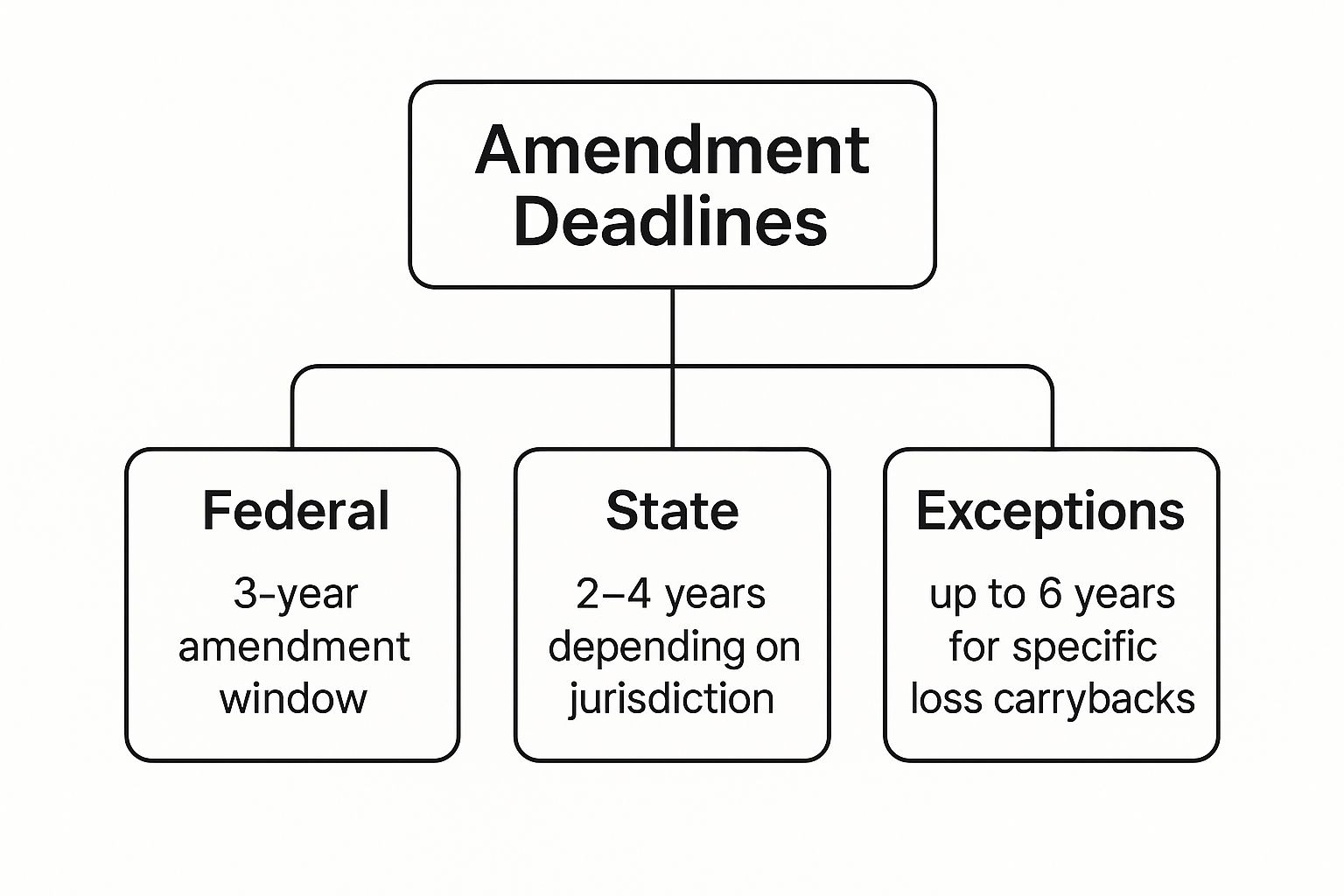
As you can see, the three-year federal window is the starting point, but other rules can give you much more time—sometimes up to ten years.
Extended Timeframes for Specific Situations
One of the biggest exceptions is the six-year statute of limitations. This extended period kicks in if you accidentally left off more than 25% of your gross income on your original return. For example, if you earned $100,000 but only reported $70,000, the IRS gets six years to follow up. This six-year rule also applies if you didn't report over $5,000 in income from foreign sources.
Other situations give you even more time:
- Bad Debts or Worthless Securities: You have seven years to file a claim for a loss from a bad debt or from a stock or other security that became worthless. So, if that promising startup you invested in finally went under, you have a generous seven-year window to go back and claim that loss.
- Foreign Tax Credits: The timeline stretches to a full ten years if you need to claim or adjust a credit for taxes you paid to another country.
It's crucial to know that there is no statute of limitations if you never filed a return in the first place, or if the IRS determines your return was fraudulent.
These rules create a vital safety net for complex financial events that might take years to fully play out. To dig deeper into these specific statutes and see how they might apply to your tax records, you can review these tax planning guidelines.
Understanding the Two-Year Payment Rule
While the three-year rule is all about when you filed your return, there’s another critical deadline that focuses on when you paid the tax. The IRS gives you a second window: you can file a claim for a refund within two years from the date the tax was paid.
Think of this "two-year payment rule" as a valuable safety net. It really comes into play when its deadline falls later than the three-year filing deadline, giving you an alternative path to claim a refund.
So, when does this actually happen? It’s most common for people who filed on time but couldn't pay their tax bill right away. This often happens if you've been on an IRS payment plan or paid a tax assessment that came out of an audit.
How the Payment Rule Works in Practice
Let’s walk through a real-world example. Imagine you filed your 2020 tax return on time in April 2021 but couldn't cover the full balance. You arranged a payment plan with the IRS and made your final payment on June 1, 2023.
Here’s how the two deadlines would stack up:
- Three-Year Rule: The clock for this one would run out on April 15, 2024 (three years from the original filing deadline).
- Two-Year Rule: This deadline would be June 1, 2025 (two years from your final payment date).
The IRS lets you use whichever deadline gives you more time. In this scenario, the two-year payment rule provides an extra 13 months to amend that 2020 return and get your money back.
This is a perfect illustration of why knowing how far back you can amend taxes is about more than just one date on a calendar. Understanding both timelines is crucial so you don’t accidentally leave a refund on the table, especially if you’ve had to pay your taxes over time.
Of course. Here is the rewritten section, designed to sound natural and human-written, as if from an experienced tax professional.
Why State Amendment Rules Are Different
It’s one of the most common—and costly—assumptions taxpayers make: thinking that state tax rules just mirror what the IRS does. When you’re trying to figure out how far back you can amend taxes, this belief can get you into trouble. While the feds give us a consistent set of rules, each state is its own separate taxing authority. That means its own laws, its own deadlines, and its own procedures.
So, that three-year window you have for your federal return? It might not apply to your state at all. Some states stick close to the IRS timeline, but others might give you four years or even less. The only way to know for sure is to check the statute of limitations on your specific state's department of revenue website. Don't guess.
The Critical Federal-State Connection
Here's the most important thing to remember: if you amend your federal return and it changes your adjusted gross income (AGI), you almost certainly have to file an amended state return, too. Think of your AGI as the foundation of your state tax calculation. When that foundation shifts, everything built on top of it shifts as well.
Let's say you file a Form 1040-X because you found a big deduction you forgot to take. This lowers your federal AGI. Because your state return started with that original, higher AGI, your state taxable income is now wrong. You're probably due a refund from the state, but if you don't file, you're just letting them keep your money.
A change to your federal return doesn't automatically update your state filing. You must proactively file a separate state amended return to stay in compliance and claim any potential refund.
For instance, California's Franchise Tax Board generally gives you four years to file an amended return for a refund. If you amend your 2021 federal return in early 2024, you're still well within California's window to amend your state return for that same year. But if that change meant you actually owed more tax and you didn't file the state amendment, you could be looking at penalties and interest down the road.
The bottom line is to treat federal and state amendments as two separate, but deeply connected, tasks.
So, you've figured out the deadlines for amending your taxes. That's the first hurdle. Now, it’s time to actually get it done. The key to this whole process is a specific document: Form 1040-X, Amended U.S. Individual Income Tax Return.
Think of this form as your official way of raising your hand and telling the IRS, "Hey, I need to make a correction." It's what you'll use to fix an error, claim a deduction you missed, or even change your filing status after the fact.

At first glance, Form 1040-X might look a little intimidating, but it’s laid out logically. You’ll essentially show the IRS three things: the numbers from your original return, the new corrected numbers, and the difference. It's a simple before-and-after comparison.
One of the most important parts, though, is the written explanation. You have to provide a clear, straightforward reason for every change. This isn't the place for a novel—just get straight to the point. For example, a simple note like, “Forgot to report interest income from a 1099-INT form” or “Now claiming the student loan interest deduction” is perfect.
What You Need To Get Started
Getting your ducks in a row before you start filling out the form will save you a world of headache. To help you prepare, we've put together a checklist of what you'll need. For a deeper dive into every step, our complete guide on how to amend a tax return has you covered.
Before you begin, gather the following items. Having everything handy makes the process much smoother.
Your Amended Return (Form 1040-X) Checklist
| Document or Information | Why You Need It |
|---|---|
| A copy of your original tax return | This is your baseline. You can't calculate the changes without knowing where you started. |
| New or corrected documents | This could be a corrected W-2, a 1099 you forgot, or any other form that triggered the amendment. |
| Proof to support your changes | If you're adding a deduction, have the receipts. If you're claiming a credit, have the necessary forms. |
Having these documents ready will help ensure your amended return is accurate and complete.
Good news! For recent tax years, the IRS now lets you e-file Form 1040-X. This is a huge step up from the old mail-in-only system—it’s faster, more secure, and frankly, just easier for everyone involved.
Once you've sent your amended return on its way, you won't be left in the dark. The IRS has a handy "Where's My Amended Return?" tool online. Just give it about three weeks after you file, and then you can start tracking its progress through the system.
Common Questions About Amending Your Taxes
Even when you know the rules, theory and practice are two different things. When you're staring at a past return and wondering how far back you can amend taxes, a bunch of practical questions are bound to pop up. Is this tiny error even worth fixing? How long will this take?
Let's walk through some of the most common questions people have. The goal here is to give you the confidence to move forward.
First up: how long does this whole process take? The short answer is, you’ll need some patience. The IRS officially states that processing a Form 1040-X can take up to 20 weeks, and sometimes even longer. The good news is you don't have to wait in the dark. You can start checking on your filing using the "Where's My Amended Return?" tool on the IRS website about three weeks after you send it in.
Another frequent dilemma is deciding if a very small mistake is worth the trouble of amending. For the most part, the answer is no. The IRS usually catches and corrects minor math or clerical errors on its own. If a mistake only shifts your tax bill by a few dollars, the time and effort to file an amendment probably isn't worth it.
What If My Amended Return Shows I Owe More?
This is the scenario that gives everyone a little bit of anxiety, but tackling it is surprisingly straightforward. If you realize you owe more tax, you should file your Form 1040-X and pay what you owe right away.
Moving quickly is your best defense against mounting interest and potential penalties.
The IRS will bill you for any interest owed, which starts accruing from the original tax deadline of the return you are amending, not from the date you file the amendment.
This is just one of many situations that can arise. To learn more, check out our guide on common tax filing mistakes to avoid and how to fix them. Understanding these potential pitfalls ahead of time can make the entire process much smoother and less stressful.
Navigating amended returns, whether you owe more or are due a refund, requires careful attention to detail. The team at Allied Tax Advisors has decades of experience helping individuals and businesses manage every aspect of their financial journey, from simple filings to complex resolutions. Visit us at https://alliedtax.com to see how our personalized service can bring you peace of mind.