
That sinking feeling in your stomach right after you’ve filed your taxes and realize you made a mistake? It’s a classic. But before you panic and start filling out more forms, take a breath. Not every slip-up actually requires you to file an amended return.
Knowing when to act—and when to just let it be—can save you a ton of paperwork and keep your return from getting stuck in an IRS processing jam. The big question you need to ask yourself is simple: does this mistake change the amount of tax I owe or the refund I’m getting? If the answer is yes, you’ll likely need to amend.
Deciding When to Amend Your Tax Return
Scenarios That Demand an Amendment
Some mistakes are just too significant to ignore. These are the kinds of errors that directly affect your bottom line—your adjusted gross income (AGI), your tax credits and deductions, or your total tax bill. In my experience, these are the most common reasons people need to file a Form 1040-X.
You absolutely need to file an amendment if you find out you:
- Got your income wrong. This happens all the time. Maybe you forgot about that side gig and the 1099-NEC that came with it. Or perhaps your employer sent a corrected W-2 after you’d already filed. Underreporting your income is a red flag for the IRS and can result in penalties and interest, so it’s always best to get ahead of it.
- Used the wrong filing status. Let’s say you filed as Single but then discovered you actually qualified for Head of Household, which offers a bigger standard deduction and better tax brackets. An amendment here could mean a much larger refund.
- Overlooked major tax breaks. Did you pay for college tuition and forget to claim the American Opportunity Tax Credit? Or maybe you had a pile of medical bills you didn’t realize were deductible. Amending your return is the only way to claim those missed deductions and credits and get back the money you’re owed.
For instance, I once had a client who received an unexpected 1099-MISC in March for a consulting project she’d finished the previous year. Since that income wasn’t on her original return, she had to amend to report it and pay the income and self-employment tax. If she’d ignored it, she would have eventually received a notice from the IRS, but with interest and penalties attached.
The Bottom Line: You amend your return to fix mistakes that change your tax calculation. If the error has a real financial impact, Form 1040-X is your next step.
When You Should Not File an Amended Return
On the flip side, filing an amendment for a minor hiccup can actually cause more problems than it solves. It can create confusion and slow everything down.
So, you can put the pen down for these kinds of issues:
- You made a simple math mistake. The IRS computers are built for this. They will almost certainly catch a small arithmetic error, correct it for you, and send a notice explaining the change. No need for you to do anything.
- You forgot to attach a form. If you left out a W-2 or another required schedule, don’t file an amendment. The IRS will just send a letter asking for the missing document. Simply send them what they need and you’re done.
For these minor issues, it’s much more efficient to just wait. Let the IRS process your original return and contact you if they need something. This keeps you from creating a duplicate filing that could gum up the works and cause unnecessary delays.
Key Deadlines and Processing Timelines You Need to Know

The moment you realize you need to amend a tax return, the first question that usually pops into your head is, “Is it too late?” It’s a great question. The IRS has very specific time limits, what they call statutes of limitations, and knowing them is everything. If you miss the window, you could lose out on a refund you’re entitled to.
The Three-Year Rule of Thumb
The most critical deadline to have on your radar is what we often call the “three-year rule.” The general guideline is this: you have three years from the date you originally filed, or three years from the tax filing deadline for that year (whichever is later), to submit a Form 1040-X and claim a refund.
Here’s a practical example. Say you filed your 2022 tax return early, on March 15, 2023. The official due date for that return was April 18, 2023. In this case, your three-year clock starts from the later date—April 18, 2023. That gives you until April 18, 2026, to file an amendment for your 2022 return.
What About the Two-Year Rule?
Things get a little more nuanced with a second timeline, known as the “two-year rule.” You can also file for a refund within two years from the date you actually paid the tax, if that date is later than the three-year deadline.
When does this come into play? It’s most common for people who paid their tax bill late. Imagine you filed your 2022 return on time in April 2023 but couldn’t pay the amount owed until June 2024. If you later find an error that entitles you to a refund, this two-year rule gives you until June 2026 to file your Form 1040-X.
The IRS gives you the benefit of the doubt here, letting you use whichever rule—the three-year or the two-year—gives you the most time.
Once You’ve Filed: The Waiting Game
After you’ve sent your Form 1040-X on its way, whether by mail or electronically, it’s time to be patient. Very patient. Under normal conditions, the IRS says to expect processing to take up to 20 weeks or more.
You can check on its progress using the IRS’s “Where’s My Amended Return?” tool online. Just know that your information won’t even show up in their system for at least three weeks after you file.
A few things can really stretch out this timeline:
- How you filed: E-filing is usually quicker, but paper returns take significantly longer to get through the system.
- The complexity: A simple fix, like a missed deduction, will process faster than an amendment that touches multiple schedules and complex calculations.
- Mistakes on the form: Any errors or missing details on your 1040-X will get it flagged and sent to the back of the processing queue.
The IRS is an agency that processes millions of documents weekly, especially during tax season. That sheer volume, which you can see in the annual IRS filing season statistics, creates backlogs that inevitably slow down everything else, including amended returns. Think of amending your return as a marathon, not a sprint. Knowing what to expect makes the whole process a lot less stressful.
My Two Cents: Seriously, don’t rush to file your Form 1040-X. The single biggest mistake I see people make is filing an amendment before their original return has even finished processing. If you haven’t received your initial refund or paid your tax bill yet, just wait. Filing too soon can confuse the IRS systems and lead to massive delays.
A Practical Walkthrough of Amending Federal Taxes
Alright, let’s get down to the nitty-gritty of actually amending your federal tax return. While it might sound daunting, the whole process boils down to one key document: Form 1040-X, Amended U.S. Individual Income Tax Return. Don’t think of it as starting from scratch. Instead, see it as a “correction report” for the IRS, showing them exactly what changed and why.
But before you even touch that form, you need to gather your paperwork. It’s all about preparation.
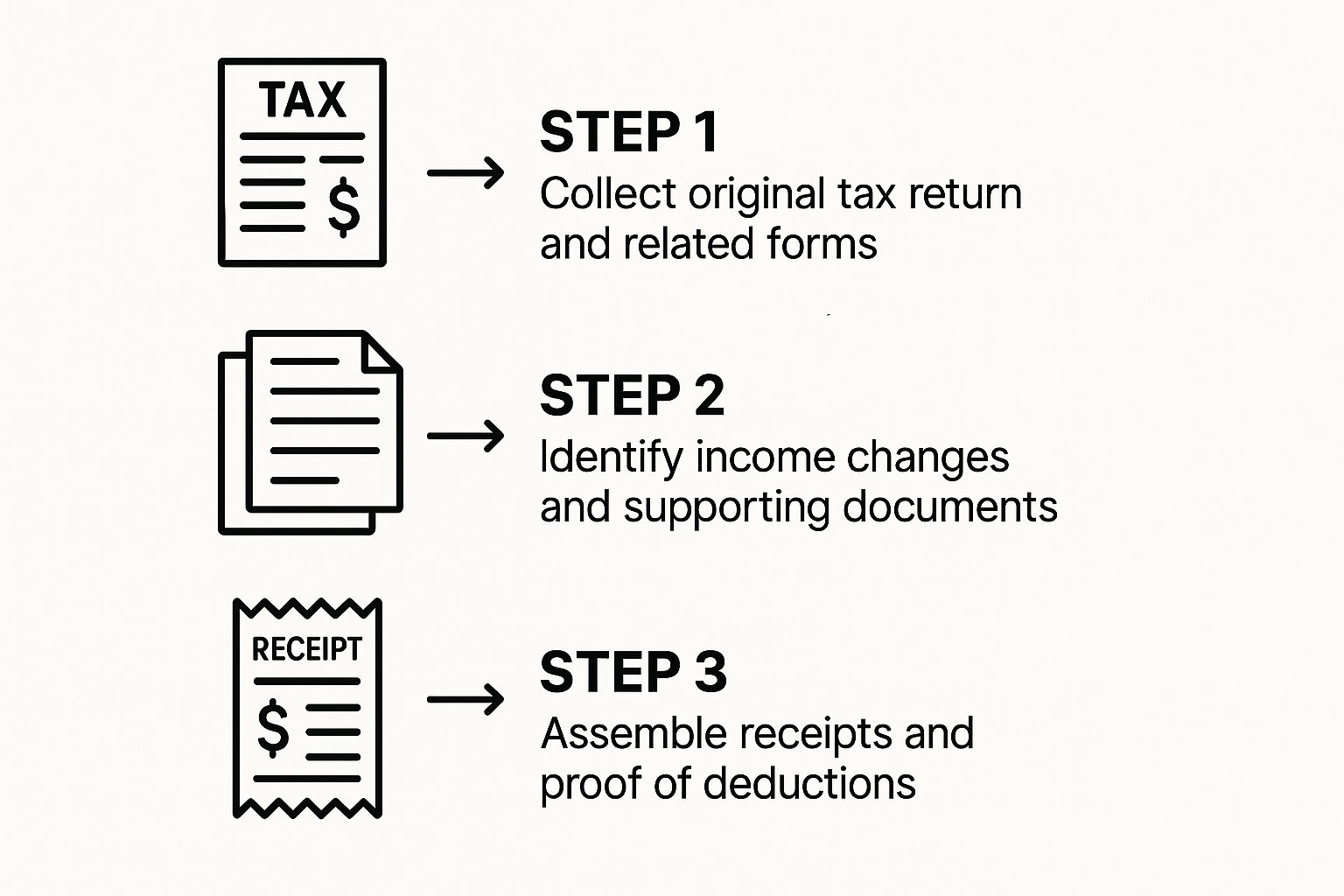
Starting with a copy of your original return and having all the new documents ready makes this process infinitely smoother.
Understanding the Logic of Form 1040-X
The real key to conquering Form 1040-X is understanding its three-column layout. The entire form is designed to create a clear, side-by-side comparison for the IRS agent reviewing your file. Once this clicks, the rest is easy.
- Column A: Original Amount. This is your starting point. You’ll pull these numbers directly from the tax return you already filed.
- Column B: Net Change. Here’s where you show your math. This column is for the difference—positive or negative—between your original figures and the new, correct ones. If you found a W-2 with $5,000 in income you forgot, you’d enter
+$5,000here. - Column C: Correct Amount. This is the final answer. Just add or subtract Column B from Column A to show the numbers as they should have been.
I had a client once who realized after filing that they’d missed a $10,000 charitable donation. For their 1040-X, their original itemized deduction amount went in Column A. In Column B, we entered $10,000. And Column C showed the new, higher total for their itemized deductions. It’s a simple, logical story of what happened.
Navigating the Form and Attaching Your Proof
Beyond those three main columns, a couple of other sections are absolutely critical. Right at the top of the form, you have to check the box for the tax year you’re amending. It seems obvious, I know, but you’d be surprised how many people forget this, leading to major processing delays.
You’ll also find a section on Part III for a written explanation. You need to be concise but specific. “Made a mistake” isn’t going to cut it. A better explanation is something like, “Forgot to include Form 1099-INT from XYZ Bank” or “Now claiming the Child and Dependent Care Credit, with Form 2441 attached.”
Expert Tip: Never, ever send a Form 1040-X by itself if your changes involve other tax forms. If you’re adding a capital gain, you must attach a corrected Schedule D. If you’re adding business income, you have to include a new Schedule C. Think of your 1040-X as the cover letter and the corrected forms as the crucial evidence.
E-Filing vs. Snail Mail: Which Is Right for You?
For years, amending a return meant printing everything out and heading to the post office. Thankfully, things have gotten a lot easier. The IRS now accepts e-filed amended returns for tax year 2019 and later, which is a game-changer for most people.
So, how do you decide?
- E-Filing: If you used tax software for your original return, this is your best bet. The software will walk you through creating the 1040-X and usually pre-fills a lot of the original info for you. It’s fast, efficient, and you get a quick confirmation that it’s been received.
- Paper Filing: For older tax years (before 2019) or for some really complex situations, you’ll have to file a paper copy. If you go this route, I always tell my clients to send it via certified mail with a return receipt. That piece of paper is your proof that the IRS got it, which can be a lifesaver if your amendment gets lost in their system.
One final, important caution: if the IRS sends you a notice about an error—like a CP2000 notice proposing changes to your return—hold off on filing a 1040-X right away. It’s usually much better to respond directly to that specific notice first. Filing an amendment can cross wires and create a confusing record with the IRS. To learn more, check out our guide on what to do if you receive an IRS CP2000 notice.
How to Handle State Tax Return Amendments

Successfully amending your federal return is a huge milestone, but your work probably isn’t over. One of the most common oversights I see people make is forgetting about their state tax return. If the changes on your federal Form 1040-X affect your income, deductions, or credits, they almost certainly impact your state tax liability as well.
Ignoring this is a classic mistake. State revenue departments talk to the IRS, and a mismatch between your federal and state filings is a red flag that can easily trigger a notice, leading to potential penalties and interest. Every state has its own rulebook, its own forms, and its own procedures, creating a complex web that can feel pretty overwhelming.
The State Amendment Domino Effect
Think of your federal return as the first domino. When it changes, it almost always tips over the state return right behind it. This is because most states use your federal Adjusted Gross Income (AGI) as the starting point for their own tax calculations. So, if your AGI went up or down on that 1040-X, you can bet your state return needs a second look.
The key is to be proactive. As soon as you confirm a federal amendment is necessary, start looking into your state’s process. Don’t wait for the IRS to fully process your 1040-X. State deadlines can be different, and you don’t want to risk missing your window to file.
Navigating the Maze of State-Specific Rules
This is where things get tricky. Unlike the IRS with its universal Form 1040-X, there’s no standardized process for state amendments. Some states have a dedicated “X” form, but many others have their own unique methods.
For instance, the process in Pennsylvania is completely different. You don’t use a separate amendment form. Instead, you have to file a corrected version of the original tax year’s return (like the PA-40), but you must clearly mark an oval to designate it as an “AMENDED RETURN.” On top of that, you have to attach a Schedule PA-40X to explain the changes. You can find all the details on the Pennsylvania Department of Revenue’s tax guide.
This just goes to show you can’t assume one state’s process is anything like another’s.
Expert Tip: Your first stop should always be your state’s Department of Revenue website. Search for terms like “amend return,” “amended tax form,” or “correct a return.” This will usually get you to the right forms and instructions for the specific tax year you need to fix.
Your Game Plan for a Smooth State Amendment
To make sure your state amendment goes off without a hitch, it pays to be methodical. Here’s a rundown of what you need to do:
- Find the Right Form: The first, most critical step. Locate the correct amendment form or procedure for your state and the specific tax year you’re correcting. Forms change, so don’t grab the newest one by default.
- Gather Your Paperwork: You’ll absolutely need a copy of your original state tax return and your completed federal Form 1040-X. The federal amendment is the foundation for the state changes, and many states require you to attach a full copy of it.
- Complete the State Form Meticulously: Carefully fill out the state form, transferring the corrected numbers from your federal 1040-X. Keep a sharp eye out for state-specific deductions or credits that might also be affected by the changes.
- Write a Clear Explanation: Just like with the federal return, provide a brief but clear reason for the changes. No need to write a novel, just be direct.
- Check Your Filing Options: See if your state allows e-filing for amended returns. While many states are modernizing, some still require a paper filing for amendments, so don’t just assume.
To help you visualize the differences, here is a quick look at how the federal and a typical state process compare.
Federal vs. State Amendment Process at a Glance
| Aspect | Federal Amendment (Form 1040-X) | State Amendment (General Example) |
|---|---|---|
| Primary Form | Form 1040-X | Varies by state (e.g., Form IL-1040-X, Schedule PA-40X) |
| Filing Method | E-file available for 2019+ returns; paper for older years | Varies widely; always check the state’s revenue department website |
| Required Attachments | Any corrected schedules or forms (e.g., Schedule C, Form 8962) | Almost always requires a copy of the federal Form 1040-X and its attachments |
| Explanation | Required in Part III of Form 1040-X | Usually required on the state-specific form or an attached statement |
Treating the state amendment with the same diligence as the federal one is the best way to ensure you’re fully compliant and can avoid those dreaded letters from the state tax authorities down the road.
Common Mistakes to Sidestep When Amending
Filing a Form 1040-X should be a straightforward fix. Unfortunately, I’ve seen a few simple slip-ups turn a routine correction into a months-long headache of IRS notices and delays. If you can sidestep these common pitfalls, your amendment should sail through the system without raising unnecessary red flags.
The most frequent error I see, by far, is impatience. You realize you made a mistake on the return you just filed, so you immediately rush to send in a Form 1040-X. The problem is, your original return is likely still chugging its way through the IRS processing system. Filing an amendment too early just confuses the computers, often causing both your original and amended returns to get stuck in limbo.
Expert Takeaway: Always wait until the IRS has fully processed your original return before you amend. A good rule of thumb is to wait until you’ve actually received your initial refund or your payment has cleared your bank account. Give the IRS a clean slate to work from.
Forgetting Crucial Attachments
Another common oversight is sending in a “naked” Form 1040-X. Your amended return isn’t just that one form; it’s a complete package that tells the full story of your correction. If your changes affect numbers that were originally calculated on another form or schedule, you must attach the new, corrected version of that document.
Think of it this way:
- Adding business income? You’ll need to attach a brand-new, corrected Schedule C showing the updated profit or loss.
- Claiming a tax credit you missed? You have to include the form that goes with it, like Form 2441 for child care expenses or Form 8863 for education credits.
- Changing your capital gains or losses? A corrected Schedule D and Form 8949 are absolutely required.
Failing to include this supporting evidence is one of the fastest ways to get your amendment kicked back or delayed. The IRS agent reviewing your file needs to see the complete trail of your calculations, and those attached forms are your proof.
Providing Vague Explanations
On Part III of Form 1040-X, there’s a section where you explain why you’re amending your return. This isn’t optional, and a one-word answer just won’t do. Vague explanations are a red flag for the IRS because they don’t give the agent enough context to understand and approve your changes.
Avoid generic phrases like “made a mistake” or “forgot income.” Be specific, yet concise.
- Weak Explanation: “Correcting my income.”
- Strong Explanation: “Amending to include $1,500 of interest income from a 1099-INT received from ABC Bank after my original filing.”
A clear, direct explanation helps the IRS process your return without having to send you a letter asking for more information. It shows you have a legitimate reason for the change and builds credibility. Of course, even with a perfect amendment, the IRS might disagree with your changes. If that happens, you may need to learn how to appeal an IRS tax decision, which is a separate but important process.
Ultimately, a successful amendment comes down to three things: patience, completeness, and clarity. Take the extra time to gather all your documents, wait for your original return to fully clear, and write a clear reason for your changes. These simple steps are your best defense against the frustration of a delayed or questioned return.
Frequently Asked Questions on Tax Amendments

Even with a step-by-step guide, it’s completely normal to have a few more questions pop up. Filing an amended tax return isn’t something most people do every year, and the rules can feel a little murky. Let’s clear up some of the most common questions we hear from clients to help you move forward with confidence.
Can I Amend a Return to Get a Bigger Refund?
Yes, absolutely. In fact, this is one of the top reasons people file a Form 1040-X. If you realize you missed out on a valuable deduction or didn’t claim a tax credit you were entitled to, amending your return is the only way to get that money back.
We see this all the time. For example, a client filed their taxes early, only to realize later they qualified for the American Opportunity Tax Credit for their child’s college tuition. By filing an amendment, they were able to claim that credit and get a much larger refund than they originally received.
What if My Amendment Results in Me Owing More Tax?
If your changes mean you owe the government more money, it’s best to file that amendment and pay the balance as quickly as you can. Waiting only allows interest and potential penalties to pile up on the unpaid amount.
When you file your Form 1040-X showing an additional tax liability, you should include your payment right along with the form if you’re mailing it in. If you e-file, your software will walk you through paying electronically. The goal is to stop the clock on that interest.
Important Takeaway: Don’t let the fear of owing more stop you from filing an amendment. Taking the initiative to correct the error looks much better to the IRS than if they discover it themselves, which can lead to much harsher penalties.
How Is an Amended Return Different from a Superseding Return?
This is a great question that gets into the finer points of tax filing. Both are used to correct a return, but the real difference comes down to timing.
- An Amended Return (Form 1040-X) is what you file after the tax filing deadline (including any extensions) has already passed. It’s designed to change a return the IRS has already processed and accepted.
- A Superseding Return is a corrected return you file before the tax filing deadline. Think of it as replacing your original return with a new, correct one.
Let’s say you file in March and then find a mistake before the April deadline. You could file a superseding return on a standard Form 1040. This is a huge help for making certain tax elections that must be made on a timely-filed, original return. Once that deadline is gone, amending is your only choice.
How Far Back Can I Go to Amend a Tax Return?
The IRS has a strict “look-back” period for claiming a refund. You generally have three years from the date you filed your original return or two years from the date you paid the tax, whichever date is later.
This means that in 2024, you can usually still amend returns for the 2021, 2022, and 2023 tax years. If you try to amend a 2018 return today to claim a refund, it will be rejected because the statute of limitations is closed.
Can I Fix Multiple Tax Years at Once?
No, you have to file a separate Form 1040-X for each individual tax year you need to correct. You can’t just lump the changes for 2022 and 2023 onto one form. Each amendment must be filled out using the numbers from that specific year’s original return.
While you can send them to the IRS in the same envelope, using separate forms for each year is a must. It’s the only way to ensure the IRS processes each correction properly. Many times, the need for an amendment comes from a simple oversight. You can learn more about common tax filing mistakes to avoid and how to fix them in our other guide.
What Happens if the Person Is Deceased?
Claiming a refund for someone who has passed away involves an extra step: filing Form 1310, Statement of Person Claiming Refund Due a Deceased Taxpayer. You’ll need to attach this form to the deceased person’s final Form 1040 or their amended Form 1040-X.
Be prepared for potential delays, as the IRS has historically had backlogs in processing these specific forms. Form 1310 essentially tells the IRS who is legally entitled to receive the refund, whether it’s a surviving spouse, the executor of the estate, or another court-appointed representative. It’s a crucial document for getting the refund into the right hands.