
At its core, calculating your capital gain is pretty straightforward. You simply take the price you sold an asset for and subtract what you originally paid for it (your cost basis). The leftover profit is what you'll be taxed on.
Getting this formula right is the first step to managing your finances smartly and, just as importantly, making sure you don't hand over more than you need to the IRS.
Capital Gains: The "What" and the "Why"
Before we get into the nitty-gritty of the math, let's make sure we're on the same page about what a capital gain actually is. It's the profit you make when you sell a "capital asset"—a term that covers most things you own for personal use or as an investment.
Think of things like:
- Stocks and bonds
- Real estate, including your home or rental properties
- Cryptocurrency
- Collectibles like art, rare coins, or classic cars
If you sell any of these for more than you paid, that profit is your capital gain. On the flip side, selling for less results in a capital loss, which has its own set of tax rules we can use to our advantage.
Why This Calculation Is So Important
Figuring out your capital gains isn't just about filling out a form correctly come tax season. It's a cornerstone of any solid financial strategy.
An accurate calculation ensures you're paying the right amount of tax—no more, no less. Forgetting to factor in something like a brokerage fee into your cost basis can make your gain look bigger than it really was, leading to an unnecessarily high tax bill.
Beyond that, understanding the tax implications helps you make better investment decisions. Knowing how a sale will affect your taxes allows you to be strategic about when you sell, potentially minimizing your liability and boosting your overall returns. It’s a vital skill for anyone serious about growing their wealth over time.
A precise calculation isn't just about compliance; it's about control. It transforms tax season from a reactive chore into a proactive opportunity to optimize your financial outcomes and keep more of your hard-earned money.
To broaden our understanding, it can be useful to see how other countries handle this. For instance, taking a look at what Capital Gains Tax means in Australia offers a different perspective on the same fundamental concepts we're discussing here.
The Core Formula: More Than Just Sale Price Minus Purchase Price
At its heart, the capital gains calculation seems straightforward: Sale Price – Cost Basis = Capital Gain or Loss. The math is simple, but the real work—and where a lot of people trip up—is in figuring out the numbers that go into that formula.
The "sale price" is usually the easy part. It's the gross amount you received when you sold the asset, whether that's a house, a portfolio of stocks, or a piece of art.
The tricky variable is the cost basis. This is where I see investors make the most expensive mistakes. Your cost basis isn't just what you paid for the asset. It’s your total investment, which includes the original price plus a whole host of other costs you incurred along the way. Forgetting to account for these costs inflates your profit on paper and can lead to a much bigger tax bill than necessary.
This whole process, from the initial profit to the final tax payment and strategic planning, is really a cycle.
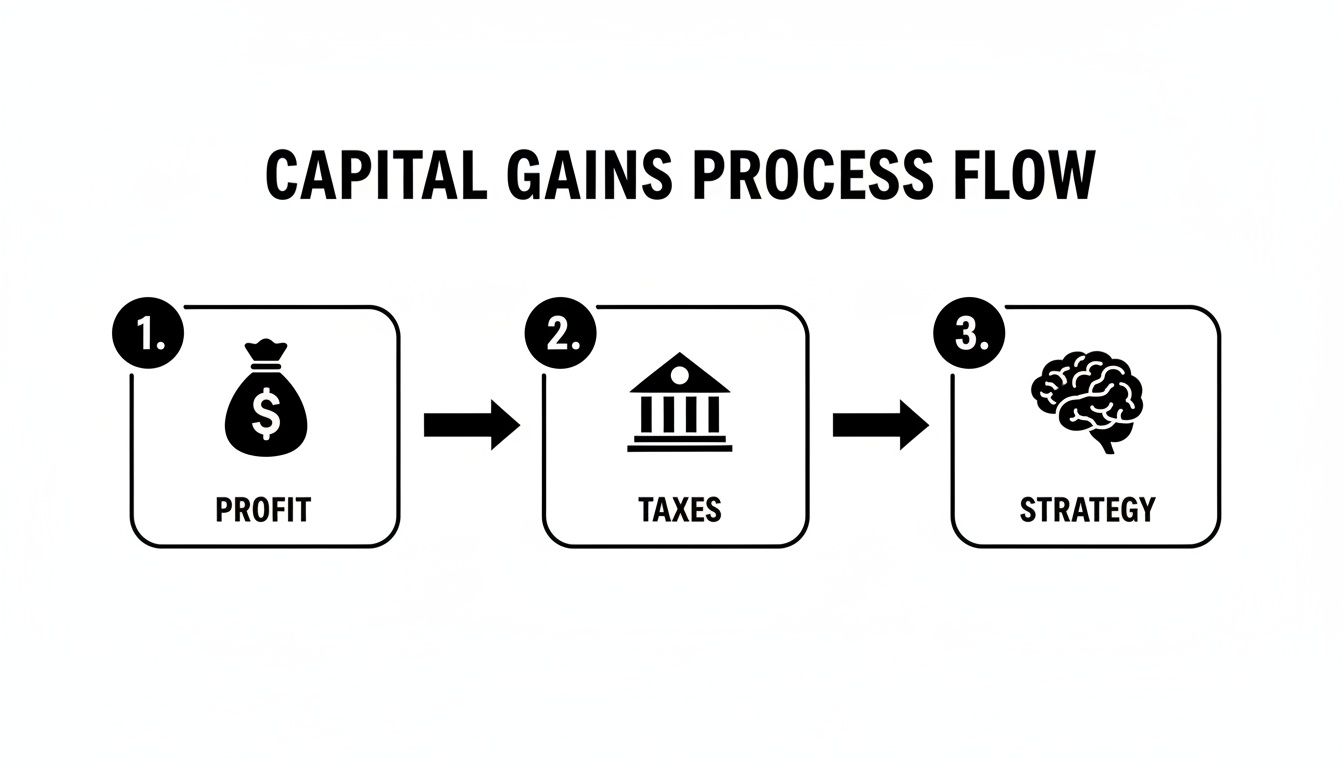
As you can see, understanding the tax hit you'll take is critical for making smart decisions about what to do with your proceeds. It’s not just about paying the IRS; it’s about planning your next investment.
How to Adjust Your Cost Basis (and Lower Your Tax Bill)
To get an accurate picture of your capital gain, you need to track every single expense that can be added to your initial investment. These are what we call basis adjustments. They increase your cost basis, which is great news because a higher basis means a lower taxable gain.
So, what kind of expenses count? It depends on the asset, but here are some of the big ones:
- Acquisition Costs: Think of these as the fees you paid just to get your hands on the asset. For stocks, this is your broker's commission. For real estate, it’s a much longer list, including things like legal fees, title insurance, and transfer taxes.
- Improvement Costs: This is a huge one for property owners. It covers major projects that add value or extend the life of the property, like putting on a new roof or doing a full kitchen remodel. Just remember, routine repairs and maintenance don't count here.
- Selling Costs: Finally, the expenses you paid to actually sell the asset can also be factored in. This includes the real estate agent's commission, advertising fees, and any legal costs tied to the sale.
For real estate investors, getting a handle on how to calculate capital expenditures (CapEx) is non-negotiable, as these major expenses are a primary way to increase your property's basis.
Here’s a quick look at some common adjustments for different asset types.
Common Adjustments to Your Cost Basis
Tracking these costs is essential because they can significantly reduce your taxable gain. Every legitimate expense you add to your basis is money you don't have to pay taxes on.
| Asset Type | Common Cost Basis Adjustments | Example |
|---|---|---|
| Real Estate | Closing costs (title insurance, legal fees), major improvements (new roof, kitchen remodel), special tax assessments | You add the $15,000 cost of a new HVAC system to your home's original purchase price. |
| Stocks | Brokerage commissions, transaction fees | A $7.95 commission paid to buy 100 shares of a stock is added to the total cost. |
| Business | Installation costs for new equipment, legal fees for acquisition, major upgrades to facilities | The $5,000 cost to transport and install a new piece of machinery is included in its basis. |
The key takeaway is that every receipt and invoice matters. Proper documentation lets you confidently and legally minimize your tax obligation.
Key Takeaway: Meticulous record-keeping is your best defense against overpaying taxes. Every commission, fee, and improvement cost you can document works to lower your taxable profit.
While the core formula hasn't changed, the tax rates and rules certainly have. A major shift came with the 1997 Taxpayer Relief Act, which slashed long-term capital gains rates and, critically, introduced the primary residence exclusion. This powerful provision allows homeowners to exclude up to $250,000 (or $500,000 for joint filers) in gains from the sale of their main home, provided they meet certain criteria.
Short-Term vs. Long-Term Gains and How Holding Periods Impact You
When you get down to calculating capital gains, one detail overshadows everything else when it comes to your tax bill: the holding period. It’s just a fancy term for how long you actually owned an asset before you sold it. But this simple timeframe is what slices your profit into one of two buckets, each with wildly different tax rules.

Understanding this distinction is the bedrock of smart tax planning. Seriously, holding onto an investment for just one extra day can mean keeping thousands more dollars in your pocket. It’s a situation where patience literally pays off.
Defining the Holding Periods
The IRS keeps this part surprisingly simple, drawing a clear line in the sand at the one-year mark.
- Short-Term Capital Gain: This is your profit from any asset you owned for one year or less.
- Long-Term Capital Gain: This is your profit from any asset you owned for more than one year.
So, why is this dividing line so important? Because short-term gains get taxed as ordinary income—the very same rate that applies to your paycheck, which can be as high as 37%. Long-term gains, on the other hand, get special treatment with much friendlier tax rates.
The core strategy for minimizing your tax bill is straightforward: whenever possible, aim to hold profitable investments for more than a year. The tax rate difference between selling on day 365 versus day 366 can be enormous.
A Tale of Two Investors
Let's walk through a real-world scenario to see how this works. Imagine two friends, Alex and Ben. They both invested $20,000 in the same stock, and both eventually sell it for $30,000, locking in a $10,000 gain. Let's also say they both fall into the 24% income tax bracket.
The only difference is when they sold.
-
Alex (The Impatient Investor): Alex sells his shares after only 11 months. Because he held it for a year or less, his $10,000 gain is short-term. It gets taxed at his ordinary income rate of 24%, landing him a tax bill of $2,400.
-
Ben (The Patient Investor): Ben holds on for 13 months. Now, his $10,000 profit is a long-term gain. At his income level, the long-term capital gains rate is just 15%. His tax bill? Only $1,500.
Just by waiting a little over two more months, Ben saved $900 in taxes on the exact same investment. That’s a significant difference. If you want to dive deeper, we have a guide that covers all the nuances of short-term vs. long-term capital gains.
This basic principle is central to how our tax system works. While the initial math is just the sale price minus your cost basis, the tax rates turn it into a game of strategy. For most people, long-term gains are taxed at 0%, 15%, or 20%, all based on your total income. As we saw with Alex, short-term gains face the much steeper ordinary income rates, which can climb all the way to 37%. And for higher earners, there’s often an additional 3.8% Net Investment Income Tax (NIIT) to think about. You can always see the latest tax rules from the IRS for the official details.
Finding the Right Tax Rate for Your Gains
Okay, you've done the hard part: you figured out your cost basis, calculated your total gain, and know whether it's short-term or long-term. Now comes the final piece of the puzzle—applying the right tax rate. This is where your total taxable income and filing status really matter, as they determine exactly which tax bracket your investment profits fall into.
The big difference is how the IRS treats your holding period. Short-term gains are simple: they’re taxed just like your regular income, at your marginal tax rate. But long-term gains get a much friendlier deal.
For most investors, long-term capital gains are taxed at one of three rates: 0%, 15%, or 20%. These rates aren't random; they’re tied directly to your income level. The whole idea is to tax higher earners more, but it also creates a fantastic opportunity for some investors to pay zero federal tax on their profits. Getting a handle on these brackets is key to smart tax planning. It lets you anticipate your tax bill and set aside cash, or maybe even tweak your selling strategy to stay in a lower tax bracket.
The Three Main Long-Term Capital Gains Rates
The tax rate you'll ultimately pay on a long-term gain isn't just about the profit itself. It's based on your total taxable income for the year, which includes your salary, investment profits, and any other income sources combined. The IRS lays out specific income thresholds for each filing status (Single, Married Filing Jointly, etc.) to sort you into one of the three main tax buckets.
Here’s how it generally breaks down:
- The 0% Rate: This is for taxpayers in lower-income brackets. If your total taxable income is below a certain amount, your long-term gains could be completely tax-free at the federal level. It's a huge benefit that many people overlook.
- The 15% Rate: This is the most common bracket. A vast majority of middle-income earners will find their long-term gains land here.
- The 20% Rate: This rate is reserved for high-income earners. Once your taxable income crosses the highest threshold, that top rate kicks in for your long-term profits.
These rates aren't set in stone. Tax laws are always evolving, and it’s a good idea to stay on top of them. For a little perspective, the maximum capital gains rate was 15.0% in the late 1930s, but it shot up to 35.0% by the 1970s. Today, it sits at 20% for top earners. This history is a great reminder of how much things can change—and why getting good advice is so important. You can dig deeper into the historical capital gains rates on Wolters Kluwer's site.
Below is a table that breaks down the 2024 federal long-term capital gains tax rates. These income thresholds show you where your gains will fall based on your filing status. Just remember, these are federal rates—your state might have its own capital gains tax on top of this.
Long-Term Capital Gains Tax Rates by Income Bracket
| Filing Status | 0% Rate Income Threshold | 15% Rate Income Threshold | 20% Rate Income Threshold |
|---|---|---|---|
| Single | $0 to $47,025 | $47,026 to $518,900 | $518,901 or more |
| Married Filing Jointly | $0 to $94,050 | $94,051 to $583,750 | $583,751 or more |
| Married Filing Separately | $0 to $47,025 | $47,026 to $291,850 | $291,851 or more |
| Head of Household | $0 to $63,000 | $63,001 to $551,350 | $551,351 or more |
Source: IRS data for the 2024 tax year.
Seeing the numbers laid out like this makes it much clearer how your overall financial picture influences your tax liability. A change in income or even just your filing status can shift you into a different bracket.
When Special, Higher Tax Rates Apply
Just when you think you have it figured out, the tax code throws a few curveballs. While the 0%, 15%, and 20% rates cover most investments like stocks and mutual funds, certain assets play by their own set of rules. If you're not aware of these exceptions, you could be in for a nasty surprise come tax time.
For instance, profits from selling collectibles—things like rare art, stamps, coins, or even that vintage bottle of wine—are taxed at a maximum rate of 28%, no matter what your income bracket is. Another common one is real estate. When you sell a depreciated rental property, a portion of your gain, known as "unrecaptured Section 1250 gain," is taxed at a flat 25%.
Pro Tip: Never assume all your long-term gains get the same tax treatment. Always double-check the type of asset you sold to make sure you’re applying the correct—and sometimes much higher—tax rate.
Finally, high earners need to be aware of the Net Investment Income Tax (NIIT). This is an extra 3.8% tax slapped on top of investment income for individuals and trusts with income above certain high thresholds. For many, this effectively pushes the top federal capital gains rate from 20% to 23.8%. Putting all these pieces together is what it takes to truly master how to calculate capital gains.
Proven Strategies to Minimize Your Capital Gains Tax
Knowing how to calculate your capital gains is one thing, but the real skill lies in legally shrinking that final tax bill. Smart investors don't just sit back and watch their gains pile up; they actively manage them with proven strategies designed to keep more of their hard-earned profits. Luckily, the tax code itself offers some powerful tools to help you do just that.

One of the most common and effective techniques out there is tax-loss harvesting. The idea is simple: you strategically sell investments that are currently in the red. You can then use those realized losses to offset your capital gains, essentially wiping them off your tax return.
Let's say you cashed in on Stock A for a $10,000 long-term gain. But later in the year, you decided to cut your losses on Stock B, selling it for a $7,000 loss. You can apply that $7,000 loss directly against your gain, bringing your taxable amount down to just $3,000.
What if your losses are bigger than your gains? You can use up to $3,000 of the excess loss to reduce your regular income. Anything left over gets carried forward to future tax years. It's a fantastic way to turn a market downturn into a tax advantage.
Beyond Harvesting Losses
While tax-loss harvesting gets a lot of attention, it's certainly not the only tool in the shed. Depending on your financial picture and long-term goals, several other strategies can be just as powerful.
Here are a few other impactful approaches to consider:
- Donating Appreciated Stock: Got a stock that has soared in value? Instead of selling it and facing a hefty tax bill, you can donate the shares directly to a qualified charity. This often lets you claim a tax deduction for the stock's full market value, and the best part is that neither you nor the charity has to pay capital gains tax.
- Leveraging Tax-Advantaged Accounts: This is a big one. Accounts like a 401(k) or an IRA are designed for tax efficiency. Your investments grow either tax-deferred or completely tax-free, meaning you don't have to sweat capital gains taxes year after year.
- Timing Your Sales: We've already touched on this, but it’s worth repeating: holding an asset for more than a year is critical. Patiently waiting for a profitable investment to cross that one-year threshold before you sell is a straightforward yet incredibly effective way to slash your tax rate.
Each of these methods comes with its own set of rules and requires a bit of planning. For a deeper dive, check out our guide on the essentials of capital gains tax and how to minimize your liability for more detailed insights.
A Special Strategy for Real Estate
For those invested in real estate, the 1031 exchange is one of the most powerful tax-deferral mechanisms available. This part of the tax code allows you to sell an investment property and kick the capital gains tax can down the road, provided you reinvest the proceeds into a similar "like-kind" property.
Imagine selling a rental house and clearing a $200,000 gain. That would normally trigger a massive tax bill. But by using a 1031 exchange and following the strict IRS guidelines to buy a new investment property, you can defer the entire tax payment. This frees up your capital to keep working for you.
Key Takeaway: It’s important to remember that a 1031 exchange doesn't eliminate your tax liability—it postpones it. The strategy's real power is in allowing you to roll your full proceeds into a new, potentially larger investment, preserving your capital and maximizing your purchasing power.
Common Questions About Calculating Capital Gains
Once you've got the basic formulas down, you'll inevitably run into weird situations that don't quite fit the mold. The tax code is full of special rules for unique circumstances, like what to do with inherited property or how to handle a year with big losses.
Let's walk through some of the most common questions I hear from investors. Getting these right is key to accurate tax reporting and, frankly, to avoiding some expensive mistakes.
How Do I Calculate Gains on Inherited Property?
This is a big one, and the answer lies in a fantastic tax rule called the "stepped-up basis."
When you inherit property, your cost basis isn't what the original owner paid for it. Instead, the basis gets "stepped up" to the fair market value of the asset on the day the original owner passed away.
Let's say your dad bought a stock portfolio for $50,000 years ago. When you inherit it, that portfolio is now worth $400,000. Your cost basis is reset to $400,000. If you turn around and sell it immediately for that price, you have zero taxable capital gain. This rule is a huge advantage for heirs and applies to stocks, real estate, and other capital assets.
This provision can literally wipe out decades of taxable appreciation, which is why getting a proper valuation at the time of inheritance is so critical. It’s a cornerstone of smart estate planning.
What Happens if My Capital Losses Exceed My Gains?
Having more losses than gains for the year isn't the end of the world—in fact, it can be a useful tax tool. When this happens, you have a net capital loss, and the IRS lets you use it to offset your other income, like your salary.
There are, of course, limits to this.
- You can deduct up to $3,000 of a net capital loss against your ordinary income each year.
- The limit is halved to $1,500 if you're married and filing separately.
But what if your net loss is, say, $10,000? You deduct the first $3,000 this year, and the remaining $7,000 gets carried forward. This capital loss carryover can be used to offset gains in future years or continue the $3,000 annual deduction until it's all used up.
Can I Use the Home Sale Exclusion on a Rental?
This is where things get very specific. The powerful Section 121 exclusion, which lets you exclude up to $250,000 of gain (or $500,000 if you're married filing jointly), is strictly for your primary residence.
To qualify, you must have both owned and lived in the property as your main home for at least two of the five years right before the sale. If you turned your primary home into a rental property before selling, the rules get much more complicated. You might only be able to exclude a portion of the gain, not the whole thing. For a deeper dive, check out our guide on the capital gains tax on home sales.
Navigating the world of capital gains takes more than just a calculator—it requires expertise and forward-thinking. At Allied Tax Advisors, our team lives and breathes this stuff. We're here to help you make sense of your tax obligations and find every opportunity to minimize what you owe. Visit us at https://alliedtax.com to see how we can support your financial journey.
Say I have a long term investment that grew from $100,000 to $200,000 so I have a capital gain of $100,000.
I will be paying a capital gain of $15,000 on that money. MY question is, since I took out $100K is that full
amount also added to my income for the year? And if so , is it also taxed at my income level of 22% ? Or
is it somehow removed. Am I only taxed on the gain itself … What happens to the other $85K ?