
Figuring out your crypto taxes really comes down to one simple formula: take the sale price (fair market value) and subtract what you originally paid for it (your cost basis). The difference is your capital gain or loss.
Hold onto an asset for less than a year, and any profit is a short-term gain, taxed just like your regular income. But if you hold it for over a year, you get the benefit of lower long-term capital gains rates. This simple principle is the foundation for every taxable event you'll encounter in the crypto world.
Understanding Your Crypto Tax Obligations
Before you can even start crunching numbers, you have to know the rules of the game. Here’s the single most important thing to understand: the IRS views cryptocurrency as property, not currency. This one detail changes everything, turning many everyday crypto activities into taxable events.
A lot of new investors get tripped up by this. Buying crypto with dollars and just holding it? Not taxable. But the second you sell, trade, or spend it, the tax clock starts ticking.
What Is a Taxable Event?
So, what exactly triggers a tax bill? A "taxable event" is any time you dispose of your crypto. This is the moment you have to sit down and calculate whether you made a profit or a loss. You might be creating these events more often than you think.
Here are a few of the most common triggers:
- Selling crypto for cash: This one's the most obvious. You cash out your crypto for U.S. dollars.
- Trading one crypto for another: Swapping your Bitcoin for some Ethereum isn't a simple, tax-free exchange. The IRS sees it as you selling the Bitcoin and immediately using that money to buy Ethereum.
- Using crypto to buy things: That coffee you bought with crypto? That's a disposition. You're effectively selling your crypto for its fair market value at the moment of purchase, which creates a small gain or loss.
Keeping track of these events is step one for staying out of trouble. Any time you get rid of a crypto asset, you need to log the details for your records. It's also smart to keep an eye on the global regulatory climate, since things like the consequences of a cryptocurrency ban can have a ripple effect on the market and your own tax situation.
Taxable vs Non-Taxable Crypto Events
To make it easier, here's a quick cheat sheet to help you sort through your transactions. It can get confusing, so having a clear breakdown of what does and doesn't need to be reported is a lifesaver.
| Activity | Is It a Taxable Event? | Why or Why Not? |
|---|---|---|
| Selling Crypto for USD | Yes | You are disposing of property for cash, realizing a gain or loss. |
| Trading Crypto for Crypto | Yes | This is a disposition of one asset to acquire another. |
| Paying for Goods/Services | Yes | You are using your crypto's value to buy something, which is a sale. |
| Buying Crypto with USD | No | You are simply acquiring property; no gain or loss is realized. |
| Holding (HODLing) Crypto | No | Unrealized gains are not taxed. The tax event happens upon sale. |
| Moving Crypto You Own | No | Transferring between your own wallets is not a disposition of the asset. |
| Donating to Charity | No | Donating to a qualified 501(c)(3) is generally not a taxable event. |
This table should help you quickly categorize your activity from the past year. Knowing the difference is the first step toward getting your taxes right.
Clarifying Non-Taxable Activities
Just as important is knowing what won't land you with a tax bill. Getting a handle on these non-taxable activities can save you a ton of time and prevent you from over-reporting.
For the most part, you don't have to worry about taxes when you're:
- Purchasing cryptocurrency with U.S. dollars.
- Holding your cryptocurrency (the "HODL" strategy).
- Donating crypto to a qualified charity.
- Moving crypto between wallets or exchanges that you own and control.
Key Takeaway: Shuffling your crypto from a Coinbase account to your personal Ledger wallet doesn't trigger a taxable event. The IRS only cares when you give up ownership by selling, trading, or spending it.
This is a critical distinction for everyone, from day traders to long-term holders.
In the end, it all comes back to the IRS treating crypto as property. A gain on an asset you held for less than a year is considered a short-term capital gain, and it gets taxed at your ordinary income rate—anywhere from 10% to 37%.
Hold for more than a year, though, and you’re in long-term territory. Those gains are taxed at much friendlier rates of 0%, 15%, or 20%, depending on your income. This structure is a clear incentive to think long-term with your investments.
Calculating Your Gains and Losses
This is where the rubber meets the road. The entire crypto tax puzzle really boils down to one simple formula for every single taxable event: Fair Market Value – Cost Basis = Capital Gain or Loss.
Think of your cost basis as your total "all-in" price for an asset. It’s what you originally paid for it, plus any associated transaction fees, like exchange commissions or network gas fees. The fair market value is simply what the asset was worth in U.S. dollars the moment you sold, traded, or spent it. Getting these two numbers right for every transaction is the foundation of calculating your crypto taxes correctly.
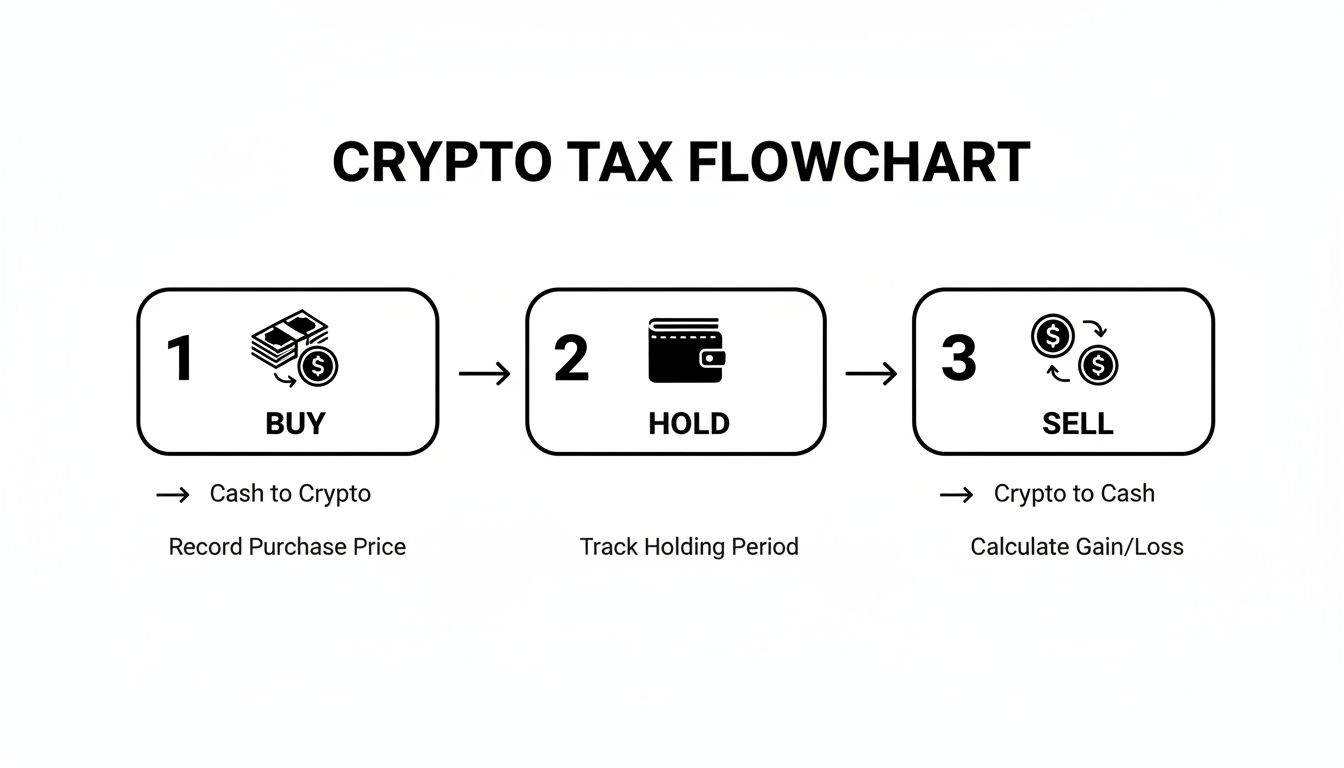
As the flowchart shows, you don't trigger a tax event when you buy or just hold your crypto. The taxable moment comes when you dispose of it—that’s when you have to sit down and figure out your gain or loss.
Pinpointing Your Cost Basis
Your first job is to nail down your cost basis. If you bought 1 ETH for $2,000 and the transaction had a $20 network fee, your actual cost basis for that 1 ETH is $2,020. That’s the number you'll subtract from your sale price later on.
The real headache starts when you've bought the same coin multiple times at different prices, a common strategy called dollar-cost averaging. This is where your choice of accounting method becomes absolutely critical.
Choosing An Accounting Method
When you sell just a portion of your holdings, how do you know which specific coins you sold? Was it the first batch you ever bought, or the ones you picked up last week? The IRS gives you a choice here, as long as you apply your chosen method consistently.
Here are the main players:
- First-In, First-Out (FIFO): This is the IRS default. It assumes the first assets you acquired are the first ones you sold. In a bull market, this method can lead to higher capital gains because your oldest coins likely have the lowest cost basis.
- Highest-In, First-Out (HIFO): With HIFO, you act as if you sold the coins you paid the most for first. This is often the smartest move for minimizing your tax bill, as it either generates a larger loss or a smaller gain.
- Last-In, First-Out (LIFO): This method assumes you’re selling your most recently purchased assets first. It can be a handy tool in a volatile market for harvesting short-term losses.
A Word of Caution: If you want to use HIFO or LIFO, you must be able to specifically identify which units of crypto you sold. This requires meticulous, transaction-by-transaction records. It's nearly impossible to do by hand, which is why most serious investors lean on specialized crypto tax software.
If you want to get deeper into the nuts and bolts, our guide on how to figure capital gains breaks down the mechanics with more examples that work for both crypto and stocks.
A Practical Example: FIFO vs. HIFO
Let's look at how this plays out in the real world. Imagine you made two Bitcoin purchases during the year:
- January: Bought 1 BTC for $30,000
- June: Bought 1 BTC for $50,000
Then, in December, you decide to sell 1 BTC for $45,000. How does your accounting method change the outcome?
This table shows the dramatic difference your choice can make.
Impact of Accounting Methods on Tax Liability
| Accounting Method | Cost Basis of Asset Sold | Capital Gain or Loss | Potential Tax Advantage |
|---|---|---|---|
| FIFO | $30,000 (from January) | $15,000 Gain | None; results in a taxable gain. |
| HIFO | $50,000 (from June) | ($5,000) Loss | Creates a deductible loss, potentially lowering your overall tax bill. |
It's a stark contrast. By simply choosing HIFO over the default FIFO method, you transformed a $15,000 taxable gain into a $5,000 loss that you can use to offset other gains. This isn't a loophole; it's a legitimate tax-planning strategy.
Diving Into More Complex Crypto Scenarios
The crypto world is so much more than just buying and selling on major exchanges. Once you start exploring things like staking, DeFi, or airdrops, the tax picture can get complicated fast. It's really important to get a handle on these situations to make sure your tax reporting is spot on and you don't end up with a surprise bill from the IRS.
These aren't just obscure activities anymore; they're how millions of people are engaging with crypto today. While the IRS has given us some clarity, many of these areas are still a bit of a gray zone. Let's walk through some of the most common advanced scenarios you’re likely to run into.
Staking Rewards and Interest
Putting your crypto to work through staking or lending is a great way to earn passive income. The tax rules here are fairly clear-cut: the rewards you earn are considered ordinary income.
What this means is you have to report the fair market value (in U.S. dollars) of the crypto you received at the exact moment it landed in your account. This value also becomes the cost basis for those new coins.
- Here's a quick example: Let's say you stake 1 ETH and get a reward of 0.01 ETH. On the day that reward shows up in your wallet, it’s worth $20. You’ll need to report that $20 as ordinary income.
- What happens later? The cost basis for that 0.01 ETH is now $20. If you decide to sell it down the road for $25, you've made a $5 capital gain that you'll also have to report.
I can't stress this enough: you have to keep meticulous records of every single reward—the date, the amount, and its USD value at the time. This is one of the most common mistakes people make, and it often leads to underreporting income.
Airdrops and Hard Forks
Getting free tokens from an airdrop or a blockchain hard fork feels like a win, but the IRS views it as income. Just like with staking, you have to report the fair market value of the new tokens at the moment you gain access to them.
A critical point to remember: If you get airdropped tokens and you have the ability to sell or trade them immediately, their value at that instant is considered taxable income. This is true even if you decide to hold onto them.
The cost basis for these new tokens is whatever income you reported. This same logic generally applies to hard forks, where a new cryptocurrency is spun off from an existing one. Things can get tricky, though, especially with newer ways of distributing tokens. For a closer look, understanding the details of crypto points programs and airdrops can really help clear up how to handle these specific tax events.
DeFi Yield Farming and Liquidity Pools
This is where things can get even more tangled. Activities in Decentralized Finance (DeFi), like yield farming or providing liquidity, usually involve a whole series of transactions, and each one can be a taxable event.
Think about providing liquidity. You typically take two tokens (say, ETH and USDC) and trade them for LP (Liquidity Provider) tokens. The IRS often sees this as a taxable event. You're essentially selling your original tokens to buy a new asset (the LP token), which can trigger a capital gain or loss right then and there.
Any rewards you earn from that LP position are then taxed as ordinary income, similar to staking. And when you finally pull your liquidity out? That’s another taxable event, as you're selling the LP token to get your original crypto back.
Token Swaps and NFTs
Trading one token directly for another on a decentralized exchange (DEX) is a taxable event. This is a huge pitfall for many investors. People often think a "swap" isn't a sale, but in the eyes of the IRS, you disposed of one asset to acquire another. You have to calculate the capital gain or loss on the token you traded away.
Non-Fungible Tokens (NFTs) bring their own set of rules. While they are taxed as property, the IRS might classify them as "collectibles," which carries some serious implications:
- A Higher Tax Rate: Long-term capital gains on collectibles can be taxed at a maximum rate of 28%. That’s significantly higher than the typical 20% top rate for other assets like Bitcoin.
- Buying with Crypto: If you buy an NFT using ETH, for example, that transaction is a taxable sale of your ETH. You have to figure out the gain or loss on the ETH you spent.
These examples really drive home why precise, detailed record-keeping is absolutely essential. While using a method like HIFO can help reduce your gains, another powerful strategy is tax-loss harvesting. To learn how you can turn market downturns into a tax advantage, check out our complete guide on crypto tax-loss harvesting. Thoughtful planning around these advanced transactions can make a massive difference to your bottom-line tax bill.
Reporting Crypto on Your Tax Forms
After you’ve done all the heavy lifting with the calculations, the last hurdle is getting that information onto the official IRS paperwork. This part can feel daunting, but it's really just a matter of putting the right numbers in the right boxes. Nailing this is just as important as the calculations themselves—it’s your official declaration to the IRS, after all.
Think of it as a logical sequence. You start with the nitty-gritty details of each transaction, summarize them, and then carry the final numbers over to your main tax return.

Following this path ensures every gain and loss is accounted for, creating a clear paper trail from your crypto activity straight to your tax liability.
Starting with Form 8949: Sales and Other Dispositions of Capital Assets
Your reporting journey kicks off with Form 8949. This is where you lay it all out, listing every single taxable crypto event for the year. Each sale, trade, or crypto payment gets its own dedicated line.
For every transaction, you’ll need to list:
- A description of what you sold (e.g., "1.5 BTC")
- The date you acquired it
- The date you sold it
- Your sale price (the proceeds)
- Your cost basis
- The final gain or loss
This form is split into two main sections: one for short-term trades (assets you held for one year or less) and another for long-term trades (held for more than one year). Keeping these separate is non-negotiable, as the tax rates for each are worlds apart.
Summarizing on Schedule D: Capital Gains and Losses
With every transaction meticulously logged on Form 8949, you then move on to Schedule D. This form is purely a summary. You don't list individual trades here; you just transfer the totals over from your various Form 8949s.
Schedule D gives the IRS the 10,000-foot view. It clearly shows your net short-term gain or loss and your net long-term gain or loss. These two figures are then combined to get your total net capital gain or loss for the year from all your investments, not just crypto.
The final number calculated here is what will ultimately impact your total taxable income.
Answering the Form 1040 Crypto Question
The last stop is your main tax return, the Form 1040. The net gain or loss from your Schedule D flows directly onto your 1040, where it merges with your other income.
But there’s one more critical, can't-miss step. Right at the top of the form, the IRS now includes a direct question about virtual currency. It asks something like, "At any time during the year, did you: (a) receive… or (b) sell, exchange, or otherwise dispose of a digital asset…?"
You must answer this question truthfully with a "Yes" or "No." If you sold, traded, spent, or earned crypto, you have to check "Yes." Simply buying and holding crypto with no other activity is one of the few situations where you can check "No."
Ignoring this question or checking "No" incorrectly is a massive red flag for the IRS and can be considered perjury. Don't risk it.
Trying to fill out Form 8949 by hand for hundreds, let alone thousands, of transactions is a recipe for disaster. This is precisely why any active trader relies on specialized software. To see how the different options compare, take a look at our detailed crypto tax software comparison. These tools generate a perfect Form 8949 for you automatically, saving you an incredible amount of time and preventing expensive mistakes.
Best Practices for Crypto Record Keeping
Let's be blunt: you can't calculate your crypto taxes without good data. It's that simple. Keeping detailed records isn't just a "best practice"—it's your only real defense against costly mistakes, dreaded IRS letters, and the sheer panic of piecing together a year's worth of trades at the last minute.
The habits you build today will literally save you headaches, time, and money tomorrow.
This isn't something you can put off until tax season. The process starts the second you make your first transaction. Every buy, sell, swap, and airdrop has a data trail, and the IRS holds you responsible for it. Trying to find historical price data from nine months ago for a random altcoin is a nightmare you want to avoid.
The Essential Data Points You Must Track
For every single move you make, you need a log. This is the raw material for your entire tax return. Miss one detail, and the whole calculation can get thrown off.
Make sure your records capture:
- Transaction Date: The exact day you acquired or got rid of the crypto.
- Transaction Type: Was it a buy with USD? A sale for cash? A crypto-to-crypto trade? Staking income? Be specific.
- The Asset: Which coin was it? Bitcoin (BTC), Ethereum (ETH), etc.
- Fair Market Value (in USD): You need the asset's dollar value at the precise time of the transaction.
- Your Cost Basis: What you paid for the asset, plus any fees.
- All Associated Fees: Don't forget exchange fees or network gas fees. These can adjust your cost basis or sale proceeds, often in your favor.
A Pro Tip from Experience: Keep a record of transfers between your own wallets (e.g., from Coinbase to your Ledger). While these aren't taxable events, they establish a clear chain of custody. If you're ever audited, proving that you simply moved your own funds—not sold them—is critical.
The Power of Automation: Why Crypto Tax Software is a Game-Changer
Look, you can try to track all of this in a spreadsheet. I've seen people do it. But for anyone with more than a handful of transactions a year, it becomes a soul-crushing, error-prone task. Fast.
This is exactly why dedicated crypto tax software is so valuable.

Tools like CoinLedger are built for this. You connect your exchange and wallet accounts via API keys or by uploading CSV files, and the software automatically pulls in your entire transaction history.
From there, it does the heavy lifting: fetching historical price data, calculating your cost basis, and applying your chosen accounting method (like FIFO or HIFO). The end result? The exact forms you need, like Form 8949, ready to go.
Create a System That Actually Works
Whether you go manual or use software, the key is consistency. Your goal is a reliable system you can stick with all year long.
Here's a simple workflow that I've seen work time and again:
- Pick your tool. Are you a spreadsheet warrior or a software subscriber? Make the call.
- Schedule it. Don't let things pile up. Put a reminder on your calendar—weekly or monthly—to import new transactions and reconcile everything.
- Pull from everywhere. Get your transaction histories from every single platform you use. Centralized exchanges, DEXs, and your personal hardware wallets. All of it.
- Do a spot check. Every so often, scan your records for obvious errors or missing trades. Catching a mistake in February is infinitely easier than finding it the following April.
By making solid record-keeping a habit, you turn the beast of crypto tax calculation from a year-end monster into a manageable, ongoing task. It puts you back in control.
Frequently Asked Questions About Crypto Taxes
Even with a good guide, crypto taxes can feel like navigating a maze. It’s one thing to read about the rules, but another thing entirely when you’re staring at your own messy transaction history.
Let's tackle some of the most common questions that pop up when people start calculating their crypto taxes.
Do I Have to Pay Taxes If I Just Traded One Crypto for Another?
Yes, you absolutely do. This is probably the single most common mistake I see people make. The IRS is crystal clear on this: swapping one crypto for another is a taxable event.
Think of it this way: you are effectively selling the first crypto and immediately buying the second one. You have to calculate the capital gain or loss on the coin you got rid of, based on its fair market value in U.S. dollars at that exact moment. So, trading 0.1 BTC for 1.5 ETH means you disposed of your Bitcoin, and that transaction has to be reported on Form 8949.
What If I Lost Money on My Investments?
Losing money never feels good, but there's a silver lining when it comes to taxes. Those capital losses can be a powerful tool to lower your overall tax bill. You can use them to wipe out capital gains you might have from other crypto trades or even from selling stocks.
If you have more losses than gains for the year, you can deduct up to $3,000 of that excess loss against your regular income, like your salary. Any leftover loss above that $3,000 isn't gone forever—you can carry it forward to offset gains in future tax years. This strategy is known as tax-loss harvesting, and it’s a smart move in a down market.
A Pro Tip: Don't just see a market crash as a loss. It can be a strategic opportunity. By purposefully selling some assets at a loss, you can generate a tax benefit that helps cushion the blow. It's about turning a bad situation into a tax-saving play.
How Can I Get My Records from an Exchange That Shut Down?
This is a tough spot to be in, but it’s usually not a dead end. The first place you should always look is your own email. Search for any trade confirmations, withdrawal notices, or account statements the exchange ever sent you. These are gold.
If your inbox comes up empty, it's time to become a blockchain detective. Use a blockchain explorer to look up your personal wallet addresses. You can trace the history of transactions moving to and from the exchange's wallets. While this won't show the specific trades you made on the exchange, it helps rebuild a timeline and establish your cost basis for what you moved on and off the platform. A good-faith effort to reconstruct your history is always the right call.
Are NFTs Taxed Differently Than Bitcoin?
For the most part, no, but there's one giant exception that can have a huge impact. While NFTs are taxed as property just like Bitcoin, the IRS often classifies them as "collectibles." This changes the math significantly for long-term holds.
- Regular Crypto (like BTC): If you hold it for more than a year, your long-term capital gains are taxed at favorable rates, maxing out at 20%.
- NFTs (as Collectibles): That same long-term gain on an NFT could be taxed at a much higher rate—up to 28%.
This distinction means you have to be extra careful with your NFT sales. And don't forget, if you mint or buy an NFT using ETH, you've just triggered a separate taxable event on the sale of that ETH.
Trying to get crypto taxes right can be overwhelming, especially when audits are on the rise. If you're dealing with a complex situation or just want a professional to make sure it's done correctly, our team at Allied Tax Advisors is ready to help. We specialize in the unique challenges of digital assets and can build a strategy that works for you.