
Figuring out payroll taxes really boils down to a few key actions: you start with an employee's gross pay, pull out any pre-tax deductions to get their taxable wages, and then calculate what's owed for federal, state, and local taxes. At its heart, the process is all about accurately withholding for federal income tax, FICA (Social Security and Medicare), and any other taxes your state or city requires.
Setting Up Your Payroll System for Success
Before you even think about cutting a check, you have to build a solid foundation. I’ve seen it time and again: business owners rush the initial setup and end up with major headaches and even financial penalties later on. Getting this part right from the get-go is non-negotiable.
The entire system relies on having the right information for every single employee. This all begins with a properly filled-out Form W-4. Think of it less as a piece of paperwork and more as the instruction manual telling you exactly how much federal income tax to hold back from their pay.
Differentiating Employees and Contractors
One of the very first things you have to do is correctly classify your workers. Is this person an employee or an independent contractor? It’s a critical distinction. You withhold taxes for employees; contractors handle their own. Misclassifying an employee as a contractor can lead to some seriously steep fines and a bill for back taxes. Make sure you're familiar with the IRS guidelines on behavioral control, financial control, and the nature of your relationship with the worker.
Securing Your Tax Identification Numbers
Once you have employees on the books, you need the right credentials to report and send in their taxes. This means getting a federal Employer Identification Number (EIN) from the IRS—it’s essentially a Social Security number for your business. You'll also need to register for any required state and local tax IDs to handle things like state income tax and unemployment insurance. For more on this, you can check out our detailed guide right here: https://alliedtax.com/how-to-do-payroll-for-small-business/
A proactive setup is your best defense against payroll errors. Getting your EIN, state IDs, and worker classifications right from day one prevents costly corrections and ensures your calculations start from an accurate baseline.
Essential Employee Payroll Information Checklist
To run payroll correctly, you'll need a specific set of documents and data from each employee. It's best to collect all of this during the onboarding process to avoid any delays when it's time to run that first payroll.
| Information/Document | Purpose | Where to Get It |
|---|---|---|
| Form W-4 | Determines federal income tax withholding. | Employee completes during onboarding. |
| State W-4 Equivalent | Determines state income tax withholding (if applicable). | Employee completes during onboarding. |
| Form I-9 | Verifies employment eligibility in the U.S. | Employee completes; you review their ID. |
| Direct Deposit Form | Provides bank account details for payment. | Employee provides (optional but recommended). |
| Full Legal Name & SSN | Required for tax reporting and identity verification. | Employee provides. |
| Home Address | Determines applicable state and local taxes. | Employee provides. |
| Pay Rate & Type | Establishes gross pay (hourly, salary, etc.). | Outlined in the official job offer. |
Having this checklist ensures you aren't chasing down missing pieces of information when you’re on a deadline. It makes the entire process smoother from the very beginning.
It's also smart to get a handle on the financial impact from your side. In the United States in 2025, employer payroll taxes usually fall somewhere between 10% to 15% of an employee's gross pay, though this can shift depending on your state. For example, an employee making $80,000 a year in a state with average tax rates could cost you, the employer, between $9,000 and $11,500 annually in just payroll taxes.

Before we get into the nitty-gritty of the calculations, it helps to see the big picture. This step-by-step guide to calculating payroll is a fantastic resource for understanding how everything—from collecting data to making the final deposits—fits together.
Calculating Federal Income and FICA Taxes
Once you've got your payroll system set up, it’s time to get into the nuts and bolts of tax calculations. This is where we tackle the two main federal taxes you’ll handle for every employee: Federal Income Tax (FIT) and FICA taxes. It might seem intimidating, but breaking them down makes the whole process much clearer.
The first piece of the puzzle is the federal income tax. How much you withhold isn't a one-size-fits-all number; it's unique to each employee and their life situation. They give you all the info you need on their Form W-4, detailing their filing status, how many dependents they have, and any other adjustments they want to make.
You'll take that W-4 information and pair it with the current year's IRS tax withholding tables to find the right amount to deduct from their paycheck. If you want a deeper dive on this specific deduction, we've put together a guide on https://alliedtax.com/what-does-fit-mean-on-my-paystub/.
Before you can calculate anything, though, you have to start with the employee's gross pay. It's crucial to understand the distinction between bill rate and pay rate, since it’s the employee’s actual pay rate that forms the foundation for their gross wages.
A Real-World Withholding Example
Let's put this into practice. Say you have an employee, Sarah, who makes a salary of $65,000 a year and gets paid bi-weekly. That gives her a gross pay of $2,500 each pay period.
On her W-4, Sarah has selected "Married Filing Jointly" and claimed $4,000 in dependents (Step 3). Using the IRS tables, you’d look up her tentative withholding based on her $2,500 gross pay and filing status. Then, you'd factor in her dependents, which lowers her annual tax liability and reduces the amount you withhold from each check.
This infographic gives a great visual overview of how these pieces fit together.
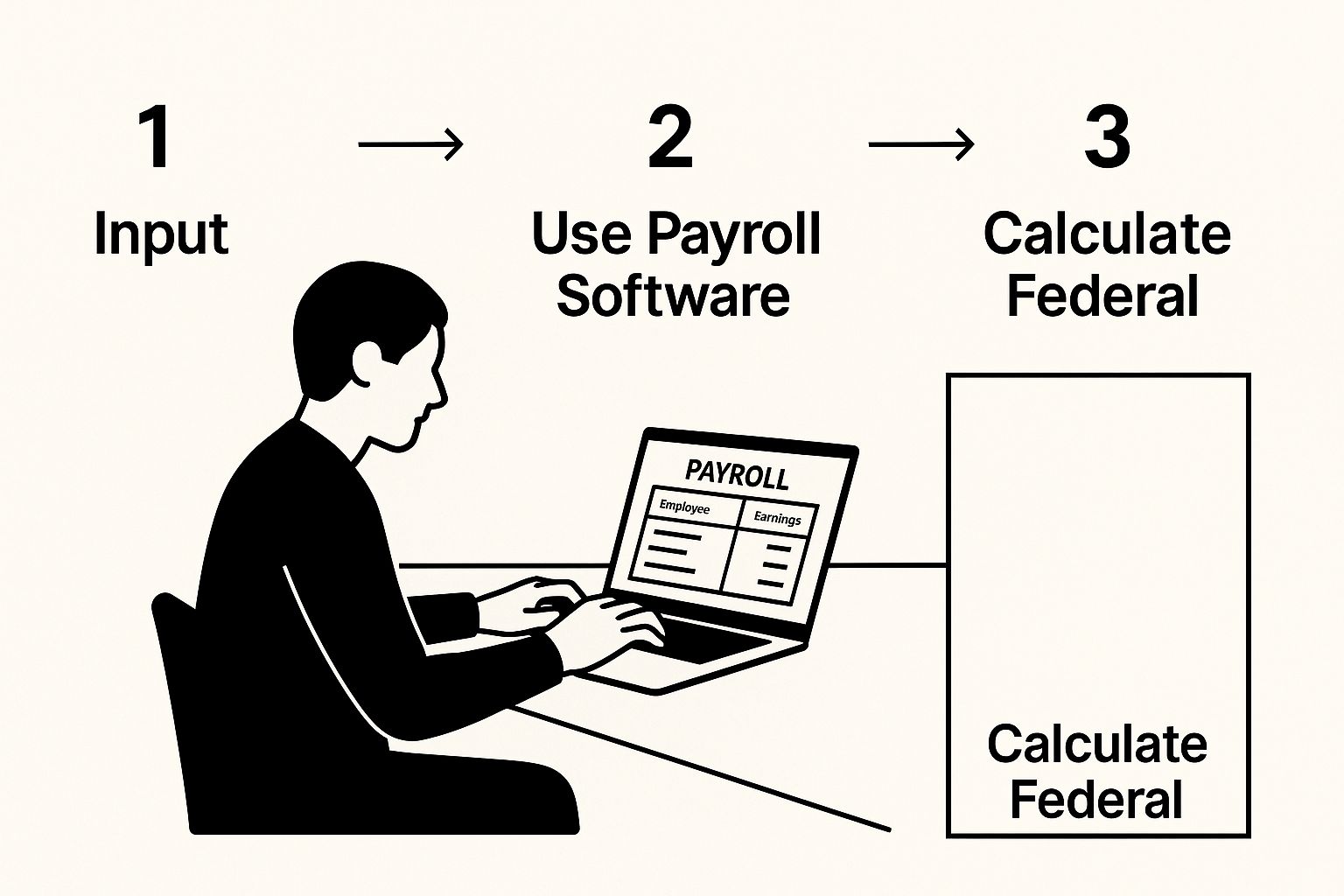
As you can see, the data from the W-4 is the starting point for the entire calculation. Getting that initial setup right is non-negotiable.
Understanding FICA Taxes
Now, let's talk about FICA. These taxes are completely separate from income tax and are used to fund Social Security and Medicare. The calculation here is much more straightforward—it’s a flat percentage of an employee's taxable wages, and you, the employer, split the cost with them.
Here’s the FICA breakdown:
- Social Security: The rate is a flat 6.2%, paid by both the employee and the employer. The key thing to remember is that this tax has an annual wage limit. Once an employee earns more than that limit in a calendar year, you stop withholding their share of Social Security tax.
- Medicare: This rate is 1.45%, also paid by both employee and employer. Unlike Social Security, Medicare has no wage base limit. It applies to every single dollar the employee earns.
Don’t forget: As the employer, you must match your employee's FICA contributions dollar-for-dollar. You are paying 6.2% for Social Security and 1.45% for Medicare out of your business funds. This is a direct payroll cost.
Let’s go back to Sarah and her $2,500 bi-weekly paycheck to see FICA in action.
- Social Security Withholding: $2,500 x 6.2% = $155.00
- Medicare Withholding: $2,500 x 1.45% = $36.25
So, you’ll withhold a total of $191.25 from Sarah’s check for her share of FICA. Then, you’ll contribute another $191.25 to match it. Nailing these federal calculations is the foundation of accurate payroll.
Getting a Handle on Federal and State Unemployment Taxes
Unemployment taxes are a different beast altogether. Unlike income or FICA taxes, these are almost always an employer-only cost. You don’t pull this money from your employees' paychecks; it comes directly out of your business account. Getting this right is crucial, so let's break down the two parts: the Federal Unemployment Tax Act (FUTA) and its state-level counterpart, SUTA.

First up is the federal piece. Officially, the FUTA tax rate is 6%. The good news? It only applies to the first $7,000 an employee earns each year. This $7,000 figure is called the FUTA wage base. Once an employee crosses that threshold, you can stop calculating FUTA tax for them for the remainder of the year.
The Big Win: The FUTA Credit Reduction
Now, that 6% rate sounds steep, but a little-known secret is that almost no one pays it. The system is set up to reward businesses that stay current with their state unemployment taxes. If you pay your SUTA on time and in full, you’re eligible for a FUTA tax credit of up to 5.4%.
This credit knocks your effective FUTA rate all the way down to just 0.6%. Let's be clear: that’s a massive difference. At 0.6%, your maximum FUTA cost for any employee is a mere $42 for the entire year ($7,000 x 0.6%).
A Pro Tip From Experience: The single easiest way to control payroll tax costs is to pay your state unemployment bill on time. A late SUTA payment can wipe out your FUTA credit, suddenly bumping your federal rate from 0.6% to the full 6%. That's a tenfold increase you really want to avoid.
Here’s how that plays out with real numbers. Let's say you have an employee who earns $10,000 in the first quarter.
- With the credit (0.6%): Your FUTA tax is $7,000 x 0.006 = $42.
- Without the credit (6%): Your FUTA tax is $7,000 x 0.06 = $420.
For just one employee, timely SUTA payments save you $378. Imagine that impact across your entire team.
Making Sense of Your SUTA Rate
While FUTA is fairly uniform, SUTA rates are all over the map. Every state has its own wage base and a range of possible tax rates. When you first register as an employer, the state will assign you a standard "new employer" rate, which is often based on your industry.
Over time, your business will earn an "experience rating." This is where you have some control. Your rating is directly tied to how many former employees file for and receive unemployment benefits. Fewer successful claims against your account generally lead to a lower SUTA rate in the future.
So, where do you find your rate?
- Look for the Annual Notice: Every year, your state's unemployment agency will mail you an official notice with your assigned rate for the upcoming year. Don't toss this letter!
- Check the State Portal: Most states now have online portals for employers. Log in, and you should be able to find your current rate and filing history.
- Pick Up the Phone: If all else fails, simply call your state's department of labor or unemployment insurance division. They can look it up for you.
Actively managing this part of your payroll is smart business. By setting clear expectations, carefully documenting performance issues, and challenging unemployment claims you believe are unwarranted, you can directly influence your experience rating. This turns a simple compliance task into a strategic lever for managing your business's expenses.
Untangling State and Local Payroll Taxes
Once you get a handle on federal taxes, you’ll quickly realize that state and local taxes are a completely different ballgame. The rules can change dramatically just by crossing a state line—or even a city limit. Nailing these calculations is every bit as important as getting your federal obligations right.
The landscape of state income tax is all over the map. Some states, like Florida and Texas, make it easy with no state income tax at all. Then you have states like Pennsylvania, which use a flat tax rate—everyone pays the same percentage, no matter how much they earn.
But most states, including California, have a progressive tax system with multiple income brackets. The more an employee earns, the higher the percentage they pay. This means you have to pinpoint the exact tax bracket for each employee and apply it to their wages correctly.
Why State Tax Structures Matter So Much
Let's look at a real-world example to see just how different things can be.
Picture an employee who earns $75,000 a year.
- If they're in Texas: Simple. With no state income tax, you don't withhold anything for the state. The employee's take-home pay is higher, and your job is a little easier.
- If they're in California: It's a different story. That employee falls into a specific tax bracket (currently 9.3% for their income). You’ll need to withhold that amount from each paycheck based on California's official tables, which definitely affects their net pay.
This is exactly why you have to get the state tax laws right for every single employee. If you have a remote team, you could easily be juggling half a dozen different state tax systems at once.
Don’t Forget About Local Payroll Taxes
Just when you think you've got state taxes sorted, local taxes pop up. These are the ones that are easiest to miss, and they can cause major compliance headaches down the road. Local taxes can be charged by cities, counties, or even school districts.
For instance, states like Ohio and Pennsylvania are notorious for their complex local income tax rules. An employee might owe a tax for the town they live in (a residency tax) and a different tax for the city they work in (a workplace tax). As the employer, you're on the hook for withholding the correct one—which is usually the higher of the two.
It's helpful to think about the "tax wedge," which is the total gap between what an employer pays for an employee and what that employee actually takes home. The OECD found that between 2023 and 2024, this wedge grew by over 0.5 percentage points in eight different countries. It’s a constant reminder of how tax policies are always in flux. You can read the full report on global tax trends to see the bigger picture.
How to Apply the Right Taxes, Every Time
So, how do you keep everything straight? It all comes down to two key pieces of information: an employee's home address and their work address. These details determine which state and local governments get a piece of their wages.
Here’s a practical approach to make sure you're compliant:
- Pinpoint the Work Location: Start by confirming the employee’s primary work location. This is your starting point for almost all state and local tax obligations.
- Verify Their Home Address: Next, make sure you have their current home address on file. This is crucial for residency-based local taxes.
- Go Straight to the Source: Use the official websites for each state's department of revenue. They have the most current withholding tables, forms, and specific rules you need to follow.
Forgetting to withhold for a tiny school district tax might seem like a small mistake, but it can lead to frustrating penalty notices and a messy correction process. When it comes to payroll taxes, a little proactive verification saves a lot of headaches later.
Getting Your Payroll Taxes Paid and Reported on Time
Calculating payroll taxes is one thing, but the job isn't done until the money actually gets to the right government agencies. This is where a lot of businesses stumble—getting the tax deposits and reports filed correctly and on time is just as critical as the math itself. One slip-up can lead to some painful, and completely avoidable, penalties.
Once you’ve collected federal income tax and FICA from your employees' paychecks, you have to deposit those funds, plus your own employer match, directly with the IRS. You can't just drop a check in the mail anymore; all payments must go through the Electronic Federal Tax Payment System (EFTPS).
Knowing Your Deposit Schedule
The IRS doesn't let you pick when to pay. They assign you a deposit schedule—either monthly or semi-weekly—based on how much tax you reported during a specific "lookback period."
The rule of thumb is pretty simple: if you reported $50,000 or less in taxes during that period, you're a monthly depositor. Report more than that, and you'll find yourself on the semi-weekly schedule. Most new businesses start out as monthly depositors, which gives you a little more breathing room.
You absolutely have to know which schedule you're on. The deadlines are rigid, and being even a day late can trigger penalties.
Think of it this way: you're not just a business owner; you're a trustee for the government. The money you withhold from an employee's check isn't yours to use. It belongs to them and the government, and making timely deposits is a non-negotiable part of that trust.
As a business grows, especially one that operates across borders, these complexities can really stack up. A recent report found that 66% of payroll pros feel they don't have the right tools to handle payroll costs with different payment providers. This is a huge headache for companies paying employees in multiple countries and opens the door to serious compliance risks. You can discover more insights from the Global Payroll Payments Report 2025 to see just how deep these challenges run.
Filing the Key Forms
Depositing the money is only half the battle. You also have to file reports to tell the government what you’ve been doing. Two of the big ones you'll get very familiar with are:
-
Form 941 (Employer's Quarterly Federal Tax Return): This is your quarterly check-in. It's where you report all the FICA and federal income tax you withheld and show that it matches what you deposited. It’s due by the last day of the month after a quarter ends—so, April 30, July 31, October 31, and January 31.
-
Form 940 (Employer's Annual Federal Unemployment Tax Return): This one is filed just once a year to report your FUTA tax liability. The deadline is January 31 for the previous year.
Getting these forms filed accurately and on time officially closes the loop on your payroll tax duties for the period. It’s the final step to keeping your business in good standing with the IRS.
Got Payroll Tax Questions? We've Got Answers.
Even when you have a solid payroll process, questions always come up. It's just the nature of the beast. Business owners often run into specific scenarios that a standard guide just doesn't cover. Let's tackle some of the most common payroll tax questions we hear from clients.
Think of this as your go-to reference for those "what do I do when…" moments, helping you handle real-world payroll curveballs with confidence.
How Should I Handle Taxes for Bonuses?
A bonus is a great way to reward your team, but it's important to remember they're considered supplemental wages, which means they are taxable. You've got two main ways to handle the federal income tax withholding.
- The Percentage Method: This is the straightforward route. You simply withhold a flat 22% from the bonus for federal income tax. Easy and done.
- The Aggregate Method: For this one, you'll combine the bonus with the employee's regular paycheck for that pay period. Then, you calculate the income tax withholding on the total amount, just like you normally would using the standard tax tables.
Don't forget FICA taxes. The same 6.2% for Social Security and 1.45% for Medicare apply to bonuses, just as they do to regular wages.
What's the Difference Between Gross and Net Pay?
Getting this right is the absolute foundation of payroll. It's a point of confusion for new business owners and new employees alike, so it’s worth a clear explanation.
Gross pay is the full amount of money an employee has earned before a single penny is taken out. It’s their salary, hourly wages, overtime—everything. Net pay is what they actually get on payday. It’s the amount left over after all deductions (like taxes, health insurance, and retirement contributions) have been subtracted.
What If I Make a Payroll Calculation Error?
It happens to everyone. The most important thing is to fix it fast and fix it right.
If you under-withheld taxes, you'll need to correct the shortfall in a future payroll run to make sure your tax deposits to the government are accurate.
If you over-withheld, you can either refund the employee the difference directly or adjust their next paycheck. No matter which route you take, make sure you update your payroll records. This is critical for getting your quarterly Form 941 filing right. The sooner you spot a mistake, the simpler it is to correct.
It's also worth remembering that independent contractors are a different ballgame entirely. They handle their own tax obligations. For a deep dive, check out our guide on how to calculate self-employment tax for more on that topic.
At Allied Tax Advisors, we live and breathe this stuff. We help businesses cut through the complexity of payroll processing to ensure you stay compliant and your team gets paid accurately, every single time.