
If you have income that isn't subject to withholding—think freelancing, a side business, or investments—you'll likely need to pay estimated taxes. The general rule of thumb from the IRS is pretty clear: if you expect to owe at least $1,000 in federal tax for the year, you’re on the hook for quarterly payments.
This is a "pay-as-you-go" system. It’s designed to keep tax revenue flowing to the government throughout the year, rather than all at once in April. For freelancers, independent contractors, and small business owners, this is a core financial responsibility.
When Are Estimated Taxes a Must?

If you're used to a traditional W-2 job, your employer handles withholding for you. The taxes just disappear from your paycheck. But when you work for yourself, you become your own payroll department.
This shift can be a surprise for many. Whether you've just left a salaried job to start your own business or your side hustle has really taken off, you can no longer rely on an employer to manage your tax obligations. You're in the driver's seat now.
Who Should Pay Estimated Taxes? A Quick Checklist
To simplify things, here’s a quick rundown of who typically needs to get on a quarterly payment schedule. If you fit one of these profiles and expect to owe at least $1,000, it's time to start planning.
| Your Profile | Common Income Sources | When You Should Pay Estimated Taxes |
|---|---|---|
| Freelancer or Gig Worker | 1099-NEC from clients, app-based work (e.g., rideshare, delivery) | Your income has no withholding, so payments are almost always required. |
| Small Business Owner | Profits from a sole proprietorship, partnership, or S corp | You're responsible for taxes on your business's net earnings. |
| Investor | Capital gains from selling stocks or crypto, dividends, interest | Significant gains or investment income can easily push you over the threshold. |
| Landlord | Net rental income from properties | Rental profits are taxable and usually require estimated payments. |
| Retiree | Pension, IRA/401(k) distributions without withholding, Social Security | If you don't opt for voluntary withholding, you may need to pay quarterly. |
Ultimately, if you have significant income streams where taxes aren't automatically taken out, the responsibility falls squarely on you.
The bottom line is simple: if you anticipate owing the IRS $1,000 or more for the year after accounting for any withholding or tax credits, you need to pay estimated taxes. Don't make the mistake of ignoring this, as it can trigger underpayment penalties—even if you pay your full tax bill by the April deadline.
It's More Than Just Income Tax
One of the biggest misconceptions I see is that estimated taxes only cover federal income tax. For the self-employed, that's only half the story. Your quarterly payments must also cover your self-employment taxes.
Self-employment tax is how you pay into Social Security and Medicare. A W-2 employee splits this with their employer. But when you're self-employed, you're on the hook for both halves. This comes out to 15.3% on the first $168,600 of your net self-employment earnings (for 2024), plus 2.9% on any earnings above that.
Forgetting to account for this is a classic rookie mistake that leads to a much larger tax bill than expected. When you're learning how to calculate quarterly estimated taxes, bake this in from the very beginning.
Gathering the Right Financial Documents
Trying to figure out your quarterly taxes without the right paperwork is a recipe for disaster. It’s a bit like trying to navigate a new city without a map—you’ll get somewhere, but probably not where you intended. Before you even think about numbers, the first real step is getting all your financial documents in one place.
Honestly, this prep work is non-negotiable. It’s what separates a quick, confident calculation from a stressful, confusing mess. When everything is laid out in front of you, the actual math becomes much, much easier.
Your Income Documentation Checklist
First things first, let's look at your income. You need a complete, accurate picture of every single dollar that came into your business during the quarter. This isn't the time to guess or go off memory. We need hard data.
Start by pulling together the following:
- Invoices and Payment Records: Line up all your paid invoices for the period. This is the most direct evidence of your earnings.
- Bank Deposits: Scan your business bank statements. This is a great way to catch any payments that might have slipped through the cracks or didn't have a formal invoice.
- 1099 Forms: If you've received any Forms 1099-NEC or 1099-K so far this year, grab them. These report what clients or payment processors have paid you.
- Other Income Sources: Did you earn interest from a savings account, sell some stock, or collect rent? You'll need those statements, too.
Having a good system for tracking your income throughout the year makes this part a breeze. For some practical tips on getting organized, our guide on bookkeeping basics for small business is a fantastic resource for building good habits.
Compiling Your Deductible Business Expenses
Next up: your expenses. Every legitimate business expense you claim lowers your net profit, which directly reduces your taxable income. The less taxable income you have, the less tax you owe. It’s that simple. Missing even small deductions throughout the year can lead to a surprisingly large overpayment.
Your job here is to track down every valid business cost. Think about things like:
- Software and Subscriptions: All those monthly or annual fees for accounting software, project management tools, or industry publications.
- Home Office Costs: If you have a dedicated home office, you can deduct a portion of your rent, mortgage interest, utilities, and internet.
- Mileage Logs: Keep a detailed log of your business-related drives. Note the date, destination, and mileage for each trip.
- Supplies and Materials: Anything you bought to run your business, from printer paper to raw materials for a product.
- Professional Fees: Did you pay an accountant, lawyer, or consultant? Those fees are deductible.
Pro Tip: Don't estimate. Keep receipts for everything—digital is fine! This isn't just for your own accuracy; it's your proof if the IRS ever has questions.
The Most Important Document: Last Year's Tax Return
Okay, last but certainly not least, go find a copy of your tax return from last year. This one document is incredibly important for two reasons. First, it gives you a solid benchmark. But more importantly, it's your ticket to using the "safe harbor" rule.
The safe harbor rule is your best friend when it comes to avoiding underpayment penalties. In a nutshell, if you pay at least 100% of the total tax you owed last year (or 110% if your Adjusted Gross Income was over $150,000), the IRS generally won't penalize you, even if you end up owing more this year.
Having last year's return makes finding that "safe harbor" number easy. It gives you a clear, reliable baseline for your estimated payments and a whole lot of peace of mind.
Calculating Your Payments with the Standard Method
Let's walk through the most common way to figure out your quarterly estimated tax payments. This "standard method" is all about looking ahead, projecting your entire year's finances, and then splitting what you'll owe into four equal chunks. It's a reliable way to stay on the IRS's good side and avoid a nasty surprise next April.
First up, you need a good estimate of your Adjusted Gross Income (AGI) for the whole year. This isn't just your business profit; it's your total expected income from every source—consulting gigs, side hustles, investments, you name it. From that total, you'll subtract specific "above-the-line" deductions, like any student loan interest you pay or contributions to a traditional IRA.
Think of your AGI as your total earnings before you get to the big tax deductions. Nailing this number is the first critical step.
From AGI to Taxable Income
Once you have your estimated AGI, the next move is to figure out your taxable income—the actual amount of money the government will tax. To do this, you subtract your main deductions from your AGI. Every dollar you can legitimately deduct here directly lowers your final tax bill, so it pays to be thorough.
You generally have two choices for deductions:
- The Standard Deduction: This is the easy button. The IRS sets a fixed dollar amount each year based on your filing status (single, married, etc.), and you just subtract it. No fuss, no extra paperwork.
- Itemized Deductions: If your deductible expenses—things like mortgage interest, state and local taxes (up to a limit), and charitable giving—add up to more than the standard amount, you should itemize. It takes more effort to track, but the tax savings can be well worth it.
And for freelancers or small business owners, there's a huge one to remember: the Qualified Business Income (QBI) deduction. This can let you deduct up to 20% of your qualified business income. It's a game-changer for many self-employed folks.
Don't Forget Self-Employment Tax
After you've got your taxable income figured out, you'll apply the current federal tax brackets to see what you owe in income tax. But if you're self-employed, you're not done yet. You also have to factor in self-employment tax.
This is your contribution to Social Security and Medicare. Unlike W-2 employees who split the cost with their company, you're on the hook for both halves. That works out to a 15.3% tax rate on 92.35% of your net self-employment earnings. It’s a significant number, and getting it right is crucial. For a deeper dive into the specifics, our guide on how to calculate self-employment tax breaks it all down.
Finally, you add your estimated income tax and your self-employment tax together. That grand total is your projected tax bill for the year. Just divide that by four, and you've got your quarterly payment amount.
This whole process—from tracking income and expenses to filling out the final forms—is a foundational part of running your own business.
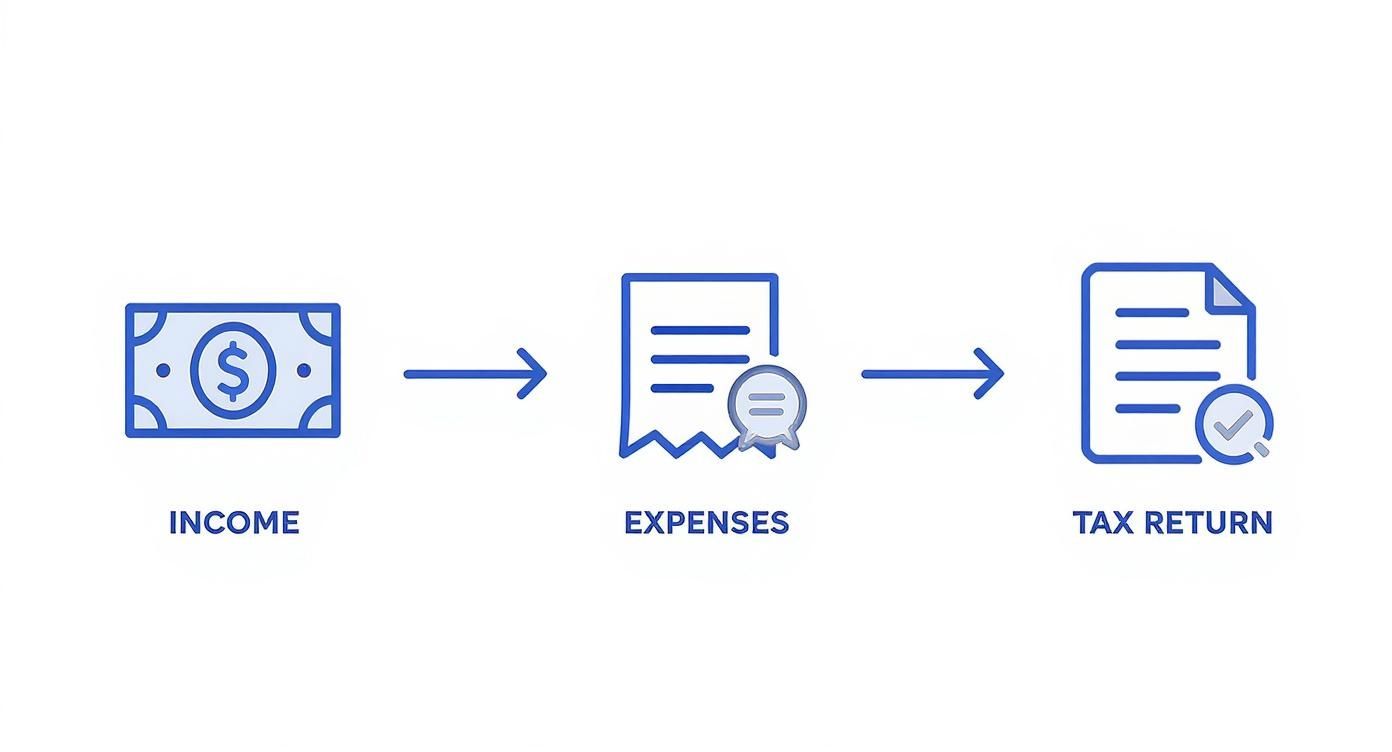
As the visual shows, solid record-keeping isn't just a good habit; it's the bedrock of an accurate tax calculation.
A Practical Walkthrough with a Freelance Consultant
Theory is one thing, but let's see how this works for a real person. Meet Alex, a freelance marketing consultant.
1. Projecting Total Income: Alex expects to clear $100,000 in net income this year after all business expenses are paid.
2. Calculating Self-Employment Tax:
- Net Earnings Subject to SE Tax: $100,000 x 0.9235 = $92,350
- Total SE Tax: $92,350 x 0.153 = $14,130
3. Finding Adjusted Gross Income (AGI): As a self-employed person, Alex gets to deduct half of that self-employment tax.
- SE Tax Deduction: $14,130 / 2 = $7,065
- AGI: $100,000 (Net Income) – $7,065 (SE Deduction) = $92,935
4. Determining Taxable Income: Alex is single and plans to take the 2024 standard deduction ($14,600) plus the QBI deduction.
- QBI Deduction: $92,935 (QBI) x 20% = $18,587
- Taxable Income: $92,935 (AGI) – $14,600 (Standard Deduction) – $18,587 (QBI) = $59,748
5. Figuring Out Total Tax Liability: Using the 2024 tax brackets for the income tax, Alex then adds the self-employment tax back in.
- Income Tax: $8,530 (calculated from the 2024 brackets)
- Total Annual Tax: $8,530 (Income Tax) + $14,130 (SE Tax) = $22,660
6. The Final Quarterly Payment:
- Quarterly Payment: $22,660 / 4 = $5,665
So, Alex needs to send the IRS a check for $5,665 each quarter. This entire calculation is laid out on the worksheet found in Form 1040-ES, Estimated Tax for Individuals.
Leveraging the Safe Harbor Rule
While forecasting your income is a solid strategy, there's an even simpler, penalty-proof alternative that I recommend to many clients: the safe harbor rule.
At its core, the rule is simple. You can avoid underpayment penalties by paying estimated taxes equal to 100% of your total tax liability from the previous year. Just take last year's total tax, divide it by four, and pay that amount each quarter.
There’s one key exception: if your AGI was over $150,000 last year, you need to pay 110% of the prior year's tax liability to qualify for the safe harbor. This method is incredibly popular for its simplicity—it requires zero guesswork about the current year.
This "safe harbor" is a powerful tool. Even if your income doubles this year, as long as you pay 100% (or 110% for high earners) of last year's tax, you're protected from underpayment penalties. You'll just need to settle the remaining balance when you file your annual return.
This approach gives you peace of mind, especially in years with unpredictable income growth. It lets you focus on your business without worrying about a penalty later on. While the principles differ, understanding tax calculations in various contexts can be helpful, as seen in guides on subjects like how to calculate Capital Gains Tax in the UK.
What If My Income Fluctuates? Using the Annualized Method
Calculating your estimated taxes is pretty straightforward if your income is consistent throughout the year. But let's be realistic—for most freelancers, consultants, and small business owners, steady income is a fantasy.
A wedding photographer might make the bulk of their money between May and October. A consultant could land a massive project in the first quarter and have a much quieter second half of the year. If this is you, paying the same large estimated tax payment every quarter can be a real cash flow killer during the lean months. You end up overpaying early on, only to feel the squeeze when you need that cash the most.
This is exactly why the annualized income method exists.
Paying What You Owe, When You Earn It
Think of this method as pay-as-you-go for taxes. Instead of taking your best guess for the entire year and dividing it by four, you figure out what you owe based on what you actually earned in each specific payment period. When you have a great quarter, you pay more. When things are slow, you pay less.
This approach is a lifesaver for anyone whose earnings are lumpy or seasonal. It does require more legwork—you're basically doing a mini tax return four times a year—but the improved cash flow is almost always worth the extra effort.
You should seriously consider this method if you are:
- A seasonal business owner, like a landscaper or a tax preparer, whose income is heavily concentrated in certain parts of the year.
- A freelancer with project-based work, where large payments come in unpredictably.
- Someone who had a big, one-time income event, like selling a bunch of stock for a large capital gain or getting a huge freelance bonus early in the year.
The goal here is precision. It helps you avoid having to choose between draining your bank account to overpay the IRS during a slow period or underpaying and getting hit with penalties. This isn't a niche problem, either. A 2022 survey found that 42% of small business owners said their income varied by more than 20% from quarter to quarter, making this a crucial tool for financial stability. You can discover more insights about managing quarterly tax payments for fluctuating income and see why this method is gaining traction.
The Bottom Line: The annualized method syncs your tax payments with your actual earnings. It demands diligent bookkeeping each quarter but gives you incredible flexibility and protects your cash flow.
How It Works in the Real World
With the annualized method, you'll be calculating your income and deductions separately for each payment period. The IRS has a specific worksheet for this, Schedule AI (Annualized Income Installment Method), which is part of Form 2210, Underpayment of Estimated Tax.
Let’s walk through a real-world scenario. Imagine a freelance graphic designer, Chloe, who has a fantastic start to her year.
- Period 1 (Jan 1 – Mar 31): Chloe lands a huge branding project and nets $30,000. Using the annualized method, she calculates her estimated tax based on this high-income period and makes a substantial payment by the April 15 deadline.
- Period 2 (Apr 1 – May 31): Things slow down. Chloe only earns $10,000 in net income.
- Period 3 (Jun 1 – Aug 31): Business picks back up, and she brings in a steady $15,000.
- Period 4 (Sep 1 – Dec 31): The year ends quietly with $8,000 in earnings.
For her second payment due June 15, Chloe doesn't just look at her income from April and May. She totals her income for the year so far ($40,000), annualizes it (projects what that would look like for a full year), figures out the total tax owed to date, and then subtracts the big payment she already made in April.
The result? A much smaller, more manageable payment for the second quarter that actually reflects her lower earnings. She'll repeat this same process for the September and January deadlines. By doing this, she avoided having to make another huge payment in June when her cash flow was tight. The calculations on Form 2210 are definitely more involved, but the result is a tax payment schedule that makes sense for her business.
Ditch the Spreadsheet: Tools That Make Tax Math Easy
Let's be honest, trying to calculate your estimated taxes with a pen, paper, and a calculator is a recipe for a headache. It's tedious, time-consuming, and makes it incredibly easy for a simple mistake to snowball into a big problem with the IRS.
Thankfully, we live in an age where technology can handle the heavy lifting. The right software can transform this dreaded chore into just another manageable part of running your business.
Modern accounting software is a true game-changer, especially for anyone navigating the world of quarterly payments. Platforms like QuickBooks Self-Employed, FreshBooks, and Wave were built from the ground up with freelancers and small business owners in mind.
These tools sync directly with your bank accounts and credit cards to pull in every transaction automatically. All you have to do is categorize your income and expenses as they happen. This gives you a live, up-to-the-minute picture of your finances and, crucially, what you're likely to owe in taxes.
Why You Should Use Accounting Software
The real magic of these platforms isn't just about organizing your books. It's about how they actively keep you compliant and help you find savings.
Here's where they really shine:
- Effortless Tracking: By syncing with your bank, you eliminate manual data entry. Every dollar is accounted for, which means you won't accidentally forget to report income or miss out on a valuable tax deduction.
- Live Tax Estimates: Most of these programs feature a running tax estimate that updates in real-time. As you log income and expenses, you can see exactly how much you should be setting aside for the IRS. No more guesswork.
- Painless Reporting: When a payment deadline rolls around, the software generates the reports you need. They summarize your income, expenses, and estimated tax due, making it much simpler to fill out Form 1040-ES with confidence.
If you're trying to figure out which tool is best for you, our guide to the top business expense tracking apps breaks down the options.
A 2023 survey revealed that 68% of small business owners and freelancers now rely on accounting software. The impact is significant: the IRS has seen a 25% drop in underpayment penalties among those who use these tools compared to those who don't. You can learn more about these tax trends and findings to see just how much of a difference technology makes.
Lighter Alternatives for Quick Calculations
Not quite ready to commit to a full accounting suite? No problem. There are plenty of dedicated tax calculators and mobile apps that offer a simpler approach for quick, on-the-fly estimates.
Many free online calculators can give you a solid projection of your quarterly payments. You just need to plug in your income and expense figures, and they'll do the math for you.
Ultimately, using these tools turns tax time from a source of anxiety into a routine business task. By automating the grunt work, you free up your time and mental energy to focus on what actually matters—growing your business—knowing your tax situation is handled.
Answering Your Top Questions About Estimated Taxes
Even when you've got the math down, the real world has a way of throwing curveballs. Estimated taxes are no exception, and there are a handful of "what-if" scenarios that pop up constantly for freelancers and small business owners.
Let's walk through some of the most common questions I hear. Think of this as your go-to guide for those tricky situations that the standard instructions don't always cover.
What If I Have a W-2 Job and a Side Hustle?
This is probably the most common scenario I see. You’ve got your day job, but you’re also driving for Uber, doing freelance design on the side, or running an Etsy shop. The great news is you have a really simple way to handle this without ever writing a check to the IRS for quarterly payments.
You can just adjust your tax withholding at your W-2 job.
All you have to do is fill out a new Form W-4 with your employer and ask them to withhold an additional, specific dollar amount from each paycheck. This extra withholding can be set to cover the taxes you expect to owe from all your side income.
The trick is to get a solid estimate of your total tax liability for the year—from both your salary and your business—and then divide that by your remaining pay periods. The IRS’s Tax Withholding Estimator is a fantastic tool for this. It’s a "set it and forget it" strategy that keeps your tax payments automated and off your mind.
What Happens If I Underpay My Estimated Taxes?
Underpaying is a common fear, and for good reason. If you don't pay enough tax throughout the year, the IRS can hit you with an underpayment penalty. This is basically an interest charge on the amount you should have paid by each quarterly deadline, even if you settle up in full by April 15th.
But don't panic. There are a few ways to avoid this penalty:
- You Owe Less Than $1,000: If your total tax due for the year (after subtracting withholding) is under $1,000, the IRS typically lets it slide.
- The Safe Harbor Rule: You're generally in the clear if you paid at least 90% of the tax you owe for the current year, OR 100% of the tax you owed for the previous year (110% for higher earners). This is the go-to safety net for most people.
- Annualized Income Method: If your income was really uneven—say, you’re a wedding photographer with a busy summer—you can use this method to show you paid the right amount of tax as your income came in.
If a penalty does happen, it’s not the end of the world. The IRS will calculate it for you when you file your return and simply add it to your final tax bill.
Can I Get a Refund If I Overpay?
Absolutely. It’s actually quite common to overpay, especially if it’s your first year in business and you want to play it safe. If you find you’ve sent the IRS more money than you actually owe, you have two options when you file your annual return.
You can ask for the difference back as a refund, or you can have the IRS apply the overpayment to next year's estimated taxes. Applying it forward is a great way to get a head start on the next year's obligations. Plus, a little financial discipline goes a long way. Looking into things like tax-efficient investing strategies can also help reduce your overall taxable income in the long run.
My advice? Aim for accuracy, but if you’re going to be wrong, be a little bit wrong in the IRS’s favor. An overpayment means you get your own money back. An underpayment means you’re giving the IRS extra money as a penalty.
What If I Miss a Payment Deadline?
It happens. Life gets busy, and a deadline slips by. If you miss a quarterly payment, the most important thing you can do is make that payment as soon as you realize it.
The underpayment penalty is calculated based on how much you underpaid and for how long you underpaid it. The clock is ticking. The sooner you pay, the smaller the penalty will be. Don't just wait for the next deadline to roll around—send in the missed payment right away. You can then adjust your next quarterly payment to get fully back on track.
At Allied Tax Advisors, we know that navigating the details of estimated taxes can be a headache. Our team is here to give you the personalized guidance you need to stay compliant, avoid penalties, and build a better financial strategy. Schedule a consultation with us today and let us simplify your tax journey.