
Getting a bigger tax refund isn't about uncovering secret loopholes. It's about being strategic and methodically applying the tax code in your favor. The whole game boils down to a simple, proven formula: fine-tuning your W-4 withholdings, claiming every single tax credit you're entitled to, and taking all eligible deductions to shrink your taxable income.
Your Blueprint for a Bigger Tax Refund

It’s easy to think of a tax refund as a surprise bonus from the government, but let's be clear: it's your money coming back to you. You simply overpaid during the year. While a big check feels great, the real goal of smart tax planning isn't just about the size of your refund; it’s about improving your entire financial picture. This guide is your playbook for doing just that—keeping more of the money you earn.
First, let's shift our perspective. Instead of giving the IRS an interest-free loan all year, you can adjust your finances to strike the right balance. Some people love a big refund as a form of forced savings, while others would rather have more cash in each paycheck. Understanding how it all works is the key to making the system work for you.
The Two Most Powerful Tools in Your Tax Toolkit
At the core of any refund-boosting strategy are the two heavy hitters the IRS gives us: tax credits and tax deductions. Knowing how they differ is the first real step toward building a solid plan.
-
Tax Credits: These are the superstars of tax savings. A tax credit is a dollar-for-dollar reduction of your final tax bill. So, a $1,000 credit literally chops $1,000 off what you owe. Some are even "refundable," which means you can get cash back even if you don't owe any tax at all.
-
Tax Deductions: These work a bit differently. Deductions lower your taxable income. For example, if you’re in the 22% tax bracket, a $1,000 deduction saves you $220 ($1,000 x 0.22). They aren't as powerful as credits, but they are absolutely essential for cutting down the amount of your income subject to tax in the first place.
This distinction is everything. A small credit can often save you more money than a much larger deduction, so you need to know where to focus your energy.
The Foundational Step Your W-4 Withholding
Before we even get into the weeds of specific credits and deductions, we have to talk about the foundation of it all: your Form W-4. This is the form you hand your employer that dictates how much federal income tax they pull from each paycheck.
An incorrectly filled-out W-4 is one of the most common culprits behind a disappointingly small refund or, worse, a big tax bill come April. I always tell my clients to review it once a year or anytime a major life event happens—getting married, having a baby, or a spouse changing jobs.
Getting your withholding right is a balancing act. Withhold too much, and you get that big refund (your loan to the government). Withhold too little, and you’ll be writing a check to the IRS. The goal is to find that sweet spot so you have the cash you need all year without getting hit with a surprise bill. Think of this as your strategic overview—now let's get into the specific tactics.
To get started, here's a quick look at the most effective strategies we'll be covering.
Key Strategies to Boost Your Tax Refund
| Strategy | How It Works | Best For |
|---|---|---|
| W-4 Optimization | Adjusting withholdings on your Form W-4 to control the amount of tax paid per paycheck. | W-2 employees, especially after life changes like marriage or a new child. |
| Tax Credit Maximization | Claiming dollar-for-dollar reductions on your tax bill for specific expenses or situations. | Families with children, students, low-to-moderate income earners, and homeowners. |
| Deduction Stacking | Lowering your taxable income by itemizing deductions or claiming above-the-line deductions. | Homeowners, high-income earners in high-tax states, and the self-employed. |
| Retirement Contributions | Contributing to tax-deferred accounts like a 401(k) or traditional IRA to reduce current taxable income. | Anyone with earned income looking to save for the future and get a current tax break. |
| Timing Income & Expenses | Deferring income to a future year or accelerating deductions into the current year. | Freelancers, business owners, and those with control over their payment schedules. |
This table is just a snapshot. Each of these strategies has nuances we’ll explore in detail to help you build a personalized plan.
Don't Just Settle for Deductions—Supercharge Your Refund with Tax Credits
If you really want to move the needle on your tax refund, you have to look past deductions and focus on tax credits. They're not the same thing, and the difference is huge for your bottom line.
Deductions are good; they lower your taxable income. But credits are great—they are a dollar-for-dollar reduction of the actual tax you owe. Think about it: a $1,000 deduction in the 22% tax bracket saves you $220. A $1,000 credit, however, saves you a full $1,000.
Even better, some credits are refundable. This is the holy grail of tax benefits. If a refundable credit is larger than the tax you owe, the IRS actually sends you the leftover amount as part of your refund.
Must-Have Credits for Parents
If you have kids, two credits should be at the top of your list: the Child Tax Credit (CTC) and the Child and Dependent Care Credit. They’re both aimed at helping families, but they work in very different ways.
The Child Tax Credit is pretty direct—it gives you a credit for each qualifying child under 17. A good chunk of it is often refundable, which means you could get money back even if you don't owe any income tax.
The Child and Dependent Care Credit is all about helping you cover the costs of care—like daycare, after-school programs, or summer camps—that you need to be able to work or look for a job. While it's a nonrefundable credit, it can make a massive dent in your tax bill, especially if you have significant childcare expenses.
Real-World Scenario: Let's look at Maria, a single mom with a six-year-old. She pays for an after-school program so she can keep her full-time job. She can claim the Child Tax Credit and the Child and Dependent Care Credit. Stacking these two benefits can easily reduce her tax bill by thousands of dollars.
The Earned Income Tax Credit: A Game-Changer for Your Refund
One of the most powerful, and sadly most missed, credits out there is the Earned Income Tax Credit (EITC). This is a refundable credit designed specifically to help low-to-moderate-income workers and families.
The amount you can get changes quite a bit depending on your income, filing status, and how many kids you have. The rules can feel a little complicated, which is why the IRS estimates that about one in five eligible people fail to claim it every single year. That's a lot of money left on the table. Taking the time to understand the EITC could be the single biggest thing you do to boost your refund. If you're unsure where you stand, it's worth taking a closer look at what the Earned Income Credit is and how to qualify.
Just how big of a deal are these credits? Well, for 2025, the Child Tax Credit is worth up to $2,000 per child, and the EITC can be as much as $7,430 for a family with three or more kids. In 2025, the IRS processed over 145 million returns, and the average refund was $2,939. You can bet that folks who correctly claimed the EITC and other credits saw refunds that were significantly higher than that average. You can always dig into the complete filing season statistics on the official IRS website.
Education Credits: Getting Paid to Learn
Paying for college or professional development courses? Don't forget to claim an education credit. The two main players are the American Opportunity Tax Credit (AOTC) and the Lifetime Learning Credit (LLC). You can only pick one per student each year, so it pays to know the difference.
Here’s a quick breakdown:
| Feature | American Opportunity Tax Credit (AOTC) | Lifetime Learning Credit (LLC) |
|---|---|---|
| Maximum Credit | $2,500 per eligible student. | $2,000 per tax return. |
| Refundable? | Yes, up to 40% ($1,000) is refundable. | No, this one is nonrefundable. |
| Who It’s For | Students in their first four years of college. | Undergrads, grad students, or professionals taking courses. |
| Course Load | Must be enrolled at least half-time. | No minimum—even one course counts. |
For most undergrads, the AOTC is the clear winner because it's worth more and is partially refundable. But the LLC is a fantastic tool for graduate students or anyone taking a class to sharpen their job skills, since you can claim it year after year. Making the right choice here is key to maximizing your savings.
Navigating Deductions: Standard vs. Itemized
When you sit down to do your taxes, you'll hit a critical fork in the road: do you take the standard deduction or itemize? This one decision can have a huge impact on your bottom line and is a cornerstone of any smart tax strategy.
Think of the standard deduction as the easy path. It’s a set dollar amount determined by the IRS that you can subtract from your income—no receipts, no fuss. For millions of people, it's the simplest and most effective way to lower their tax bill.
Thanks to the Tax Cuts and Jobs Act of 2017, those standard deduction amounts got a major boost, making them the go-to choice for even more taxpayers. But don't write off itemizing just yet. If you have certain high-dollar expenses, taking the time to itemize could unlock much bigger savings. As the pros at Chicago accounting firm Porte Brown often say, the right choice here can mean thousands of dollars back in your pocket each year.
When Itemizing Makes Sense
So, how do you know if you should bother with the extra paperwork? The rule of thumb is simple: if all your potential itemized deductions add up to more than your standard deduction, it's time to itemize.
It pays to run the numbers if you have significant spending in these areas:
- Mortgage Interest: This is the big one. For most homeowners, mortgage interest is the single largest deduction and the primary reason they choose to itemize.
- State and Local Taxes (SALT): This bucket includes your property taxes and either your state income or sales taxes. Just remember, there's a $10,000 cap per household on this deduction.
- Charitable Contributions: If you’re a generous giver, your cash and property donations to qualified charities can really add up.
- Medical and Dental Expenses: This one has a high bar—you can only deduct medical costs that exceed 7.5% of your adjusted gross income (AGI). But if you faced major health expenses during the year, it can be a lifesaver.
This flowchart gives you a good visual of how different life events can open the door to major tax benefits.
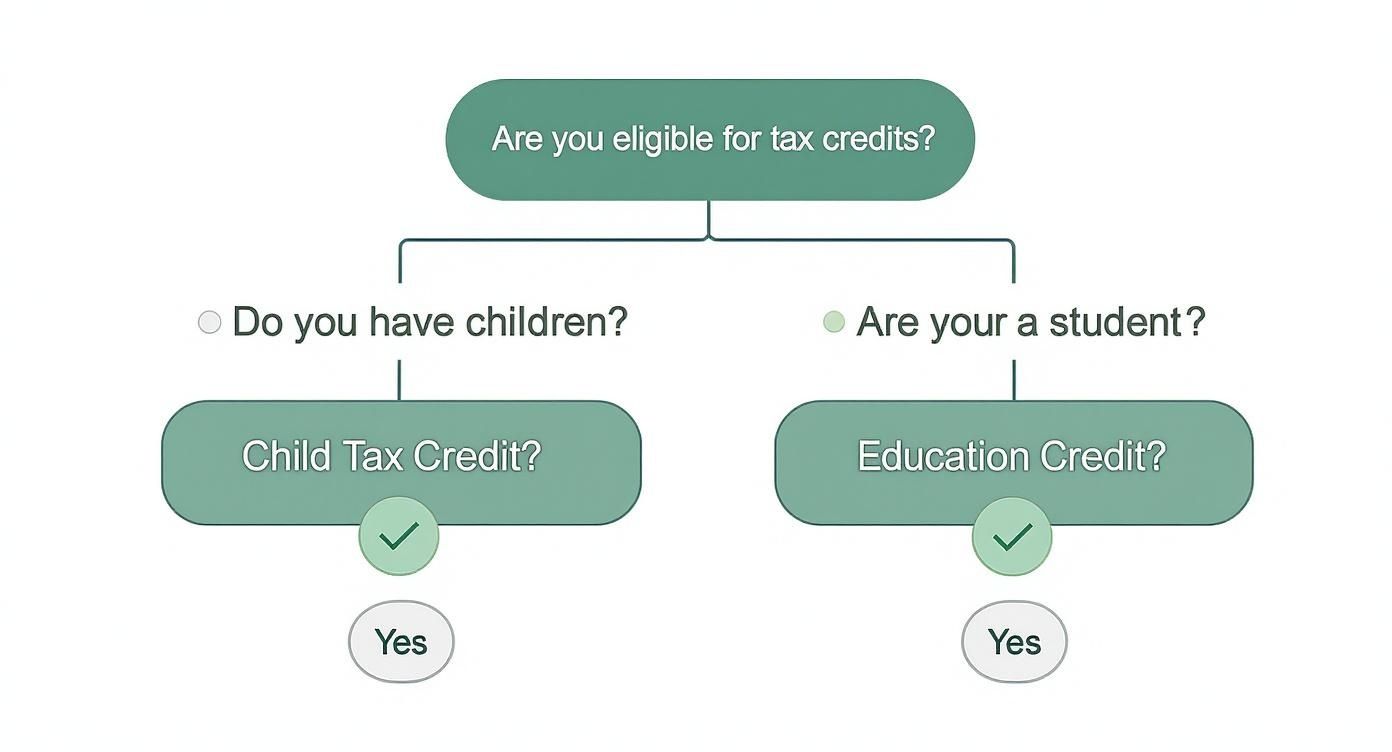
As you can see, things like having kids or paying for college are huge triggers for powerful credits that can slash your tax bill directly.
A Practical Example
Let's look at a real-world scenario. Meet Sarah, a single homeowner whose standard deduction is $14,600. She diligently tracked her expenses all year.
Here’s a breakdown of her potential itemized deductions:
| Expense Category | Annual Amount |
|---|---|
| Mortgage Interest | $8,500 |
| State Property & Income Taxes | $7,000 (deductible) |
| Charitable Donations (Cash) | $1,200 |
| Total Itemized Deductions | $16,700 |
In Sarah's case, her itemized total of $16,700 is $2,100 higher than her standard deduction. By taking the time to itemize, she gets to reduce her taxable income by an extra $2,100. That’s real money back in her wallet.
Don't just assume the standard deduction is your best bet, especially if you own a home or live in a high-tax area. Spending 30 minutes to add up your potential deductions could easily save you hundreds, if not thousands, of dollars.
Ultimately, the choice comes down to your unique financial picture. For a deeper dive, check out our detailed guide on the standard deduction vs. itemized deductions. Never leave money on the table—always do the math to see which path gives you the biggest tax win.
Tax Strategies for Investors and Self-Employed Pros

When you're an investor or work for yourself, you're playing a completely different tax game. It's more complex, sure, but it also unlocks a whole new playbook of strategies that W-2 employees just don't have access to. Knowing how to use these tools is the key to keeping more of your hard-earned money where it belongs—with you.
For investors, the name of the game is managing your gains and losses with surgical precision. For freelancers and business owners, it's all about tracking every single legitimate business expense to shrink your taxable income.
Smart Investing for a Lower Tax Bill
Successful investing isn't just about picking winners. It's about strategically managing the losers to your advantage through a tactic called tax-loss harvesting. In simple terms, you sell investments at a loss to cancel out the capital gains from your profitable trades.
This move directly cuts down the amount of profit you owe taxes on. What if your losses are bigger than your gains? You can deduct up to $3,000 of that excess loss against your regular income each year. Anything left over gets carried forward to future years to offset future gains.
Patience is also a powerful tax-saving tool. The IRS gives a serious discount to investors who hold their assets for more than one year.
- Short-Term Capital Gains: Profits from anything you've held for a year or less get taxed at your standard income rate, which can be as high as 37%.
- Long-Term Capital Gains: Hold it for more than a year and a day, and those profits are taxed at much friendlier rates—0%, 15%, or 20% for most people.
Holding onto a winning stock for just one extra day could literally save you thousands.
Essential Deductions for the Self-Employed
When you're the boss, almost every dollar you spend to run your business can become a tax deduction. The trick is knowing what qualifies and keeping flawless records. A dedicated Quickbooks virtual assistant can be a game-changer here, turning a chaotic shoebox of receipts into clean, audit-proof books.
I see it all the time—new freelancers are so afraid of an audit that they leave money on the table. The IRS expects you to deduct your ordinary and necessary business costs. Not doing so is like refusing a bonus.
Here’s a quick look at some of the most important write-offs you should be tracking. For a deeper dive, check out these other tax-saving strategies for freelancers and small business owners.
Below is a checklist of common business expenses that freelancers and independent contractors can write off to lower their taxable income.
Essential Deductions for the Self-Employed
| Deduction Category | What to Track | Pro Tip |
|---|---|---|
| Home Office | Square footage of your dedicated workspace, utilities, rent or mortgage interest, and property taxes. | The simplified option is $5 per square foot (up to 300 sq. ft.), but calculating actual expenses often results in a much larger deduction. |
| Vehicle Use | Total business miles driven, odometer readings, and costs for gas, maintenance, and insurance. | The standard mileage rate is easier, but tracking actual vehicle expenses is usually better if you have a newer or less fuel-efficient car. |
| Business Software & Subscriptions | Annual fees for project management tools, cloud storage, accounting software, and industry publications. | Scan your credit card statements once a month. It's amazing how many small, recurring subscriptions add up over a year. |
| Health Insurance Premiums | Monthly premiums paid for medical, dental, and vision insurance for yourself and your family. | This is an "above-the-line" deduction, meaning you don't need to itemize to claim it. It directly reduces your adjusted gross income. |
| Retirement Plan Contributions | Contributions to a SEP IRA, SIMPLE IRA, or solo 401(k). | These plans let you stash away a huge chunk of your income for retirement, and every dollar you contribute is a dollar off your current tax bill. |
Getting a handle on these investment and self-employment strategies can completely change your financial picture, turning tax time from a chore into an opportunity.
Advanced Moves for Year-Round Tax Planning
The biggest tax refunds aren't found by scrambling in April. They're built, piece by piece, with smart decisions you make all year long. Shifting your mindset from filing taxes to planning for them is the single most powerful way to keep more of your own money.
It means treating your tax situation as a living, breathing part of your financial life. Small adjustments and good habits throughout the year can add up to huge savings. It’s all about playing the long game.
Master the Art of Timing
One of the most effective strategies that people often overlook is controlling when you get paid and when you pay your bills. This is a game-changer if you expect your income to change next year, maybe from a promotion or a career shift.
The concept is pretty straightforward:
-
Pull Deductions Forward: If you plan on itemizing, you can pay for certain expenses a little early to claim the deduction this year instead of next. For example, making your January mortgage payment in late December pulls that interest deduction into the current tax year. The same goes for prepaying your state income taxes or making that big charitable donation before December 31.
-
Push Income Back: If you're a freelancer or small business owner, you have some control over billing. By invoicing a client in late December, you can ensure the payment doesn't land in your bank account until January. This shoves that income into the next tax year, which is a huge win if you anticipate being in a lower tax bracket.
This isn't about tax evasion; it's about smart timing. You're strategically placing income and deductions into the tax years where they'll do you the most good. One well-timed move can literally shift hundreds of dollars in tax liability.
Ditch the Shoebox for Digital Records
If you're serious about maximizing your refund, meticulous record-keeping is non-negotiable. That old shoebox stuffed with crumpled receipts? That’s a one-way ticket to missed deductions and a panic attack if the IRS ever sends a letter.
Technology makes this so much easier today. Get a dedicated app or just use a simple spreadsheet to track your expenses as they happen. Snap a photo of a receipt for a business lunch the second you pay. Fire up a mileage-tracking app every time you drive for work.
When you digitize as you go, you create an organized and searchable system that's practically audit-proof. This is how you make sure you claim every single deductible expense, from a $5 software subscription to a $500 donation.
Another key part of long-term planning involves looking at tax-advantaged investment accounts. For instance, understanding strategies for maximizing tax-free growth through vehicles like a Roth IRA or TSP can dramatically reduce your tax burden in retirement.
Knowing When to Call a Professional
Listen, DIY tax software has come a long way. But there are absolutely times when going it alone is a costly mistake. Bringing in a tax pro isn't giving up; it's a strategic investment. Their expertise can uncover savings that far outweigh their fee.
So, when is it time to call for backup?
- You started a business or have side-hustle income. The self-employment world is a minefield of complex deductions and rules. A pro ensures you claim everything you're entitled to without raising red flags.
- You had a major life event. Getting married, divorced, buying a home, or receiving an inheritance can create tax situations that off-the-shelf software just can't handle with nuance.
- Your investments are getting complicated. If you're juggling rental properties, crypto, or employee stock options, an expert can provide critical guidance to minimize your tax hit.
It’s also crucial to know who you’re hiring. A Certified Public Accountant (CPA) is great for broad financial planning, while an Enrolled Agent (EA) is a deep specialist in all things tax, licensed directly by the IRS. Either one can represent you if the IRS comes knocking. Their guidance turns tax prep from a yearly headache into a pillar of your long-term financial strategy.
Common Questions We Hear About Tax Refunds
Even with the best game plan, taxes can be tricky. Over the years, I've heard just about every question in the book. Let's walk through some of the most common ones that pop up when people are trying to get the most out of their tax return.
Is a Big Refund Really a Good Thing?
This is the classic debate, isn't it? Getting a huge check from the IRS feels fantastic, like winning a small lottery. But here's the reality: that "refund" is just the government returning the money you overpaid them throughout the year. You essentially gave them an interest-free loan.
From a pure financial strategy standpoint, the goal should be to get as close to a $0 refund as possible. By fine-tuning your W-4 withholding at work, you keep more of your money in your pocket with every paycheck. That cash can be chipping away at a credit card balance or growing in an investment account all year long, instead of sitting with the IRS.
However, I get it. For some people, that big refund is a forced savings account. It’s the one time of year they have a lump sum to buy a new appliance or finally build up an emergency fund. Whether it's "good" or "bad" really comes down to your personal financial discipline.
I Messed Up a Past Return. Is It Too Late to Fix It?
Absolutely not. So many people don't realize they have a do-over button. The IRS lets you go back and amend a tax return for up to three years from the date you originally filed it (or two years from when you paid the tax, whichever is later).
The tool for this is Form 1040-X, Amended U.S. Individual Income Tax Return. Let's say you just realized you never claimed the American Opportunity Tax Credit for your daughter's sophomore year of college two years ago. You can file an amendment for that year and get that money back. Don't leave your hard-earned cash on the table just because of a past oversight.
Is Tax Software Just as Good as a CPA?
For a lot of people, yes. If your financial situation is pretty straightforward—you have a W-2 job, maybe some student loan interest, and you take the standard deduction—today's tax software like TurboTax or H&R Block is excellent. These programs are designed to ask the right questions to find common credits and deductions you qualify for.
But the moment your finances get a little more complex, the value of a human expert—a CPA or an Enrolled Agent (EA)—becomes crystal clear.
Tax software is a great tool for filling out forms, but a tax professional provides strategy. They don't just look at last year; they help you plan for the next five years, navigating complex situations that software can't interpret with human nuance.
You should seriously consider hiring a pro if you:
- Run a business or have freelance income
- Own rental properties
- Bought or sold a home or other real estate
- Went through a major life event like a marriage, divorce, or received an inheritance
The fee you pay is often an investment that pays for itself many times over in tax savings and, just as importantly, peace of mind.
What's the Biggest Mistake People Make That Kills Their Refund?
Without a doubt, one of the costliest and most common errors is choosing the wrong filing status. I've seen it happen countless times. A single parent who provides all the support for their child files as 'Single' when they actually qualify for 'Head of Household.' That simple mistake costs them a much larger standard deduction and better tax brackets, leaving potentially thousands of dollars behind.
Another huge one is simply overlooking refundable credits, especially the Earned Income Tax Credit (EITC). Millions of eligible people fail to claim the EITC every year, often because the rules seem intimidating. This credit can be worth over $7,000 in some cases. Missing it is one of the single biggest financial blunders a taxpayer can make.
Finally, a dangerous trend is the use of "ghost preparers." These are preparers who charge a fee but refuse to sign the return or provide their official Preparer Tax Identification Number (PTIN). This is a massive red flag. It often means they're making fraudulent claims on your behalf, and when the IRS comes knocking, you're the one on the hook for audits and penalties. Always make sure your preparer is legitimate and signs your return.
At Allied Tax Advisors, we believe that expert guidance is the key to financial confidence. Whether you're navigating complex investments, managing a small business, or simply want to ensure you're not leaving money on the table, our team of CPAs and Enrolled Agents is here to help. Discover how our personalized tax planning can optimize your finances by visiting us at https://alliedtax.com.