
When you're squaring off with the IRS, it’s not about winning a fight. It’s about understanding the rulebook and presenting a case based on one thing: what you can realistically afford to pay.
There are two main roads you can go down. The first is an Offer in Compromise (OIC), which is basically a settlement for less than what you owe. The other is an Installment Agreement, where you agree to pay the full amount, just spread out over time. Getting either one approved comes down to providing solid financial proof and choosing the right path for your specific circumstances.
Understanding Your IRS Negotiation Options

It’s easy to feel overwhelmed by an IRS notice, but this isn't a battle you have to lose. At its core, the IRS is a collections agency, and like any creditor, its main goal is to get paid. That simple fact is what opens the door to negotiation.
Before you even think about picking up the phone, the most powerful move you can make is to understand how the IRS views you. It all boils down to one simple question: What is your ability to pay?
The entire negotiation process is built on the answer to that question. So, instead of seeing this as a confrontation, reframe it. You're simply presenting the facts of your financial life. Your job is to tell a clear, documented story that leads the IRS to the logical conclusion you're proposing.
The Core of Every Negotiation: Your RCP
At the heart of any discussion with the IRS is a formula they call Reasonable Collection Potential (RCP). This isn't just internal agency jargon; it's the exact calculation the IRS uses to figure out the absolute minimum it will accept to clear your debt. Think of your RCP as the sum of your net assets plus your future disposable income.
Understanding this formula is your secret weapon. The IRS isn't making an emotional judgment call here. It’s making a business decision based on cold, hard numbers. Your RCP tells them what they could realistically expect to get if they came after you with levies or wage garnishments.
Here’s a simplified look at what goes into that RCP calculation:
- Assets: This includes the "quick-sale" value of your property, cars, bank accounts, and any investments.
- Future Income: They take your gross monthly income, subtract your allowable monthly living expenses (based on their national and local standards), and then multiply that figure over a set number of months.
When you know how the IRS calculates what you're worth to them, you can frame your offer in a language they understand. This turns a stressful, reactive situation into a strategic and controlled one.
The goal isn't to hide assets or fudge your income. It's about presenting a complete and accurate financial picture, backed by documentation, to justify a resolution you can actually live with.
Two Paths to Resolution: OIC vs. Installment Agreement
Once you have a firm grip on your financials, you can figure out which negotiation path makes the most sense. For the vast majority of taxpayers, it comes down to choosing between an Offer in Compromise and an Installment Agreement.
An Offer in Compromise (OIC) is an agreement to settle your entire tax liability for less than you originally owed. This is the path for people in genuine financial distress. The IRS only accepts an OIC if they believe it's the absolute most they could ever hope to collect from you. To even have a shot, your RCP must be less than your total tax debt.
On the other hand, an Installment Agreement is a structured payment plan to pay your tax debt in full over an extended period. This is the right move if your financials show you can pay the full amount, just not in one lump sum. The negotiation here is all about landing on a monthly payment that you can sustain and that the IRS finds acceptable.
Comparing Your IRS Negotiation Strategies
Here’s a quick look at the two main paths for resolving your tax debt to see which one fits your financial reality.
| Negotiation Method | Best For | Key Requirement | Potential Outcome |
|---|---|---|---|
| Offer in Compromise | Taxpayers with low income and few assets who simply cannot pay in full. | Proving your RCP is less than your total tax debt. | Settling your entire tax debt for a significantly reduced amount. |
| Installment Agreement | Taxpayers who have the ability to pay the full debt over time. | Demonstrating you can make consistent monthly payments. | Paying off your full tax debt in manageable monthly installments. |
Choosing the right strategy from the start is absolutely crucial. If you propose an OIC when your financial documents clearly show you can afford an Installment Agreement, you’re just setting yourself up for a quick rejection and a lot of wasted time.
Assembling Your Financial Case for the IRS

When you're sitting across the table from the IRS—even a virtual one—your words carry weight, but your documents tell the real story. A successful negotiation isn't built on good intentions or heartfelt explanations. It's built on a foundation of cold, hard proof.
Think of it this way: you're building a legal case. Every document is a piece of evidence supporting your claim that you simply cannot pay the full tax debt right now. This isn't about dumping a shoebox of receipts on their desk; it’s about strategically building a portfolio that paints a clear, undeniable picture of your financial reality.
The Cornerstone: Your Collection Information Statement
The whole process really hinges on one key document. For most people, that's Form 433-A (OIC) if you're aiming for an Offer in Compromise, or Form 433-F for other collection issues. This is your Collection Information Statement, and it’s a deep dive into your entire financial life—from what you earn each month to the blue book value of your car.
Getting this form right is non-negotiable. The IRS will crunch the numbers you provide to calculate your "Reasonable Collection Potential" (RCP), which is their formula for what you can afford to pay. Every single number you put on that form needs to have a document to back it up. No exceptions.
A little prep work here goes a long way. I always advise clients to map everything out on a spreadsheet first. It helps you get your numbers straight before you ever touch the official PDF. For the final step, you might find that filling PDF forms directly from Excel data can be a lifesaver, ensuring accuracy and saving a ton of time.
Gathering Proof of Income and Assets
First, you need to show the IRS what you have coming in and what you own. They need to verify every income stream and assess the value of any assets that could theoretically be sold off to cover your tax bill.
Get ready to pull together copies of:
- Recent Pay Stubs: The last three to six months is usually the standard.
- Bank Statements: Again, the last three to six months for all accounts. They’ll be looking at deposits and spending habits.
- Investment and Retirement Account Statements: The most recent statements from your 401(k), IRAs, brokerage accounts, etc.
- Proof of Other Income: Got a side hustle? Rental income? Alimony? You'll need documentation for all of it.
This level of detail is what makes or breaks a case. For instance, we had a client who owed $206,258 and was able to settle the entire debt for just $15,850. The key was a meticulously prepared Offer in Compromise backed by a mountain of organized proof. That's a staggering savings of $190,408, all because the paperwork was airtight.
Pro Tip: Don't just hand over a chaotic stack of papers. Draft a simple cover letter explaining your situation and organize your documents into a binder with labeled tabs for income, assets, and expenses. It shows the IRS agent you're taking this seriously and makes their job easier—which can only work in your favor.
Documenting Your Necessary Living Expenses
Just as critical as what you earn is proving where that money goes. The IRS has national and local standards for what they consider "necessary" living expenses, but for many categories, you have to prove your actual costs. The goal is to show them that after your essential bills are paid, there's little or nothing left for the tax debt.
Make sure you have the paperwork to back up your monthly expenses:
- Housing and Utilities: Your most recent mortgage statement or a copy of your lease, plus recent utility bills (gas, electric, water).
- Transportation: Car loan or lease statements, proof of insurance, and if your costs are high, records of fuel and maintenance.
- Health Care: Statements for health insurance premiums, plus receipts for significant out-of-pocket costs or prescriptions.
- Other Mandatory Payments: If you have court-ordered payments like child support, you’ll need the official documentation.
When you meticulously assemble this package, you're no longer just asking for a break. You're presenting a data-driven argument. You’re giving the IRS agent everything they need to come to the same conclusion you have: that the deal you’re proposing is the best they can realistically hope to collect.
Submitting a Winning Offer in Compromise
Think of an Offer in Compromise (OIC) less as a simple settlement request and more as a detailed financial argument. You're essentially proving to the IRS that accepting a lower amount now is the most they can realistically expect to ever collect from you. Getting one approved isn't about asking nicely; it’s about building a rock-solid case based on their own rules.
The first step is figuring out which of the three official grounds for an OIC fits your situation. This is the foundation of your entire application.
- Doubt as to Collectibility: This is the most common path. You're making the case that, based on your current income, assets, and future earning potential, you simply will never be able to pay the full tax debt before the collection statute expires.
- Doubt as to Liability: This one is rare. You'd use this if you have a legitimate reason to believe the tax was assessed in error and you don't actually owe it in the first place.
- Effective Tax Administration (ETA): This is a special circumstance. You might have the assets to pay the debt in full, but doing so would create an extreme economic hardship—for example, forcing you to liquidate your home and leaving you unable to afford basic living expenses.
The infographic below gives a great overview of how payment schedules are structured, which is a key concept whether you're proposing a lump-sum OIC or a long-term installment plan.
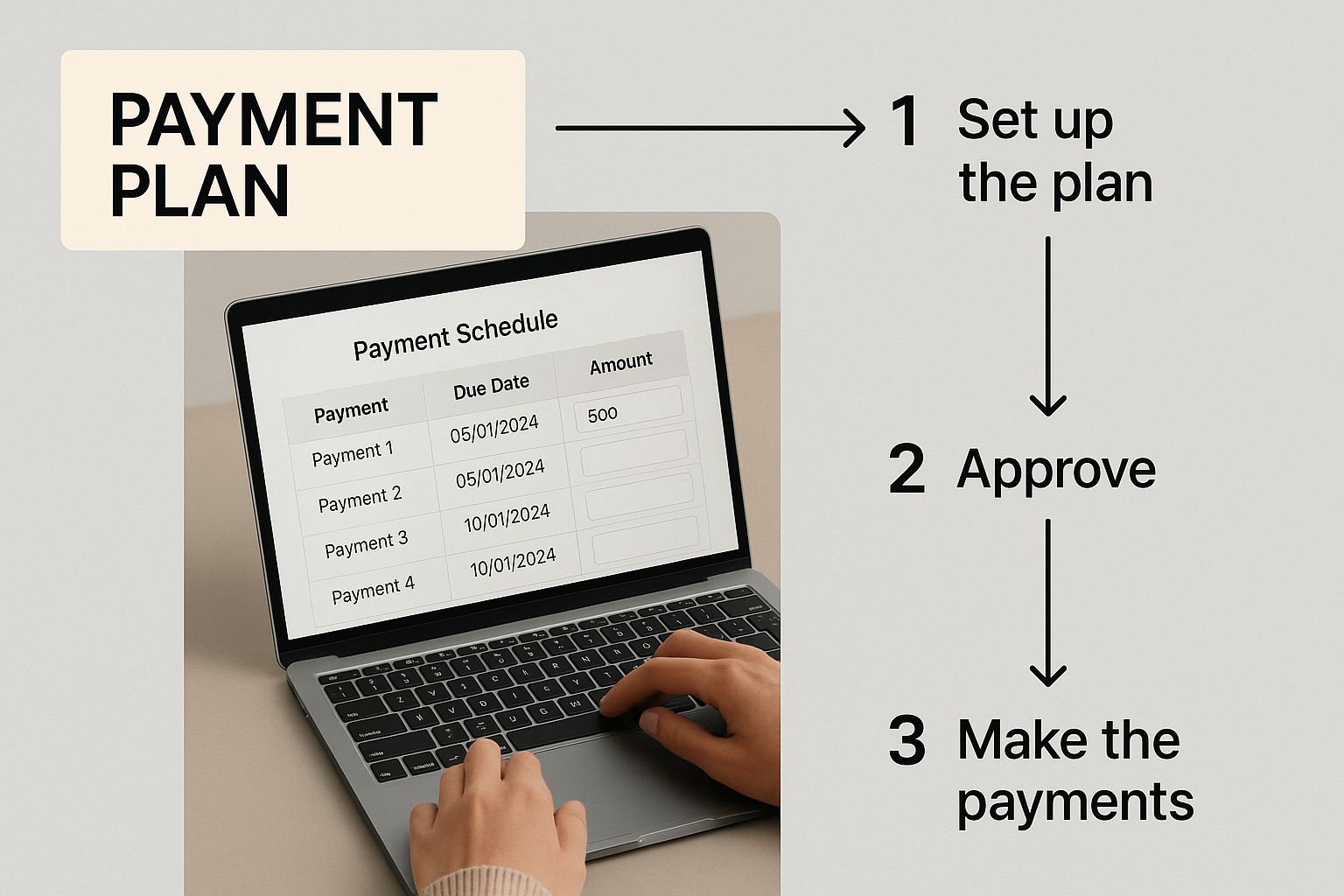
This kind of structured thinking is exactly what the IRS wants to see when you present your offer.
Calculating a Realistic Offer
The IRS runs on numbers, not sob stories. Your offer will be accepted or rejected based on a rigid formula that determines your Reasonable Collection Potential (RCP). The amount you offer must be equal to or greater than your calculated RCP.
To figure this out, you need to put on your IRS agent hat. The formula is a combination of what your assets are worth and how much income you have left over after essential expenses.
- Asset Calculation: Tally up the "quick sale value" of your assets (think real estate, vehicles, bank accounts) and then subtract any outstanding loans against them.
- Income Calculation: Start with your total monthly income and then subtract the IRS's allowable living expenses for your area. The leftover amount is your disposable income.
From there, the IRS multiplies your disposable income by either 12 (if you plan to pay the offer in five months or less) or 24 (if you'll pay it over 6 to 24 months). Add that number to your net asset value, and you have your RCP. This calculation is critical, and you can learn more about it in our comprehensive guide to understanding the IRS Offer in Compromise.
Crafting a Compelling Hardship Narrative
While the math is the core of your OIC, your personal story provides the context that can make all the difference, especially if you're arguing for an ETA. This narrative needs to explain why you fell behind on your taxes.
Keep it factual, concise, and backed up with documentation. Was there a sudden job loss that drained your savings? A medical emergency with crippling bills?
I once worked with a client who owed $75,000 after their small business went under. We were able to settle that debt for just $5,000. The key was a clear narrative explaining the business failure, supported by final business records and proof of their current, much lower-paying job. We demonstrated that their financial reality had fundamentally and permanently changed.
Navigating the Low Acceptance Rate
It's crucial to go into the OIC process with your eyes open. The reality is, many offers are rejected, but knowing why can help you build a much stronger case from the get-go.
Statistics from the Taxpayer Advocate Service show that the acceptance rate for OICs often hovers between 30% and 45%. That's a tough number. But the data also reveals something fascinating: for the rejected offers, the IRS's own calculated RCP was typically 7 to 10 times higher than what the taxpayer offered.
This huge disconnect shows just how important it is to align your offer with the IRS's own formulas. Submitting a lowball offer without the financial data to back it up is one of the fastest ways to get rejected. Your goal isn't to propose what you want to pay; it's to prove what is the absolute most the IRS can ever hope to collect. When you take that data-driven approach, your chances of success increase dramatically.
Setting Up a Manageable IRS Payment Plan
So, you owe the IRS, but you don't have a pile of cash sitting around to pay it all at once. If you have a steady income, an IRS Installment Agreement is almost always your best bet. It’s a completely different animal from an Offer in Compromise—you’re not trying to settle for less, you’re just asking to pay what you owe over time. This turns a terrifying lump-sum bill into a manageable monthly payment.
The real advantage here is peace of mind. As soon as you have an approved Installment Agreement, the IRS has to back off. That means no more threats of wage garnishments or bank levies. For most people, this is the most practical way to get back on their feet without having to prove the kind of severe financial hardship an OIC demands.
Don't Wait for Them to Call You
Your first move is everything. If you wait for the IRS to start chasing you, you’re immediately on the back foot. By reaching out to them first to set up a payment plan, you signal that you're taking this seriously and want to make things right. It completely changes the tone of the conversation.
I can't stress this enough: how you communicate with the IRS shapes the entire outcome. The agency is far more willing to work with taxpayers who come to them proactively. It shows good faith and often results in more flexible terms. Just by picking up the phone, you put yourself in a much stronger position. This article from J. David Tax Law has some great insights on how proactive communication can lead to better deals.
Finding the Right Agreement for Your Situation
The IRS isn’t a one-size-fits-all organization. They have a few different payment plans, and which one you get depends on how much you owe and how fast you can clear the debt.
-
Guaranteed Installment Agreement: If your total bill—including tax, penalties, and interest—is $10,000 or less, the IRS is pretty much required to give you a payment plan. The main condition is that you have to agree to pay it all off within three years.
-
Streamlined Installment Agreement: This is the most common route. If you owe less than $50,000, you can usually set up a payment plan online that gives you up to 72 months to pay. The best part? You typically don't have to fill out a mountain of financial paperwork to get it approved.
-
Non-Streamlined Installment Agreement: Once your debt climbs over $50,000, things get more complicated. You'll need to submit a full Collection Information Statement (Form 433-F) to prove what you can afford and negotiate directly with an IRS agent.
How to Negotiate Your Monthly Payment
When you’re in that over-$50,000 bracket, the negotiation is all about one thing: what can you realistically afford to pay each month? This isn't a number you just guess at. It's calculated directly from the financial details you provide on your Collection Information Statement.
Your job is to justify a payment you can actually live with by clearly showing your necessary living expenses. Get ready to have a detailed conversation about your budget with an IRS agent, covering everything from your rent or mortgage to groceries and car payments.
Here's a sample script you can adapt:
"Looking at my Form 433-F, my monthly income is $4,500, and my necessary living expenses come to $4,150. That leaves me with $350 of disposable income. I can commit to a monthly payment of $325, which allows me to consistently meet my obligation while leaving a tiny cushion for emergencies."
This approach grounds the negotiation in hard numbers. If the agent pushes for a higher payment, you don’t have to get emotional or defensive. You can simply point back to your documentation. "I understand you're aiming for a higher amount, but as my bank statements show, my basic living costs leave very little wiggle room. A payment higher than $325 would mean I couldn't cover my rent."
Using data from your own financial life is the most powerful tool you have to lock in a payment plan that you can actually see through to the end.
Knowing When to Call in a Pro
There's a temptation to handle everything with the IRS yourself. I get it. But sometimes, going it alone is like bringing a pocketknife to a sword fight. Knowing when to tag in a professional isn't a sign of weakness—it's a smart, strategic move that can level the playing field.
Think of it this way: a good tax professional doesn't just know the rules; they know the unwritten rules. They speak the IRS's language fluently and can navigate the bureaucracy in ways most taxpayers simply can't.
Red Flags That Scream "Get Help Now"
While many minor tax issues can be handled on your own, certain situations are clear indicators that you’re in over your head. If any of these sound familiar, the cost of a professional is an investment that can save you thousands of dollars, not to mention sleepless nights.
Here are the most common triggers I see that mean it's time to make the call:
- The Debt is Over $50,000: Once you cross this threshold, the IRS playbook changes. The collection process gets more serious, and the simpler "streamlined" payment plans are often no longer an option. You're now in the territory of detailed financial disclosures and formal negotiations.
- The IRS is Taking Action: If you’ve received a notice of a wage garnishment, a bank levy, or a federal tax lien, the clock is ticking. This isn't just a letter anymore; it's active enforcement. A pro can often step in immediately to request a temporary hold on these actions while they work out a permanent solution.
- You Owe Payroll Taxes: The IRS does not mess around with payroll taxes, also known as Trust Fund taxes. They can and will hold business owners and other responsible parties personally liable for this debt. This is a complex area that absolutely requires expert guidance.
- You're Years Behind on Filing: You can't negotiate a debt until you're fully compliant, which means all your past-due returns must be filed. A tax pro can help reconstruct records and prepare these returns accurately to minimize additional penalties before you even start the negotiation process.
Understanding Your Professional Options
Not all tax pros are created equal, and choosing the right one depends on your specific mess. There are three main types of professionals licensed to represent you before the IRS: Enrolled Agents (EAs), Certified Public Accountants (CPAs), and Tax Attorneys.
| Professional | Specialization | When to Hire Them |
|---|---|---|
| Enrolled Agent (EA) | Deep specialists in tax law and IRS representation. It's all they do. | The go-to for most complex tax debt cases, like Offers in Compromise or tricky Installment Agreements. |
| CPA | Broad accounting and financial expertise, including tax planning and prep. | A great choice if your issues stem from business accounting or you need to file multiple years of back taxes. |
| Tax Attorney | Legal experts who specialize in tax law. | Essential for situations with potential criminal charges, tax court appeals, or deep legal disputes. |
For most people trying to figure out how to negotiate with IRS debt, an Enrolled Agent is usually the most direct and cost-effective expert for the job.
Remember, the IRS isn’t a faceless monster. It's a system run by people following a complex set of rules. A good representative knows those rules inside and out and can use them to protect your rights and find the best possible resolution.
Watch Out for "Tax Relief" Scams
Sadly, where there's fear, there are predators. The tax relief industry is filled with companies that make wild promises to vulnerable people. They'll blast ads promising to settle your debt for "pennies on the dollar" before they even know your name.
Steer clear of any company that:
- Guarantees they can slash your debt before even looking at your financials.
- Demands a huge upfront fee before they've done any real work.
- Uses high-pressure sales tactics to get you to sign a contract on the spot.
A true professional will start by conducting a thorough review of your tax history and financial situation. They’ll be upfront about their fees and give you a realistic assessment of your options. As you look for help, keep in mind that expertise in tax preparation services is a foundational skill for any legitimate resolution firm.
You can learn more about what to expect when you explore how a professional tax accountant can help resolve IRS issues to better understand the process.
Answering Your Top Questions About IRS Negotiations
Even the best-laid plans can hit a snag, and when you're dealing with the IRS, it's natural to worry about the "what ifs." Thinking through these common questions ahead of time can give you the clarity and confidence you need to see the process through.
Let's break down some of the most frequent concerns that come up when you're getting ready to talk to the IRS.
What Happens if the IRS Rejects My Offer in Compromise?
Getting an OIC rejection letter can feel deflating, but I always tell my clients it’s not the end of the road. In fact, it's often just part of the process. The IRS has to give you a specific reason for the denial, and that explanation is gold—it tells you exactly what you need to fix.
Usually, a rejection means the IRS calculated your Reasonable Collection Potential (RCP) and found it was higher than your offer. From the date on that rejection letter, you have 30 days to file an appeal. This is your chance to correct their numbers, provide new information they might have missed, or argue why your assessment of your financial situation is more accurate.
If the appeal doesn't work out, don't panic. You can immediately pivot to negotiating an Installment Agreement. A rejection isn't a "no forever," it's just a signal to try a different strategy.
Can I Negotiate IRS Penalties and Interest?
Yes, and you absolutely should try. Negotiating penalties can slash your total debt significantly. The official term for this is Penalty Abatement, and the most common way to get it is by showing you had "reasonable cause" for not filing or paying on time.
What counts as reasonable cause? Think of major life events that were out of your control:
- A severe illness or a death in the immediate family that disrupted everything.
- Your home or business records were lost in a flood, fire, or another disaster.
- You relied on bad advice from a tax professional who should have known better.
There's also a fantastic option called the First-Time Penalty Abatement waiver. If you've been a model taxpayer for the past three years (no penalties, all filings on time), the IRS will often agree to waive penalties as a one-time courtesy.
Now, when it comes to interest, you can't negotiate the rate itself—it's set by law and compounds daily. But, here's the key: when you reduce the principal tax debt or get penalties abated, the amount of interest you owe automatically drops, too. This is why tackling penalties head-on is so important. Many people don't realize that simple, honest mistakes can trigger hefty penalties, which is why it's always a good idea to check for common tax filing mistakes to avoid and how to fix them before you even get to the negotiating table.
Does Negotiating with the IRS Affect My Credit Score?
This is a big one, and the answer is both no and yes.
Directly, your negotiations with the IRS are a private matter. The IRS doesn't report your tax debt or your payment plan to credit bureaus like Experian, Equifax, or TransUnion. So, setting up an Installment Agreement won't show up on your credit report.
But there's a serious indirect risk. If the tax debt is large enough and you ignore it, the IRS can file a Notice of Federal Tax Lien. This is a public legal claim against your property, and credit bureaus absolutely scoop up that public information. A tax lien can do serious damage to your credit score.
The best defense is a good offense. By proactively setting up a payment plan, you can often prevent a lien from ever being filed. If a lien is already in place, getting into a Direct Debit Installment Agreement and making a few on-time payments can make you eligible to apply for a lien withdrawal, helping your credit score bounce back much sooner.
At Allied Tax Advisors, we know that facing the IRS is a heavy burden. Our team of experienced CPAs and Enrolled Agents is here to lift that weight, offering the expert guidance you need to negotiate effectively and find financial peace of mind. Visit us at https://alliedtax.com to schedule a consultation and take the first step toward resolving your tax issues.