
Getting ready for tax season isn't just a mad dash in April. The secret to a stress-free filing experience is to start early, keep meticulous records, and have a clear game plan. When you treat tax prep as a year-round habit instead of a last-minute chore, you turn a potential headache into a straightforward, manageable process.
Your Blueprint for a Stress-Free Tax Season
Let’s be honest, nobody loves tax season. But it doesn't have to be a nightmare. The trick is to shift from a reactive scramble to a proactive strategy. From our years of experience, a successful tax prep process always comes down to the same four fundamentals: gathering your documents methodically, understanding your full financial picture, choosing the right way to file, and carefully reviewing everything before you hit "submit."
This simple framework demystifies the whole thing. Instead of frantically searching for a misplaced W-2 in April, you’ll know exactly where it is. Rather than guessing at business expenses, you’ll have organized receipts ready to go. The goal is to build a system that gives you confidence and control, making tax time a simple checkpoint, not a major hurdle.
Visualizing Your Tax Year
Breaking down the year into manageable chunks is the best way to stay on track. A visual timeline helps you see what needs to be done and when, preventing that last-minute panic. This simple graphic lays out the key phases, from gathering documents as the year closes to filing by the April deadline.
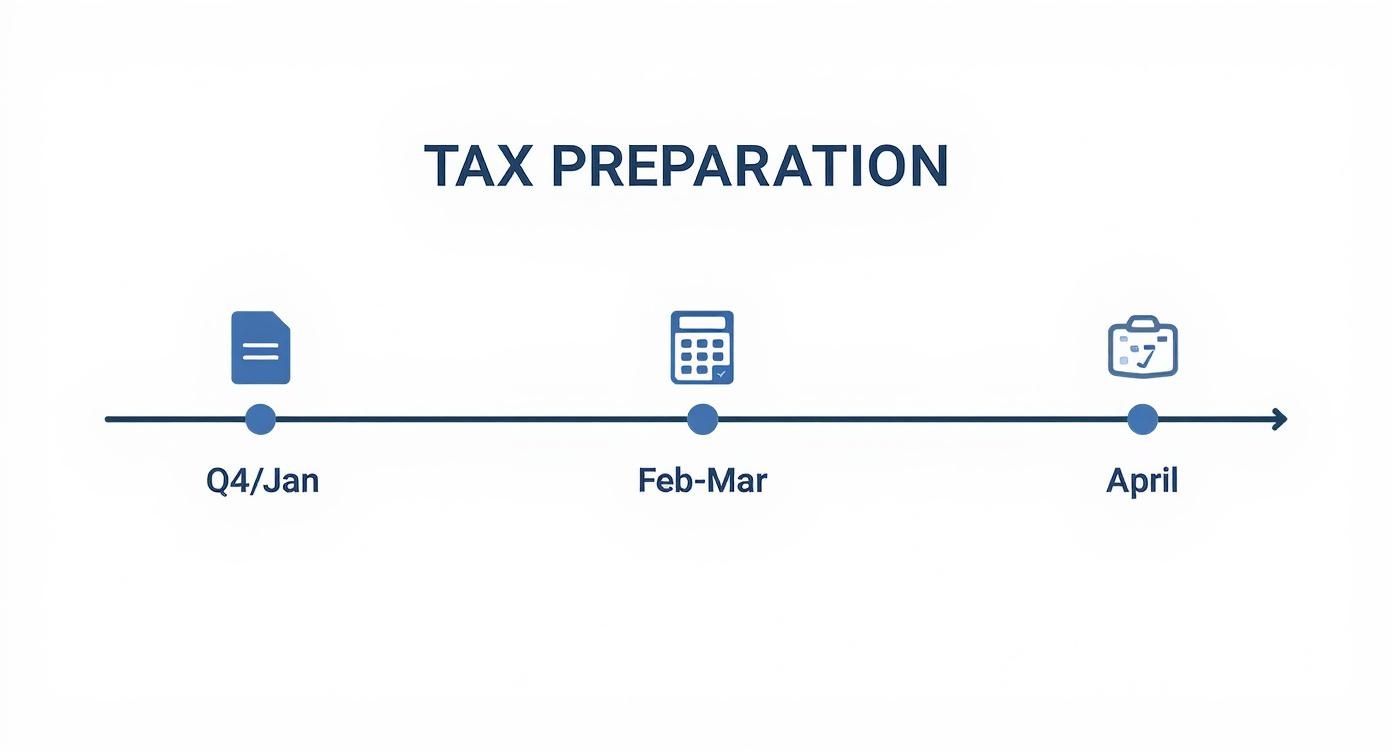
As you can see, the work starts long before the official forms are even available. Organization is the foundation. By the time February and March roll around, you’ll be focused on calculation and strategy, leaving plenty of time for a final review before the filing deadline.
To make this even clearer, here’s a quick-start timeline outlining the most important actions.
Quick-Start Tax Preparation Timeline
| Timeframe | Key Actions | Primary Goal |
|---|---|---|
| Q4 (Oct-Dec) | Finalize bookkeeping for the year. Estimate tax liability. Make any last-minute contributions (e.g., retirement, HSA). | Minimize surprises and maximize year-end tax-saving opportunities. |
| January | Watch the mail for incoming tax forms (W-2s, 1099s, etc.). Gather all receipts and financial summaries. | Consolidate all necessary documents into one secure location. |
| Feb – March | Organize and categorize all your documents. Calculate income, deductions, and credits. | Prepare a draft of your return for review and strategic analysis. |
| April | Complete a final review of your tax return. File electronically by the deadline. Pay any taxes due. | Ensure accuracy and submit your return on time to avoid penalties. |
This table provides a high-level overview, but a detailed, personalized plan will set you up for success.
The Real Cost of Being Unprepared
Why does all this preparation matter so much? The numbers are staggering. During the 2024 tax season alone, Americans spent a collective 7.1 billion hours preparing their returns. That’s an incredible amount of time.
When you factor in the money spent on software and professional help, the total economic burden of tax filing soared to $464 billion. On average, an individual taxpayer spent 13 hours and $290 just to get their taxes filed. These figures highlight that getting organized isn't just about convenience—it's a smart financial move. If you want to dig deeper, you can learn more about these tax compliance statistics.
By adopting a structured approach, you're not just saving time; you're actively reducing your share of this enormous compliance burden. A few hours of organization can translate into significant savings and peace of mind.
Gathering Your Essential Tax Documents

Let’s be honest, the secret to a painless tax season doesn’t start when you open up your tax software. It starts way earlier, with the not-so-glamorous task of getting your paperwork in order. This is the bedrock of an accurate and efficient tax return.
Think of it like being a chef. You wouldn't start cooking a five-course meal by running to the pantry for each ingredient. You’d get everything prepped and ready on the counter first. Doing the same with your tax documents prevents that last-minute scramble for a missing 1099 or a misplaced donation receipt—a situation that almost always leads to mistakes or missed deductions.
Identifying Your Income Sources
First things first, let's round up every document that shows how you made your money last year. These forms will trickle in from employers, clients, and banks, and most should be in your hands by January 31st. My advice? Keep a dedicated folder, whether it's on your desktop or in a filing cabinet, and toss them in as they arrive.
- Form W-2: The one you get from your employer, showing your wages and the taxes they've already withheld. You’ll get a separate one for every job you held.
- Form 1099-NEC: If you're a freelancer or contractor, you'll see this from any client who paid you $600 or more.
- Form 1099-MISC: This is a catch-all for other income sources like rent, royalties, or even prize winnings.
- Form 1099-K: Received payments through a service like PayPal, Stripe, or Square? This form reports those transactions.
- Form 1099-INT and 1099-DIV: These report the interest you earned from a savings account or dividends from investments.
Getting a complete picture of your income isn't optional—the IRS gets copies of these forms, too. For a truly exhaustive list, you can grab our 2024 tax filing checklist for everything you need to prepare for tax season.
Documenting Deductions and Credits
Now for the fun part: finding the documents that will lower your tax bill. This is where being organized throughout the year really pays dividends. You're hunting for proof of any expense that could potentially qualify as a deduction or credit.
One of the biggest headaches for people is keeping track of all the little receipts that add up. Let's face it, nobody enjoys hoarding paper. Exploring the Top 12 Best Receipt Organizer App Solutions can be a game-changer here, making sure you don't leave money on the table.
Here are some of the key documents to pull together:
- Homeownership Records: Grab your mortgage interest statement (Form 1098), property tax bills, and any receipts for energy-saving home upgrades.
- Charitable Donations: You'll need the official acknowledgments from any organization you donated to, for both cash and non-cash gifts.
- Medical Expenses: Gather receipts from doctor's visits, prescription co-pays, and even your mileage log for trips to appointments.
- Educational Costs: Look for Form 1098-T (tuition) and Form 1098-E (student loan interest) to claim valuable education credits.
- Retirement Contributions: Find the statements showing your contributions to traditional IRAs, as these are often deductible.
Pro Tip: Don't just make a pile. Sort these documents as you go. Create simple folders labeled "Medical," "Charity," or "Business Travel." It's a small bit of effort that will save your tax preparer—and you—hours of frustration.
Tracking Investment and Other Financial Activity
If you’re an investor, a small business owner, or a landlord, you have another layer of paperwork to manage. This information is crucial for correctly reporting your gains, losses, and other business financials. Be patient, as these forms often show up a little later, usually by mid-February.
Key Investment & Business Documents
| Document Type | What It Shows | Why It's Important |
|---|---|---|
| Form 1099-B | Proceeds from selling stocks, bonds, and other securities. | Absolutely essential for calculating your capital gains and losses. |
| Crypto Transaction History | A full record of every crypto purchase, sale, or trade. | The IRS views crypto as property, meaning every single transaction has tax implications. |
| Rental Property Records | A clean summary of rental income and all your expenses, from repairs to insurance. | Needed to figure out your net rental income or loss. |
| Business P&L Statement | A simple report of your business's revenue and expenses. | This is the financial snapshot you'll need to calculate your self-employment tax. |
Putting a system in place to track all this is the real cornerstone of a stress-free tax season. It doesn't matter if it's a simple spreadsheet, a dedicated filing cabinet, or accounting software—the key is consistency. A little organization now turns tax time from a dreaded chore into a manageable financial task, ensuring nothing gets missed and you get the best possible outcome.
Prepping for Your Unique Financial Situation

When it comes to taxes, a one-size-fits-all checklist just won't cut it. Your financial life is unique, and your tax prep needs to match. A salaried employee has a vastly different set of requirements than a freelance designer or a landlord juggling a few properties.
This is where we move beyond just gathering documents and start thinking strategically. Nailing down the specifics of your situation is the key to a smooth, accurate filing. Get it wrong, and you could be looking at missed deductions, filing errors, and a whole lot of unnecessary stress.
For Freelancers and Small Business Owners
If you're self-employed, you wear two hats: individual taxpayer and business owner. That second hat is what changes the game for tax season, demanding a higher level of organization and record-keeping. Your main job is to paint a crystal-clear picture of your business's profitability.
The foundation of that picture is meticulous expense tracking. Every client lunch, software subscription, and portion of your home office utility bill needs to be accounted for. This isn't just about digging for deductions—it's about accurately calculating your net income, which is what your self-employment tax is based on.
One of the biggest mistakes I see is mixing personal and business finances. Tossing everything into one bank account creates a bookkeeping nightmare and is a red flag for the IRS. A dedicated business bank account isn't optional; it's essential.
Your Essential Business Prep Checklist:
- Generate a Profit & Loss (P&L) Statement: This is your financial report card, summarizing all your income and expenses. If you use accounting software like QuickBooks, this report is just a few clicks away.
- Round Up Your 1099s: Make sure you have a 1099-NEC from every client who paid you $600 or more during the year.
- Total Your Estimated Tax Payments: Get the final tally of the quarterly tax payments you made throughout the year. Having these figures ready will save a ton of time.
- Categorize Your Expenses: Group all your receipts and bank charges into logical buckets like advertising, supplies, travel, and professional development.
For Rental Property Owners
Owning a rental property officially makes you a real estate investor, and that comes with its own unique set of tax rules. Your focus here is two-fold: documenting every dollar of rental income and, just as importantly, every single expense tied to owning and maintaining that property. These deductions are your best tool for lowering your taxable rental income.
It's easy to remember the big stuff, like a new water heater. But don't forget the smaller, recurring costs that really add up—think landscaping, pest control, insurance premiums, and even the mileage you log driving back and forth for property-related errands.
A crucial concept for landlords is depreciation. This is a powerful, non-cash deduction that lets you write off a portion of your property's value over its useful life. It's complex but incredibly valuable, requiring precise calculations from the moment you put the property into service.
For Crypto Investors and Traders
The world of digital assets introduces a whole new level of complexity. The IRS views cryptocurrency as property, not currency. This means every transaction—selling, trading one coin for another, or even using crypto to buy a coffee—is a taxable event. The real challenge here is simply gathering the data.
Unlike the tidy 1099-B form you get from your stockbroker, crypto exchange reporting can be a mixed bag. The responsibility falls on you to track the cost basis (what you originally paid) for every single asset. Without that number, you can't accurately calculate your capital gains or losses.
Getting Your Crypto Ducks in a Row:
- Download Complete Transaction Histories: You need to pull the full CSV or API data from every exchange and wallet you've ever used. Don't just grab last year's data; you need the full history to correctly establish your cost basis for older assets.
- Use a Dedicated Crypto Tax Software: Trying to reconcile thousands of transactions by hand is a recipe for disaster. Tools like Koinly or CoinLedger are designed to process this data and generate the reports your tax preparer needs.
- Identify Gains and Losses: The software will do the heavy lifting, categorizing your transactions into short-term (held under a year) and long-term (held over a year) gains, which are taxed at very different rates.
The growing complexity in personal finance—especially with assets like crypto and real estate—isn't just in your head. The US tax code has become a behemoth compared to what it was after the major overhaul in 1986, demanding far more detailed information from taxpayers. You can explore the history of tax data collection to see just how much things have changed. This evolution is precisely why a meticulous, personalized approach isn't just a good idea; it's your best defense.
Choosing How to File and Finding Every Last Deduction
Okay, you’ve gathered all your documents and have everything organized. This is where the real work—and the real savings—begins. It's time to decide how you're going to file and, more importantly, how to make sure you're not paying a dollar more in tax than you absolutely have to.
Your choice of filing method really depends on your life circumstances. What works for a college student with a single W-2 is completely different from what a small business owner or real estate investor needs.
Selecting the Right Filing Approach
You basically have three paths you can take. Think honestly about your financial picture. Are you juggling W-2s, 1099s, investment gains, or rental income? The more moving parts you have, the more you'll benefit from expert help.
Deciding how to file your taxes is a big decision, and there's no one-size-fits-all answer. Below is a quick breakdown to help you see which option might be the best fit for your specific situation.
Comparison of Tax Filing Methods
| Filing Method | Best For | Pros | Cons |
|---|---|---|---|
| DIY Software | Individuals with simple tax situations (W-2 income, standard deduction). | Inexpensive, convenient, and you’re in the driver’s seat. | Easy to make mistakes or miss deductions; can be surprisingly time-consuming. |
| Tax Professional | Business owners, investors, landlords, and anyone with complex finances. | Maximizes deductions, offers strategic advice, and minimizes audit risk. | Higher upfront cost than doing it yourself. |
| Free File Services | Low-to-moderate income filers with straightforward returns. | It's free for federal returns and guides you through the process. | Strict income limits apply, and state filing isn't always free. |
It's a pretty even split out there. During the 2025 tax season, tax professionals e-filed around 74.9 million returns, while DIY filers submitted about 64.6 million on their own. This just goes to show there’s no single "right" way—it's all about what makes sense for you.
Uncovering Commonly Missed Deductions
Once you’ve picked a filing method, the next mission is to hunt down every single deduction and credit available to you. This is where your diligent prep work pays off. People leave so much money on the table just because they aren’t aware of what they can claim. Keeping good records and learning how to reduce business expenses throughout the year makes finding these deductions much easier.
Here are a few big ones that often get missed:
- Home Office Deduction: If you're self-employed and have a dedicated space in your home for work, you can write off a portion of your rent, utilities, and insurance.
- Charitable Contributions: Don't just think about cash donations. Did you drive for a nonprofit? That mileage is deductible. Donated clothes or furniture? You can deduct their fair market value.
- Education Credits: The American Opportunity Credit and Lifetime Learning Credit are huge for students and parents, but they’re frequently overlooked.
- State and Local Taxes (SALT): You can deduct the taxes you paid to your state and local governments—up to $10,000 per household. This includes property taxes plus either income or sales taxes.
The real secret is understanding the difference between a tax deduction and a tax credit. A deduction reduces your taxable income, but a credit is a dollar-for-dollar reduction of your actual tax bill. Credits are almost always better.
It's a crucial distinction. For an in-depth look, we have a guide on understanding tax deductions vs tax credits and what the difference is.
Think of it this way: a $1,000 deduction for someone in the 22% tax bracket is worth $220 in their pocket. But a $1,000 tax credit saves them the full $1,000. That’s a massive difference. By taking the time to review every possible saving, you turn tax season from a chore into a smart financial move.
When to Partner with Allied Tax Advisors

While DIY tax software can be a fantastic tool, it has its limits. There’s a tipping point where your financial life gets too complex for a simple Q&A format. When that happens, going it alone isn't just stressful—it can be a serious financial risk.
Knowing when to switch from DIY to a professional partnership is a crucial part of smart financial management. It’s not about giving up; it’s a strategic move to protect what you’ve built and optimize your financial future. Certain life events and financial situations are clear signals that it’s time to call in an expert.
Your Financial Picture Gets Complicated
A single W-2 from one job? That’s one thing. But once you start juggling multiple income streams or growing your assets, the tax rules get tangled—fast. This is often the first red flag that you need a professional to look over your numbers.
Do any of these scenarios sound like you?
- You launched a business: Suddenly, you’re dealing with self-employment tax, quarterly estimated payments, and a whole new world of business deductions. This is a far cry from standard employee filing.
- You own rental properties: Calculating depreciation, correctly tracking expenses, and making sense of passive activity loss rules requires specialized knowledge. It's easy to get this wrong.
- You have significant investment activity: Properly reporting capital gains from stocks, bonds, or especially crypto is a minefield. You need to get your cost basis right and spot opportunities for tax-loss harvesting.
If you nodded along to any of these, you’ve probably crossed the line where professional tax advice becomes essential. The right guidance can be the difference between paying what you owe and paying for costly mistakes.
Navigating Major Life Transitions
Life doesn’t stand still, and major events almost always come with major tax implications. During these times, you don't just need a tax preparer; you need a tax planner who can help you see around the corner.
Getting married, for example, changes your filing status and opens up new strategies for you and your spouse. Inheriting property or other assets involves a unique set of tax rules that you have to get right from day one. Even a good thing, like a sudden windfall or a big promotion, requires careful planning to manage the tax hit.
Partnering with an advisor isn't a once-a-year transaction. It's about building a relationship with someone who understands your financial journey and can offer year-round guidance to help you make smarter moves and avoid surprises.
Responding to IRS and State Notices
Nothing spikes your heart rate like a letter from the IRS or a state tax agency. While a notice doesn't automatically mean you did something wrong, it absolutely means you need to respond—correctly and quickly. This is not a situation you want to handle alone.
An experienced tax advisor can step in immediately to:
- Interpret the Notice: They speak the language of tax authorities and can decipher the codes and jargon to understand the exact issue.
- Communicate on Your Behalf: Let them talk to the agents. They can navigate the bureaucracy, saving you the stress and preventing you from saying the wrong thing.
- Represent You in an Audit: If you're facing an audit, having a professional representative is non-negotiable. They protect your rights and ensure the process is fair.
Bringing in an expert gives you a critical buffer and ensures your case is presented with accuracy and authority. If you’re ready to find the right partner, our guide to choosing the best tax advisors near you offers practical tips to help you choose with confidence.
At Allied Tax Advisors, we go beyond just filing returns. We provide the strategic planning and expert representation you need for genuine peace of mind.
Frequently Asked Questions About Tax Preparation
No matter how organized you are, questions always seem to come up when you’re in the thick of tax prep. Getting solid answers to these common sticking points is the key to filing accurately and avoiding simple mistakes that can cost you time and money. Here are some of the questions we hear most often from our clients.
We'll give you the straightforward answers you need to handle these tricky situations with confidence. Knowing what to do when a form is missing or how long to hang onto old records can make all the difference.
What Should I Do If I’m Missing a W-2 or 1099 Form?
This happens all the time. You know a W-2 from a former employer or a 1099 from a client should be in your mailbox, but it’s nowhere to be found. Don't panic.
The first and easiest thing to do is reach out to the employer or payer directly. Often, it’s just a simple issue like an old address on file, and they can send you a digital copy right away.
If you can’t get ahold of them, you’re not out of luck. The IRS has a workaround called Form 4852, Substitute for Form W-2, Wage and Tax Statement. You’ll need to do your best to estimate your wages and the taxes that were withheld. Your final pay stub from that job is the perfect tool for this.
The most important thing to remember is to still file on time, even if you have to use Form 4852. If the official W-2 or 1099 eventually shows up and the numbers are different, you’ll just need to file an amended return with Form 1040-X.
How Long Do I Need to Keep My Tax Records and Documents?
Once you’ve hit "submit" on your tax return, the urge to shred every last piece of paper is strong. Resist it. The IRS has a specific timeframe, called the statute of limitations, where they can come back and audit your return. You absolutely need to keep your records for at least that long.
As a general rule, plan on keeping your tax records for three years from the date you filed.
However, there are a couple of crucial exceptions that can extend that timeline:
- The Six-Year Rule: If you accidentally underreported your income by more than 25%, the IRS has six years to audit. Because of this, holding onto records for six years is the safer bet for everyone.
- Records for Property: This one is different. For anything related to assets—like your home, investments, or business equipment—you need to keep those records for as long as you own the property, plus an additional three years after you sell it. These documents are essential for proving your cost basis and correctly calculating capital gains down the road.
Our Go-To Tip: Don't let stacks of paper take over your office. Scan your tax documents and save them to a secure, encrypted cloud folder. It protects them from getting lost or damaged and keeps them right at your fingertips if you ever need them.
Can I File an Extension If I’m Not Ready by the Deadline?
Yes, absolutely. Filing for an extension is a very common and simple process. Millions of people do it every year.
You can get an automatic six-month extension by submitting Form 4868, Application for Automatic Extension of Time To File U.S. Individual Income Tax Return before the original tax deadline (which is typically April 15th). This will push your filing deadline all the way to October 15th, giving you plenty of breathing room.
But here’s the catch that trips up so many people:
An extension to file is not an extension to pay. You still have to estimate what you owe for the year and pay that amount by the original April deadline. If you don't, the IRS will start charging penalties and interest on the unpaid balance, even if your extension was approved.
Trying to navigate the tax code on your own can be overwhelming. With a trusted partner, it doesn't have to be. At Allied Tax Advisors, we provide the expert guidance you need for every situation, from simple filings to complex tax planning and IRS representation. Visit us at alliedtax.com to see how we can bring you peace of mind.