
Want to know the fastest way to shrink your taxable income? It’s all about getting aggressive with every single tax deduction and credit you're legally entitled to. This means looking beyond the easy route of the standard deduction and strategically itemizing expenses while hunting down credits that slash your tax bill directly.
With the right game plan, you can make a serious dent in what you owe the IRS.
Your Guide to Tax Deductions and Credits

If you really want to learn how to reduce your taxable income, you have to master the two main tools the IRS gives you: deductions and credits. People often toss these terms around like they're the same thing, but they have completely different effects on your tax return. Getting this straight is the first, most crucial step in building a smarter tax strategy.
Here's the bottom line: a tax deduction lowers the amount of your income that's subject to tax. So, if you're in the 22% tax bracket, a $1,000 deduction saves you $220.
A tax credit, on the other hand, is a dollar-for-dollar reduction of the taxes you actually owe. A $1,000 tax credit saves you a full $1,000. That's a huge difference. If you want to dive deeper, you can check out our detailed breakdown on the differences between tax deductions and credits.
Because of this, credits are almost always more powerful. But don't sleep on deductions—a well-thought-out deduction strategy is often the key to bringing your overall tax bill down.
Tax Deductions vs Tax Credits Key Differences
To really hammer this home, let's look at how deductions and credits work in the real world. This table clarifies the impact of deductions versus credits, helping you prioritize your tax planning efforts for maximum financial benefit.
| Attribute | Tax Deduction | Tax Credit |
|---|---|---|
| What it Does | Reduces your taxable income. | Reduces your tax bill directly. |
| How it Works | You save a percentage of the deduction amount, based on your tax bracket. | You save the full amount of the credit, dollar-for-dollar. |
| Impact | Indirect savings on your final tax bill. | Direct, powerful savings on your final tax bill. |
Ultimately, the goal isn't to choose one over the other. It's about combining every available deduction and credit to get your tax liability as low as legally possible.
Common but Overlooked Deductions
A lot of people just take the standard deduction because it's simple. I get it. But by doing that, they're often leaving a pile of cash on the table by not itemizing. Itemizing makes sense the moment your total deductible expenses add up to more than the standard deduction for your filing status.
You'd be surprised where you can find major deductions. Here are a few places to look:
-
Charitable Contributions: This is so much more than just writing a check. You can deduct the fair market value of items you donate, and even out-of-pocket expenses you rack up while volunteering. For big-ticket non-cash gifts, like a car, there are specific rules you need to follow. For expert advice, learning about maximizing tax deductions from car donations can make a big difference in how much you can claim.
-
Home Office Deduction: If you're self-employed and have a dedicated space in your home used exclusively for business, this is a goldmine. You can deduct a percentage of your rent, mortgage interest, utilities, and even home insurance.
-
Medical Expenses: This is a big one that many miss. You can deduct unreimbursed medical costs that are more than 7.5% of your adjusted gross income (AGI). This includes everything from copays and prescriptions to dental work and the mileage to and from appointments.
Expert Tip: Try "bunching" your charitable giving. Instead of making donations every year, consider making two years' worth of contributions in a single year. This can often push your itemized deductions over the standard deduction threshold, letting you claim a much larger deduction in one year while taking the standard deduction in the other.
The Power of Tax Credits
While deductions are great for chipping away at your taxable income, credits deliver a direct knockout blow to your tax bill. Some of the most valuable credits get missed simply because people are in a hurry to get their taxes done.
Don't let these slip through the cracks:
- Child Tax Credit: This is a huge one for parents, offering a substantial credit for each qualifying child that directly lowers the tax you owe.
- American Opportunity Tax Credit (AOTC): A fantastic credit for students in their first four years of college, covering expenses for tuition, fees, and books.
- Lifetime Learning Credit (LLC): This credit isn't just for traditional college students. It helps pay for undergraduate, graduate, and professional degree courses—even classes taken just to improve your job skills.
Using Retirement and Health Accounts to Save on Taxes

When it comes to legally lowering your taxable income, one of the most effective strategies is to think long-term. By contributing to tax-advantaged retirement and health accounts, you’re not just saving for the future—you're getting an immediate tax break right now.
These accounts are designed by the IRS to do just that. Every dollar you put into certain retirement or health plans is a dollar you can subtract from your income, which can make a huge difference when you file your taxes. Let's dig into how you can make these powerful tools work for you.
Maximize Your Workplace Retirement Plan
If your employer offers a retirement plan like a 401(k) or 403(b), this is often the best place to start. Your contributions are made with pre-tax dollars, meaning the money comes out of your paycheck before the government calculates your income tax. This instantly lowers your taxable income for the year.
Here’s a simple example: say you earn $80,000 a year and contribute $10,000 to your 401(k). For tax purposes, it’s like you only earned $70,000. That single move could easily drop you into a lower tax bracket, saving you even more.
For 2025, you can contribute up to $23,500 to a 401(k) or 403(b). That’s a massive deduction few other strategies can match.
And if you're 50 or older, you get a bonus. The government allows you to make an additional "catch-up" contribution of $7,500 for 2025, bringing your total possible contribution to $31,000. At the very least, always contribute enough to get the full employer match—it’s literally free money. But aiming for the max will give you the biggest tax win.
Leverage a Traditional IRA for Tax Deductions
Whether you have a workplace plan or not, a Traditional Individual Retirement Arrangement (IRA) is another fantastic way to reduce your taxable income. Just like with a 401(k), your contributions can be tax-deductible, which directly lowers your adjusted gross income (AGI).
The IRA contribution limit for 2025 is $7,000. If you're age 50 or over, you can add another $1,000 as a catch-up contribution. Now, there are some income limits on deductibility if you also have a 401(k), but many people still qualify for at least a partial deduction. If you don't have an employer plan, you can almost always deduct the full amount.
Key Insight: A Traditional IRA is a game-changer for freelancers, gig workers, or anyone whose employer doesn't offer a retirement plan. It gives you a direct way to save with tax-deferred growth while cutting your current tax bill.
For small business owners and the self-employed, a SEP IRA is an even more powerful option, with much higher contribution limits. It allows you to sock away a significant chunk of your income and get a major tax deduction. Retirement planning can feel overwhelming, but figuring out your options is the first step toward minimizing taxes in retirement.
Unlock the Triple Tax Advantage of an HSA
A Health Savings Account (HSA) might just be the most powerful tax-saving tool out there. If you’re enrolled in a high-deductible health plan (HDHP), you're eligible for its unique triple tax benefit.
Here’s why financial pros love HSAs:
- Tax-Deductible Contributions: The money you put in is deducted from your income for the year, just like a Traditional IRA.
- Tax-Free Growth: You can invest your HSA funds, and any earnings or interest grow completely tax-free.
- Tax-Free Withdrawals: When you pull money out for qualified medical expenses, you don't pay a dime in taxes.
No other account offers this powerful combination. For 2025, the contribution limits are $4,300 for an individual and $8,550 for a family. There's also an extra $1,000 catch-up contribution for those 55 or older.
While HSAs are meant for healthcare costs, many people use them as a secret retirement-boosting account. Once you turn 65, you can withdraw the money for any reason without penalty (you'll just pay ordinary income tax, like a 401(k)). But if you keep using it for medical expenses in retirement, the withdrawals remain 100% tax-free.
Smart Investment Strategies for Tax Efficiency
Your investment portfolio is more than just a wealth-building engine—it's one of the most powerful tools you have for managing what you owe the IRS each year. Tax-efficient investing isn't about chasing high-risk stocks; it's about being deliberate with your choices so you can keep more of what you earn.
You don't need a degree in finance to do this. By applying a few core principles, you can turn your portfolio into a tax-saving machine.
Master the Art of Tax-Loss Harvesting
One of the most effective techniques in any investor's playbook is tax-loss harvesting. In simple terms, this means selling an investment that's lost value to lock in, or "realize," a capital loss. You can then use that loss to cancel out capital gains from your winning investments.
Here’s how it works in the real world:
- You sell Stock A and make a $5,000 profit—a taxable capital gain.
- At the same time, you're holding Stock B, which is down $4,000 from your purchase price.
- By selling Stock B, you "harvest" that $4,000 loss.
The result? You use the $4,000 loss to offset your $5,000 gain. Now, you only owe taxes on a net gain of $1,000. If your losses happen to be bigger than your gains, you can even use up to $3,000 of that excess loss to lower your regular taxable income, which is a huge win.
Heads Up: Watch out for the "wash sale" rule. The IRS won't let you claim a loss if you buy the same or a "substantially identical" security within 30 days before or after selling it. This stops people from selling for a quick tax break only to buy the same asset right back.
Time Your Sales to Get a Better Tax Rate
Patience really pays off in investing, especially when it comes to taxes. The amount of time you hold an asset before selling it makes a massive difference in the tax rate you’ll pay on the profit. This holding period splits your gains into two very different buckets.
Short-Term vs. Long-Term Capital Gains
| Holding Period | Gain Type | Tax Treatment |
|---|---|---|
| One year or less | Short-Term Capital Gain | Taxed at your ordinary income rate (as high as 37%). |
| More than one year | Long-Term Capital Gain | Taxed at much lower rates of 0%, 15%, or 20%, based on your income. |
For most people, the long-term capital gains rate is a bargain compared to their regular income tax rate. Just by holding a winning stock for a year and a day before selling, you could save thousands. It’s a foundational concept for anyone who wants to understand how capital gains tax works and how to minimize your liability.
Look Into Tax-Advantaged Investments
Beyond just timing your sales, you can also bake tax savings directly into your portfolio by choosing investments with built-in benefits. These are assets that produce income that’s either partially or fully shielded from federal—and sometimes state—taxes.
Think about adding a few of these to your mix:
- Tax-Exempt Municipal Bonds: The interest you earn from "munis" (bonds issued by state and local governments) is almost always exempt from federal income tax. Better yet, if you live in the state that issued the bond, the interest is often free from state and local taxes, too.
- Qualified Dividends: Not all dividends are taxed the same way. Qualified dividends, which are paid out by most major U.S. companies, are taxed at the friendlier long-term capital gains rates. This is a huge leg up over "ordinary" dividends, which get taxed as regular income.
- Index Funds and ETFs: These funds generally have lower "turnover" than funds managed by an active stock-picker. Less buying and selling inside the fund means fewer taxable capital gains are passed down to you as an investor, making them inherently more tax-efficient.
By strategically harvesting losses, timing your gains, and choosing smarter assets, you can make a real, tangible dent in your tax bill.
Tax Planning for Entrepreneurs and Freelancers
When you work for yourself, you step into a whole new world of tax planning—one that just isn't accessible to W-2 employees. As an entrepreneur or freelancer, you have far more say over your financial situation, giving you the power to legally and proactively bring down your taxable income with smart business moves. This isn't about frantically trying to find receipts in April; it's about building a solid strategy that works for you all year long.
That freedom of being your own boss comes with the responsibility of handling your own taxes, including the hefty self-employment tax. This tax, covering both Social Security and Medicare, can tack a significant 15.3% onto your tax bill before you even get to federal and state income tax. The good news? Many of your day-to-day business costs can be written off, which directly reduces the income that gets hit with these taxes.
Choosing the Right Business Structure
One of the biggest financial decisions you'll make is how you legally structure your business. The default for a solo operator is a sole proprietorship. It's simple, for sure, but it offers zero legal separation between your personal and business finances. This means every dollar of net business income flows right onto your personal tax return, where it's subject to those self-employment taxes.
As your business grows, forming an LLC (Limited Liability Company) is a common next step for liability protection. By default, the IRS treats a single-member LLC just like a sole proprietorship for tax purposes. But this is where a truly powerful strategy comes into play.
An LLC can choose to be taxed as an S Corporation, and this move can be a total game-changer for your bottom line. With an S-Corp, you pay yourself a "reasonable salary," which is subject to standard payroll taxes. Any profit left over in the business can then be paid out to you as a dividend, which is not subject to self-employment tax. This one move can literally save you thousands of dollars every year.
Maximizing Your Business Deductions
Just about every dollar you pour into running and growing your business has the potential to lower your taxable income. The trick is to track everything meticulously. For anyone self-employed, getting a firm grip on key freelancer tax deductions is the foundation for keeping your tax bill as low as possible.
Some of the most common, and often overlooked, deductions include:
- Home Office Expenses: If you have a dedicated space in your home used exclusively for your business, you can deduct a percentage of your rent, mortgage interest, utilities, and insurance.
- Software and Subscriptions: All those tools that keep your business humming—from accounting software to project management apps—are fully deductible.
- Vehicle Mileage: Driving to meet a client or run to the office supply store? Track those miles. The IRS standard mileage rate is a straightforward and often substantial deduction.
Tax laws are always evolving. We saw massive shifts in the 1980s when major tax reforms slashed the top marginal rate from around 70% all the way down to 28%, completely changing how people managed their money. It's a powerful reminder that you have to adapt your strategy to the current rules to keep your tax liability in check.
This decision tree gives a great visual of how something as simple as how long you hold an asset can change your tax outcome.
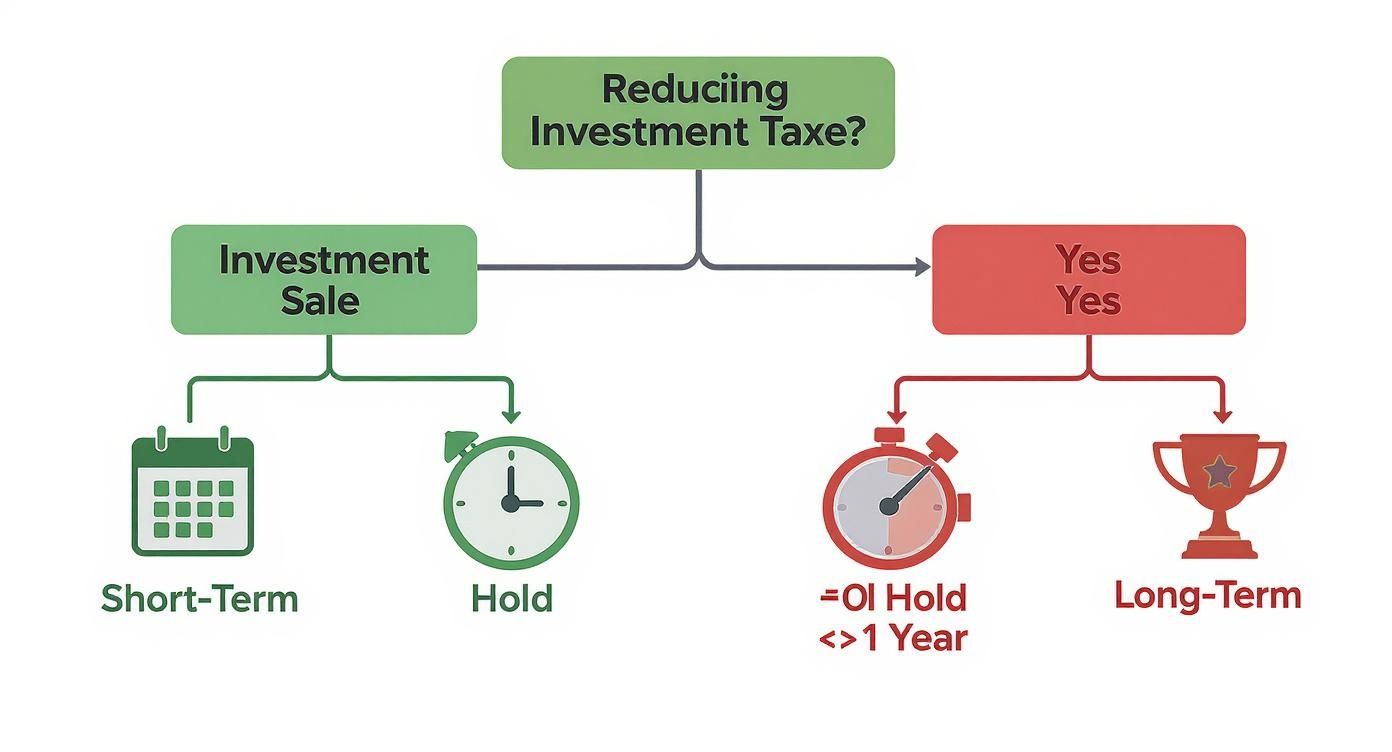
The big takeaway here is that holding an investment for more than a year can bump your gains into a lower tax bracket. It’s a simple strategy, but a powerful one.
Strategic Equipment Purchases and Section 179
Here’s another fantastic tool in the entrepreneur's tax kit: the Section 179 deduction. This part of the tax code lets businesses write off the entire purchase price of qualifying equipment or software in the year they start using it, instead of having to depreciate it bit by bit over several years.
Let’s put that into practice: Say you’re a freelance photographer and you invest $8,000 in new cameras and lenses. Instead of deducting a small portion of that cost over the next five to seven years, Section 179 allows you to deduct the full $8,000 from your business income this year. That creates a significant, immediate drop in what you owe.
This is an especially smart move if you're having a great year financially and need to lower your taxable income. By timing your big equipment purchases strategically, you can directly manage your tax bill while also investing in your company's future. This kind of proactive thinking is what effective tax planning is all about.
Advanced Strategies: Timing Your Income and Expenses
Once you've nailed the basics of maximizing deductions and retirement savings, you can move on to a more sophisticated level of tax planning. This is where we stop looking at just what you earn and spend, and start focusing on when. The art of timing your income and expenses is a powerful tool for managing your tax bill, and it’s something I’ve seen savvy clients use to great effect year after year.
This isn't just about the current tax year; it's about playing the long game. You need to look ahead. Is a big promotion on the horizon? Are you planning to retire or take a sabbatical next year? The answers to these questions open up some incredible opportunities to shift your tax burden into a year where it will have less impact.
The Power of Pushing Income into the Future
If you have a strong reason to believe you'll be in a lower tax bracket next year, deferring income is one of the smartest moves you can make. Maybe you’re planning to scale back at work, or perhaps a large, one-time project that boosted your income this year won't be repeating. In these cases, pushing income forward means it gets taxed at that future, lower rate.
Let's look at a classic real-world example:
Imagine you're in sales, and you’re owed a hefty commission check in December. But you've already decided that next year you're transitioning to part-time to focus on a new venture, which will drop your income significantly. A simple request to your employer to pay that bonus in January instead of December shifts that income into a year where you'll keep more of it. Simple, right?
This same principle works wonders for freelancers who can hold off on invoicing a client until after the New Year, or for business owners who can strategically time the closing of a major sale. It's just a small shift on the calendar, but it can translate into thousands of dollars saved.
Pulling Your Deductions into the Present
On the other side of the coin is accelerating your deductions. If you’re having a fantastic income year and find yourself in a high tax bracket, it’s the perfect time to pull some of next year's planned expenses into the current one. This creates an immediate, and often substantial, tax break right when you need it most.
Here are a few practical ways I’ve seen this work:
- Pay Your Property Taxes Early: If your property tax bill is due in January, paying it before December 31st allows you to claim the deduction this year. The same goes for your last estimated state income tax payment. Just remember the $10,000 cap on state and local tax (SALT) deductions.
- "Bunch" Your Charitable Giving: Instead of donating a little each year, consider using a donor-advised fund to make two or three years' worth of contributions at once. You get the full, beefed-up tax deduction in this high-income year, but you can still distribute the funds to your favorite charities over the next few years.
- Schedule That Medical Procedure: If you have a planned medical or dental expense on the horizon, getting it done and paid for before the year ends can help you get over the 7.5% of AGI threshold required to deduct medical costs.
The core strategy is simple: load up on deductions in your highest-earning years because that’s when they save you the most money. In contrast, try to recognize income in years when you expect your tax rate to be at its lowest.
This isn't a new concept. Strategic timing has been a cornerstone of tax planning for decades, often influenced by major shifts in tax policy. Think back to the huge tax reforms of the 1980s, which saw the top marginal income tax rate plummet from a staggering 70% down to 28% by 1988. As you can imagine, this created massive incentives for high earners to legally rearrange when and how they reported income. You can read more about how those historical tax cuts influenced taxpayer behavior and gave rise to many of the strategies we still use today.
Shifting Income to Family Members
Another advanced, yet perfectly legal, technique involves shifting income to a family member in a much lower tax bracket. This is most commonly done through gifting highly appreciated assets.
For instance, let’s say you want to sell $20,000 worth of stock you bought years ago for $5,000 and then give the proceeds to your adult son for a down payment on a car. If you sell it, you'll be on the hook for capital gains tax on the $15,000 profit.
A much smarter way is to gift the stock directly to your son. When he sells it (assuming he isn't subject to the "kiddie tax"), the capital gains will be taxed at his much lower rate—which could be as low as 0%. The tax liability is transferred to someone who will pay far less, keeping much more of that money within the family.
Answering Your Top Tax Reduction Questions
As you start putting these tax-saving strategies into practice, you're bound to run into some specific questions. It's completely normal. Let's walk through a few of the most common issues that come up and get you some clear, straightforward answers.
A question I've heard more and more recently is, "Can I still deduct losses if I was the victim of a financial scam?" The rules on this have shifted, and frankly, the answer isn't great for most people right now.
Thanks to the Tax Cuts and Jobs Act (TCJA), for the tax years 2018 through 2025, personal theft loss deductions have been suspended. That means if you lost money to something like a romance scam or an imposter scheme, you likely can't claim that loss on your federal return. It's a tough pill to swallow. However, there's a small silver lining: if your loss was related to a for-profit venture, like a fraudulent investment, you might still be able to deduct it.
Is It Better To Pay Taxes Now or Later?
This is the classic "Roth vs. Traditional" debate. When clients ask me whether they should contribute to a Roth or a Traditional IRA/401(k), what they're really asking is if they should pay the tax now or kick the can down the road.
The right answer for you really boils down to one thing: what you expect your income to look like in the future.
- Go with a Traditional account if you think you’ll be in a lower tax bracket when you retire. You get the tax break now, during your higher-earning years.
- Lean towards a Roth account if you anticipate being in a higher tax bracket later on. You bite the bullet and pay taxes on your contributions today, but all your withdrawals in retirement are completely tax-free.
Key Takeaway: There's no magic formula here. The best choice is a personal one, based on an honest look at your career path and what you realistically expect to earn in retirement.
Handling Capital Gains from Inherited Property
"I just inherited my parents' house—am I going to get hit with a massive tax bill when I sell it?" This is a huge source of anxiety, but the tax code actually has a pretty generous rule for this exact situation. It's called a "stepped-up basis."
Here’s how it works: the cost basis of the property is "stepped up" to whatever its fair market value was on the date of the original owner's death. Let's say your parents bought their home for $100,000, but it was worth $700,000 when you inherited it. Your new basis is $700,000. If you turn around and sell it for that exact price, your taxable capital gain is $0. This single provision can save a family a fortune in taxes and is a critical piece of the puzzle when learning how to reduce taxable income.
At Allied Tax Advisors, our job is to bring this kind of clarity to your financial life. We help you move beyond just filing taxes and start building a proactive plan to minimize what you owe, year after year. Visit us at https://alliedtax.com to see how our personalized tax and accounting solutions can help you reach your goals.