
That sudden shock of seeing a large tax bill is a feeling no one enjoys. But before the panic sets in, know that you have options. The IRS isn't looking to ruin you; they provide structured ways to pay what you owe over time. You can think of it as breaking down a mountain into manageable hills.
The two most common paths are the Short-Term Payment Plan, which gives you up to 180 days to clear your debt, and the Long-Term Installment Agreement, for those who need more time. The most important thing to remember? You absolutely must have filed all your required tax returns to even be considered.
Understanding Your IRS Payment Options
Getting that official-looking envelope from the IRS can feel like hitting a wall, but it's really just a detour. The absolute worst thing you can do is ignore it. That's a fast track to escalating penalties, interest, and eventually, more aggressive collection tactics.
In fact, letting IRS notices pile up can lead to some pretty severe outcomes, so it's crucial to understand how to stop IRS wage garnishment before things get that far. The real key is to get ahead of the problem.
So, where do you start? Your choice really boils down to two main avenues:
-
Short-Term Payment Plan: This gives you a little breathing room—up to 180 extra days—to pay your balance in full. It's a fantastic fit if you're just facing a temporary cash crunch and know you have money coming in soon, like a bonus or a commission check. There's no setup fee, but keep in mind that interest and penalties don't stop. They'll keep adding up until you're paid off.
-
Long-Term Installment Agreement: If you know you'll need more than six months, this is the way to go. It’s a formal plan that lets you make monthly payments for up to 72 months (that's six years). For anyone who owes a significant amount, this is often the most practical solution because it gives you a predictable, manageable payment that fits into your budget.
The Most Important Prerequisite: Filing Compliance
Before you even think about applying for a payment plan, the IRS has one rule that is completely non-negotiable: you must be current on all of your tax filings.
This means every single tax return you were supposed to file in previous years has to be submitted. The IRS simply won't negotiate a payment arrangement if they don't have a complete picture of what you owe. Getting those old returns filed is your first and most critical job.
I see this all the time—people get laser-focused on the big bill from this year and completely forget about the unfiled return from two years ago. The IRS looks at your entire history. Getting compliant by filing all overdue returns is the bedrock of resolving any tax debt.
A little proactive financial planning can also keep you out of this situation in the future. For example, learning about effective strategies to reduce your taxes in retirement can make a huge difference in avoiding surprise tax bills later in life.
Once you’ve made sure all your returns are filed, you can confidently figure out which payment plan makes sense for your situation and start the application process.
Comparing IRS Payment Plan Options
Choosing the right plan can feel confusing, so here’s a quick breakdown to help you see the key differences at a glance.
| Plan Type | Payment Timeframe | Total Debt Limit (Tax, Penalties, Interest) | Best For |
|---|---|---|---|
| Short-Term Payment Plan | Up to 180 days | Under $100,000 | Individuals facing a temporary cash flow shortage who can pay in full within six months. |
| Long-Term Installment Agreement | Up to 72 months | Under $50,000 (for streamlined online application) | Taxpayers with larger debts who need to make smaller, predictable monthly payments over several years. |
This table gives you a starting point. Your personal financial situation will ultimately determine the best fit, but understanding these basic parameters helps narrow down the choice.
Finding the Right Payment Agreement for Your Situation
Figuring out how to tackle a tax bill you can't pay upfront isn't a one-size-fits-all problem. The best path forward really boils down to your specific financial reality—how much you owe and how quickly you can realistically pay it off. The good news is the IRS has a few different arrangements, each built for a different kind of situation.
To get a quick lay of the land, this decision tree can help you see which option might be the best starting point.
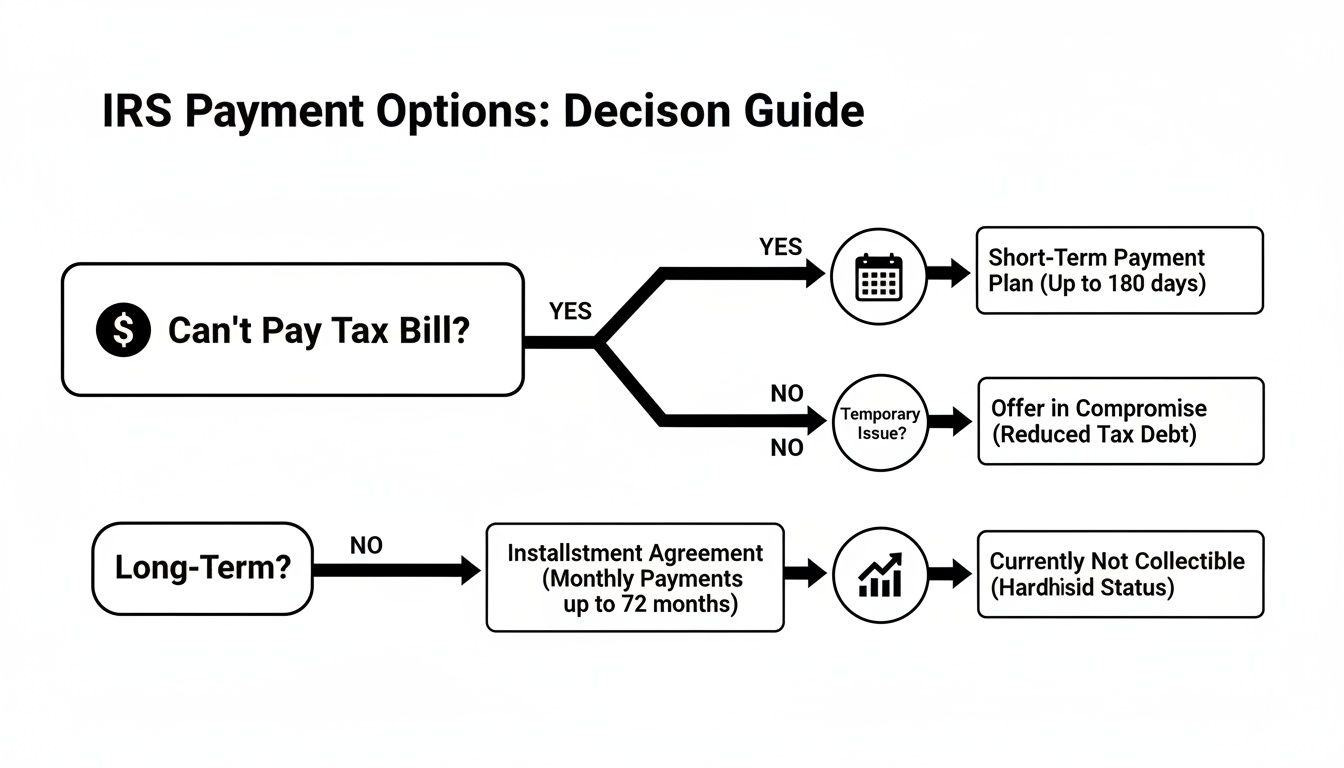
As the flowchart shows, the first question to ask is whether you're facing a temporary cash crunch or a more long-term financial challenge. Answering that question will point you in the right direction.
Short-Term Payment Plan: For Quick Resolutions
If you’re pretty sure you can pay your tax debt in full within the next few months, the Short-Term Payment Plan is probably your best bet. It’s a straightforward extension that gives you up to 180 days to get your balance to zero.
Let’s say you’re a freelance graphic designer waiting on a big check from a client. You know the money is coming, but it won’t land in your bank account before the tax deadline. A short-term plan is perfect here. It gives you the breathing room you need without getting tangled up in a formal, long-term agreement.
Here’s what makes this option attractive:
- No Setup Fee: Unlike its long-term counterpart, there's no fee to get this set up.
- Simple to Arrange: It’s a much less formal process than a full installment agreement.
- Interest and Penalties Still Apply: Just remember, interest and penalties will keep adding up until you've paid every last dollar.
This is the ideal choice for anyone with a clear line of sight to the necessary funds within six months. It stops a temporary cash flow issue from spiraling into a much bigger tax problem.
Long-Term Installment Agreement: For Larger Debts
When you know you'll need more than 180 days, the Long-Term Installment Agreement is the standard go-to. This is a formal arrangement where you make predictable monthly payments for up to 72 months (that's six years).
Honestly, this is where the process is far more approachable than most people think. Imagine you're a small business owner in San Diego, and you've just opened an IRS notice for a $30,000 tax bill you absolutely can't pay at once. An installment agreement can be a lifeline.
In fact, over 90% of individual taxpayers who need a payment plan will qualify for the IRS's Simple Payment Plan. It’s designed for debts of $50,000 or less (that includes the combined tax, penalties, and interest) and lets you spread out payments over a long period, keeping aggressive collection actions at bay while you get back on track.
The most common mistake I see is people assuming the process is too complex and intimidating. For debts under $50,000, the online application is incredibly straightforward and provides immediate peace of mind by stopping collection notices.
Special Considerations For Businesses
If you're running a business, especially an S-Corp or LLC, the rules can get a little tricky. The IRS gets particularly serious when the debt involves payroll taxes—the money you withhold from your employees' paychecks. A failure to pay these can trigger a Trust Fund Recovery Penalty, which can pierce the corporate veil and hold you personally liable for the debt.
For business tax debts up to $25,000, you might qualify for an In-Business Trust Fund Express Agreement, which gives you 24 months to pay in full. If you owe more than that, the IRS will likely require a much more detailed look at your company's financials.
When a Payment Plan Isn't Enough
Sometimes, the tax debt is just too large for even a long-term payment plan to be a realistic solution. In these tougher situations, you may need to explore more complex resolutions.
An Offer in Compromise (OIC) is a program that allows certain taxpayers to settle their tax liability with the IRS for less than the full amount they owe. But be warned, the eligibility requirements are very strict. The IRS looks closely at your ability to pay, your income, expenses, and the equity in your assets.
If you're facing what feels like an insurmountable debt, you can learn more about what an Offer in Compromise is and see if it could be a viable path. For most people, however, a standard payment plan is the correct and most direct route back to compliance.
How to Apply for Your IRS Payment Plan Online
So, you've decided an installment agreement is the right path forward. Great. The good news is that for most people, the days of wrestling with paper forms and sitting on hold with the IRS are over. The fastest, most straightforward way to get a payment plan in place is by using the Online Payment Agreement (OPA) tool right on the IRS website.
Think of the OPA tool as your direct line to the IRS. It's designed to walk you through the process, and in many cases, you'll get an immediate decision on your application. If your tax situation isn't overly complicated, this should absolutely be your first stop.

This is what you'll see when you land on the IRS's application page. It’s pretty clear about what you need, and having your information ready beforehand will make the whole thing go much quicker.
First, Gather Your Information
A little prep work here will save you a massive headache later. Taking ten minutes to gather your documents means you won't have to frantically search for something mid-application. It transforms a potentially stressful task into a simple one.
Here’s a quick checklist of what to have on your desk:
- Your name and address, exactly as they appear on your last tax return.
- A valid email address for confirmation.
- Your date of birth.
- Your filing status (e.g., Single, Married Filing Jointly).
- Your Social Security Number (SSN) or Individual Taxpayer Identification Number (ITIN).
You'll also need specific details from your tax records. The best source is the most recent notice the IRS sent you. If you can't find it, you can often use information from your last-filed tax return to verify who you are.
A common trip-up I see is people not knowing their exact balance owed, which includes all the accrued penalties and interest. If you're even slightly unsure, it's smart to pull your official tax records first. You can learn more about how to get an IRS transcript online to make sure you’re working with the most up-to-date numbers.
Walking Through the Online Application
Once you start the process, the system will first confirm your identity. After you're in, it's time to propose the terms of your plan. This is where you need to be strategic.
The application will ask for a proposed monthly payment. Be honest with yourself here. It's far better to propose an amount you know you can pay every single month than to overpromise and default later. You can always pay more if you have a good month, but you can't pay less than your agreed-upon amount.
You’ll also pick a monthly due date. A simple but effective trick is to choose a day that’s right after you get paid. Aligning the payment with your cash flow dramatically reduces the chance of a missed payment.
Choose Your Payment Method Wisely
This is a big one. The way you choose to pay has a direct impact on the fees you'll be charged.
| Payment Method | Setup Fee (Standard) | Setup Fee (Low-Income) | The Bottom Line |
|---|---|---|---|
| Direct Debit | $31 | $0 (Waived) | Lowest fees and automated payments mean you can't forget. |
| Check, Money Order, or Card | $130 | $43 | Much higher setup cost and you have to remember to pay manually. |
The numbers don't lie. Setting up a Direct Debit Installment Agreement (DDIA) is the smartest financial move. Not only does it slash your setup fee—or get rid of it completely if you qualify as low-income—but it automates the process. This "set it and forget it" approach is your best bet for staying compliant and avoiding the stiff penalties that come with a defaulted agreement.
What to Do If You Can't Apply Online
While the OPA tool is fantastic, it's not a one-size-fits-all solution. If your tax debt is over $50,000 as an individual, or if you're dealing with a more complicated business tax situation, the online system probably won't work for you.
In these scenarios, you'll need to go the old-school route by mail using Form 9465, Installment Agreement Request. It’s more work, but it's the standard process for cases that fall outside the online tool's limits. Another option is to simply call the IRS at the number on your tax notice and speak directly with an agent to set up a plan over the phone.
Figuring Out the Real Cost of an IRS Payment Plan
Getting an IRS payment plan can feel like a huge weight off your shoulders, but it's important to know that it’s not a free service. You’ll have to account for setup fees, ongoing interest, and penalties to really understand the total financial commitment. It's not just about what you pay each month; it's about the full price tag over the life of the agreement.

The first thing you'll run into is the setup fee. The amount you pay is entirely based on how you apply and how you plan to make your payments.
- Online Application with Direct Debit: This is the cheapest route at just $31.
- Online Application without Direct Debit: The fee jumps significantly to $130.
- Mail or Phone Application: Applying the old-fashioned way will cost you $225.
There's some good news for low-income taxpayers, who might qualify for a reduced fee of $43. That fee can even be waived completely if they choose direct debit. The takeaway here is pretty clear: setting up automatic payments from your bank account is by far the most wallet-friendly option.
Breaking Down the Interest Charges
After the initial setup fee, interest is where the real ongoing cost comes in. The IRS interest rate isn't set in stone; it can change quarterly and is calculated by taking the federal short-term rate and adding 3%. What's really crucial to understand is that this interest is compounded daily. This means every single day your balance remains unpaid, new interest is calculated on the previous day's total—which includes the interest that was just added.
Looking at historical trends really drives home why you want to tackle tax debt as quickly as possible. Interest rates have shot up from 3% in early 2022 to a steady 7% for individual underpayments through 2025. With daily compounding, a $20,000 tax debt can balloon by over $1,400 in interest alone in just one year. You can dig deeper into these figures and their effects in reports like these insights on tax collections from the Penn Wharton Budget Model.
This daily compounding is the sneaky detail that catches so many people off guard. Think of it like a snowball rolling downhill—it starts small but picks up size and speed much faster than you’d ever expect. Paying even a little extra each month can make a massive difference in how much total interest you'll pay in the long run.
The Role of Penalties
The other major cost to be aware of is the failure-to-pay penalty. This is usually 0.5% of the unpaid taxes for each month (or part of a month) that your bill goes unpaid. This penalty can keep growing until it hits a maximum of 25% of your total unpaid tax.
But here’s one of the biggest financial perks of getting a formal payment plan. As soon as your installment agreement is officially approved, the IRS cuts that failure-to-pay penalty rate in half, dropping it from 0.5% down to 0.25% per month. That reduction alone can save you a serious amount of cash over the life of your agreement.
A Real-World Cost Scenario
Let’s put all these numbers into a practical example to see how it plays out. Say you owe $20,000 in back taxes.
Without a Payment Plan:
- You're hit with a 0.5% monthly penalty, which is $100 right out of the gate for the first month.
- On top of that, the 7% annual interest (compounded daily) is constantly adding to your balance.
With an IRS Payment Plan (and Direct Debit):
- You pay a one-time $31 setup fee.
- Your failure-to-pay penalty is immediately slashed to 0.25%, which is $50 per month.
- You still have to pay interest, but because you're making regular payments, you're chipping away at the principal balance that the interest is calculated on.
By proactively setting up an agreement, you not only get a predictable payment schedule but also dramatically cut your penalty charges. This is a strategic move that’s fundamental to learning how to set up an IRS payment plan in the most financially sound way possible.
Getting your IRS payment plan approved is a huge relief, but the journey isn't over. Now comes the most important part: managing the agreement so you can finally put this tax debt behind you for good. This is about more than just sending a check each month; it's about staying disciplined and making sure you follow the rules to the letter.

The number one rule is non-negotiable: make every single payment on time. If you miss even one, the IRS can send a default notice (Form CP523), which puts your entire agreement in jeopardy. If your plan is terminated, you're back to square one, with aggressive collection actions and all those penalties and interest charges back in full force.
Staying Compliant Is More Than Just the Monthly Payment
Here's a costly mistake I've seen people make time and time again: they think that as long as the monthly payment is made, they're safe. But your agreement has another critical condition that many taxpayers completely overlook.
You absolutely must stay current on all future tax obligations. This means you have to:
- File every future tax return on time, no excuses.
- Pay any new taxes you owe in full by the deadline.
Falling behind again next year can automatically void your existing installment agreement. This is a common tripwire. The best way to avoid it is to be proactive. Adjust your withholding with your employer (using Form W-4) or start making larger estimated tax payments to prevent another surprise tax bill.
What to Do If Your Financial Situation Changes
Life happens. A job loss, a medical crisis, or some other unexpected financial hardship can suddenly make your payment unaffordable. If you find yourself in this situation, whatever you do, don't just stop paying.
The second you think you're going to have trouble, you need to contact the IRS. You may be able to revise your payment plan or find another solution. From my experience, the IRS is far more willing to work with people who are upfront and communicate than with those who simply disappear. Ignoring the problem only guarantees a default and much bigger headaches down the road.
"A key part of managing your IRS payment plan is treating it as a dynamic agreement. If your income drops significantly, the IRS has procedures to adjust your payment amount. The worst thing you can do is stick your head in the sand—communication is your most powerful tool."
The Power of Paying a Little Extra
Your agreement sets your minimum monthly payment, but there's no rule against paying more. Any time you come into extra money—a work bonus, a tax refund, or cash from a side hustle—think about throwing it at your IRS debt.
Making extra payments does two fantastic things. First, it gets you out of debt faster, which is a huge mental win. Second, and perhaps more importantly, it saves you real money.
Remember, the IRS charges interest on your unpaid balance. That interest, currently a steady 7% annually, is compounded daily. Every extra dollar you pay goes directly toward the principal, which means less interest accrues tomorrow, and the day after that. You can see more about how these calculations work by reading some helpful tax tips on IRS interest rates. This strategy is a crucial part of figuring out how to set up an IRS payment plan that works to your financial advantage.
Answering Your Top Questions About IRS Payment Plans
When you're looking at setting up a payment plan with the IRS, a lot of "what if" scenarios probably come to mind. Let's walk through some of the most common questions people have so you can get a clearer picture of how these agreements work.
What Happens If I Miss a Payment?
Missing a payment is a serious misstep, and the IRS will take notice. You'll likely receive a CP523 notice in the mail, which is their official heads-up that they intend to terminate your payment plan.
If you get one of these, don't just ignore it. Call the IRS right away to explain what happened. Sometimes they're willing to work with you, but if your agreement is officially terminated, the consequences can be steep. The failure-to-pay penalty jumps back to its full rate, and they can restart collection efforts, which could mean a lien or levy. It’s always easier to stay on track than to try and fix a default.
Can I Set Up a Plan If I Haven’t Filed All My Tax Returns?
This is a firm "no" from the IRS. They won't even entertain the idea of an installment agreement until you are completely up-to-date on all your required tax filings. If you have any unfiled returns from previous years, your application will be dead on arrival.
A lot of people think they can tackle this year's tax bill and worry about past years later. But the IRS needs to see your complete financial situation before they'll agree to a payment plan, and that means every single required return has to be on file.
Does an IRS Payment Plan Hurt My Credit Score?
Here’s some good news: the installment agreement itself won't show up on your credit report. The IRS doesn't report these arrangements to Experian, Equifax, or TransUnion.
But—and this is a big one—there's an indirect way your credit can take a hit. If you owe a substantial amount (typically over $10,000), the IRS might file a Notice of Federal Tax Lien. That lien is a public record and can absolutely devastate your credit score. In many cases, getting a payment plan in place is one of the best ways to prevent a lien from being filed in the first place or to get an existing one withdrawn.
Dealing with IRS notices and negotiating payment plans can feel overwhelming, but it’s not a journey you have to take by yourself. The team at Allied Tax Advisors has spent decades helping people and businesses get their tax issues sorted out for good. Learn more about our tax resolution services and get some peace of mind.