
The real difference boils down to this: an LLC offers flexibility and simplicity, which is why it’s a go-to for most small businesses. On the other hand, a corporation provides a rigid structure built for raising capital and issuing stock. The right choice really depends on what you value more—operational ease or future fundraising potential.
Choosing Your Business Structure: An Executive Summary
Picking between a Limited Liability Company (LLC) and a corporation is one of the first, and most critical, decisions you'll make as a founder. This choice impacts everything from your personal liability and how you're taxed to your ability to bring on investors down the road.
For the majority of entrepreneurs, freelancers, and small business owners, the LLC hits the sweet spot. It gives you the strong liability shield of a corporation but with the simpler, pass-through taxation you’d get as a sole proprietor.
A corporation, however, is built for a different game entirely. Its formal framework is designed to handle outside investment, issue different classes of stock, and offer equity incentives to attract top talent. While this structure is more complex and demands more administrative upkeep, it's the gold standard for any company planning to seek venture capital or eventually go public. Getting these core differences is the first step in matching your legal structure to your long-term vision.
LLC vs. Corporation At a Glance
To make the pros and cons a bit clearer, here's a quick side-by-side comparison. Think of this as a cheat sheet for understanding the most important distinctions at a high level.
| Feature | Limited Liability Company (LLC) | Corporation (C Corp) |
|---|---|---|
| Liability Protection | Strong protection for personal assets from business debts and lawsuits. | Strong protection for personal assets, creating a distinct legal entity. |
| Taxation | Pass-through by default; profits and losses are reported on owners' personal tax returns, avoiding double taxation. | Double taxation; the corporation pays taxes on profits, and shareholders pay taxes on dividends. |
| Ownership | Owned by "members." Highly flexible, with few restrictions on who can be a member or the number of members. | Owned by "shareholders." Can issue different classes of stock, which is attractive to investors. |
| Management | Flexible structure; can be managed directly by members or by appointed managers. | Rigid structure with a board of directors, officers, and shareholders, each with defined roles. |
| Fundraising | Less attractive to venture capitalists due to its less standardized ownership structure. | The preferred structure for venture capital and angel investors due to its ability to issue stock. |
| Administrative Burden | Minimal formal requirements; less paperwork and fewer mandatory meetings. | High administrative burden; requires annual board meetings, detailed record-keeping, and bylaws. |
While this table gives you a great starting point, the devil is in the details. Each of these points has nuances that can make a real difference to your operations and your bottom line. If you want to dig deeper into the various business structure types available, our detailed guide can help you explore all the options.
How Each Structure Impacts Your Tax Strategy
When you choose between an LLC and a corporation, you're not just making a legal decision—you're setting your company's entire tax strategy. This choice directly impacts how much profit you keep and how much you send to the IRS, making it one of the most critical factors in the LLC vs. corporation debate.
The way your business is taxed can either unlock significant savings or leave you with a surprisingly large tax bill. It all comes down to a few core differences.

At the heart of the matter is pass-through taxation, the default setting for LLCs. This model lets all business profits and losses "pass through" the company directly to the owners' personal tax returns. The business itself doesn't pay a dime in federal income tax.
For most small businesses, this is a massive advantage. Instead of the company paying tax and then you paying tax again on your income, everything is taxed just once at your personal rate. Simple and efficient.
The C Corporation and Double Taxation
A C Corporation, on the other hand, operates as a completely separate taxable entity. It files its own corporate tax return and pays tax on its profits at the corporate rate, which introduces the dreaded problem of double taxation.
Here’s a practical look at how that plays out:
- Corporate Level Tax: The C Corp earns a profit and pays corporate income tax. The current federal rate is a flat 21%.
- Shareholder Level Tax: When the company distributes the remaining profits to shareholders as dividends, those shareholders have to report that income on their personal tax returns and pay taxes on it again.
This two-tier tax system can take a serious bite out of the money that actually makes it into the owners' pockets. It's the main reason many smaller businesses steer clear of the C Corp structure, especially if they plan to distribute profits regularly.
Key Insight: Double taxation is the C Corp's biggest tax hurdle. Profits get taxed when the company makes them and again when they're paid out to shareholders. This can dramatically shrink an owner's final take-home pay.
The LLC's ability to sidestep this issue is one of its most compelling features. Its default pass-through status ensures profits are only taxed once. The sheer popularity of this approach speaks for itself: IRS data from 2021 shows LLCs made up 71.7% of all partnership returns filed in the U.S., a dominance they've held for two decades.
The S Corporation Election: A Hybrid Solution
There’s a powerful strategic move that can give you the best of both worlds: the S Corporation (S Corp) tax election. It’s crucial to understand that an S Corp isn't a legal entity like an LLC or a C Corp. It’s a tax status that either an LLC or a C Corp can choose.
Opting for S Corp taxation lets you keep the pass-through model (avoiding double taxation) while also opening the door to potential savings on self-employment taxes.
Here’s the strategy: As an active owner, you pay yourself a "reasonable salary," which is subject to FICA taxes (Social Security and Medicare). Any remaining profits can be taken as distributions, which are not subject to those same self-employment taxes. For a profitable business, this can translate into thousands of dollars in tax savings. Our guide on what is tax classification for an LLC explores this election in more detail.
However, the S Corp election isn't for everyone. It comes with strict eligibility rules:
- You can have no more than 100 shareholders.
- All shareholders must be U.S. citizens or residents.
- You can only issue one class of stock.
These limitations make the S Corp a non-starter for companies that plan on raising venture capital, since investors often demand preferred stock classes. But for many profitable small businesses, it's the perfect middle ground in the LLC vs. corporation tax showdown.
Liability Protection vs. Administrative Hassle
Let's get down to brass tacks. When you're weighing an LLC against a corporation, two things usually matter most: how well it protects your personal assets and how much paperwork it's going to create. On the surface, both structures give you a crucial liability shield—the "corporate veil"—that legally separates you from your business.
This is the big prize. It means that if your company gets sued or racks up debt, your personal home, car, and savings account are generally off-limits to creditors. Both LLCs and corporations do a great job of providing this fundamental protection, which is non-negotiable for any serious business owner.
But that’s where the similarities end. The day-to-day reality of running each entity is worlds apart, and this is where the administrative burden can become a deal-breaker.

The Corporation: A Stickler for the Rules
Corporations are built on a foundation of formality. That strong, traditional structure comes with a strict, non-negotiable set of rules you have to follow to keep your liability protection intact. If you slip up, you risk a court "piercing the corporate veil," putting your personal assets right back on the line.
Here’s a look at the corporate compliance checklist:
- Mandatory Annual Meetings: You are legally required to hold and document annual meetings for both your board of directors and shareholders.
- Detailed Meeting Minutes: Every significant corporate decision must be recorded in formal minutes. This creates a paper trail that proves you're operating correctly.
- Formal Officer Roles: You have to appoint a President, Secretary, and Treasurer, and these aren't just titles—they come with legally defined duties.
- Issuing Stock: Ownership is handled by issuing formal stock certificates, and you must maintain a stock ledger to track them.
- Creating Bylaws: A corporation must be governed by a detailed set of bylaws that dictate everything from voting rights to officer responsibilities.
All these formalities take real time and money, which can be a huge drain for a solo entrepreneur or a small team just trying to get off the ground.
The LLC: Built for Flexibility
The Limited Liability Company, on the other hand, was specifically designed to offer that same robust asset protection without all the red tape. It’s the go-to choice for entrepreneurs who want to keep things simple.
With an LLC, the ongoing compliance is refreshingly minimal. While you absolutely should have an Operating Agreement to lay out the rules for your business, it’s an internal document. There are typically no legal requirements for annual meetings, formal minutes, or designated officer roles. This streamlined approach lets you spend your time actually building your business, not just documenting it.
The real difference boils down to this: formality vs. flexibility. A corporation’s rigid compliance is the cost of its structured governance. An LLC’s operational simplicity is its biggest selling point for founders who need to stay nimble.
The contrast in setup and upkeep is stark. Forming an LLC usually means filing articles of organization and drafting an operating agreement, a process that can take a few weeks with state fees typically running between $50 and $500. Corporations demand more—drafting bylaws, appointing a board, issuing stock—with costs often hitting $200 to $1,000+ and a much longer timeline.
Once you're up and running, corporations can generate roughly 60% more paperwork. For a small business, ongoing compliance costs can easily top $2,000 annually, which is a world away from an LLC's simpler annual report filings. To dig deeper into why LLCs have become so popular, check out this detailed comparison on InCorp.com.
Evaluating Your Potential for Fundraising and Growth
If your business roadmap includes scaling up, bringing in outside investors, or maybe even going public one day, your choice of entity is more than just a box to check—it’s a foundational strategic decision. When it comes to raising capital, there’s a clear favorite in the investment world, and the differences between an LLC and a corporation become incredibly sharp.
For founders with big growth plans, the C Corporation is almost always the default choice. Venture capitalists (VCs) and angel investors overwhelmingly prefer it for one simple reason: its structure is predictable, standardized, and built for scale. This isn't just a matter of preference; it's about how corporations handle ownership and equity.
Why Investors Prefer the Corporate Structure
Corporations were designed to sell ownership stakes cleanly and efficiently through shares of stock. This is a system investors know and trust, and it allows for complex funding arrangements that are a real headache—if not impossible—to pull off with an LLC.
The killer feature for corporations? The ability to issue different classes of stock. VCs almost always invest in exchange for preferred stock, which gives them special rights and protections that the common stock held by founders and employees doesn't have. These rights typically include things like:
- Liquidation preference: This ensures investors get paid back first if the company is sold or shuts down.
- Anti-dilution provisions: These protect their ownership percentage if you raise more money later at a lower valuation.
- Special voting rights: This gives them a say in major company decisions.
LLCs don't have stock. They have "membership interests." While you can get creative and define these interests in an operating agreement, they just don't have the standardization and legal history of corporate stock, making them a non-starter for most institutional investors.
The ability to issue preferred stock is non-negotiable for nearly every venture capital firm. This single factor often makes the C Corporation the only real choice for a startup planning to seek institutional funding.
Beyond just investors, the corporate structure is also crucial for attracting and retaining top talent with equity. Employee Stock Option Plans (ESOPs) are standard practice for high-growth startups. These plans are pretty straightforward to set up in a C Corp but become a legal and administrative nightmare within an LLC.
The Fundraising Limitations of an LLC
An LLC is a fantastic entity for many businesses, but its trademark flexibility becomes a major weakness when you start looking for outside capital. That flexible ownership structure is often seen as too ambiguous and risky for professional investors.
It gets even trickier if an LLC elects S Corp tax status to save on self-employment taxes. S Corps come with serious fundraising roadblocks. They're legally capped at 100 shareholders, all of whom must be U.S. citizens or residents. More importantly, they can only have one class of stock, making it impossible to issue the preferred shares that investors require.
The numbers don't lie. A huge pro for corporations is their unmatched ability to raise money. In 2023, U.S. venture funding hit $170 billion, and over 90% of that capital went to C Corps. Investors flock to this structure because it seamlessly supports the stock options and equity incentives that fuel growth. You can discover more insights about why C-corps attract the vast majority of investment capital.
As you weigh your options, especially with growth in mind, knowing how to search for investors is key, and part of that is having a structure they find appealing. Picking an entity that aligns with investor expectations from day one can save you from a costly and complicated conversion process down the road. Our detailed guide on choosing between a C Corp or LLC dives even deeper into this critical decision.
Making the Right Choice for Your Business
After breaking down the pros and cons of LLCs vs. corporations, one thing becomes crystal clear: there’s no universal "best" answer. The right choice isn't about fitting into a template; it's about matching the legal structure to your specific vision, how you plan to operate, and where you want to be in five or ten years.
So, what's your endgame? Are you building a lifestyle business, a solo consulting practice, or a portfolio of rental properties? Or is your ambition to build the next industry-disrupting unicorn, backed by venture capital? Getting honest about this fundamental question is the first, most critical step.
When an LLC Is Your Best Bet
For most entrepreneurs who value simplicity, flexibility, and tax efficiency—without giving up personal liability protection—the LLC is the undisputed champion. It’s practically built for businesses that plan to grow organically, funding operations with their own profits instead of pitching outside investors.
This structure really shines in a few common scenarios. An LLC is probably the perfect fit if your business is:
- A Solo Operation: Single-member LLCs give consultants and freelancers a liability shield that a sole proprietorship completely lacks, all with minimal administrative fuss.
- A Real Estate Venture: LLCs are ideal for holding properties. You can create a separate entity for each asset, which brilliantly isolates the liability of one property from the others.
- A Family-Owned Business: The relaxed management structure and straightforward pass-through taxation make it incredibly easy to run the business and distribute profits among family members.
- A Service-Based Firm: For agencies, freelancers, and small professional teams, the LLC delivers solid protection without the stuffy, rigid formalities that come with a corporation.
The core strength of the LLC is its adaptability. It protects your personal assets like a corporation but runs with the operational ease of a partnership, making it the go-to choice for the vast majority of small businesses in the U.S.
When a Corporation Is the Clear Winner
While the LLC is a versatile workhorse, the corporation is a specialized vehicle built for a high-growth journey. Its rigid structure and formal governance aren't drawbacks; they're essential features for any business planning to scale at lightning speed with the help of outside money. If your dreams involve ringing the opening bell on Wall Street or attracting institutional investors, the C Corporation is non-negotiable.
A corporation is the only logical move if you plan to:
- Raise Venture Capital: VCs almost exclusively fund C Corporations. Why? Because C Corps can issue preferred stock, which is a standard requirement in nearly every venture deal.
- Offer Employee Stock Options: Attracting top-tier talent often means offering a piece of the pie. A C Corp provides the established, legally sound framework needed to create and manage stock option plans.
- Go Public (IPO): An Initial Public Offering is only possible for corporations, as the entire process revolves around selling shares of stock to the public.
- Reinvest Profits for Growth: The C Corp's ability to retain its earnings and pay a flat corporate tax rate can be a huge advantage for companies that intend to reinvest heavily back into the business instead of distributing profits.
Your Funding Goals Determine Your Path
Ultimately, how you plan to fund your business is one of the biggest factors in this decision. If you’re bootstrapping or seeking traditional bank loans, an LLC offers all the protection and flexibility you’ll ever need. But the moment your strategy includes angel investors or venture capitalists, the C Corporation becomes the only viable path.
This decision tree shows exactly how your funding plans steer you toward either an LLC or a corporation.
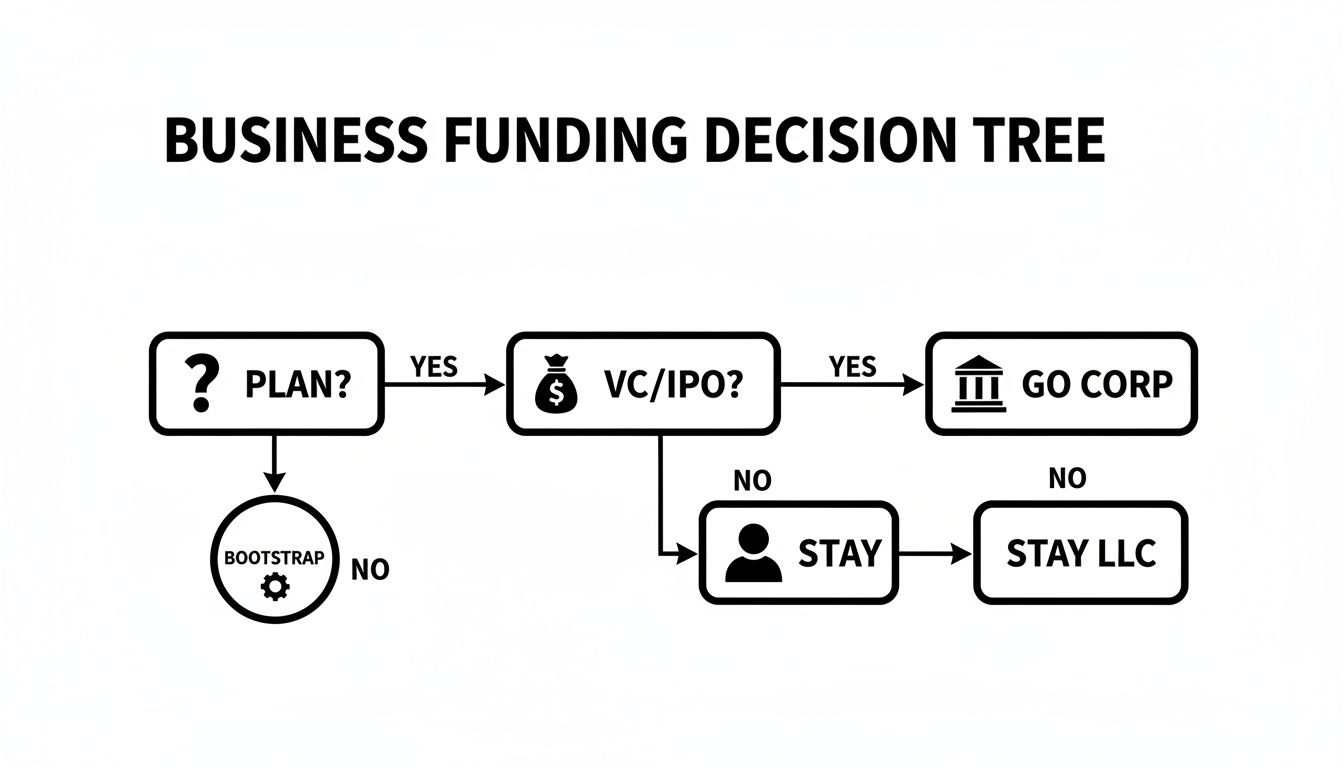
The flowchart highlights a critical fork in the road. If raising venture capital or planning an IPO is on your roadmap, a corporate structure is almost always required to meet investor demands and expectations.
Getting this right from the start can save you a mountain of headaches and cash down the line. While you can convert an LLC to a corporation later, it’s a complex legal and tax process. It's far better to avoid it if you have a clear vision from day one. Consulting with a professional can help you align your business structure with your long-term ambitions.
Common Questions About LLCs and Corporations
Even after comparing the major differences between an LLC and a corporation, you probably still have some specific questions. That's normal. Let's dig into some of the most common things entrepreneurs ask when they're at this critical crossroad.
Can I Change My LLC to a Corporation Down the Road?
Yes, absolutely. Switching an LLC to a corporation is a very common move, especially for startups that eventually want to raise money from venture capitalists. The official process is often called a "statutory conversion," and while the specific paperwork varies from state to state, it’s a well-established path for businesses that have outgrown the LLC structure.
Just be sure to get professional tax and legal advice before you make the leap. A conversion can have some serious financial consequences, particularly if your LLC is already taxed as an S Corp. The right guidance will make sure the transition is smooth and actually lines up with your new growth goals.
What's Better for a Business with Just One Owner?
For most solo entrepreneurs, the LLC is the clear winner. It gives you the exact same liability protection you'd get from a corporation, but with far less red tape and lower costs. By default, a single-member LLC is taxed just like a sole proprietorship, which makes tax time incredibly simple and sidesteps the whole double taxation problem entirely.
The LLC also gives you fantastic flexibility as you grow. You can always choose to be taxed as an S Corp later. This becomes a really smart tax-saving move once your business income gets high enough that you can save a meaningful amount on self-employment taxes.
For a solo founder, the single-member LLC strikes the perfect balance. You get that crucial legal shield between your personal and business assets without being bogged down by corporate rules like mandatory board meetings and complex bylaws.
Does It Matter Which State I Form My Business In?
It matters a great deal. Where you decide to form your business is a foundational choice that will affect your costs, compliance, and legal standing for years to come. Every state has its own filing fees, annual report fees, and franchise taxes—and the differences can be huge.
You'll often hear about states like Delaware and Nevada being popular because of their business-friendly laws. But for most small businesses, the most practical and cost-effective route is to form your entity right in the state where you actually operate. If you form it elsewhere, you'll likely have to register as a "foreign entity" in your home state anyway, which means double the paperwork and double the annual fees.
What Does "Piercing the Corporate Veil" Mean?
"Piercing the corporate veil" is a legal term for a court's decision to ignore your company's liability protection and hold you, the owner, personally responsible for business debts. It's the ultimate nightmare scenario because it completely undoes the main reason you formed an LLC or corporation in the first place.
When does this happen? It’s usually when the lines between the owner and the business get too blurry. The court essentially decides the company isn't a truly separate entity. Key triggers include:
- Commingling Funds: Using your business bank account for personal expenses (or vice versa) is a classic mistake.
- Ignoring Formalities: This is a bigger risk for corporations. If you skip required board meetings or fail to keep minutes, you're weakening your liability shield.
- Fraud or Misconduct: Intentionally using the company to mislead creditors or hide assets is a sure way to get the veil pierced.
The best way to protect your liability shield is to act like your business is a separate entity. Always maintain a dedicated business bank account, keep clean financial records, and follow the simple formalities required for your structure.
Figuring out the right business structure and tax strategy is a huge step toward building a successful company. The expert team at Allied Tax Advisors can walk you through the pros and cons of an LLC vs. corporation for your unique business, making sure your choice sets you up for financial success. Learn more about our business advisory and filing services at Allied Tax Advisors.