
When you get married, deciding how to file your taxes can feel like a big hurdle. But it doesn't have to be complicated. The choice usually boils down to a simple trade-off: do you want the best possible tax savings, or do you need to protect yourself by keeping your finances separate?
For the vast majority of married couples, Married Filing Jointly (MFJ) is the clear winner for saving money. The U.S. tax code is built to reward couples who file together.
Deciding Your Filing Status: A Quick Comparison
If you were legally married on December 31st, the IRS gives you two choices for that tax year: file jointly or file separately. While your personal situation will dictate the final answer, getting a handle on the core differences is the first step. For a deeper look into the specific advantages, you can read more about the benefits of filing taxes jointly.

To really see what’s at stake, let's look at a side-by-side comparison of the financial implications. This view makes it pretty clear why most people go the MFJ route.
Key Financial Differences: MFJ vs MFS
The table below breaks down the most significant financial distinctions between filing jointly and filing separately. It's a high-level snapshot that quickly shows where the biggest advantages and disadvantages lie for each status.
| Tax Feature | Married Filing Jointly (MFJ) | Married Filing Separately (MFS) |
|---|---|---|
| Standard Deduction (2024) | A generous $29,200. | Only $14,600. |
| Tax Brackets | Much wider brackets, meaning more of your combined income is taxed at lower rates. | Narrow brackets, often pushing you into a higher tax bracket much faster. |
| Key Tax Credits | Full eligibility for major credits like the EITC, education credits, and child-related credits. | Most valuable credits are disallowed. |
| Student Loan Interest | Can deduct up to $2,500 of interest paid on student loans. | This deduction is not allowed. |
| IRA Contributions | Higher income limits for deducting traditional IRA contributions. | Very low income phase-out limits, making deductions difficult for most. |
| Tax Liability | Both spouses share joint and several liability for the entire tax bill. | Each spouse is only responsible for the tax on their own return. |
The most glaring difference is the standard deduction. For 2024, joint filers get a $29,200 deduction, which is exactly double the $14,600 that separate filers get. That difference alone is a huge deal, but the benefits of MFJ don't stop there. Combining your incomes and deductions often unlocks even more tax breaks that you just can't get when filing on your own.
Choosing to file separately means you're almost certainly giving up valuable tax deductions and credits. You have to be sure that the reason for separating your tax liability is worth the higher tax bill.
Even though the numbers heavily favor MFJ, the MFS status exists for a reason. It can be a powerful tool in very specific situations. For instance, if one spouse has massive medical bills, filing separately might allow them to exceed the 7.5% of Adjusted Gross Income (AGI) threshold to deduct those expenses. It's also a common strategy for spouses on income-driven repayment plans for federal student loans, as it can result in a much lower monthly payment.
How Joint vs. Separate Filing Actually Works for Your Wallet
To really get to the heart of the married filing separately vs. jointly debate, we have to move past the standard deduction and look at how the IRS calculates what you owe. The real difference—and where it can cost you—is in the tax brackets. How your income fits into those brackets determines your final bill.
When you file a joint return, you and your spouse pool your incomes together. This combined total is then applied to the Married Filing Jointly (MFJ) tax brackets. These are, hands down, the most favorable brackets the tax code offers. They’re wider, which means a larger chunk of your income gets taxed at the lower rates before you get bumped into a higher bracket.
Filing separately is a completely different story. It splits your incomes, but it also shoves each of you into a much more restrictive tax structure. The Married Filing Separately (MFS) brackets are essentially the same as the Single filer brackets, but they're much tighter. You’ll find yourself hitting higher tax rates far sooner, and on much less income.
A Tale of Two Tax Brackets
The difference between these two bracket structures can be huge. For most couples, especially when one person earns significantly more than the other, filing separately often feels like taking a financial penalty.
Let's look at a quick example for the 2024 tax year. The 22% tax bracket for joint filers covers income from $94,301 all the way up to $201,050. But for separate filers? That same 22% bracket only covers income from $47,151 to $100,525. Someone earning $80,000 would sit comfortably in the 22% bracket with their spouse under MFJ rules. If they filed separately, part of that income would get pushed into the 24% bracket.
Key Insight: The tax brackets for Married Filing Separately are not simply the joint brackets cut in half. They're designed in a way that almost always results in a higher total tax bill for the couple, even if their combined income is identical.
The Big One: Joint and Several Liability
Perhaps the most critical factor that isn't about numbers is a legal concept called joint and several liability. This applies only to joint returns, and it's a big deal. When you both sign that joint return, you are each 100% responsible for the entire tax bill, plus any interest or penalties that might come up.
Think about what that means. If your spouse messes up—say, they underreport income or claim deductions they shouldn't have, even if you had no idea—the IRS can legally come after you for the full amount. It doesn't matter who earned the income or who made the mistake; the debt belongs to both of you. This is a major reason why some couples, particularly those with trust issues or very separate and complex financial lives, choose to file separately despite the tax hit. Filing separately breaks that financial bond, making each person responsible only for their own return.
How Your Investments Are Treated
Your filing status also changes the rules for your investments, especially how you handle capital gains and losses. For most people with a brokerage account, filing jointly makes life much simpler.
-
Married Filing Jointly: You can easily balance out your investment results. If one of you has a $5,000 gain and the other has a $2,000 loss, you can net them together and only pay tax on the remaining $3,000 gain. If you have more losses than gains, you can deduct up to $3,000 of those net losses from your regular income each year.
-
Married Filing Separately: That powerful capital loss deduction gets sliced in half. Each spouse can only deduct a maximum of $1,500 in capital losses from their income. For couples where one or both partners actively invest, this limitation is a significant drawback.
This single difference can cost a couple $1,500 in valuable deductions every single year. When you understand these specific rules—from the tax brackets to liability and investment deductions—you get a much clearer picture of what’s really at stake. It’s not just a simple choice; it’s about the entire financial framework that will be applied to your income.
How Major Tax Credits Hinge on Your Filing Status
Deciding between married filing separately vs. jointly is about more than just tax brackets. This one choice can either open the door to or slam it shut on some of the most powerful tax-saving tools the IRS offers. Your filing status acts as a gatekeeper, and choosing to file separately often means locking yourself out of valuable tax credits and deductions that can save families thousands.

This decision carries real weight. These tax benefits aren't just minor tweaks to your return; they're designed to help with major life expenses like raising children, paying for college, and saving for retirement. When you opt for MFS, you’re often giving up that support.
The Most Impactful Credits You Forfeit
Let's be clear: certain tax credits are immediately off the table for MFS filers. This isn't a case of getting a smaller benefit—it's a complete disqualification. The list includes some of the most significant credits available to American taxpayers.
Here are the primary benefits that become inaccessible:
- Earned Income Tax Credit (EITC): A huge help for low-to-moderate-income working families, this credit can be worth up to $7,830 in 2024 for a household with three or more kids. If you file separately, you get $0.
- American Opportunity Tax Credit (AOTC): A crucial education credit, this provides up to $2,500 per student for the first four years of college. It’s completely unavailable if you file separately.
- Lifetime Learning Credit (LLC): This is another key education credit for tuition and fees, offering up to $2,000 per tax return. It's also disallowed for MFS filers.
- Credit for Child and Dependent Care Expenses: This credit helps you pay for daycare or other care expenses so you can work. Filing separately makes you completely ineligible to claim it.
Losing these credits alone can make the MFS status financially impossible for many families, especially those with kids in school or daycare. For a complete look at benefits you might be missing, check out our guide on how to reduce your tax bill with top deductions and credits.
The U.S. tax code is built with a strong preference for joint filing, making it the default path for maximizing household tax benefits. By choosing to file separately, you are actively stepping away from this preferred path and the financial advantages that come with it.
Deductions That Disappear or Shrink
It's not just credits. Several popular and impactful deductions are also restricted for those who file separately. While credits cut your tax bill dollar-for-dollar, deductions reduce your taxable income. Losing them still means a higher tax bill.
Two of the most common deductions affected are:
- Student Loan Interest Deduction: Joint filers can deduct up to $2,500 in student loan interest paid during the year. If you file separately, you are not allowed to take this deduction at all, no matter what your income is.
- IRA Contributions Deduction: While you can still put money into a traditional IRA, your ability to deduct those contributions is severely limited. For MFS filers who lived with their spouse, the income phase-out range is so low that the deduction is effectively unavailable to most.
This structure reveals a clear policy choice. While tax systems for married couples vary globally, the United States is one of the few major economies that maintains joint taxation as the default. The restrictions on MFS filers are a direct result of this system, reinforcing joint filing as the standard.
Ultimately, the decision to file separately requires a very careful cost-benefit analysis. You have to be absolutely sure that the reason for choosing MFS—like separating your tax liability from your spouse's—is worth more than the definite financial loss you'll take from giving up these powerful credits and deductions.
When Filing Separately Is the Smarter Move
It’s true that over 95% of married couples file their taxes jointly, and for good reason. For most, it's the simplest path to a lower tax bill. But the Married Filing Separately (MFS) status isn’t just a forgotten option; it's a critical tool for very specific financial situations.
Choosing to file separately is rarely about discovering a secret tax loophole. Instead, it's a strategic move when unique circumstances—like protecting your assets or unlocking specific deductions—outweigh the benefits of filing together. The decision between married filing separately vs jointly really comes down to the math when one spouse has exceptionally high expenses tied to their income.
This infographic lays out a clear decision-making path to help you see if MFS deserves a closer look.
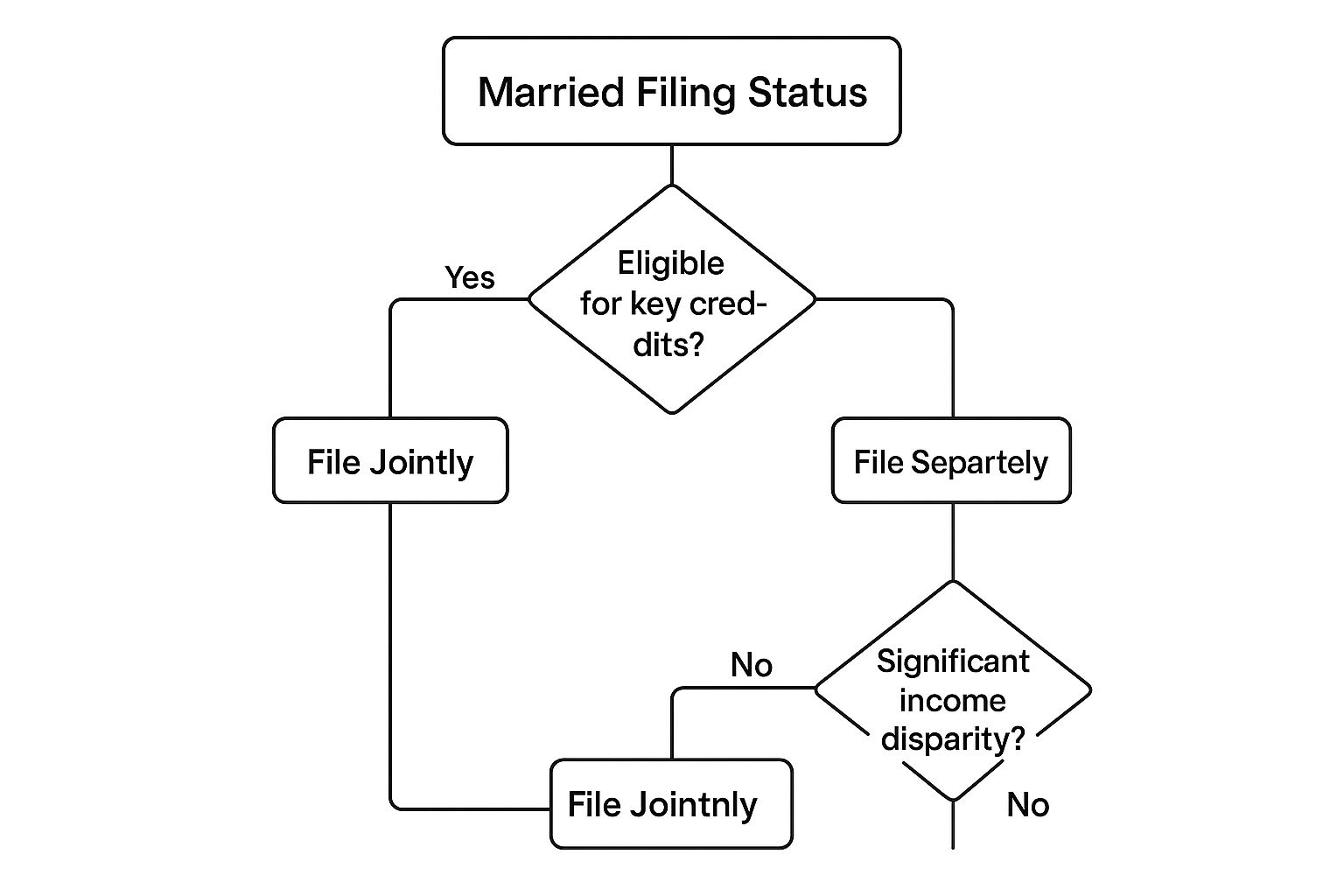
As you can see, the main triggers for considering MFS often revolve around liability protection or a significant income gap between spouses, especially when popular tax credits aren't a big part of your financial picture.
Lowering the Bar for Medical Expense Deductions
One of the most compelling reasons to file separately pops up when one spouse has massive medical bills. The IRS lets you deduct qualifying medical costs, but only the amount that exceeds 7.5% of your Adjusted Gross income (AGI). When you file a joint return, that threshold is based on your combined AGI, making it a very high bar to clear.
Here’s a practical example. Let's say Alex has $15,000 in medical bills.
- Filing Jointly: Alex and their spouse have a combined AGI of $120,000. The 7.5% deduction threshold is $9,000. This means they can only deduct the amount over that line: $6,000 ($15,000 – $9,000).
- Filing Separately: Alex’s individual AGI is $50,000. The 7.5% threshold plummets to just $3,750. Suddenly, Alex can deduct a whopping $11,250 ($15,000 – $3,750).
In this scenario, the much larger deduction from filing separately could easily save them more in taxes than they'd lose from the higher MFS tax rates and forfeited credits. It's a powerful strategy, but you absolutely have to run the numbers both ways to be sure.
Reducing Student Loan Payments
Another huge factor pushing couples toward MFS is federal student loan debt. If you're on an income-driven repayment (IDR) plan like SAVE (Saving on a Valuable Education) or PAYE (Pay As You Earn), your monthly payment is calculated from your discretionary income.
File jointly, and that payment is based on your total household income, which can result in a painfully high monthly bill. But if you file separately, many IDR plans will calculate your payment using only your individual income.
Key Insight: For a spouse with a hefty student loan balance but a much lower income than their partner, filing separately can slash their monthly payment, sometimes by hundreds of dollars. The long-term savings from lower loan payments can easily dwarf the extra tax you might pay.
Protecting Yourself From Spousal Liability
Beyond the numbers, liability is a major—and often non-negotiable—reason to choose MFS. When you sign a joint tax return, you agree to "joint and several liability." In plain English, this means the IRS can come after you for 100% of the tax debt, including any penalties and interest, no matter which spouse earned the income or made the mistake.
Filing separately creates a crucial financial firewall in certain situations:
- Trust Issues: You suspect your spouse isn't being completely honest about their income or deductions.
- Complex Finances: Your spouse is a business owner with aggressive tax strategies you don't fully understand or feel comfortable with.
- Pending Divorce: Separating your finances with MFS can be a clean break as the marriage is ending. Major life events like these always have tax implications, which is why it's wise to understand how major life changes impact your taxes in greater detail.
In these cases, the peace of mind and legal protection from MFS are invaluable. Paying a little more in tax becomes a worthwhile trade-off to shield yourself from your spouse's potential tax troubles.
Here’s a quick checklist to help you identify if filing separately might be right for you.
Checklist: When to Consider Filing Separately
Use this checklist to see if your financial situation matches one of the key scenarios where MFS might be the right choice.
| Scenario | Why MFS Might Help | Key Consideration |
|---|---|---|
| High Medical Expenses | Lowers the AGI threshold, making it easier to qualify for a large medical expense deduction. | The tax savings from the larger deduction must outweigh the loss of MFJ credits and benefits. |
| Student Loan Debt (IDR Plan) | Calculates monthly payments on only one spouse's income, potentially lowering the payment significantly. | The savings on loan payments must be greater than the extra income tax you'll pay. |
| Spouse Has Tax Problems | Creates a legal firewall, protecting you from liability for your spouse's tax errors or debts. | Is the cost of higher taxes worth the peace of mind and financial protection? |
| Pending Divorce or Separation | Allows for a clean financial separation before the divorce is finalized. | This is often a temporary strategy to simplify the division of financial responsibilities. |
Ultimately, choosing to file separately is a calculated decision. It requires carefully weighing the immediate tax costs against your personal financial security and long-term goals.
How U.S. Marriage Taxes Compare Globally
To really get a handle on the American system for taxing married couples, it helps to see how we stack up against the rest of the world. The whole debate over married filing separately vs. jointly is a very American conversation, largely because the U.S. is one of the few major economies that strongly encourages taxing the household as a single unit.
This context is key to understanding why our system is structured the way it is.

Our approach is a stark contrast to the model you'll find in most other developed nations, where individual taxation is simply the norm. This fundamental difference in policy creates a unique set of economic incentives that shape everything from household budgets to career decisions.
Two Worlds of Taxation: Individual vs. Joint
Globally, the biggest divide comes down to a simple question: do you tax the family or the individual? Most of Europe, along with many other countries, operates on a system of individual taxation. In these places, whether you're married or not has very little impact on your tax rate. Each spouse is treated as a distinct taxpayer, filing their own return based on their own income. Simple as that.
The United States, however, is a champion of joint taxation. Our tax code is fundamentally built around the idea of the household as one economic entity. While this system often works out well for single-earner couples, it can also lead to the infamous "marriage penalty," where two working spouses end up paying more in taxes combined than they would if they were still single.
Most OECD countries use separate income taxation for spouses. A few, like the United States, France, and Germany, stick with a joint or family-based system. This distinction directly affects the tax burden on different types of families, as dual-earner couples in separate taxation countries often find the tax implications more neutral. For a deeper dive, the OECD analyses of tax neutrality offer a detailed comparison of these systems.
The core difference really boils down to philosophy: Is a household one financial entity or two independent taxpayers? The U.S. tax code firmly bets on the former, and that shapes the entire married filing separately vs. jointly decision.
The Economic Ripple Effects on Household Decisions
This policy choice has real, tangible consequences, especially when it comes to the secondary earner in a household deciding whether to work. In a joint taxation system, the very first dollar earned by the second spouse isn't taxed at the bottom rate. Instead, it's taxed at the highest marginal rate of the primary earner. This can be a huge disincentive for that second person to join the workforce, since a big chunk of their paycheck goes straight to taxes.
This structure can inadvertently discourage dual-income households—an effect that's far less common in countries with individual taxation. In those systems, each spouse's income is taxed on its own, starting in the lowest bracket, which makes entering the workforce a much more attractive financial proposition. This global view helps clarify why the benefits of filing jointly are so significant in the U.S.—it’s the central feature of a system designed to tax the household, not the individual.
Making Your Final Filing Decision
After weighing the pros and cons, it's time to land on a final decision. The only truly foolproof way to settle the married filing separately vs. jointly debate for your family is to see how the numbers shake out. Theory is one thing, but your actual tax liability is what really counts.
This means you’ll need to prepare your tax return two different ways before you officially file. Yes, it’s a bit of extra work, but it's the single best way to guarantee you aren't leaving money on the table. Think of it as a financial dress rehearsal.
Thankfully, most modern tax software simplifies this. You can plug in all your financial information once, then just toggle between the MFJ and MFS statuses. The software will instantly show you the refund or tax owed for each option.
The Two-Return Test Run
This side-by-side comparison is the gold standard for making a confident choice. By drafting one joint return and one separate return, you're swapping guesswork for hard data. This is how you'll see the real-world impact of losing certain tax credits or, conversely, qualifying for a major deduction.
It's a common mistake to assume a single factor, like a lower student loan payment, automatically makes MFS the winner. Without running the numbers, you have no way of knowing if the higher tax bill from filing separately completely wipes out those loan savings.
The most accurate way to pick your filing status is to calculate your tax liability both ways. It's the only method that accounts for every single variable in your financial life, from income and deductions to specific credits.
This head-to-head calculation is absolutely critical if you're in one of those specific situations where MFS might make sense, like dealing with hefty medical expenses or managing an income-driven student loan repayment plan.
When to Bring in a Professional
While running the numbers yourself is incredibly helpful, some situations really benefit from a professional eye. The tax code is a complicated beast, and the wrong call can have ripple effects on your finances for years.
You should seriously consider talking to a tax advisor, like the team at Allied Tax Advisors, if you find yourself in these situations:
- Complex Scenarios: Your decision is tangled up with major life factors, like student loans, high medical bills, or liability concerns from a spouse's business.
- Confusing Results: The outcomes from your two-return test run are surprising or don't make sense to you.
- Long-Term Planning: You need to know how this year's filing status will impact future financial goals, like saving for retirement or getting a mortgage.
A good tax pro can confirm your calculations, spot opportunities or risks you might have overlooked, and give you clarity on the best path forward. A well-informed decision now can save you from costly headaches and corrections down the road.
Common Questions About Filing Status
When you're trying to decide between married filing separately vs. jointly, a lot of practical questions pop up. Getting straight answers is key to smart tax planning and, frankly, avoiding headaches later on. Let's walk through some of the most common ones.
Can We Change Our Filing Status Later?
This is probably the number one question I hear. The answer is yes, but with a major catch: it's a one-way street.
You have a three-year window from the original tax deadline (including extensions) to file an amended return, Form 1040-X. This lets you switch from Married Filing Separately to Married Filing Jointly if you run the numbers and realize you left money on the table.
But once you file a joint return and the deadline has passed, that’s it. You cannot amend it to file separate returns for that year. The decision to file jointly is locked in.
How Does Filing Separately Affect Social Security?
For anyone nearing or in retirement, this is a big one. Your filing status can dramatically change how much of your Social Security benefits get taxed, and filing separately can be a real trap.
If you file separately but lived with your spouse at any time during the year, the IRS rules get tough. Up to 85% of your Social Security benefits could become taxable, and this kicks in at a much lower income level than it does for joint filers. It's a scenario that often leads to a surprisingly high tax bill for retirees who expected to owe very little.
What Are the Rules for Community Property States?
Living in a community property state throws another wrench in the works. These states have their own laws about what constitutes marital income and assets, and you have to follow them even if you file separate federal returns.
The nine community property states are:
- Arizona
- California
- Idaho
- Louisiana
- Nevada
- New Mexico
- Texas
- Washington
- Wisconsin
If you’re in one of these states and file separately, you generally can't just report your own earnings. You typically have to report half of all "community income"—which is most income earned by either of you during the marriage—plus any of your own separate income. These complex rules can completely undermine the reason you wanted to file separately in the first place, like trying to lower one spouse's income for a student loan payment plan.
Navigating these rules isn't easy. The team at Allied Tax Advisors has spent decades helping couples make the right call for their specific situation. To make sure your choice really supports your financial goals, you can learn more about our personalized tax services at https://alliedtax.com.