
Retirement is supposed to be your time to finally enjoy the nest egg you’ve spent a lifetime building. The last thing you want is a hefty, unexpected tax bill eating into those savings.
I’ve found that the secret to minimizing taxes in retirement isn’t some complicated loophole. It boils down to a single powerful idea: tax diversification. It’s about building a mix of different account types—tax-deferred, tax-exempt, and taxable—to give yourself maximum control over how much you pay the IRS each year.
Building Your Low-Tax Retirement Foundation
Most people I talk to are hyper-focused on one number: the total balance in their retirement accounts. It’s an important number, sure, but it only paints half the picture. The real game-changer for a low-tax retirement is understanding not just how much you’ve saved, but how that money gets taxed when you actually start using it.
Think of it like this: you wouldn’t build a house with only one tool. You need a hammer, a saw, a drill—each for a specific job. Your retirement accounts work the same way. Each one has a unique tax purpose, and having a variety gives you incredible flexibility.
The Three Buckets of Retirement Savings
When you get down to it, your savings will fall into one of three main tax buckets. Knowing how each one works is the first, most critical step to keeping your retirement taxes low.
- Tax-Deferred Accounts (Traditional IRAs, 401(k)s): This is the “tax-me-later” bucket. You get a tax break on contributions now, and your money grows without being taxed along the way. The catch? Every single dollar you pull out in retirement is taxed as ordinary income.
- Tax-Exempt Accounts (Roth IRAs, Roth 401(k)s): This is the “tax-me-now” bucket. You contribute with after-tax dollars (so no upfront deduction), but your investments grow tax-free. Here’s the magic: every qualified withdrawal you make in retirement is 100% tax-free.
- Taxable Accounts (Brokerage Accounts): This is your flexible, after-tax bucket. You fund it with money you’ve already paid taxes on. You’ll pay taxes on dividends and capital gains as you go, and when you sell investments for a profit, you’ll owe capital gains tax—often at a lower rate than income tax.
Having money in all three buckets means you can essentially create a custom “tax paycheck” for yourself every year. Need more cash but don’t want to jump into a higher tax bracket? Pull from your Roth. It’s all about having options.
By blending withdrawals from these different account types, you can proactively manage which tax bracket you fall into each year. This control is the cornerstone of advanced retirement tax planning.
Why Tax Diversification Matters in the Real World
Let’s look at a real-world example. Imagine Sarah, a retiree who was a diligent saver but put everything into her traditional 401(k). Now she needs $60,000 for her annual living expenses. When she pulls that money out, the entire $60,000 is added to her taxable income for the year. This could easily bump her into a higher tax bracket and even make more of her Social Security benefits taxable.
Now, let’s consider David. He practiced tax diversification throughout his career and has a traditional IRA, a Roth IRA, and a taxable brokerage account. To get the same $60,000 in cash, he can be strategic:
- He pulls $30,000 from his traditional IRA (this is taxable income).
- He takes $20,000 from his Roth IRA (completely tax-free).
- He sells some stock in his brokerage account for $10,000 (only the profit portion is taxed, likely at a lower capital gains rate).
David ends up with the exact same $60,000 in his pocket as Sarah, but his taxable income is dramatically lower. He stays in a lower bracket and keeps far more of his hard-earned money.
As you can see, understanding how taxes will affect your savings is absolutely fundamental. This strategic approach is the foundation upon which all other tax-minimizing retirement strategies are built.
Smart Withdrawal Strategies to Lower Your Tax Bill

Once the paychecks stop, you become your own CFO. How you draw money from your various retirement accounts isn’t just a simple choice—it’s a strategic decision that can dramatically shift your lifetime tax bill. It’s time to put theory into practice.
For years, the conventional wisdom was pretty straightforward: first, spend down your taxable brokerage accounts, then tap into tax-deferred accounts like your Traditional IRA, and finally, save your tax-free Roth accounts for last. It makes sense at a glance, but this rigid, one-size-fits-all approach can leave a surprising amount of money on the table for the IRS.
A much smarter strategy is to blend your withdrawals, actively managing your taxable income year by year. This is really the heart of minimizing taxes in retirement.
Beyond the Conventional Withdrawal Order
Sticking to that old “taxable, then tax-deferred, then Roth” order can be a real misstep, especially in your early retirement years. Let’s say you retire at 62, but you’re delaying Social Security and your Required Minimum Distributions (RMDs) are still years away. These are your “gap years,” and they’re a golden opportunity.
During this window, your taxable income might be incredibly low. If you only draw from your taxable brokerage account, you could be completely wasting the valuable real estate in the lower tax brackets (like the 10% and 12% brackets). Fast forward a few years when you’re forced to take large, fully-taxable RMDs, and you’ll be wishing you had that low-bracket space back.
A much better approach is to strategically “fill up” the lower tax brackets each year. This means intentionally taking small, calculated distributions from your Traditional IRA or 401(k) to bring your taxable income right up to the top of a low bracket—but not over it.
You pay a small amount of tax now at a very favorable rate, but in doing so, you shrink the future RMDs that would have been taxed at a much higher rate. It’s a proactive move that truly pays off down the road.
The Art of Blending Withdrawals
Let’s walk through a real-world scenario. Meet Jane, a 65-year-old retiree who needs $70,000 for her annual living expenses. She has money saved across all three tax buckets.
Instead of pulling the full $70,000 from her Traditional IRA and getting slammed with a huge tax bill, Jane can get creative and blend her withdrawals. Here’s one way she could structure her income to stay in a lower tax bracket:
- $40,000 from her Traditional IRA: This covers a big chunk of her expenses but is low enough to keep her from jumping into a much higher tax bracket.
- $20,000 from her Roth IRA: This withdrawal is completely tax-free, so it doesn’t add a single penny to her adjusted gross income (AGI).
- $10,000 from her brokerage account: She sells stocks she’s held for over a year. Only the long-term capital gain is taxed, and depending on her total income, that tax rate could be as low as 0%.
By mixing her income sources, Jane gets the $70,000 she needs while keeping her taxable income—and her tax bill—as low as possible. This flexibility is the true power of having your money in different tax-advantaged accounts.
Managing Income to Avoid Hidden Taxes
This level of control isn’t just about your income tax. Your AGI is the key number that affects other costs, like how much of your Social Security benefits are taxed and what you’ll pay for Medicare premiums.
When your income crosses certain thresholds, it can trigger what’s known as the Income-Related Monthly Adjustment Amount (IRMAA). These are surcharges tacked onto your Medicare Part B and Part D premiums that can cost a single retiree hundreds of extra dollars every month. By carefully blending withdrawals, especially from Roth and taxable accounts, you can often keep your AGI just below those critical IRMAA thresholds.
Of course, this all starts with disciplined saving. A global study on retirement readiness found that people should aim to save between 13% to 21% of their pre-tax income to build a nest egg that can support them. Having that solid foundation is what allows for a sustainable withdrawal rate, giving you the power to control your taxable income each year. You can explore more about these global savings benchmarks and see how you stack up.
The Strategic Power of Roth Conversions
Of all the tools we have for managing retirement taxes, the Roth conversion is one of the most powerful. It might sound complicated, but the idea is actually pretty simple. You’re just moving money from a pre-tax retirement account, like a Traditional IRA or 401(k), over to an after-tax Roth IRA.
So, what’s the catch? You have to pay income tax on the amount you convert, and you pay it in the year you make the move. I know what you’re thinking—why on earth would I pay taxes now if I don’t have to? It’s all about playing the long game. By settling the tax bill today, you’re buying yourself a future of 100% tax-free growth and, crucially, tax-free withdrawals down the road.
Understanding the Trade-Off
A Roth conversion is really a calculated bet on where tax rates are headed. You’re betting that your tax rate today is lower than what you’d be paying on withdrawals years from now. For many people, this is a smart bet. Once Required Minimum Distributions (RMDs) kick in, you could be forced into a higher tax bracket, whether you need the income or not.
By converting, you’re not just building a tax-free nest egg. You’re also shrinking the balance in your traditional account, which means smaller future RMDs. This gives you far more control over your taxable income in your later years.
The whole point is to have a bucket of money you can access in retirement without a tax bill attached, as this chart shows.
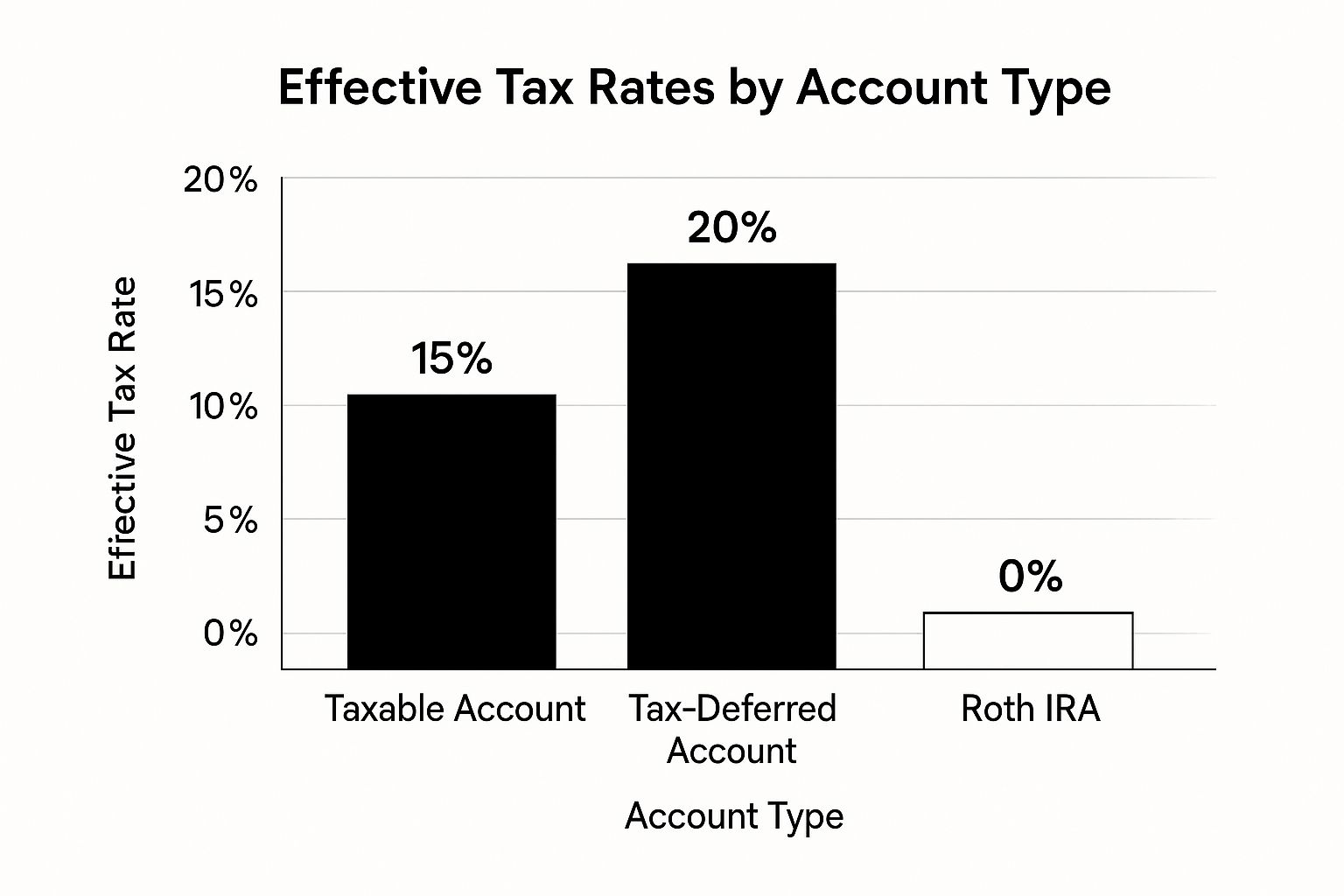
As you can see, the real magic of a Roth is that qualified withdrawals have a 0% effective tax rate—a huge advantage over taxable and tax-deferred accounts.
Finding the Sweet Spot for Conversions
With Roth conversions, timing is everything. I’ve found the sweet spot for many of my clients is during their “gap years.” This is the window after you’ve stopped working but before you start taking Social Security and RMDs begin (now at age 73 or 75, depending on your birth year).
During these gap years, your earned income is often the lowest it’s been in decades. This creates a perfect opportunity to convert chunks of your traditional IRA to a Roth, strategically “filling up” the lower tax brackets (10% and 12%) before other income pushes you into higher ones.
Here’s how this plays out in the real world:
- Meet Mark, Age 63: Mark just retired with $500,000 in his Traditional IRA. He’s decided to hold off on Social Security until he’s 70.
- His Strategy: With very little taxable income, he decides to convert $40,000 a year from his Traditional IRA to a Roth IRA. This move is small enough to keep his income in a low federal tax bracket.
- The Result: He pays a little tax now, but it’s manageable. By the time he hits 75, his Traditional IRA balance is much smaller, which means his RMDs will be lower. Best of all, he’ll have a large, tax-free Roth account to pull from for big-ticket items without sending his tax bill through the roof.
By strategically converting funds during low-income years, you are essentially “filling up” low tax brackets with income that might otherwise be taxed at 22%, 24%, or higher in the future.
Let’s look at a table to see how a well-timed conversion can make a significant difference.
Roth Conversion Scenario Analysis
This table shows the potential impact of doing a conversion in a low-income year versus waiting until your income (and tax bracket) is higher.
| Scenario | Conversion Amount | Tax Bracket During Conversion | Estimated Tax on Conversion | Future Tax Savings (Tax-Free Withdrawals) |
|---|---|---|---|---|
| Early Conversion (Low-Income Year) | $50,000 | 12% | $6,000 | All future growth and withdrawals are tax-free. |
| Delayed Conversion (Higher-Income Year) | $50,000 | 24% | $12,000 | All future growth and withdrawals are tax-free. |
As the analysis shows, timing your conversion to align with a lower-income year can cut the immediate tax cost in half, while still locking in the same long-term tax-free benefits. It’s a clear win.
Avoiding Common Roth Conversion Mistakes
While Roth conversions are a fantastic strategy, there are a few rules that can trip you up if you’re not paying attention.
First up is the notorious five-year rule. There are actually two of them. The first says you must wait five years from your very first Roth IRA contribution to take out earnings tax-free. The second rule is specific to conversions: each conversion starts its own five-year clock. If you’re under 59 ½, you have to wait five years to withdraw the converted principal without a penalty.
It’s also critical to have cash on hand to pay the taxes. The best approach is to use money from a separate savings or brokerage account. If you use money from the converted amount itself to pay the tax, you’ll likely face penalties (if under 59 ½) and you’ll have less money working for you in the tax-free account. If you need to sell some investments to cover the tax, you can learn more about minimizing your capital gains tax liability. A little bit of planning here goes a long way toward maximizing the benefit.
Optimizing Your Social Security Benefits
It often comes as a shock to new retirees, but your Social Security benefits can absolutely be taxed. The good news? You have more control over this than you might think. Whether the IRS gets a cut of your benefit check comes down to how you manage your other income streams.
The whole thing hinges on a unique figure called provisional income. This isn’t your typical income calculation; it’s a special formula the IRS uses for one reason only: to see if your Social Security is taxable. If you can keep your provisional income below certain thresholds, your benefits stay completely tax-free. But once you cross those lines, up to 85% of your benefits can suddenly become taxable income.
Understanding the Provisional Income Formula
So, what goes into this “provisional income”? It’s a bit different from your adjusted gross income (AGI) that you see on your tax return. The formula is pretty straightforward:
Provisional Income = Your AGI + Tax-Exempt Interest + 50% of Your Social Security Benefits
Your AGI includes most of the income you’d expect, like wages from a part-time job, pension payments, and, critically, withdrawals from your Traditional IRAs or 401(k)s. What’s not included? Withdrawals from a Roth IRA don’t count towards AGI, which makes them an incredibly powerful tool for keeping this number down.
For 2024, here are the income tripwires for a married couple filing jointly:
- Below $32,000: Your benefits are 100% tax-free.
- Between $32,000 and $44,000: Up to 50% of your benefits may be taxed.
- Above $44,000: Up to 85% of your benefits may be taxed.
A crucial point here is that these thresholds are not indexed for inflation. As costs rise over time, it becomes easier and easier to accidentally cross these lines, which is why having a proactive plan is so important.
By carefully choreographing your withdrawals from different accounts, you can directly influence your provisional income and potentially keep your Social Security benefits completely off the IRS’s radar.
A Real-World Scenario
Let’s look at how this plays out for a hypothetical retired couple, Mike and Susan. They file their taxes jointly and together they receive $40,000 a year from Social Security.
Scenario 1: An Uncoordinated Approach
In their first year of retirement, they need another $40,000 to cover their expenses. Without much thought, they simply pull the entire amount from Mike’s Traditional IRA.
- AGI: $40,000 (The full IRA withdrawal is taxable income)
- 50% of Social Security: $20,000
- Provisional Income: $40,000 + $20,000 = $60,000
Their $60,000 provisional income blows past the $44,000 threshold. The result? A whopping $23,800 of their Social Security benefits is now considered taxable, creating a bigger tax bill.
Scenario 2: A Strategic Approach
Now, let’s assume they planned ahead and have a mix of accounts. To get that same $40,000, they take $20,000 from the Traditional IRA and $20,000 from their tax-free Roth IRA.
- AGI: $20,000 (Only the Traditional IRA withdrawal counts)
- 50% of Social Security: $20,000
- Provisional Income: $20,000 + $20,000 = $40,000
This time, their $40,000 provisional income lands below the $44,000 threshold. A much smaller portion of their benefits—just $6,800—becomes taxable. By simply changing which bucket they pulled money from, they dramatically cut their tax liability for the year.
Coordinating All Your Income Sources
The ultimate goal is to get every piece of your financial puzzle working in harmony. This isn’t just about retirement accounts; you have to look at the timing of all your income.
Pension payments and part-time job earnings, for instance, both add to your AGI and push that provisional income number higher. By understanding how every dollar affects the formula, you can make smarter decisions each year. For example, delaying your Social Security claim can keep your provisional income low in your early retirement years, opening up a perfect window for tax-efficient Roth conversions. It’s all about making deliberate choices to stay under those critical tax tripwires.
How Your State Impacts Your Retirement Taxes

It’s easy to get tunnel vision and focus only on federal tax strategies, but that’s just one piece of the puzzle. A huge factor that can dramatically alter your retirement income is something people often forget until they’re already filing their first tax return as a retiree: state taxes. Honestly, where you decide to plant your roots in retirement can be just as impactful as how you take money out of your accounts.
The classic dream of paying little to no tax in retirement usually starts with a map. Right now, there are nine states that don’t have a state income tax, which makes them incredibly popular retirement destinations:
- Alaska
- Florida
- Nevada
- New Hampshire (which only taxes interest and dividends, not earned income)
- South Dakota
- Tennessee
- Texas
- Washington
- Wyoming
If you live in one of these states, your Social Security checks, pension payments, and every dollar you pull from your 401(k) or Traditional IRA are completely free from state income tax. That can easily add up to thousands of dollars back in your pocket every year.
Beyond Zero Income Tax
But don’t assume your options are limited to just those nine states. The tax-friendly landscape is much broader than that. Many other states have rolled out the welcome mat for retirees with some really valuable, specific tax breaks.
For instance, states like Illinois, Mississippi, and Pennsylvania tax regular earned income but completely exempt all retirement income. You read that right—your pension and IRA withdrawals are off-limits. Others offer very generous deductions or credits specifically for seniors drawing on their retirement funds, which can significantly chip away at your tax liability.
Your state of residence is a dynamic part of your retirement tax equation. A move from a high-tax state like California or New York to a more tax-friendly state like Florida or Texas can feel like giving yourself a significant raise.
This is something I’ve seen firsthand with clients. It really drives home the need to look at the complete state tax picture before you start packing.
The Bigger Picture: Property and Sales Taxes
A state with no income tax sounds perfect, but it’s not the end of the story. States still need money to pave roads and fund schools. To do that, they often lean much more heavily on other taxes, namely property and sales taxes. A state with a $0 income tax might have sky-high property taxes that could completely wipe out the savings you were expecting.
Before you call the movers, you have to run all the numbers. A truly comprehensive look should include:
- Income Tax: How does the state treat your retirement accounts, pension, and Social Security?
- Property Tax: What are the average rates in the specific areas you’re considering? Are there property tax breaks or “circuit breakers” for seniors?
- Sales Tax: What’s the combined state and local rate? And importantly, does it apply to essentials like groceries and prescription drugs?
By weighing all three, you get a much more realistic feel for the true cost of living and the actual impact on your retirement budget.
Expanding Your Horizons: Retiring Abroad
For the more adventurous, the ultimate tax-minimization strategy might mean looking beyond U.S. borders entirely. Choosing a tax-friendly country is a path more and more Americans are taking.
Popular destinations in Europe, Asia, and Latin America offer incredibly low—or even zero—taxes on pension income and capital gains. Countries like Portugal, Costa Rica, and Malaysia have rolled out attractive incentives, from full exemptions on foreign pension income to simple, low flat tax rates. For retirees who take the leap, it’s a way to make their savings stretch much further while legally sidestepping the higher tax rates back home.
This international approach can dramatically lower your effective tax rate, sometimes by thousands of dollars a year. It’s a powerful strategy that combines smart withdrawal planning with a change of scenery to truly maximize your net retirement income.
If this idea piques your interest, you can discover more insights about retiring to tax-friendly countries on taxesforexpats.com.
Your Top Retirement Tax Questions, Answered
Let’s be honest: navigating retirement taxes can feel like learning a whole new language. You can have a solid plan in place, but specific questions always seem to pop up. Here, I’ll tackle some of the most common ones I hear from clients, giving you clear answers to help you keep more of your money.
One of the first things people ask is, “When do I really need to start thinking about all this?” The simple answer? Much earlier than you might think. While the years right before and after you stop working are critical, the seeds of a tax-smart retirement are planted decades earlier. It all comes down to tax diversification—building a mix of traditional, Roth, and even taxable accounts over your working life.
When Is a Roth Conversion a Bad Idea?
Roth conversions get a lot of attention, and for good reason. They can be incredibly powerful. But they aren’t a one-size-fits-all solution.
A conversion might actually be a bad move if it bumps you into a significantly higher tax bracket. The goal is to pay taxes at a lower rate now than you would in the future. If the conversion creates a massive upfront tax bill, it can easily wipe out the long-term benefits. This is especially true if you genuinely expect your income—and your tax rate—to be much lower in retirement, even after Required Minimum Distributions (RMDs) kick in.
For example, maybe you plan to work part-time, have a large pension, or expect other income sources down the road. In that case, paying a high tax rate today just to convert doesn’t make much sense. It’s also less helpful if you think you’ll need the converted money soon and will get tripped up by the five-year rule, which can trigger penalties.
Dealing with Required Minimum Distributions
RMDs can throw a real wrench into even the most carefully laid plans. These are the mandatory withdrawals from your traditional retirement accounts (like 401(k)s and IRAs) that now start at age 73 or 75. They can easily force you to take out more taxable income than you actually need, pushing you into a higher tax bracket and potentially hiking up your Medicare premiums.
The best defense against painful RMDs is a good offense—managing them long before they begin.
- Strategic Roth Conversions: As we just talked about, converting funds during your lower-income “gap years” (after you retire but before RMDs start) shrinks your traditional IRA balance. A smaller balance means smaller future RMDs.
- Qualified Charitable Distributions (QCDs): If you’re charitably inclined and over age 70½, this is a fantastic tool. You can donate up to $105,000 a year directly from your IRA to a qualified charity. This donation counts toward your RMD but isn’t included in your taxable income. It’s a huge win-win. You might also find that a new senior deduction can help you save more on taxes in certain situations, offering another layer of savings.
I often tell clients to think of their traditional IRA like a slowly inflating balloon. Every year, it gets bigger. RMDs are the point where the government forces you to start letting air out. Proactive strategies like Roth conversions and QCDs let you control that inflation, keeping the balloon at a much more manageable size.
Can I Still Contribute to Retirement Accounts After I Retire?
Absolutely! This is a strategy that catches many people by surprise. Your ability to contribute to a retirement account is tied to having earned income, not your formal employment status.
So, if you retire from your main career but decide to do some part-time work or consulting, you can keep adding to your retirement savings. This is a golden opportunity for more tax planning.
Recent legislation has made this even more appealing. The annual 401(k) contribution limit is now $23,500, with an extra $7,500 catch-up contribution for those 50 and older. The SECURE 2.0 Act even allows people aged 60 to 63 to make a larger catch-up contribution. IRA limits have also risen to $7,000, plus a $1,000 catch-up.
This allows you to shelter some of that new income from taxes while continuing to grow your nest egg. It just goes to show that your journey to a tax-efficient retirement doesn’t have to end just because you’ve left your full-time job behind.