
It’s a frustrating moment for any investor: you’ve suffered a real financial loss on an investment, but your tax form says you can't deduct it. What gives? You've just run into the passive activity loss rules.
The core idea is surprisingly simple. The IRS won't let you use a loss from a "passive" investment—like a rental property you don't manage day-to-day—to lower the taxes on your "active" income, like the salary from your job.
Decoding the Purpose of Passive Loss Rules

At first glance, the passive activity loss (PAL) rules can feel unfair. A loss is a loss, right? Why should it matter where it came from? To get why the IRS sees it differently, you have to understand how they categorize your financial life. They essentially sort everything you earn (and lose) into three distinct buckets.
The Three Income Buckets
Understanding how the IRS separates your income is the first step to mastering the passive activity loss rules. They created these categories to prevent people from using paper losses on investments to get out of paying taxes on their regular income.
| Income Type | What It Includes | How Passive Losses Affect It |
|---|---|---|
| Active Income | Money you earn from work where you "materially participate," such as wages, salaries, commissions, or profits from a business you actively run. | You generally cannot use passive losses to reduce your active income. |
| Portfolio Income | Income from investments like stocks, bonds, and mutual funds. Think dividends, interest payments, and capital gains. | Passive losses cannot be used to offset your portfolio income. |
| Passive Income | Earnings from a trade, business, or rental activity where you do not materially participate. A classic example is a rental property managed by a property management company. | This is where your passive losses get applied. They can only be used to offset income from other passive activities. |
The entire system is built on keeping these buckets separate. Think of it like a firewall the IRS built around your passive activities. A loss from your passive bucket is generally stuck there; it can't be used to shelter income in your active or portfolio buckets.
The primary goal of these rules is to ensure that your tax deductions reflect a genuine economic loss, not just a paper loss created for tax avoidance.
Why Were These Rules Created?
A little history goes a long way in understanding the logic here. The Passive Activity Loss rules came into being with the U.S. Tax Reform Act of 1986 (IRC § 469). Congress created them to shut down a very popular—and costly—loophole.
Before 1986, high-income taxpayers were using tax shelters to generate huge "paper losses" from business activities without much real economic risk. They would then use these artificial losses to wipe out the tax liability on their high salaries. This was costing the U.S. Treasury a fortune. You can find more details on the history and specifics of these IRS regulations.
Ultimately, these rules force a simple matching principle: passive losses can only offset passive income. While it feels restrictive, grasping this foundation is the key to navigating the system. The rest of this guide will break down the specific definitions, crucial exceptions, and strategies you can use to work within these important tax laws.
How to Classify Your Business Activities
Before you can even think about passive loss rules, you first have to sort your business ventures into the right buckets. When it comes to taxes, the IRS isn't interested in your job title or how you describe what you do. They care about one thing and one thing only: whether you materially participate in the activity.
This single concept is the bright line that separates an "active" business from a "passive" one.
Think of it this way: imagine you own a classic car. Are you the one spending every weekend under the hood, meticulously tuning the engine and hunting down rare parts? Or did you just provide the cash to buy it while someone else handles all the restoration and upkeep? The IRS sees one as active involvement and the other as a passive investment.
To make this distinction official, the IRS created seven tests to measure your involvement. The good news? You only have to meet one of them for your business to be considered nonpassive for the year.
The Seven Tests for Material participation
These tests are the official yardsticks for determining if you're truly hands-on. While a few are pretty nuanced, most tax situations boil down to the most straightforward test: the 500-hour rule.
-
The 500-Hour Test: Did you participate in the activity for more than 500 hours during the tax year? This is the undisputed gold standard for proving you’re an active player.
-
The Substantially All Participation Test: Was your participation essentially all the work done by anyone for the year? This includes work done by non-owners. If you're the only one running the show, you pass this test.
-
The 100-Hour and More Than Anyone Else Test: Did you put in more than 100 hours, and was that more time than any other single person (including employees or contractors) spent on the activity?
-
The Significant Participation Activity (SPA) Test: This one is for people juggling multiple ventures. An activity is an SPA if you participated for more than 100 hours. If your total time across all your SPAs adds up to more than 500 hours, then all of them are considered active.
Let's say you own a small coffee shop (150 hours), run a side consulting gig (200 hours), and manage a small e-commerce store (160 hours). Each one is an SPA because you spent over 100 hours on it. Since your total time is 510 hours, all three are treated as active businesses.
Key Takeaway: The burden of proof is entirely on you. The IRS expects you to keep solid records—like a calendar, logbook, or appointment schedule—to back up your hours if they ever ask.
More Specific Participation Tests
The last three tests are designed for more specific situations, often involving your history with the business or the type of work you do.
- The Five-Out-of-Ten-Years Test: You materially participated in the business for any five of the last ten tax years. This helps if you're stepping back but were heavily involved in the past.
- The Three-Year Personal Service Test: This applies to personal service fields like law, accounting, or medicine. If you materially participated for any three previous tax years, you're still considered active.
- Facts and Circumstances Test: This is the most subjective test. It requires you to prove you participated on a regular, continuous, and substantial basis. You still must have at least 100 hours of participation, but you'll need to build a strong case based on the specific details of your involvement.
Keeping detailed logs is more than just good bookkeeping; it's your primary defense in an audit. This is particularly critical if your business requires a lot of driving, as your records must justify both your time and your travel expenses. For more on this, our guide on deducting vehicle expenses offers practical tips on keeping the right kind of records.
The Special Case for Rental Activities
Now, there's one giant exception to everything we just discussed: rental real estate is, by default, a passive activity. It doesn't matter if you spend 1,000 hours a year managing your properties. The IRS automatically puts rental activities into the passive bucket right from the start.
There are powerful exceptions to this rule for dedicated real estate professionals, but for most investors, rentals are passive. Period. Understanding this default classification is the first and most critical step in navigating the passive activity loss rules correctly.
Calculating Your Allowable Passive Losses

Alright, so you’ve successfully sorted your activities into their "passive" and "nonpassive" buckets. Now for the crucial part: figuring out how much of your passive loss you can actually write off on your tax return.
The IRS has a specific form for this, Form 8582, Passive Activity Loss Limitations. At first glance, it can look pretty intimidating, but the logic behind it is simpler than you might think. Just imagine you're doing a year-end review of your passive investment portfolio. The whole point is to lump all your passive income and all your passive losses together to see where you ended up.
At its core, the rule is simple: losses from passive activities can only offset income from other passive activities. That's it. You can't use a loss from your rental property to wipe out the tax you owe on your day job salary.
The Netting Process Explained
The actual calculation is just a two-step dance of addition and subtraction. You're simply combining everything in your passive "bucket" to arrive at a single number for the year. This final number will tell you if you have a net passive gain or a net passive loss.
Let's walk through a quick, real-world example to see how this plays out.
Meet Alex:
- Active Income: Alex works as a graphic designer and earns a W-2 salary.
- Passive Activity #1: He owns a rental condo that had a good year, generating $8,000 in passive income.
- Passive Activity #2: He also owns a second rental that needed a new roof, resulting in a $12,000 passive loss.
To figure out what he can deduct, Alex just needs to net the results from his two passive activities.
- Total Passive Income: $8,000
- Total Passive Losses: ($12,000)
Now, we just combine them: $8,000 (income) – $12,000 (loss) = ($4,000).
Alex has a net passive loss of $4,000 for the year. This is the amount that gets "disallowed," meaning he can't use it to lower the taxable income from his design job. But that $4,000 doesn't just vanish into thin air.
Introducing Suspended Losses
This brings us to one of the most important concepts in the entire passive activity universe. That disallowed $4,000 loss isn't gone for good—it’s just put on hold.
The IRS calls these disallowed amounts suspended losses. They are losses you can't deduct in the current year, but you can carry them forward indefinitely to use in the future.
Think of suspended losses like a tax-deductible IOU from the IRS. You can't cash it in this year, but it's waiting for you to use when the time is right. This carryforward rule ensures that, eventually, you do get the tax benefit for your real economic losses.
How Suspended Losses Are Tracked
Each year you file Form 8582, you have to keep a running tally of your suspended losses for each individual activity. This is absolutely critical for smart tax planning down the road. In Alex's case, that $4,000 suspended loss is tied directly to the rental property that created it.
Here’s why that distinction is so important:
- Future Passive Income: If Alex's passive activities generate a net profit next year, he can use this $4,000 suspended loss to offset that income.
- Selling the Property: When Alex eventually sells the property that generated the loss, he can "release" and deduct all of its accumulated suspended losses in the year of the sale.
This whole process—netting your gains and losses and then suspending the excess loss—is the engine that makes the passive activity loss rules work. It’s what stops investors from creating artificial losses to shelter their regular income, while still preserving those deductions for when they're truly needed. Getting a handle on this is the key to managing your passive investments for the long haul.
What To Do With Your Suspended Losses
So, you've been carefully tracking those disallowed losses on Form 8582. It might feel like a pointless exercise, but those numbers represent real economic losses, and the good news is they aren't gone for good. Think of these suspended losses as a valuable tax asset, just waiting for the right moment to be "unlocked."
The passive activity loss rules essentially put these losses in a holding pattern. You can't just claim them whenever you want. But the IRS provides two specific events that act as keys, allowing you to finally use those deductions to lower your tax bill.
Offset Future Passive Income
The most common way to free up your suspended losses is to apply them against future passive income. This is the slow-and-steady method. Your suspended losses carry forward year after year, waiting patiently for a time when your passive activities finally turn a profit.
Let's say you have $10,000 in suspended losses from a rental property that's had a few tough years. This year, things turn around, and the property generates $7,000 in passive income.
- You can use $7,000 of your suspended losses to wipe out that $7,000 of income.
- This brings your taxable passive income for the year down to $0.
- You'll still have $3,000 in suspended losses ($10,000 – $7,000) to carry forward for next time.
This process lets you use old losses to make future profits tax-free until you've used up the entire suspended loss balance. It’s a core strategy for anyone managing long-term passive investments.
Sell the Entire Activity
The second key is much more decisive. When you completely sell the passive activity that generated the losses, you get to unlock and deduct all of the accumulated suspended losses for that activity in one go. This is often the biggest payoff for tracking those losses.
A "complete disposition" is a very specific term. It means selling your entire interest in the activity to someone who isn't a related party. Selling just a piece of it or giving it to a family member won't trigger the rule.
Why this rule exists: This is a fundamental part of the PAL framework. The logic is that once you've completely walked away from an investment, the tax code should let you recognize the true economic outcome of that venture—including all the losses you sustained along the way.
Imagine you finally sell that same rental property, and at the time of sale, you have $25,000 in suspended losses tied to it. In the year you sell, you can deduct that entire $25,000.
Even better, this "released" loss is no longer considered passive. It becomes a general deduction you can use to offset other income in a specific order:
- First, against any gain you realized from selling the property.
- Second, against any net income from your other passive activities for the year.
- And finally, against your nonpassive income—things like your W-2 salary, active business income, or investment income.
That last step is the real game-changer. The sale effectively transforms your previously locked-up passive losses into powerful nonpassive deductions, which can create a significant, one-time tax break. Knowing how these two triggers work is crucial for timing your investment decisions to get the most tax benefit.
Special Rules for Real-Estate Investors
For most people, the IRS draws a pretty clear line in the sand: rental real estate is a passive activity. Period. But what if real estate isn't just a side hustle for you? What if it's your primary business or a hands-on venture you pour significant time into?
The tax code acknowledges this reality with two powerful exceptions to the passive loss rules. For serious investors, these aren't just minor loopholes; they are game-changing provisions that can unlock the ability to deduct rental losses against your regular income. Getting a handle on them is crucial for building a smart tax strategy.
The $25,000 Special Allowance For Active Participation
The first major exception is what’s known as the $25,000 Special Allowance. Think of it as a middle ground for landlords who are more involved than a completely hands-off investor but don't quite meet the stringent requirements of running their properties as a full-time profession.
To qualify, you need to prove active participation. Don't let the term intimidate you—it’s a much lower bar to clear than the "material participation" standard we discussed earlier. You don't have to log hundreds of hours or be on-site every day.
Generally, you’re considered an active participant if you:
- Own at least a 10% interest in the property.
- Make the big-picture management decisions. This includes things like approving new tenants, deciding on rental terms, and giving the final say-so on major repairs.
You can absolutely hire a property manager for the day-to-day grind and still qualify. As long as you hold the ultimate decision-making power, you’re in the clear.
If you meet this standard, you can potentially deduct up to $25,000 in rental losses against your nonpassive income, like your W-2 salary. But there's a catch: this benefit is aimed at moderate-income earners.
The deduction starts phasing out once your modified adjusted gross income (MAGI) hits $100,000. It disappears completely once your MAGI reaches $150,000. For every dollar you make over that $100,000 threshold, you lose 50 cents of the potential deduction.
This allowance provides real relief, but it has its limits, especially when compared to the next exception.
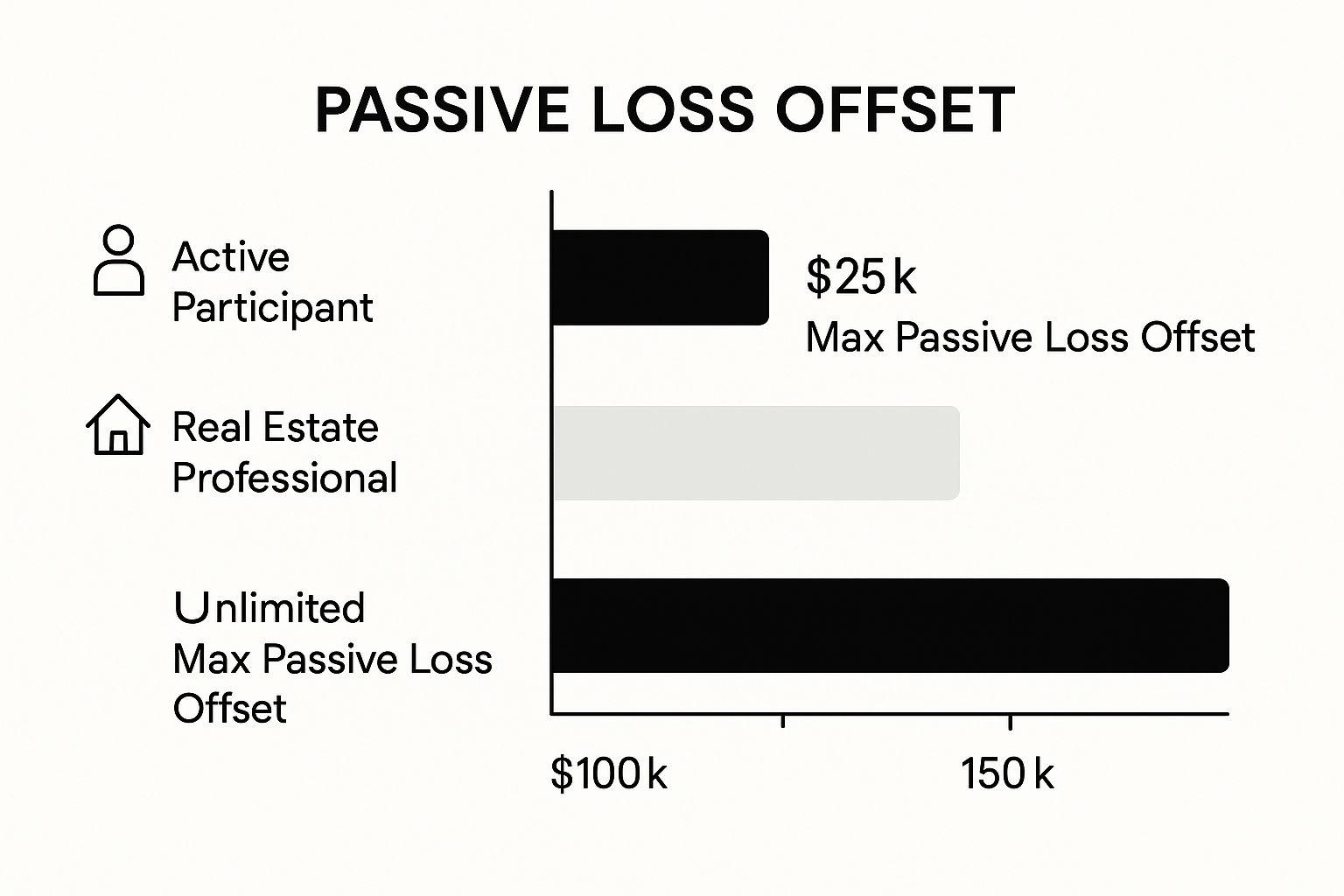
As you can see, the $25,000 allowance is a great tool for many investors. But for those whose career is real estate, achieving professional status opens the door to unlimited loss deductions, completely bypassing the income caps.
Qualifying As A Real Estate Professional
The second, and far more powerful, exception is earning Real Estate Professional Status (REPS). This is the holy grail for people whose primary career is in real estate. Achieving this status fundamentally changes how the IRS views your rental activities—it reclassifies them from "passive" to "active."
What does that mean for your tax bill? You can deduct 100% of your rental losses against your other income. There’s no $25,000 ceiling and, critically, no income phase-out.
But as you might expect, the IRS doesn't hand this designation out lightly. The tests to qualify are notoriously strict and require serious commitment. To become a qualifying real estate professional, you have to meet two demanding tests during the tax year.
The Two Tests for Real Estate Professional Status
- The 750-Hour Test: You must spend more than 750 hours during the year working in real property trades or businesses.
- The More-Than-Half Test: The time you spend on real estate activities must represent more than 50% of the total time you spend working in all your professional endeavors.
So, what counts as a "real property trade or business"? The IRS lists activities like development, construction, acquisition, rental, management, leasing, and brokerage. So, your time spent as a real estate agent or property manager all goes into the bucket. To see how these rules fit into the bigger picture of your investments, take a look at our complete guide to taxes on rental income.
Here’s a critical point many people miss: qualifying as a real estate professional is just the first step. After clearing those two hurdles, you still have to prove you materially participated in your rental activities to treat the losses as nonpassive. This is where impeccable, detailed time logs become your best friend. Without them, an IRS audit could easily dismantle your claim and cost you thousands in disallowed deductions.
Comparing Real Estate PAL Exceptions
Here’s a side-by-side look at the two major exceptions to help you quickly see which one might fit your situation.
| Feature | The $25,000 Special Allowance | Real Estate Professional Status |
|---|---|---|
| Primary Goal | Provides limited loss deduction for involved, moderate-income landlords. | Allows full loss deduction for those whose primary career is real estate. |
| Participation | Requires "active participation" (making management decisions). | Requires "material participation" in each rental activity. |
| Hour Requirement | No specific hour test. | Must meet the 750-hour and more-than-50% time tests. |
| Deduction Limit | Up to $25,000 in losses annually. | Unlimited rental losses can be deducted. |
| Income Phase-Out | Begins at $100,000 MAGI; gone by $150,000 MAGI. | No income limitations or phase-outs. |
| Best For | W-2 earners with a few rental properties they actively manage. | Full-time real estate professionals, agents, developers, and brokers. |
Choosing the right path depends entirely on your personal and professional circumstances. While the special allowance is a valuable tool for many, REPS is the ultimate goal for those looking to maximize their tax advantages in the real estate world.
Common Questions About Passive Activity Losses

Once you get a handle on the basics of passive activity losses, the real-world questions start popping up. It's one thing to understand the theory, but applying it to your unique situation can feel like a whole different ballgame.
This is where things get practical. Let's dig into some of the most common questions investors have when they're trying to navigate these tricky rules.
Can I Group My Properties to Qualify for Tests?
Absolutely, and it’s a strategy every serious real estate investor should know about. The IRS lets you formally elect to group multiple rental activities into one larger activity. Why would you want to do that? It's often the key to meeting the material participation tests.
Imagine you spend 150 hours on one rental, 200 on another, and 160 on a third. Individually, none of them come close to the 500-hour test. But if you group them together, your total time is 510 hours. Suddenly, you’ve cleared the hurdle, and the entire portfolio can be treated as nonpassive.
Of course, you can't just group any random activities. The IRS requires them to form an "appropriate economic unit." They'll look at factors like:
- Are the businesses similar?
- Do you have common ownership and control?
- Are they in the same geographic area?
- Do the activities depend on each other?
A Word of Caution: This decision is a big one. Once you elect to group properties, that choice is binding for all future tax years. Undoing it is extremely difficult and usually only possible if the original grouping is no longer appropriate. This has huge implications, especially if you later decide to sell just one property from the group. It's a strategic move you should only make with expert tax advice.
Is Income From a PTP Considered Passive?
This is one of those classic IRS curveballs. Income from a Publicly Traded Partnership (PTP) is technically passive, but it plays by its own set of rules, separate from all your other investments.
Think of each PTP as being in its own locked box. You can’t mix its gains and losses with anything else. That means if you have big losses from your rental properties, you can't use them to offset the income from a profitable PTP.
The same logic applies if the PTP has a loss. That loss gets suspended and can only be used to offset future income from that exact same PTP. You can't use a PTP loss to shelter income from one of your rentals. The losses are stuck with that single investment until it either turns a profit or you sell your entire stake.
What Happens to Suspended Losses When I Die?
This is a really important question for estate planning. When an investor passes away, their suspended passive losses don’t just disappear, but they don't automatically transfer to their heirs, either. There's a specific rule that comes into play on the final income tax return.
First, the property’s basis is usually "stepped up" to its fair market value at the date of death. This is a huge benefit for the heirs, as it can wipe out a ton of future capital gains tax when they eventually sell.
The treatment of the suspended losses is directly tied to this step-up. Any suspended losses up to the amount of the basis step-up are eliminated. They're gone for good. You can’t double-dip by getting both the full step-up and the loss deduction.
However, if the suspended losses are greater than the step-up amount, the excess can be deducted on the decedent's final return.
For example, say a property's basis is stepped up by $40,000, and there are $50,000 in suspended losses. In this case, $40,000 of the loss is wiped out. The remaining $10,000 can be claimed as a deduction. As you can see, a full understanding of all the available tax deductions for real estate investors is crucial for smart long-term planning.