
If you're serious about real estate investing, you've probably heard whispers about a special IRS designation that can slash your tax bill: the real estate professional tax status. It's not just another line on a tax form; it’s a game-changer that reclassifies your rental property hustle from a "passive" side gig to an "active" business.
This shift is everything. It's what allows dedicated real estate investors to use their rental property losses to offset their regular income—like W-2 wages—potentially putting thousands of dollars back in their pocket each year. Honestly, it's one of the most powerful tax strategies out there for anyone deeply involved in the property game.
What Does "Real Estate Professional Status" Actually Mean?

For the average person, owning a rental property is seen by the IRS as a passive activity. Think of it this way: you plant a few tomato plants in your backyard for fun. It's a hobby, not your job. If a squirrel eats all your tomatoes, you can't write off that loss against your primary paycheck. That’s how the IRS typically views landlords—any rental losses are stuck in a "passive" bucket and can only offset other passive income, not your main salary.
But achieving real estate professional tax status flips the script entirely.
You’re no longer the casual gardener. You're now a full-time commercial farmer in the eyes of the IRS. Real estate isn't just a sideline; it's your primary business. This official reclassification is the key that unlocks some seriously valuable tax advantages.
The All-Important Shift from Passive to Active
The biggest win here is breaking free from the dreaded Passive Activity Loss (PAL) rules. These are the very rules that stop most investors from using their real estate losses to lower their overall taxable income. Once you qualify as a real estate professional, those chains come off.
Your rental activities are now treated like any other active trade or business. Here’s what that means for you:
- Losses Are Now Your Friend: Those paper losses you generate from things like depreciation can now be used to offset your active income. That includes high W-2 salaries, profits from another business, and even your spouse's income if you file jointly.
- Real, Tangible Tax Savings: For high-income earners, this isn't pocket change. It can translate into tens of thousands of dollars in tax savings every single year—money you can pour right back into growing your portfolio.
- Your Tax Status Matches Reality: Your real estate work is recognized as your primary professional focus, aligning your tax situation with the real time and effort you put in.
To get a solid grip on what it takes to qualify, it's helpful to start by understanding the real estate landscape more broadly.
The IRS Rules of the Game
The IRS didn't create this status for weekend warriors. It was designed to separate the truly active players from the passive investors on the sidelines. To get in, you have to prove that real estate is your main professional gig.
It boils down to two strict tests:
- You must spend more than 50% of your total working time during the year on real estate trades or businesses where you materially participate.
- You must spend more than 750 hours during the year on those same real estate activities.
Both tests have to be met. It's a high bar, but for those who clear it, the rewards are well worth the effort.
Standard Investor vs Real Estate Professional A Quick Comparison
To really see the difference, let's put the two statuses side-by-side. This table shows just how different the tax treatment is for a standard investor versus someone who has qualified as a Real Estate Professional (REP).
| Attribute | Standard Real Estate Investor | Qualified Real Estate Professional |
|---|---|---|
| Loss Treatment | Losses are "passive" and can only offset passive income. | Losses are "active" and can offset all types of income, including W-2 wages. |
| Tax Impact | Limited ability to reduce overall tax liability from rental losses. | Can significantly lower total taxable income, leading to major tax savings. |
| Time Commitment | No specific time requirement is needed to be a standard investor. | Must meet the 750-hour and 50% working time tests annually. |
| Primary Benefit | Long-term appreciation and passive cash flow. | Aggressive tax reduction and wealth acceleration through reinvested savings. |
As you can see, achieving REP status fundamentally changes how your real estate activities impact your bottom line. It’s a move from a simple investment to a powerful tax-advantaged business.
The Two IRS Tests You Absolutely Must Pass
Becoming a "real estate professional" in the eyes of the IRS isn't about having a broker's license or a certain number of properties. It’s a specific tax designation, and getting it means proving that real estate is, without a doubt, your primary profession.
To do this, the IRS has two strict tests you have to pass every single year. Think of them as two hurdles on a track. You have to clear both, in order, to win the race. Excelling at one doesn't give you a pass on the other.
Let's dig into what it really takes to clear these hurdles.
Test One: The 750-Hour Rule
The first test is a straightforward time commitment. You must spend more than 750 hours during the tax year on real estate activities where you "materially participate." That’s a serious chunk of time—it breaks down to over 14 hours a week, every week, all year long.
This rule is the IRS's first line of defense to weed out passive investors and weekend dabblers. They want to see a substantial, consistent effort.
So, what kind of work actually counts? The IRS is looking for hands-on, operational tasks. Things like:
- Management: Vetting tenants, signing leases, coordinating maintenance, and dealing with day-to-day property issues.
- Development & Construction: Overseeing renovations, managing contractors, or handling a ground-up development project.
- Brokerage: The time you spend as an agent or broker showing properties, negotiating deals, and marketing listings.
- Acquisition: All the hours spent hunting for properties, conducting due diligence, arranging financing, and closing the deal.
- Operations: The behind-the-scenes work of running a real estate business, from bookkeeping and paying bills to strategic planning.
The critical point here is that you have to be in the driver's seat. Simply reviewing financial statements your property manager sends you or researching markets online isn't enough. You must be actively running the show.
Test Two: The "More Than Half Your Time" Rule
Clearing the 750-hour hurdle is a great start, but it's only half the battle. The second test is often the one that trips people up, especially if they have another demanding job. You must prove that the time you spent on real estate was more than 50% of your total working time for the year.
This is a comparison test. Take all the hours you worked in every job or business during the year and put them in a pile. More than half of that pile must consist of your real estate hours.
This is exactly why it's nearly impossible for a full-time surgeon, attorney, or engineer to qualify. Let's say a lawyer works 2,000 hours a year at her firm. Even if she miraculously finds 800 hours to manage her rentals, she fails this test. Her 800 real estate hours are nowhere near "more than half" of her total 2,800 working hours.
Here’s how it plays out in the real world:
- Example 1: The Accountant. Sarah works 1,900 hours a year at an accounting firm. She’s also a serious landlord, putting in 800 hours managing her rentals. She easily passes the 750-hour test, but she fails the 50% test because her real estate work is a fraction of her accounting work. No REP status for Sarah.
- Example 2: The Full-Time Investor. David left his corporate job to manage his family's property portfolio. He documents 1,500 hours spent on leasing, management, and acquisitions. Since this is his only work, 100% of his professional time is in real estate. He easily passes both tests.
You can't talk your way out of this math. The two tests are non-negotiable and work together to paint a clear picture for the IRS of what you really do for a living. Successfully meeting these criteria is the first and most important step to unlocking the powerful tax benefits of REP status, chiefly the ability to get around the restrictive passive activity loss rules that hamstring most rental property owners.
Proving Material Participation In Your Rentals
Getting over the hump of the 750-hour and 50% tests to qualify as a real estate professional is a huge win. But hold on—you're only halfway there. To actually use your rental losses to offset your other income, you have one more crucial step: proving you materially participate in your rental activities.
Think of it this way: The first two tests establish that real estate is your main gig. This final test proves you’re the one in the trenches, actively running your specific properties. The IRS needs to see that you're a hands-on operator, not just a passive investor collecting checks while a property manager does all the heavy lifting.
If you can't prove material participation, your rental losses get stuck in the "passive" category, even with REP status. This is the last key you need to unlock their full tax-saving power.
The Seven Tests for Material Participation
The IRS gives you seven different ways to show you’re materially involved. The good news? You only need to meet one of them for a specific rental activity each year. While there are seven official tests, most investors realistically only ever use three of them.
Let's break down the most common and practical paths:
-
The 500-Hour Test: This is the gold standard because it's so clear-cut. You simply have to spend more than 500 hours during the year participating in the rental activity. It's a serious time commitment, no doubt, but it’s the most defensible position to take if you’re ever questioned.
-
The Substantially All Participation Test: Are you a one-person show? This test is for you. If your participation made up basically all of the work done on the property for the year, you pass. This is perfect for the DIY landlord who handles everything from screening tenants to fixing the sink.
-
The 100-Hour Test (and More Than Anyone Else): This is a great middle-ground option. You need to put in more than 100 hours, and that time has to be more than any other single person involved. This often works for investors who hire contractors for big jobs but still handle all the core management, strategy, and day-to-day decisions themselves.
This decision tree helps visualize how your time commitment and professional focus come together to earn REP status.
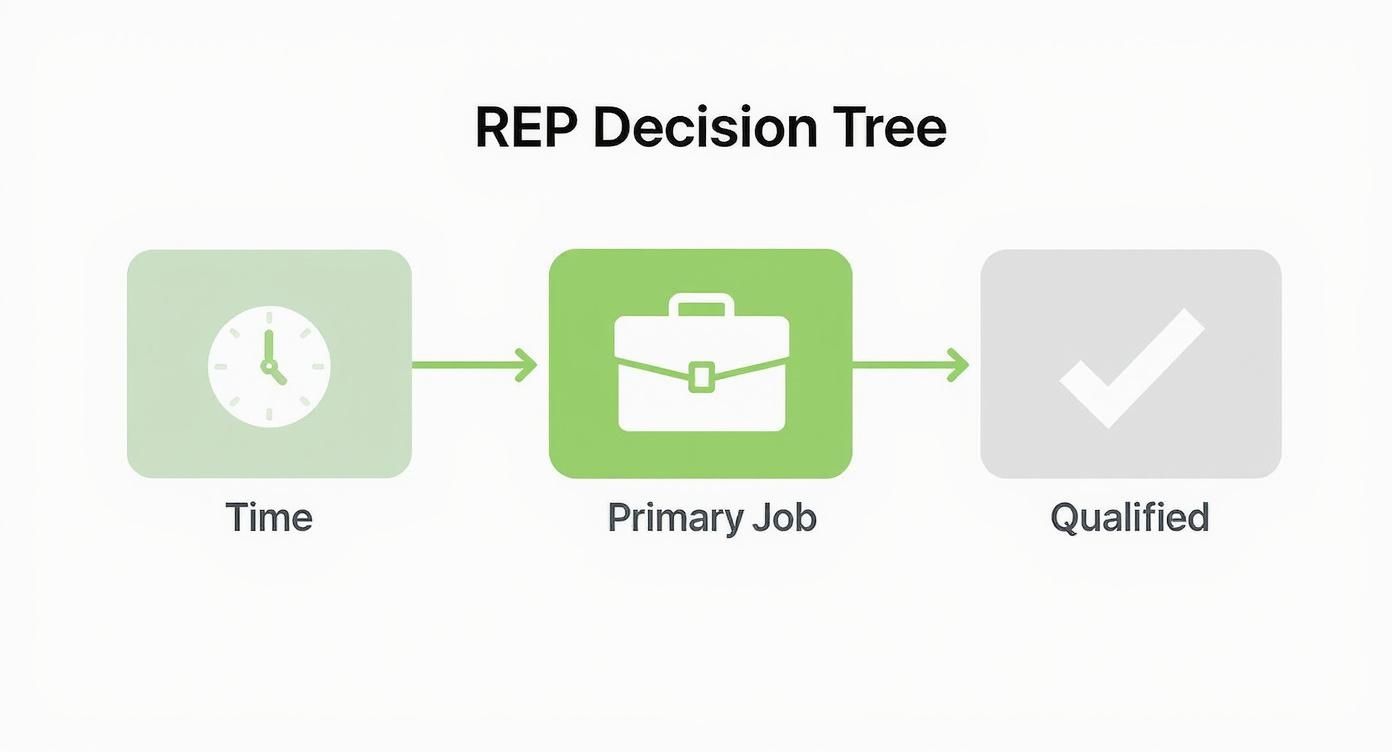
As the infographic shows, it’s the combination of hours spent and real estate being your primary work that ultimately gets you across the finish line.
Bringing Material Participation to Life
Let’s make this real with an example. Meet Alex, an investor who owns a small apartment building. He’s already cleared the main REP status hurdles and now wants to use his property's paper losses to lower his spouse's W-2 taxable income. His final challenge is proving material participation.
Alex decides the 500-hour test is his best bet, so he diligently starts tracking his time. His log includes entries like:
- Tenant Screening (15 hours): Sifting through applications, running background checks, interviewing candidates, and drafting leases for a vacancy.
- Maintenance & Repairs (120 hours): Calling and managing plumbers for a burst pipe, personally repainting two units, and doing the seasonal yard cleanup.
- Financial Management (80 hours): Entering rents and expenses into QuickBooks, paying property taxes and insurance bills, and reviewing monthly financials.
- Property Visits & Inspections (50 hours): Walking the property quarterly, meeting with tenants, and supervising a roofing contractor's inspection.
By year-end, Alex's log shows he's put in 530 hours. He's successfully proven material participation. Now, he can treat the rental as an active business and deduct its losses against their other income. His detailed log is his best defense in an audit.
What Doesn't Count as Participation
Knowing what doesn't count is just as critical as knowing what does. The IRS is very specific about excluding activities that any investor would do, even a passive one.
Be careful not to log hours for tasks like these:
- Reviewing financial statements that someone else prepared for you.
- Preparing high-level summaries of the property's finances just for your own use.
- Monitoring operations in a passive, non-managerial way.
- Travel time between your home and your rental properties (the IRS views this as commuting).
The line is pretty clear: the IRS wants to see you actively running the business, not just checking in on your investment from a distance. Proving material participation is all about documenting your role as the person truly driving your rental property's operations.
The Financial Advantages Of REP Status

Qualifying for Real Estate Professional (REP) status is much more than a new title for your business card; it’s a strategic tax play that can completely change your financial picture. The most significant perk? You get to sidestep the restrictive Passive Activity Loss (PAL) rules that tie the hands of most investors.
Normally, the IRS sees rental income—and losses—as "passive." This means any losses you generate can only offset other passive income. They’re stuck in their own little bucket, unable to touch your primary income from a W-2 job or another business.
But with REP status, you break down that wall. Your rental activities are reclassified as an active business. Suddenly, those "paper losses" from your properties can be used to directly lower your taxable income from your day job, your spouse's salary, or other active business ventures. This is where the real magic happens, especially in an industry where depreciation creates large, legitimate on-paper losses.
Unlocking Your Rental Losses: A Clear Example
The best way to grasp the power of this is to see it in action. Let's compare two investors, Maya and Ben. They have identical financial situations, but one of them is a qualified REP.
- Household Income: Both Maya and Ben earn $250,000 from their W-2 jobs.
- Rental Portfolio Loss: They each have a rental portfolio that produced a $30,000 loss for the year (mostly thanks to depreciation).
Now, let's watch how their tax outcomes diverge.
Maya (Standard Investor)
Because Maya isn't a REP, her $30,000 rental loss is passive. She has no other passive income to write it off against, so that loss is effectively locked away. It can’t reduce her W-2 income.
Result: Maya's taxable income stays at $250,000. The $30,000 loss is suspended and carried forward, only becoming useful if she generates passive income in the future or sells the property.
Ben (Real Estate Professional)
Ben, on the other hand, has met the criteria for REP status. The IRS now treats his $30,000 rental loss as an active business loss.
Result: Ben can deduct the full $30,000 loss directly from his household's $250,000 income. His taxable income drops to $220,000.
The difference is immediate and substantial. Ben just put thousands of dollars back in his pocket—cash he can now use to pay down debt, save, or reinvest in his next property. A huge part of this strategy hinges on understanding the depreciation of rental property, which is often the biggest driver of these paper losses.
Avoiding The Net Investment Income Tax
The benefits don't stop there. Another major advantage of REP status is the ability to potentially avoid the Net Investment Income Tax (NIIT). This is an extra 3.8% tax that hits certain investment income for higher earners—those with an adjusted gross income over thresholds like $250,000 for married couples filing jointly.
For most people, rental income falls squarely into the "investment income" category, making it subject to the NIIT. But when you achieve REP status, your rental activity is treated as an active trade or business. This can exempt your net rental income from that pesky 3.8% surtax, adding even more to your annual tax savings.
To get the most out of your status, it's worth digging into a comprehensive guide to rental property tax deductions to make sure you're not leaving any money on the table.
Your Guide To Bulletproof Record Keeping

Trying to claim real estate professional tax status without meticulous records is like going to court without any evidence—you’re essentially hoping for the best, and that’s a risky game to play with the IRS. Given the significant tax advantages, this status is a magnet for audits.
Your best defense isn’t a slick argument; it’s a mountain of undeniable proof. If that audit notice ever lands in your mailbox, the burden of proof falls squarely on your shoulders to back up every single hour you claim. Think of your record-keeping less as a tedious chore and more as building an impenetrable fortress around your tax strategy.
When you adopt this mindset, an IRS inquiry transforms from a source of dread into a simple matter of presenting your well-organized files.
The Cornerstone: Your Contemporaneous Time Log
The single most important document you will create is a contemporaneous time log. "Contemporaneous" is just the IRS's way of saying you need to record your activities as they happen, or at least very close to when they happen. Trying to reconstruct your entire year from memory six months down the line is a massive red flag for an auditor and can torpedo your claim.
Your log doesn't have to be fancy, but it absolutely must be detailed. Each entry should tell a story, painting a clear picture of what you did, when you did it, and for which property.
At a minimum, every entry needs to include:
- Date: The specific day the work was done.
- Hours Spent: How much time you dedicated to the task.
- Property: Which specific property this activity was for.
- Detailed Description: A crystal-clear, action-focused description. Vague notes like "property management" or "emails" won't cut it.
An auditor can spot a weak log from a mile away. Here’s how to make yours count:
| Weak Entry (Vague) | Strong Entry (Specific & Actionable) |
|---|---|
| "Worked on rental" | "Drafted and posted rental listing for 123 Main St on Zillow and Apartments.com." |
| "Phone calls" | "Spoke with plumber, John Smith, to schedule sink repair for 123 Main St, Unit 4." |
| "Maintenance" | "Purchased and installed new smoke detectors in all common hallways at 456 Oak Ave." |
Beyond The Log: Building Your Case With Evidence
A detailed time log is your foundation, but it becomes exponentially stronger when you back it up with corroborating evidence. This is the stuff that proves the activities you logged actually happened. You need to connect the dots for the auditor, showing that your logged hours correspond to real-world actions and transactions.
To make your claim virtually undeniable, you need to collect and organize proof as you go. Think of it as creating an unshakeable audit trail.
To help you get started, this table outlines the kind of documentation you should be saving for common real estate activities.
Documenting Your Real Estate Activities For The IRS
| Activity Type | Primary Documentation | Supporting Evidence |
|---|---|---|
| Property Management | Time log entry detailing tenant communication, rent collection, and coordination of services. | Email and text message records with tenants, bank deposit slips for rent, digital payment confirmations. |
| Maintenance & Repairs | Time log entry for time spent performing or overseeing repairs. | Invoices from contractors, receipts for materials purchased, before-and-after photos of the work. |
| Property Showings | Calendar appointments showing specific times and properties. | Follow-up emails or texts with prospective tenants, visitor sign-in sheets. |
| Travel | Mileage log detailing date, destination, purpose, and starting/ending odometer readings. | Gas receipts, parking stubs, toll records that correspond with property visits. |
| Tenant Screening | Time log entry detailing application review, background checks, and reference calls. | Copies of rental applications, receipts from screening services, notes from reference checks. |
| Marketing | Time log entry for creating listings, taking photos, or placing ads. | Screenshots of online listings, invoices for advertising costs, copies of printed flyers. |
By pairing your time log with this kind of tangible proof, you create a powerful, multi-layered defense.
Here are a few more categories of documents you should be meticulously organizing:
- Communication Records: Save all important emails with tenants, contractors, property managers, and your attorney.
- Financial Documents: Bank and credit card statements are crucial. They directly tie your spending to your logged activities. To learn more, check out this guide on how to organize business receipts.
- Contracts and Agreements: Keep digital and hard copies of leases, contractor bids, and any service agreements.
Your goal is to create a story that's impossible to poke holes in. When your time log says you spent three hours meeting a roofer at a property, a corresponding invoice from that roofer with the same date makes your claim airtight. This level of preparation is what separates a successful defense from a costly, stressful tax adjustment.
Turning Market Headwinds into a Tailwind
Think of qualifying for Real Estate Professional (REP) status as more than just checking a box for the IRS. It's a strategic move, especially when the real estate market gets choppy. When things like property values dip or vacancy rates climb, your portfolio might show larger "paper losses" from depreciation and expenses. For a typical investor, those losses are stuck—but for a REP, they become a powerful tool.
This is where the magic happens. REP status lets you turn a market downturn into a direct financial win. Imagine a slowing market hands you a $40,000 operational loss across your properties. Instead of just a setback, you can now use that entire loss to slash your taxable income from other sources, like a W-2 job or a spouse's business. Suddenly, a tough economic climate creates a chance for serious tax savings.
Making the Most of Economic Realities
The flexibility REP status provides is more important than ever. We've all seen the recent pressure on the real estate world from economic uncertainty and the higher cost of capital. It’s been tough on returns for property owners everywhere.
For example, global property transactions took a major hit, dropping by 31% year-over-year through mid-2025. On top of that, property values fell by 6.3% as of the second quarter of 2024. These aren't just abstract numbers; they directly squeeze your profit margins and create those on-paper losses we talked about. If you want to dig deeper into these trends, Deloitte offers some great insights into the commercial real estate outlook.
For a qualified real estate professional, these market-driven losses aren't a dead end. They are a clear, actionable opportunity to lower your overall tax bill, giving you financial breathing room right when you need it.
Shifting from Defense to Offense
This is how dedicated real estate pros play offense when others are stuck on defense. While passive investors might be forced to sell or scramble to cover their costs, a REP can use the tax savings to come out stronger.
What does that look like in the real world?
- Building a War Chest: You can channel those tax savings into a cash reserve to handle vacancies or big repairs without draining your personal accounts.
- Going on a Buying Spree: That freed-up capital could be exactly what you need to snap up properties from motivated sellers at a discount.
- Upgrading Your Portfolio: You could fund the renovations that make your properties more attractive, allowing you to command higher rents once the market bounces back.
Ultimately, getting REP status fundamentally changes how you navigate market ups and downs. You're no longer just reacting to economic cycles. Instead, you're positioned to actively use the tax code to your advantage, building a more resilient and profitable business for the long haul.
Common Questions About REP Status Answered
Getting into the weeds of the real estate professional tax status always brings up a few tricky questions. Getting these details straight is the key to using these powerful tax rules correctly and avoiding some pretty painful mistakes down the road.
Let's tackle some of the questions I hear most often.
Do I Need a Real Estate License to Qualify?
This is probably the single biggest misconception out there. The simple answer is no—you absolutely do not need a real estate license to qualify as a real estate professional in the eyes of the IRS.
The IRS cares about what you do, not what licenses you hang on the wall. It all boils down to whether you can prove you met the two main tests: spending more than 750 hours and more than 50% of your working time on your real estate activities. Your detailed time logs are the proof, not a license. While being an agent or broker can certainly help you rack up qualifying hours, it's the hands-on, active involvement that really counts.
Can My Spouse’s Hours Help Me Qualify?
The answer here has to be very specific. When a married couple files a joint tax return, the good news is that only one of you needs to earn REP status for both of you to get the benefits. But here's the catch: you cannot pool your hours together to meet the individual tests.
For example, let's say you worked 400 hours on your properties and your spouse worked 350 hours. Even though that's 750 hours combined, neither of you qualifies. One of you has to clear the 750-hour and 50% hurdles all on their own.
Once one spouse officially qualifies, then the other spouse's time can be used to help prove material participation in the rental activities themselves. It's a subtle but critical distinction.
What Happens If I Only Qualify Some Years?
Think of REP status less like a permanent title and more like an annual check-up. You have to prove you meet the tests every single year you want to claim it. Life changes, and it’s actually pretty common for someone to qualify one year but not the next.
So, what happens in an "off" year? Your rental activities simply flip back to being classified as passive. Any losses you have that year get suspended and carried forward. They aren't gone forever, though. You can use those suspended losses to cancel out passive income in future years, or you can deduct them all when you eventually sell the property. This year-by-year nature is exactly why keeping meticulous records all year long is non-negotiable.
At Allied Tax Advisors, we specialize in helping real estate investors navigate complex tax situations like REP status. If you need expert guidance to ensure compliance and maximize your deductions, our team is ready to help. Learn more about our specialized tax services for real estate investors.