
Figuring out what to pay yourself as an S corp owner is one of the most important financial decisions you'll make. It’s a bit of a tightrope walk—you need to balance saving on taxes with staying on the right side of the IRS. The whole point of an S corp is to pay yourself a fair W-2 salary, which gets hit with payroll taxes, and then take the rest of the company’s profit as distributions, which don’t.
Get this balance right, and you'll see some serious tax savings.
Why Your S Corp Salary Is A Critical Decision
Nailing down your S corp salary can feel like a high-stakes puzzle. If you set it too high, you’ll overpay on payroll taxes, chipping away at the tax benefits that made you choose an S corp in the first place.
But here’s the bigger risk: setting it too low. Paying yourself a tiny salary is a massive red flag for the IRS. It can trigger an audit, and if they decide your salary isn’t “reasonable,” they can reclassify your distributions as wages. Suddenly, you’re on the hook for a mountain of back taxes, penalties, and interest.
The magic of the S corp is that it separates your role as an employee from your role as an owner. As a sole proprietor, every dollar of net income is subject to self-employment tax. An S corp, on the other hand, gives you a powerful tool to manage that tax bill.

The Power of Salary vs. Distributions
Let’s run the numbers with a quick example to see just how much is at stake. Imagine your S corp brings in $150,000 in net profit this year.
- As a Sole Proprietor: The entire $150,000 is subject to the 15.3% self-employment tax. That’s a tax bill of roughly $22,950. Ouch.
- With an S Corp: After some research, you determine a reasonable salary for the work you do is $70,000. Only that salary is subject to FICA taxes (Social Security and Medicare), which comes out to about $10,710. The remaining $80,000 comes to you as a tax-advantaged distribution.
In this scenario, the S corp structure just saved you over $12,000 in a single year. This isn't some shady loophole; it's a legitimate tax strategy that acknowledges your risk as a business owner. But it all hinges on that one little word: "reasonable."
The IRS defines reasonable compensation as the amount a business would typically pay for the same or similar services. If you’re underpaying yourself to maximize distributions, you risk undoing all your hard-earned tax savings.
The Consequences of Getting It Wrong
Don't think the IRS isn't watching. They are well aware of S corp owners who try to game the system by taking a tiny salary while pulling out huge distributions. If they audit you and find your salary is way too low, they have a clear playbook.
Here's what you can expect to happen:
- Reclassification of Income: The IRS will reclassify a big chunk of your distributions as W-2 wages, retroactively.
- Back Taxes: You and your S corp will get a bill for all the unpaid FICA and FUTA (unemployment) taxes on that reclassified amount.
- Penalties and Interest: On top of the back taxes, they’ll add failure-to-pay penalties and interest, which can make the final bill truly painful.
This is why you have to get it right from the start. Mastering this decision isn’t just about protecting your business from the IRS—it’s about making sure you’re maximizing your financial strategy in a smart, compliant, and defensible way. The goal is to work within the rules to get the best possible outcome.
What the IRS Actually Considers "Reasonable"
First things first, let's get inside the IRS's head. When it comes to your S Corp salary, they don't have a secret formula or a magic percentage they expect you to hit. What they're looking for is a salary that makes sense in the real world.
The fundamental question they ask is simple: Is your salary what a similar business would pay someone else to do the same job? Your compensation can't be a number you just pull out of a hat; it has to be grounded in reality and comparable to what the market dictates for your role.
The Factors That Genuinely Matter
When an auditor looks at your compensation, they aren't just glancing at your company's profits. They're sizing you up as an employee and want to see a clear, logical link between the work you do and the paycheck you take home.
Here are the key criteria the IRS and tax courts come back to time and time again:
- Your Roles and Responsibilities: What do you really do day-to-day? Are you the lead strategist, the top salesperson, and the operations manager all in one? The more hats you wear, the more valuable your services are.
- Your Training and Experience: Your background is a huge piece of the puzzle. A seasoned professional with 20 years of experience and specialized credentials can justify a much higher salary than a newcomer in the same industry.
- Time and Effort: It's a simple equation. A full-time, 50-60 hour-a-week commitment warrants a different salary than a part-time gig that takes up 10 hours a week.
- Business Performance: While it’s not the only thing they look at, your company's financial health does play a role. A highly profitable business can obviously support a larger salary for its key people, including you.
A crucial part of defending your salary involves using salary benchmarking to prove your compensation aligns with industry standards. This process is all about gathering objective data to back up your decision.
The goal is to build a narrative. Your salary decision should tell a logical story: "Based on my extensive experience, my multiple critical roles, and the strong performance of the company, this salary is what the market would demand for my services."
The Infamous 60/40 Rule: Is It Real?
You’ve probably heard whispers of the "60/40 rule" as an easy shortcut for setting your S Corp salary. The idea is to pay 60% of your net business income as a W-2 salary and take the other 40% as a distribution. For a business with $200,000 in profit, that would mean a $120,000 salary and an $80,000 distribution.
This kind of split can save you a bundle on payroll taxes. You can get more details on how the https://alliedtax.com/s-corp-tax-rate/ makes these savings possible.
The 60/40 rule became a popular rule of thumb for S Corp owners back in the early 2000s. It was a simple way to split the pie, and while never officially blessed by the IRS, it was a common starting point for many CPAs. It even popped up in court cases like Paula Construction Co. v. Commissioner, where compensation was weighed against industry norms.
But here’s the reality: blindly following this or any other fixed percentage is a recipe for disaster. It completely ignores what the IRS actually cares about—your duties, your experience, and what the market says you're worth. A $120,000 salary might be laughably high for a new part-time business owner, but dangerously low for a seasoned surgeon running a thriving practice.
Treat the 60/40 rule as a thought-starter, nothing more. It might help you frame the salary-vs-distribution conversation, but it's no substitute for doing your homework. Applying a generic percentage without any real justification is one of the fastest ways to get a letter from the IRS. Your best defense is always built on solid data, not a rule of thumb.
How To Calculate A Defensible S Corp Salary
Alright, let's get down to the brass tacks. Moving from theory to actually setting your salary is where you build a number that can stand up to IRS scrutiny. Figuring out a reasonable salary isn't about some secret formula; it’s about a clear, repeatable process of gathering hard data, taking a good look at your business, and making an informed decision you can back up if needed.
The key is to look both outward at the market and inward at your company's financial reality. When you combine external salary data with your internal numbers, you create the complete picture that justifies your final salary figure. The goal here is simple: land on a number that genuinely reflects the value you bring to the table.
This diagram breaks down the core factors the IRS hones in on when they're evaluating your compensation.
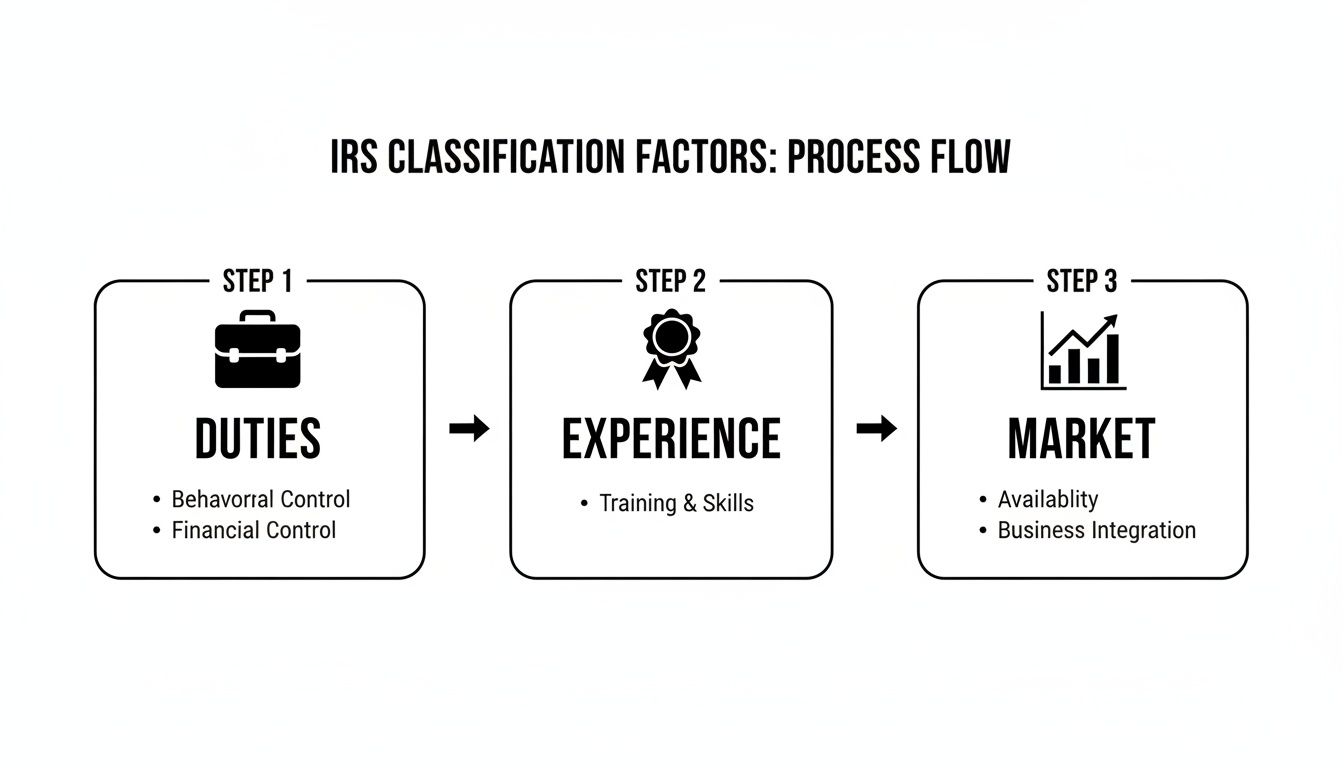
As you can see, your specific duties, your level of experience, and the current market are the three pillars of a salary that won't raise red flags.
Gather Your Market Data
First things first: you need to figure out what someone else would get paid to do your job. This has to be based on objective, third-party data. Luckily, there are some fantastic, free resources out there to help you establish a credible baseline.
Your best friend in this process is the U.S. Bureau of Labor Statistics (BLS). The BLS Occupational Employment and Wage Statistics (OEWS) database is a powerful, free tool that gives you salary info across hundreds of jobs. You can even filter it by state and specific cities.
Here’s how to approach it:
- Define Your Role(s): Get specific. You're not just a "business owner." Are you acting as the "Marketing Manager," an "IT Consultant," or the "Chief Executive"? Make a list of all the major hats you wear.
- Search the BLS Database: Look up the job titles that best match your day-to-day responsibilities.
- Filter by Location: This is critical. Salaries vary wildly depending on where you live. An IT consultant in San Diego is going to have a very different market rate than one in rural Nebraska.
Jot down the data for the 25th, 50th (median), and 75th percentile for your primary role in your location. This range gives you a solid, defensible starting point. You can also round out your research with data from sites like Glassdoor, Salary.com, or any compensation reports specific to your industry.
A Real-World Calculation Example
Let's walk through a quick scenario. Meet Alex, the sole owner of a thriving IT consulting S corp in San Diego. His business is on track to net $250,000 this year, and he needs to nail down his reasonable salary.
I've put together a table showing how Alex might organize his research. It's a simple way to document the "why" behind his final number.
| Salary Calculation Factors For A San Diego IT Consultant |
| :— | :— | :— |
| Factor | Data Point / Research Finding | Impact on Salary Decision |
| Primary Role | Information Security Analyst | Sets the baseline for salary research using the most relevant job title. |
| Location | San Diego-Carlsbad, CA Metro Area | Adjusts national averages to local market rates, which are typically higher. |
| BLS Salary Data | Median (50th Percentile) is $125,000. Range is $98k to $155k. | Provides a verifiable, third-party data range for the role in this specific area. |
| Experience Level | 15+ years in IT security. | Justifies a salary at or above the median, ruling out the lower 25th percentile. |
| Additional Duties | Handles all business development, client management, and company strategy. | Adds weight to choosing a salary in the upper-middle of the documented range. |
| Company Profitability | $250,000 net profit. | Confirms the business can comfortably afford a salary at the market median. |
Alex doesn't just do the tech work; he's also the rainmaker, the account manager, and the CEO. His 15 years of experience mean he’s far from an entry-level analyst. Based on his research and expertise, that $125,000 median salary feels like a rock-solid, defensible number. It’s grounded in real data and reflects his true value.
A common mistake is just grabbing the median salary and calling it a day. Your unique experience, the complexity of your duties, and your company's ability to pay should all push you up or down within that market range.
With the salary set, the remaining $125,000 in profit can be taken as a distribution, which isn't hit with self-employment taxes. Properly understanding how distributions are taxed is a big piece of the puzzle. You might find our guide on the tax rate on S corp distributions helpful.
The savings here really start to add up as your income grows. Imagine the business nets $400,000. If you took that all as salary, you’d be looking at roughly $61,200 in FICA taxes. But with a defensible salary between $150,000 and $250,000, you could easily save $15,000 to $25,000 a year because distributions avoid that 15.3% payroll tax hit entirely.
This methodical process—research, analyze, decide, and document—is exactly what the IRS wants to see. It proves your salary isn't just a number you pulled out of thin air to dodge taxes, but a thoughtful figure backed by real-world evidence.
Documenting Your Salary to Bulletproof Your Business
You've done the hard work of researching and calculating your reasonable salary. Great. But now comes the step that separates savvy S corp owners from those who get into hot water with the IRS: documentation.
Think of it as building your defense file before you ever need it. If the IRS comes knocking, a clear, logical paper trail is your absolute best friend. This isn't about creating mountains of paperwork; it's about being deliberate. You need to show that your salary was a thoughtful business judgment, not just a number you pulled out of thin air to minimize taxes.
A few key documents can make all the difference.

Create a Compensation Memo
The cornerstone of your defense file is a simple compensation memo. This is just an internal document that summarizes how you landed on your salary number. It’s a snapshot of your reasoning, told in a straightforward, business-like way.
It doesn’t need to be a formal legal brief. Just make sure it clearly outlines a few key things:
- Your Roles and Responsibilities: Briefly list the hats you wear. Are you the CEO, lead salesperson, and head of operations? Write that down.
- Your Experience and Qualifications: Note your years in the industry, any relevant degrees, or special certifications that add to your value.
- The Research You Conducted: Mention the sources you used. Did you pull data from the BLS, use an industry salary survey, or consult a compensation tool? List them.
- Your Final Salary Decision: State the annual salary you decided on and connect it back to your research. A simple sentence explaining how the data supports your figure is perfect.
Tuck this memo away with your corporate records. If you give yourself a raise or adjust your salary down the road, just create a new memo explaining why.
Get It into Your Corporate Minutes
Even if you're a one-person S corp, you still have to play by the corporate rules. That means holding an annual meeting (yes, even with yourself) and documenting major decisions in your corporate minutes. And trust me, your salary is a major decision.
Formally record your compensation with a board resolution in those minutes. It’s easy. It can be as simple as this:
"BE IT RESOLVED, that based on research of comparable market rates for the roles performed, the annual salary for [Your Name], President, for the fiscal year beginning January 1, 202X, is set at $XX,XXX, to be paid in regular installments."
This simple step adds a crucial layer of legitimacy. It shows your salary was an official, approved decision, not just an arbitrary amount you started paying yourself.
Keep Salary and Distributions Separate in Your Books
This one is non-negotiable. Your accounting records must draw a crystal-clear line between your salary and your owner distributions. Mixing these up is a massive red flag for the IRS and makes it look like you're trying to hide wages in plain sight.
Courts look at factors like your training, the time you devote to the business, and what others in similar roles are paid. If your books are a mess, an IRS auditor can reclassify your distributions as wages, hitting you with back taxes and painful penalties.
In a high-tax state like California, where top rates can hit 13.3%, getting this right can mean a 7-10% overall tax reduction. It’s all about compliance.
Here’s how to do it right:
- Run Formal Payroll: Always pay your salary through a dedicated payroll system. This is what ensures proper taxes are withheld and reported on critical forms like your W-2 and 941. To keep your S corp truly bulletproof, you need to nail all your federal tax filings. You can learn more by Mastering Form 941 Electronic Filing.
- Use a "Distributions" Account: When you take profits out of the business, that’s different. In your accounting software, record these payments into an equity account like "Owner's Draw" or "Shareholder Distribution"—never as a business expense.
This clean separation is vital. For more practical advice on setting this up, check out our complete guide on https://alliedtax.com/how-to-do-payroll-for-small-business/. It will give you a solid foundation for getting this right from day one.
Common S Corp Salary Mistakes And How To Fix Them
When it comes to the IRS, learning from someone else's missteps is always the smarter (and cheaper) path. I've seen a few common—and costly—mistakes trip up S corp owners over and over again. Dodging these pitfalls is the key to keeping your business compliant and making sure your tax savings are secure.
The good news is that these errors are completely avoidable with a little bit of planning. By understanding where people tend to go wrong, you can build a compensation strategy that's not just tax-efficient but also ready for scrutiny from day one. Let’s walk through the most frequent blunders and, more importantly, how to get them right.
Taking a Zero or Unreasonably Low Salary
This is the big one. It's the brightest red flag you can wave at the IRS, practically begging them to take a closer look at your books. Some owners believe they can pay themselves nothing and take all the company's profit as a distribution, neatly sidestepping payroll taxes. The IRS sees this for what it is: a clear attempt to dodge taxes.
If you’re doing any meaningful work for your business (and of course you are), you have to be paid a reasonable wage for it. The fix is simple: pay yourself something. Use the methods we've already covered—digging into Bureau of Labor Statistics data, comparing your duties to similar jobs—to land on a salary you can actually defend. Even in a lean year, you must pay yourself for your labor before you take a dime in distributions.
Inconsistent or Erratic Payments
Another trap is treating the S corp's bank account like your personal ATM. When an auditor sees random payments of varying amounts labeled "salary," it looks sloppy and unprofessional. A salary is meant to be consistent compensation for your work, not just a way to pull cash out of the business whenever you feel like it.
This erratic approach completely undermines the argument that you’re a legitimate employee of your own company.
Key Takeaway: As an S corp owner, you wear two hats: employee and shareholder. You have to keep the compensation for those roles separate. A salary is for the employee; distributions are for the shareholder. Inconsistent pay blurs that critical line and invites unwanted attention.
The solution? Get on a real payroll schedule. Pay yourself a steady, consistent amount on a recurring basis—weekly, bi-weekly, or monthly—just like you would any other team member. This simple act establishes a professional pattern and reinforces the legitimacy of your W-2 income.
Ignoring Your Salary As The Business Grows
The "set it and forget it" mindset is a dangerous game with your S corp salary. The compensation that was perfectly reasonable when your business was making $80,000 a year is almost certainly unreasonable when it’s clearing $400,000. As your company’s revenue grows and your responsibilities expand, your salary needs to keep pace.
Sticking with an outdated salary figure makes it look suspiciously low, erasing all the hard work you did to justify it in the first place.
How to Fix It
- Make It an Annual Check-Up: Put a "salary review" on your calendar every single year. Look at the company's performance, your role, and your responsibilities.
- Document the "Why": Did you land a massive new client? Take on a whole new department's worth of work? That's a great reason to adjust your pay. Write it down in a new compensation memo.
- Quickly Re-Benchmark: Every year or two, take a fresh look at market data. It doesn't have to be a massive project, but a quick check ensures your pay is still aligned with your industry.
Reasonable Salary Pitfalls And Solutions
To make this crystal clear, here’s a quick-reference table that compares the common mistakes with the compliant, audit-ready approach.
| Common Mistake | Why It's a Problem | How to Fix It |
|---|---|---|
| Setting a salary of $0 | Directly violates IRS rules; implies you are evading payroll taxes. | Pay a reasonable W-2 wage before taking any distributions. |
| Inconsistent payments | Blurs the line between salary and distributions; looks unprofessional. | Run formal payroll on a consistent schedule (e.g., bi-weekly). |
| Never adjusting salary | A stagnant salary becomes unreasonable as the business grows and profits increase. | Conduct an annual salary review and document any changes. |
In the end, avoiding these mistakes really comes down to being proactive. Taking the time to set a fair salary, pay it like a real employee, and review it periodically is the absolute best way to protect your business and enjoy the tax benefits you chose an S corp for.
Answering Your S Corp Salary Questions
Even after you've done your homework and set what you believe is a reasonable salary, the real world has a way of throwing curveballs. It’s one thing to have a plan on paper; it's another to live with it month after month.
Let’s dig into some of the most common "what if" scenarios that pop up for S Corp owners once their salary strategy is in motion. Getting these answers straight will help you manage your compensation with confidence, not just at year-end, but all year long.
Can I Change My S Corp Salary During The Year?
Yes, you can—but you need a good reason, and you absolutely must document it. A mid-year salary adjustment is perfectly fine if there’s a significant, legitimate change in your duties or the company's financial situation.
For instance, maybe you landed a game-changing contract that suddenly doubles your workload and management responsibilities. Bumping up your salary to reflect that new reality makes perfect sense. On the flip side, if you lose a major client and revenue takes a nosedive, reducing your salary to protect the company's cash flow is a sound business decision.
The trick is to record the "why" behind the change in your corporate minutes. What you want to avoid are frequent, erratic adjustments that look like you're just tweaking your paycheck to cover personal bills. That's a red flag for the IRS.
What Happens If The IRS Says My Salary Is Too Low?
This is the exact situation every S Corp owner dreads, and for good reason. If an IRS audit concludes your salary is unreasonably low, they won't just ask you to fix it going forward. They will reclassify a portion of your past distributions as W-2 wages.
That single move sets off a painful and expensive chain reaction. Suddenly, both you and your business owe back payroll taxes (Social Security and Medicare) on the reclassified amount. Then come the penalties for failure to pay, plus interest that has been quietly adding up. A strategy that was meant to save you money can quickly become a huge financial liability.
An IRS reclassification isn't a friendly suggestion. It's a forceful correction that comes with a steep bill. This is exactly why putting in the effort to research and document your salary from day one is the best defense you can have.
Do I Have To Take A Salary If My S Corp Isn't Profitable?
Generally, no. The IRS understands that businesses go through tough times. If your S Corp is losing money or has zero profit and literally can't afford to pay you, you can't be expected to take a salary. You can't write a paycheck with money the business doesn't have.
But there's a huge catch here: if you aren't taking a salary, you can't take owner distributions either.
Taking money out as a distribution while claiming the business can't afford to pay you a wage is one of the biggest red flags you can wave at the IRS. The moment the business has positive cash flow again, you need to prioritize paying yourself a reasonable salary for the work you're doing.
How Does My S Corp Salary Affect The QBI Deduction?
Your S Corp salary has a major impact on the Qualified Business Income (QBI) deduction, that powerful tax break also known as Section 199A. For many business owners, the final QBI deduction you can claim is limited by the total W-2 wages your company pays.
This creates a delicate balancing act:
- A lower salary is great for minimizing your payroll tax bill.
- A higher salary, however, might unlock a larger QBI deduction, which lowers your personal income tax.
Finding that sweet spot requires some careful number-crunching. It often involves running a few different salary scenarios to see which one delivers the best overall tax outcome. This is one of those areas where working with a tax pro can easily pay for itself by making sure you don't leave thousands of dollars on the table.
At Allied Tax Advisors, we specialize in helping S Corp owners like you navigate these complex decisions. We can help you determine a reasonable salary, optimize your tax strategy, and ensure your business stays compliant. Visit us at https://alliedtax.com to learn how our expert team can support your financial journey.